

Beyond the Sign Understanding Designated Smoking Areas
Why Designated Smoking Areas are a Necessity
A Designated Smoking Area is a clearly defined outdoor or enclosed space where smoking is permitted, designed to manage tobacco use while minimising exposure to non-smokers. These areas must comply with Australian state and territory smoke-free laws, which typically require them to be located at least 4 metres from building entrances and exits, away from air intakes, and clearly marked with appropriate signage.
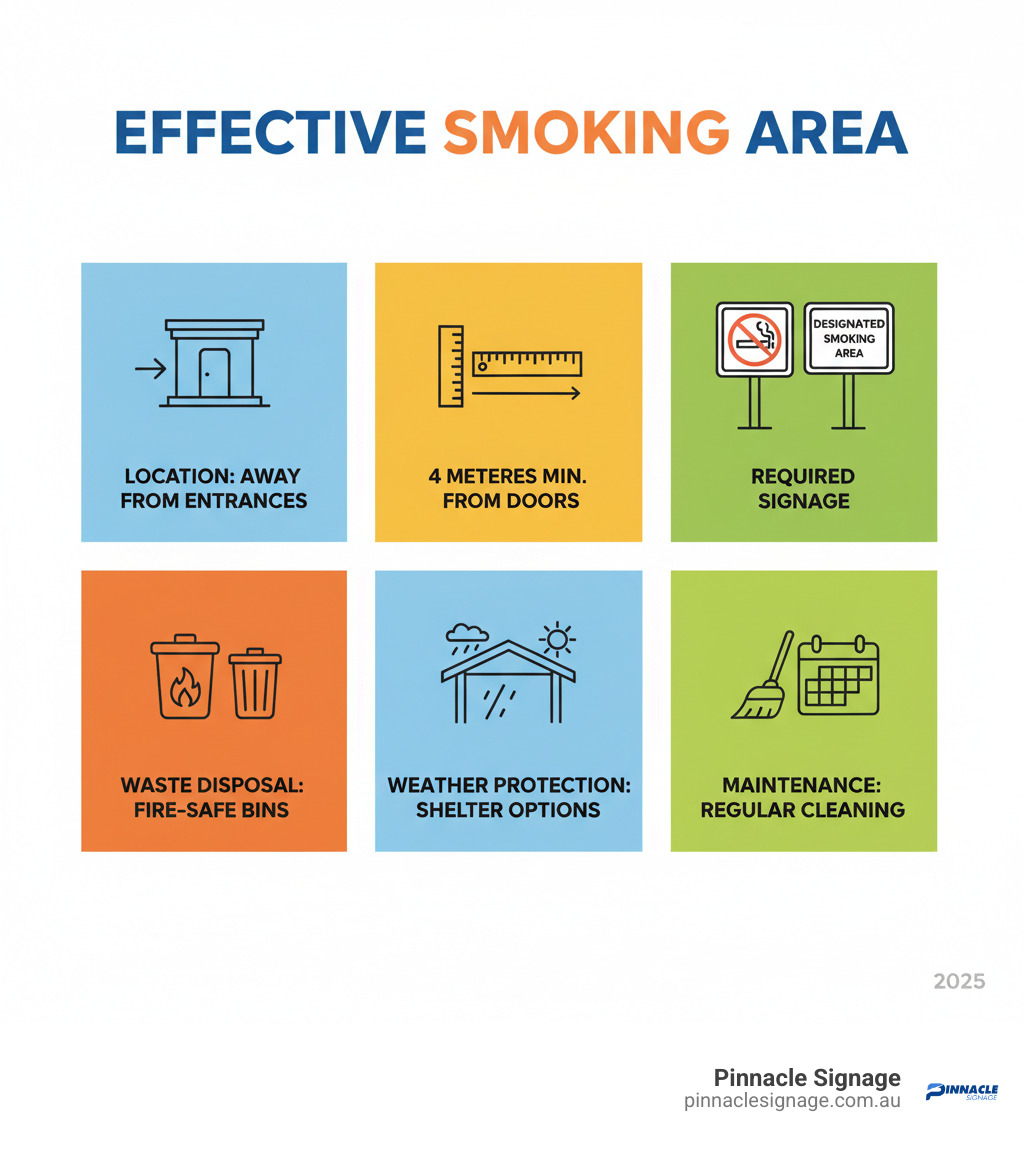
Key Elements of a Designated Smoking Area:
- Location: Must be positioned away from main entrances, exits, and ventilation intakes
- Distance Requirements: Typically 4 metres minimum from doorways in most Australian jurisdictions
- Signage: Clear prohibition and notice signs indicating smoking is only permitted in designated zones
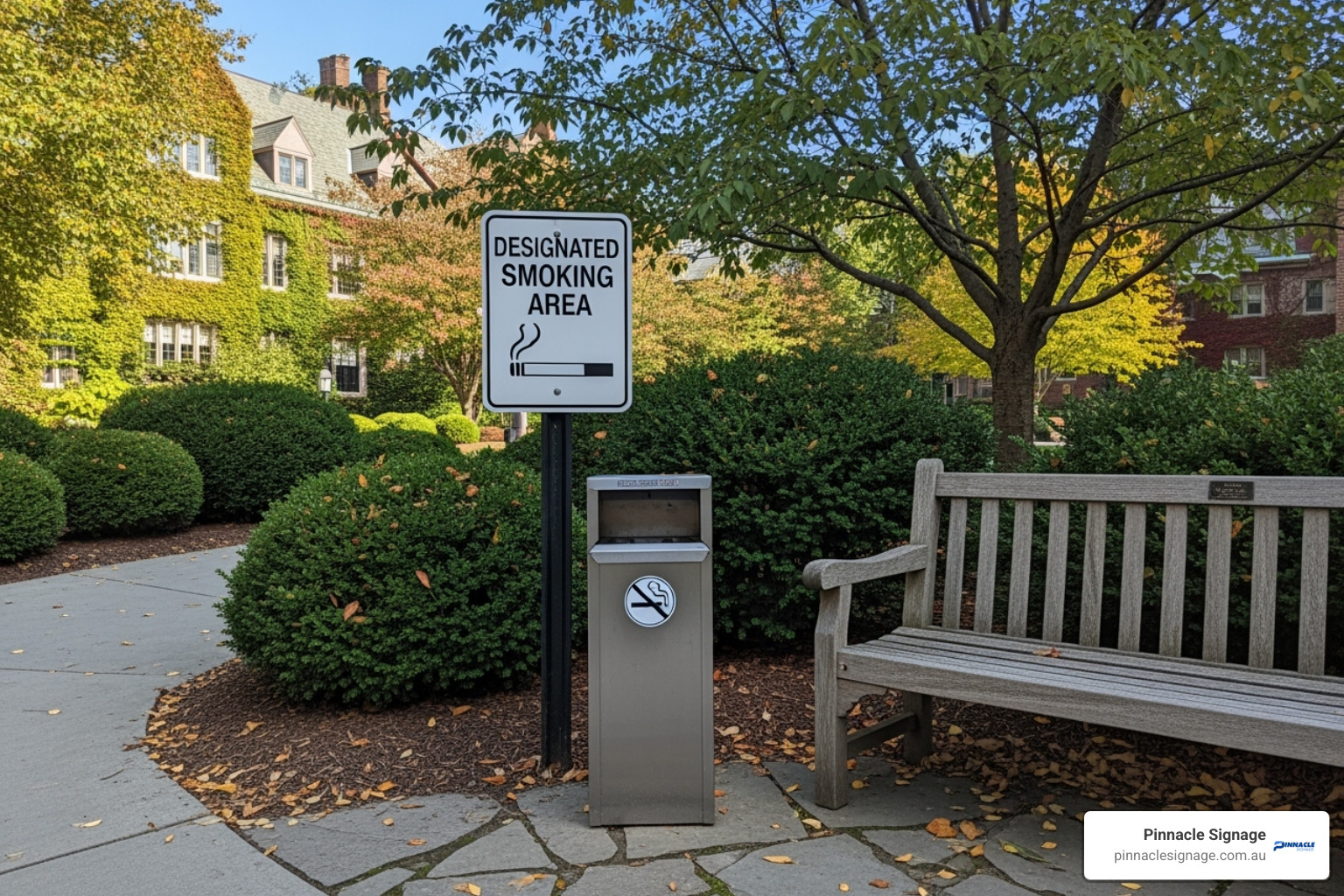
- Amenities: Fire-safe ashtrays, waste receptacles, and optional weather protection
- Maintenance: Regular cleaning schedules and proper waste disposal systems
For facilities managers and site supervisors, designated smoking areas represent more than just a compliance checkbox. They are a strategic tool for managing public health, maintaining facility cleanliness, reducing fire risks from improper cigarette disposal, and creating a more harmonious environment for everyone. However, the challenge lies in designing DSAs that genuinely work, not just areas that tick regulatory boxes but fail in practice. An effective DSA comes down to thoughtful design, proper signage, and a clear understanding of the regulations that govern them.
Key Terms for Designated Smoking Area Signage
Designated Smoking Areas (DSAs) are far more than just a convenience for smokers. They are a critical component of responsible facility management, contributing significantly to public health, safety, and overall environmental quality within a business or public space. The primary reasons for their importance stem from the need to contain smoke, minimise exposure to harmful substances, and manage the practicalities of a smoking population.
Firstly, DSAs play a vital role in reducing secondhand smoke exposure. While ideally, everyone would be protected from tobacco smoke, the reality is that many adults still smoke. Secondhand smoke is a serious health concern, linked to numerous diseases and premature deaths in non-smokers. Even if people are outside, smoke can drift, affecting those nearby. By channelling smoking activity into specific, often isolated zones, we can significantly decrease the likelihood of non-smokers inadvertently inhaling harmful airborne chemicals. This protects not only visitors and customers but also employees who might otherwise be exposed during their daily duties, aligning with the principle that there is no safe level of exposure to secondhand smoke.
Secondly, DSAs are crucial for facility cleanliness and fire prevention. Without designated areas, people might smoke anywhere, leading to cigarette butts being discarded improperly on the ground, in planters, or even near flammable materials. This creates litter, which is unsightly and costly to clean, and poses a significant fire risk. Purpose-built DSAs include fire-safe ashtrays and waste receptacles, encouraging proper disposal and drastically reducing the chances of accidental fires. This also simplifies maintenance, as cleaning staff know exactly where to focus their efforts for smoke-related debris.
Finally, DSAs help in balancing the needs of smokers and non-smokers. While the health risks of smoking are well-documented, completely banning smoking everywhere can be impractical or even lead to non-compliance and tension. By providing a clearly defined, appropriate space for smokers, businesses and public spaces can accommodate all users without alienating either group. This helps create a more pleasant and respectful environment for everyone, where policies are clear, and expectations are managed.
Designing and Implementing an Effective Designated Smoking Area
Creating an effective Designated Smoking Area goes beyond simply putting up a sign. It requires strategic design and thoughtful implementation to ensure it serves its purpose efficiently, safely, and compliantly.
The first step in best practice design is location selection. DSAs should be situated well away from main building entrances, exits, and any air intake vents. This ensures that smoke doesn't inadvertently drift into indoor spaces, impacting air quality for non-smokers. A typical minimum distance requirement in Australia is 4 metres from building openings. Consideration should also be given to prevailing wind patterns to minimise smoke drift onto adjacent non-smoking areas or pathways. Accessibility is another key factor; the DSA should be easy to reach but not obstruct main thoroughfares or emergency exits.
Once a location is chosen, the focus shifts to amenities and infrastructure. Weather protection, such as an awning or a fully enclosed smoking shelter, can make the area more comfortable and encourage its use, especially in Australia's diverse climate. Seating arrangements should be included if space permits, providing a comfortable spot for smokers. Crucially, proper waste disposal facilities are non-negotiable. Fire-safe ashtrays and bins for cigarette butts are essential to prevent litter and reduce fire hazards. These should be emptied regularly as part of a robust maintenance schedule. Regular cleaning is vital to keep the area tidy and hygienic, ensuring it doesn't become an eyesore.
What Signage is Required for a Designated Smoking Area?
Clear and unambiguous signage is the backbone of an effective Designated Smoking Area. It's how you communicate your policies, direct people, and ensure compliance. Without the right signs, even the best-designed DSA can fail.
Our signage experts recommend a multi-faceted approach to DSA signage:
- Prohibition Signs at Entry Points: These signs clearly state that smoking is prohibited outside the designated areas. This helps to manage expectations immediately upon entering the premises. We offer a comprehensive range of Prohibition Signage that meets Australian standards.
- Directional Signs: For larger or more complex facilities, directional signs with arrows are essential to guide individuals efficiently to the Designated Smoking Area. This prevents confusion and ensures people don't wander around trying to find the correct spot.
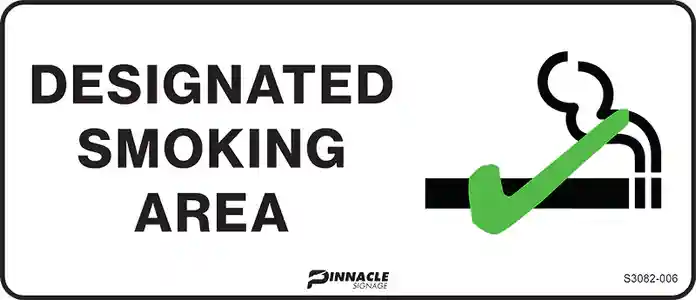
- Designated Area Identification: Once at the location, a prominent sign clearly marking it as the "Designated Smoking Area" is crucial. This can also include specific rules for the area, such as age restrictions (e.g., 18+ in some venues) or disposal instructions.
- Policy Information Signs: These signs, often Notice Signage, can detail the full smoking policy, including rules on vaping and e-cigarettes. With the rise of e-cigarettes and vaping devices, policies must clarify whether these are permitted within the DSA or if they fall under separate regulations. For instance, some university campuses explicitly state that both smoking and vaping are restricted to designated areas.
- Cigarette Butt Disposal Signs: Placed directly above or next to ashtrays, these signs encourage proper disposal, reinforcing cleanliness and fire safety.
All signage should be highly visible, easy to read, and manufactured from durable, weather-resistant materials to withstand Australia's outdoor conditions. We custom make signs to meet your specific needs, ensuring they are suitable for the intended application and understood by everyone.
What are the Alternatives to a Basic Designated Smoking Area?
While a basic outdoor Designated Smoking Area with appropriate signage and disposal units is a common solution, there are several alternatives and improvements that facilities can consider, especially when dealing with specific environmental challenges or aiming for higher levels of comfort and smoke containment.
- Smoking Shelters: These purpose-built structures offer weather protection from sun, rain, and wind, making the DSA more comfortable for users. Shelters can range from simple awnings to more robust, semi-enclosed units with integrated seating and bins. They help to concentrate smoke, making it easier to manage drift.
- Enclosed Smoking Lounges with Advanced Ventilation Systems: In some high-traffic settings or large venues, fully enclosed rooms are used for smoking. They feature sophisticated air purification technology and negative pressure systems to ensure that smoke does not escape into the main facility. While this option exists, it is important to note that even advanced ventilation systems cannot completely remove secondhand smoke exposure, and there is no safe level of secondhand smoke.
- Outdoor Patios: For hospitality venues like restaurants and pubs, dedicated outdoor patios can serve as DSAs. While offering fresh air, they require careful design to prevent smoke from bothering patrons in adjacent non-smoking outdoor areas or drifting indoors. Clear demarcation and sometimes physical barriers are needed.
- Vape-Specific Areas: With the increasing use of e-cigarettes, some facilities are exploring separate or combined designated areas for vaping. Policies often clarify whether vaping is treated the same as traditional smoking or if it has its own set of rules.
The choice among these alternatives often comes down to budget, available space, local regulations, and the specific needs of the facility and its users. For instance, a university campus might opt for simple, well-maintained outdoor DSAs, while a major airport might consider an enclosed, ventilated lounge due to its unique operational requirements and high volume of travellers.
Navigating Australian Regulations for Smoking Areas
When it comes to establishing a Designated Smoking Area, understanding Australian regulations isn't just about ticking boxes. It's about protecting your organisation from fines while genuinely safeguarding the health of everyone who uses your facility. Australia has some of the world's strictest anti-smoking laws, and they vary significantly across states and territories, which means what's acceptable in Queensland might land you in hot water in Victoria.
The core principle behind Australia's smoke-free environment policies is straightforward: protect people from secondhand smoke in public places. This means smoking is largely prohibited in enclosed public spaces and workplaces nationwide. Office buildings, restaurants, shopping centres, theatres, and similar venues are all smoke-free zones. But the regulations extend well beyond just indoor spaces.
Outdoor public places face increasing restrictions too. You'll find smoke-free zones at outdoor dining areas, public transport stops, children's play areas, and sporting grounds. The most commonly encountered regulation, particularly in New South Wales, is the 4-metre rule. This law prohibits smoking within 4 metres of a public building's entrance or exit, preventing smoke from drifting indoors and affecting people as they come and go. Similar distance requirements exist in other states, though the exact measurements and specific locations can differ. For a comprehensive overview of one state's approach, the NSW smoke-free laws provide a detailed reference point.
Employers also carry specific Work Health and Safety (WHS) obligations when it comes to smoking. Providing a safe working environment includes protecting employees from secondhand smoke exposure. This often means implementing clear smoking policies and establishing well-managed Designated Smoking Areas if smoking is permitted anywhere on your premises. It's not optional; it's a legal requirement under WHS legislation.
The regulatory landscape around e-cigarettes and vaping is also evolving rapidly. Many jurisdictions now treat vaping similarly to traditional smoking, with policies defining 'smoking' broadly enough to include the use of e-cigarettes and other vapour-producing devices. This means your DSA policies should explicitly address whether vaping is permitted in the same designated areas as traditional smoking or if separate rules apply.
Non-compliance isn't just a theoretical concern. Fines for breaching smoke-free laws can reach up to $200 for individuals and up to $500 for corporations in some jurisdictions for certain breaches. These penalties add up quickly, particularly if multiple violations occur. Beyond the financial cost, there's the reputational risk of being seen as non-compliant with public health regulations.
The most important action you can take is to consult your relevant state or territory health department website for the most current regulations applicable to your specific location. What applies in Sydney might differ from Perth or Hobart. Clear signage from our Prohibition Signage and Notice Signage ranges, combined with strict adherence to local laws, isn't just good practice. It's a legal necessity that protects both your organisation and the people who use your facilities.
Considerations for Specific Environments
Getting a Designated Smoking Area right isn't about copying and pasting the same setup everywhere. What works perfectly at a corporate office might be completely impractical at a university campus or a busy airport. The key is understanding the unique rhythms, populations, and challenges of each environment.
In workplace settings, the focus is often on minimising disruption while protecting employee health. Your DSA should be positioned well away from main entrances where non-smoking staff enter each morning, and definitely not adjacent to break rooms where people eat lunch. The last thing you want is smoke drifting into spaces where employees are trying to relax or refuel. Many organisations also establish policies around smoking breaks to ensure fairness and maintain productivity. Some companies extend their smoking policies beyond the physical premises, prohibiting smoking in company vehicles or requiring employees to follow client smoking policies when working off-site.
University campuses present their own particular challenges. With thousands of students, staff, and visitors moving through relatively confined spaces, poorly planned DSAs can affect large numbers of people. Many Australian universities have adopted comprehensive smoke- and vape-free policies with clearly designated areas to reduce secondhand smoke exposure across campus. These areas typically feature clear signage, with campus maps showing their locations, and often include specific rules about what is and isn't permitted (for instance, many explicitly prohibit cannabis use even within designated smoking zones). The goal is to accommodate smokers while ensuring the vast majority of campus remains fresh and smoke-free.
Public transport hubs like airports, train stations, and bus terminals face unique pressures. You're dealing with high foot traffic, time-sensitive travellers, and often transient populations who may not be familiar with local regulations. While many facilities have moved smoking areas entirely outside security perimeters, some still maintain designated zones for convenience and compliance. Sydney Airport, for example, provides information on its designated smoking areas to help travellers plan accordingly. These spaces often require sophisticated ventilation systems if they're enclosed, or careful placement if they're outdoor zones, to prevent smoke from affecting the thousands of people passing through each day.
Hospitality venues like pubs, clubs, and restaurants walk a particularly fine line. You're balancing customer experience with strict smoke-free laws, all while trying to maintain an atmosphere that keeps patrons happy and returning. Outdoor designated smoking areas on patios or in courtyards have become the standard solution. However, these must be clearly separated from non-smoking areas, often with physical barriers, strategic placement, or significant distance to comply with regulations. The best setups feel like a natural extension of the venue rather than an afterthought, with comfortable seating and adequate weather protection.
Regardless of the environment, clear communication through well-placed and durable signage remains absolutely critical. It's what ensures staff, students, visitors, and customers understand where they can and can't smoke, reducing confusion and fostering compliance. When everyone knows the rules and can easily find the designated areas, the result is a more harmonious environment for everyone.
Frequently Asked Questions about Designated Smoking Areas
How do DSAs impact facility maintenance and cleanliness?
The reality of managing a Designated Smoking Area is that it will either simplify your maintenance efforts or create ongoing headaches. The difference comes down to design and commitment.
When a DSA is properly set up with fire-safe bins and regular servicing, it actually makes cleaning easier. Instead of finding cigarette butts scattered across car parks, garden beds, and stormwater drains, your maintenance team knows exactly where to focus their efforts. The alternative, where butts end up everywhere, isn't just unsightly. It's expensive to clean, harmful to the environment when they wash into waterways, and creates a genuine fire risk if discarded near dry vegetation or combustible materials.
Even a well-designed DSA needs attention, though. Ash and residue accumulate quickly, and without regular cleaning schedules, these areas can become unpleasant and counterproductive. There's also the issue of smoke staining on nearby surfaces. Over time, walls, ceilings, and pavements can discolour if smoke lingers or ventilation is inadequate.
This is why we always recommend choosing durable and easy-to-clean materials for the DSA itself and any adjacent structures. The investment in quality materials and consistent maintenance pays for itself by concentrating the mess in one manageable location rather than spreading it across your entire facility.
How can businesses balance the needs of smokers and non-smokers?
Balancing the needs of smokers and non-smokers isn't about compromise. It's about creating clear boundaries that respect everyone.
The foundation of this balance is strategic placement. Your Designated Smoking Area needs to be far enough from main entrances, windows, outdoor dining areas, and busy pedestrian zones that smoke doesn't drift where it's not wanted. In Australia, the 4-metre buffer zone from building entrances is a regulatory requirement, but it's also just good practice. Using natural landscaping or physical barriers can further separate smoking and non-smoking areas, making the division obvious and effective.
Clear communication is just as important as physical distance. When your signage not only directs smokers to the designated area but also reassures non-smokers about where they can expect a smoke-free environment, you're managing expectations for everyone. This transparency reduces friction and complaints.
The most forward-thinking businesses also gather feedback from staff and patrons regularly. Your DSA might look perfect on paper, but if people aren't using it properly or if complaints are coming in, something needs adjusting. This ongoing dialogue allows you to fine-tune your approach and demonstrate that you're genuinely committed to creating a space that works for everyone.
What are the health implications of secondhand smoke, even near DSAs?
Here's the uncomfortable truth: even with a well-designed Designated Smoking Area, there is no safe level of secondhand smoke exposure.
Secondhand smoke contains over 7,000 chemicals. Hundreds of these are toxic, and many are known to cause cancer. When non-smokers breathe this in, they face increased risks of heart disease, lung cancer, and respiratory infections. The Cancer Council Australia provides extensive documentation on these health risks.
The challenge with DSAs is that even sophisticated ventilation systems have limitations. While they might reduce odours and visible smoke, many of the most dangerous toxins are odourless and invisible. Medical experts consistently agree that no ventilation system can completely eliminate secondhand smoke exposure or the associated health risks.
Then there's thirdhand smoke, which many people don't even know about. This is the residue from tobacco smoke that clings to clothing, hair, furniture, and even outdoor surfaces long after smoking has stopped. These residues can re-emit into the air and react with other pollutants to form even more toxic compounds. Children are particularly vulnerable because they're more likely to touch contaminated surfaces and put their hands in their mouths.
This is why maintaining a significant distance from main traffic areas is so crucial. It's also why facilities need to be especially mindful of protecting vulnerable individuals, including children, pregnant women, and anyone with respiratory conditions, from any proximity to smoking areas. While DSAs are designed to minimise exposure and contain smoke to specific zones, they don't eliminate health risks entirely. The most effective protection remains avoiding smoke exposure altogether.
Equip Your Space with the Right Signage
Creating and maintaining effective Designated Smoking Areas isn't just about understanding regulations and best practices. It's about having the right tools to communicate your policies clearly and consistently. That's where quality signage makes all the difference.
At Pinnacle Signage, we've spent years helping Australian businesses, councils, universities, and facility managers implement clear smoking policies through durable, compliant signage solutions. Whether you're setting up a new DSA or updating existing areas to meet current regulations, we have the signs you need.
Our range includes everything from Prohibition Signage for non-smoking zones to detailed Notice Signage that clearly communicates your facility's specific smoking policies. We also offer Danger Signage and Caution Signage for other safety aspects of your site, ensuring comprehensive coverage across all your signage needs.
What sets us apart is our commitment to customisation. We understand that every facility has unique requirements, whether it's incorporating your organisation's logo, adjusting colours to match your brand, or including specific policy wording about vaping and e-cigarettes. Our team can work with you to create signage that not only meets Australian standards but also aligns perfectly with your operational needs.
All our signs are manufactured from durable, weather-resistant materials designed specifically for Australian conditions. From the harsh UV exposure in Queensland to the coastal salt spray in coastal regions, our signs maintain their clarity and visibility year after year. This durability means you won't be replacing faded or damaged signs every few months, saving you both time and money in the long run.
Finding the right signage has never been easier. You can now find a wide selection of Pinnacle Signage products at your local Bunnings store, or conveniently browse and order online through the Pinnacle Signage at Bunnings brand page. This partnership means you can pick up what you need during your regular hardware run, or have it delivered straight to your site.
For larger facilities, councils, or organisations requiring multiple signs across different locations, we offer special distributor pricing and competitive margins that make bulk orders more economical. Our team is ready to discuss your specific requirements, provide guidance on the most appropriate signage for your needs, and ensure you get the right products at the right price. Don't hesitate to contact our team for bulk orders or custom solutions.
We pride ourselves on fast turnaround times, with most items dispatched within 48 hours of receiving your order. Our Australia-wide shipping network ensures that whether you're in Sydney, Perth, or anywhere in between, your signage arrives promptly. If you are in the Wagga Wagga area, warehouse pickup is available at our East Wagga Wagga NSW location during business hours, Monday to Friday.
Managing a Designated Smoking Area effectively starts with clear communication, and clear communication starts with quality signage. Let us help you create a safer, more compliant, and more harmonious environment for everyone who uses your facility.