

Braille Signage 101
Mechanics and Manufacturing of Tactile Signs

Braille signage is a system of raised dots and tactile characters placed on signs to help people who are blind or have low vision navigate buildings safely and independently. If you need a clear explanation of what it involves, here it is:
- What it is: Signs that combine raised letters, pictograms, and braille dot patterns so they can be read by touch
- Who it's for: People who are blind, have low vision, or lost vision later in life
- Where it's required: Permanent rooms, exit doors, lift controls, accessible toilets, first aid stations, and floor level indicators
- Australian standard: AS 1428.1 sets the specifications for braille dot size, tactile character height, contrast, and mounting height
- Mounting height: Tactile elements must be positioned between 1150 mm and 1250 mm above the finished floor
- Braille type: Contracted braille is the standard for signage
- Key rule: Signs must have a minimum 70% luminance contrast between characters and background
In short, braille signage is a legal and practical requirement for many public buildings in Australia, and getting the specifications right matters.
The stakes are real. A sign with incorrectly formed braille dots, poor contrast, or a non-compliant mounting height is not just a compliance issue, it actively fails the people it's meant to help.
I'm Doug Lindqvist, General Manager of Pinnacle Signage, an Australian-owned manufacturer based in East Wagga Wagga, NSW. My background is in safety and industrial supply, where I saw how often facilities managers struggled to source braille signage that was both compliant and delivered on time. In this guide, we'll walk through what matters most, from how braille works mechanically, to Australian requirements, correct placement, and common production mistakes to avoid.
If you are planning a fit-out or upgrade, you can explore our braille and tactile signage range.
To understand how braille signage works, we have to look at the "cell". Every braille character is based on a six-dot matrix, arranged in two vertical rows of three dots. By raising different combinations of these six dots, manufacturers can represent letters, numbers, and punctuation. In total, there are 63 possible dot combinations in a standard cell.
When we manufacture these signs at our facility in East Wagga Wagga, we are not just printing dots on a flat surface. We are creating a physical 3D surface that must be comfortable and clear for a person to read with their fingertips.
Grade 1 vs Grade 2 Braille
There are two primary levels of braille used in English:
- Grade 1 (Uncontracted): This is a letter-for-letter translation. If the sign says "EXIT", there are four braille cells, one for each letter. While easy to understand for beginners, it takes up more horizontal space.
- Grade 2 (Contracted): This is the standard for braille signage in Australia. It uses contractions to represent common words or letter combinations such as "th", "ing", or "st" with a single cell or shortened code. This makes reading faster and allows signs to remain a manageable size.
In Australia, signage follows Unified English Braille (UEB), a standardised code used across multiple countries for consistency. When you explore our braille and tactile signage range, you are looking at signs designed for Australian projects and local expectations.
Technical Specifications for Dots and Characters
The physical dimensions of the dots are not a matter of approximation. Under AS 1428.1, the tolerances are tight:
- Dot Height: Must be between 0.6 mm and 0.9 mm
- Dot Base Diameter: Must be between 1.5 mm and 1.6 mm
- Distance Between Dots in a Cell: Approximately 2.3 mm to 2.5 mm
- Tactile Character Height: Raised text must be between 15 mm and 55 mm high
- Tactile Elevation: The characters themselves should be raised at least 0.8 mm from the background
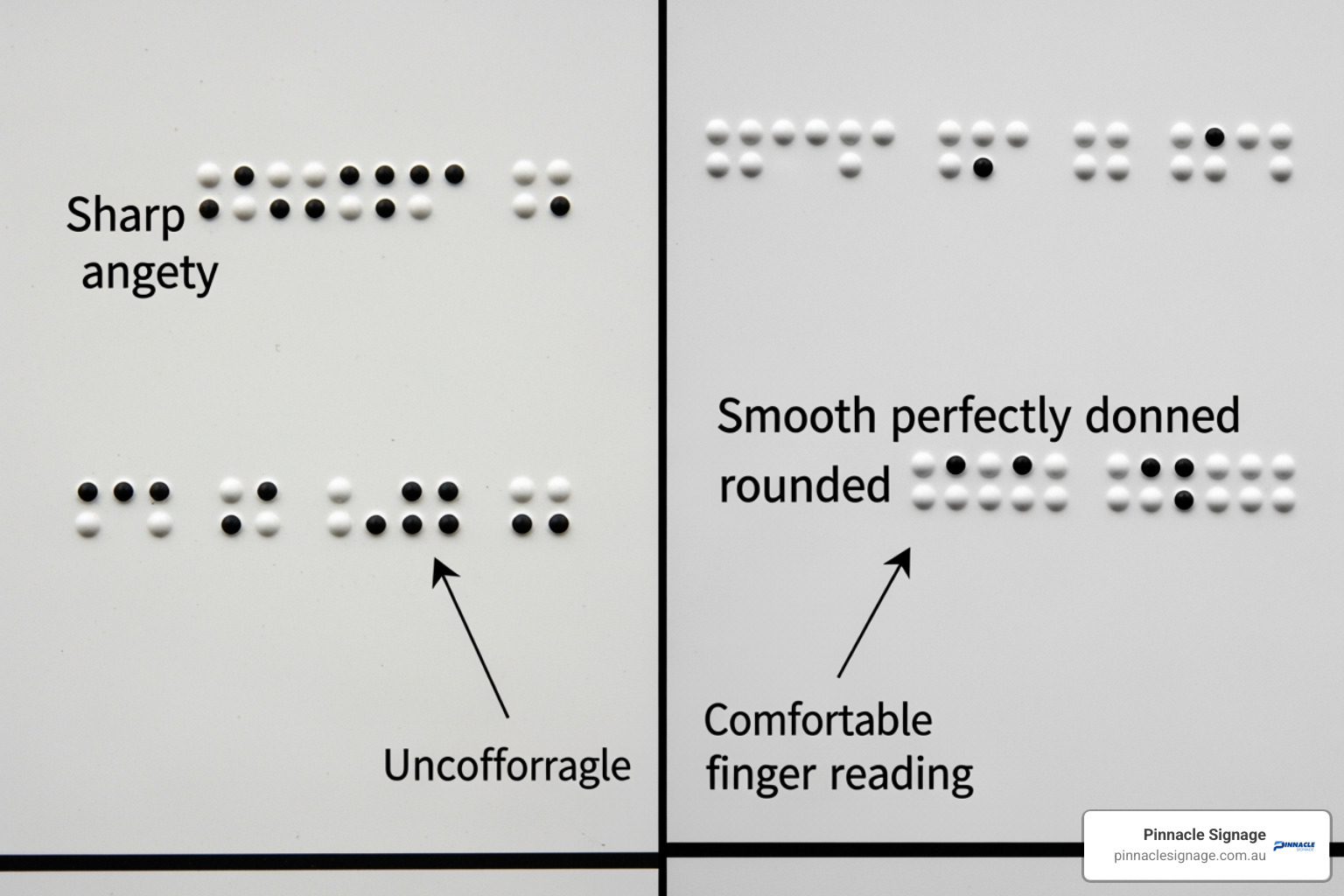
We use a combination of precision routing and raster beads to achieve this. Raster beads are tiny, rounded spheres, often made of acrylic or metal, that are press-fitted into pre-drilled holes. This helps ensure every dot is consistent in height and shape.
Common Mistakes in Braille Signage Production
Not all braille signage is created equal. We often see signs that fail inspection because of avoidable manufacturing flaws.
One of the most common issues is sharp edges. If the dots are too pointed or have burrs from machining, they can be uncomfortable to touch or difficult to distinguish. High-quality dots should be domed or rounded, providing a smooth surface for the reader.
Another mistake is incorrect spacing. Braille is read by the distance between the dots as much as the dots themselves. If the cells are too close together, the words blur together. If they are too far apart, the finger loses the reading flow.
Finally, there is the issue of durability. In high-traffic Australian environments, such as hospitals, schools, warehouses, and amenities blocks, signs get touched thousands of times. If the dots are simply glued onto the surface, they can be picked off or worn down. That is why we prefer fully encapsulated polycarbonate membranes or press-fitted beads. A sign that loses a single dot can change meaning and create confusion.
For projects that need dependable turnaround and consistent local supply, Pinnacle Signage manufactures in East Wagga Wagga, NSW and offers fast dispatch across Australia.
Compliance with Australian Standards for Braille Signage
In Australia, the main reference point for accessibility signage is AS 1428.1. This standard, together with the National Construction Code, guides where and how braille signage is typically implemented.
The 70% Luminance Contrast Rule
One of the most misunderstood parts of sign compliance is luminance contrast. This is not just about using different colours. It is a measure of how much light the text reflects compared with the background.
For a sign to be compliant, there must be a minimum 70% luminance contrast between the tactile characters and the background. This is important for people with low vision who may still read the visual text if the contrast is strong enough. White text on a dark blue background is a common example of a high-contrast combination.
Non-Glare Finishes
Australian sun and bright indoor lighting can create glare on a sign, making it hard to read. AS 1428.1 requires signs to have a matte or low-sheen finish. We ensure our materials do not exceed 50 gloss units, which helps prevent reflected light from obscuring the message.
Where dangerous goods signage forms part of a broader site safety system, we also keep the ADG Code in view so safety and accessibility work together. If you need product examples for compliant site identification, you can view our fire signage collection.
Key Requirements for Braille Signage in Public Buildings
Where exactly do you need these signs? Australian building requirements are specific about permanent rooms and spaces.
- Exit Doors: Any door required to be marked with an "EXIT" sign should also have a tactile and braille sign, including exit stairways and doors leading to open spaces
- Sanitary Facilities: Accessible toilets, ambulant toilets, and standard toilets must be clearly identified. In many projects, the accessible cubicle also needs left-hand or right-hand transfer information where relevant
- Lift Controls: Buttons inside the lift and call buttons on each floor must have braille
- Floor Levels: Signs indicating the floor number should be placed in stairwells and near lift banks
- First Aid Stations: In many commercial and industrial settings, the location of first aid kits and rooms should be tactile-accessible
For builders, facility managers, schools, hospitals, and hospitality venues wanting a straightforward local supply option, Pinnacle Signage manufactures in East Wagga Wagga and supplies across NSW and Australia.
Strategic Placement and Installation Requirements
You could have the most accurate, compliant sign in the world, but if it is mounted too high, blocked by fixtures, or placed inconsistently, it becomes difficult to use.
Mounting Height
In Australia, the standard mounting height for braille signage is specific. The baseline of the tactile elements, the bottom of the raised text or braille, must be between 1150 mm and 1250 mm above the finished floor level. This range helps keep the sign within reach for standing users and wheelchair users.
Location Relative to Doors
Consistency is the key to wayfinding. If a person who is blind has to search for a sign at every doorway, the system has failed.
- Latch Side Placement: Signs should be located on the wall on the latch side, the side with the handle, of the door
- Distance from Door Jamb: The leading edge of the sign should be between 50 mm and 300 mm from the door jamb
- Double Doors: If you have double doors where one leaf is usually fixed, the sign goes on the inactive leaf. If both are open, it goes to the right-hand side
- Safety Clearance: There should be clear floor space so a person can stand close enough to touch the sign without being hit by a door swinging open
We generally recommend avoiding mounting signs directly onto doors unless there is no wall space available. A moving sign is harder and less safe to read by touch.
If your site also needs compliant amenity or emergency identification, you can find more info about our first aid signage. For broader site rollouts, Pinnacle Signage offers 48-hour dispatch on standard ranges, free shipping over $100 Australia wide, exclusions apply, and warehouse pickup in East Wagga Wagga NSW, Monday to Friday, 8 am to 5 pm.
Frequently Asked Questions about Tactile Signage
What is the difference between tactile and braille signage?
While the terms are often used interchangeably, they refer to two different elements that usually appear on the same sign:
- Tactile Signage: This refers to the raised 3D letters and pictograms. These are designed for people who may have lost their sight later in life and still recognise the standard shape of the alphabet
- Braille Signage: This is the system of raised dots. It is for people who are braille-literate and can read the message by touch more efficiently than tracing letter shapes
A compliant sign uses both so it works for a wider range of users.
Where should Braille signs be mounted in Australian facilities?
As mentioned, the latch side of the door is the standard location. Keep placement consistent throughout the facility. If the first few office or amenity doors have signs in one position, but the next is somewhere else, it creates confusion. Aim for the 1150 mm to 1250 mm mounting range and make sure there are no obstructions, such as extinguishers, bins, or plants blocking access to the sign.
Does Braille need to be capitalised on safety signs?
In standard visual English, it is common to use all capitals for words such as "DANGER" or "EXIT". However, in braille signage, the braille itself is generally kept in lowercase for readability.
Why? Capital letters in Braille require an extra indicator before the letter. If every letter in a word is capitalised, the braille becomes longer and slower to read by touch. Under AS 1428.1, the raised tactile letters may be uppercase, but the braille below them is usually lowercase except where grammar or naming conventions require otherwise.
If you need help standardising signage across a site, Pinnacle Signage can support bulk orders from our East Wagga Wagga facility.
Braille Signage Basics: What Matters Most
At Pinnacle Signage, we believe accessibility is about more than ticking a box. It is about making buildings easier to use, safer to move through, and more welcoming for everyone.
We manufacture our braille signage in East Wagga Wagga, NSW. Because we control the process from design through to production, we can provide durable signage with dependable turnaround for projects across New South Wales and Australia.
For standard ranges, we offer 48-hour dispatch, free shipping over $100 Australia wide, exclusions apply, and warehouse pickup Monday to Friday, 8 am to 5 pm, from our East Wagga Wagga facility.
Need help with a bulk order or custom project? Explore our braille and tactile signage range.
Whether you are fitting out a hospital, upgrading a school, managing a hospitality venue, or improving access across an industrial site, Pinnacle Signage is ready to help you get the signage right the first time.