

A – Z Guide to Australian Parking Signs & Rules
Why Understanding Australian Parking Signs Matters
Australian parking signs can be confusing, and misinterpreting them often leads to costly fines and frustration. With studies showing that a significant portion of urban traffic is caused by drivers searching for parking, and many fines resulting from misread signs, understanding these markers is essential. It helps individual drivers avoid penalties and contributes to smoother, safer traffic flow for everyone.
Quick Reference Guide to Australian Parking Signs:
- P Symbol = Parking allowed
- Numbers + P = Time limit (e.g., 2P = 2 hours)
- Red Signs = Prohibitions (No Parking, No Stopping)
- Green Signs = Timed parking zones
- Blue Signs = Disability parking areas
- Arrows = Direction the rules apply
- "Ticket/Meter" = Payment required
- Times/Days Listed = Rules apply only during specified hours
For businesses, construction sites, and facility managers, clear and compliant parking signage is critical. It goes beyond simple rule-setting; it's a matter of safety, operational efficiency, and managing liability. Effective signage helps create safer, more organised parking environments for customers, staff, and visitors, reducing confusion and preventing accidents.
Decoding Common Australian Parking Signs and Rules
Navigating a street lined with multi-panel Australian parking signs can feel overwhelming, with a confusing mix of colours, arrows, and symbols. However, once you learn the basic elements, even the most complex signs become easy to understand. Let's break down the essentials.
The Building Blocks: Understanding Basic Sign Elements
Every parking sign is built from a few fundamental elements. Mastering these will save you time, money, and stress.
- The 'P' Symbol: This simply means 'Parking' is permitted.
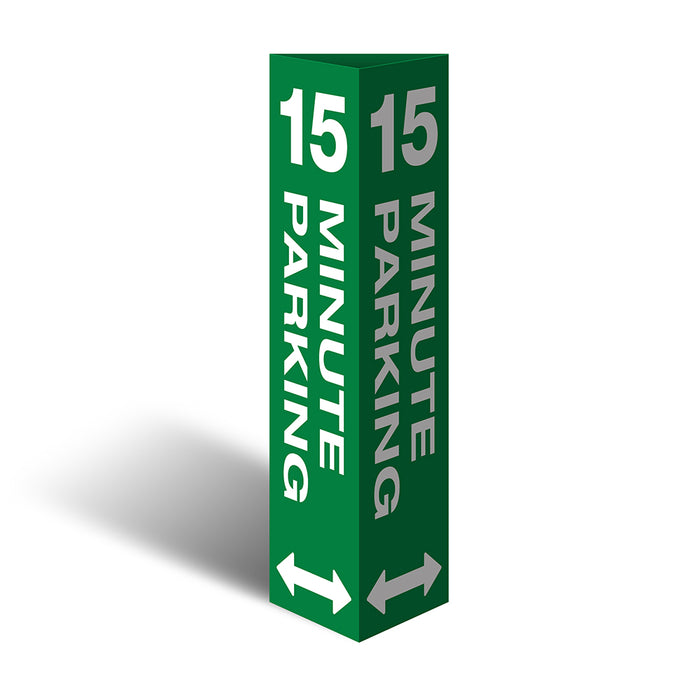
- Numbers and Time Limits: A number next to the 'P' indicates the maximum time you can park. For example, 2P means a two-hour limit, while 1/4P or 15 MIN means you can only stay for 15 minutes. These are strict limits.
- Payment Requirements: The words 'Ticket' or 'Meter' mean you must pay for parking. Paying does not extend the maximum time limit shown on the sign. A '2P Ticket' sign still means you can only park for a maximum of two hours.
- Directional Arrows: Arrows show where the rule applies. An arrow pointing left applies to the left of the sign, an arrow pointing right applies to the right, and a double-headed arrow applies to both sides. No arrow usually means the rule applies to the entire area.
Mastering the language of Australian parking signs is an essential skill for every driver. For businesses needing to establish clear rules in their own car parks, our range of Road & Transport Signs provides the clarity drivers expect.
Time, Colour, and Complex Rules on Australian Parking Signs
The colour of a parking sign provides an instant visual cue about the rules.
- Green Signs: Indicate timed or permissive parking (e.g., '1P', '2P').
- Red Signs: Indicate a prohibition, such as 'No Parking' or 'No Stopping'.
- Blue Signs: Reserved for disability parking spaces.
- Yellow Signs: Often used for special conditions like loading zones.
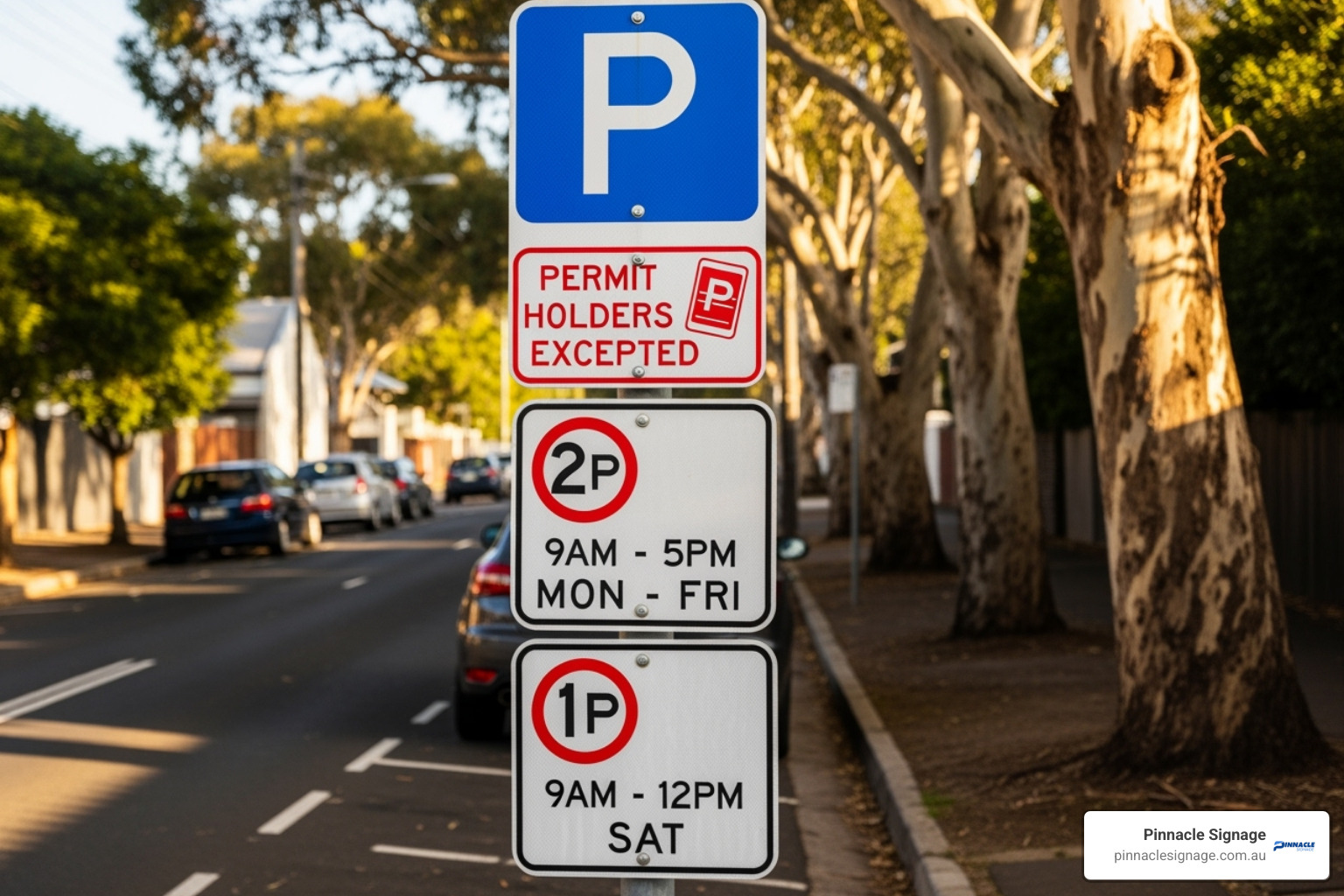
Time and day restrictions are also common. A sign that reads '2P, Mon-Fri, 8am-6pm' means the two-hour limit only applies on weekdays during those hours. Outside of these times, parking may be unrestricted unless another sign indicates otherwise. As a general rule, if a sign specifies days of the week (e.g., 'Mon-Fri'), the restriction does not apply on public holidays.
When you see multiple signs on one pole, read them from top to bottom. Each sign may have its own arrow indicating where its specific rule applies. While Australia aims for standardised parking signage, local variations can exist. For private facilities needing clear rules, we can create custom parking signage to meet your specific requirements.
No Parking vs. No Stopping: The Critical Difference
Understanding the difference between 'No Parking' and 'No Stopping' signs is crucial for avoiding expensive fines.
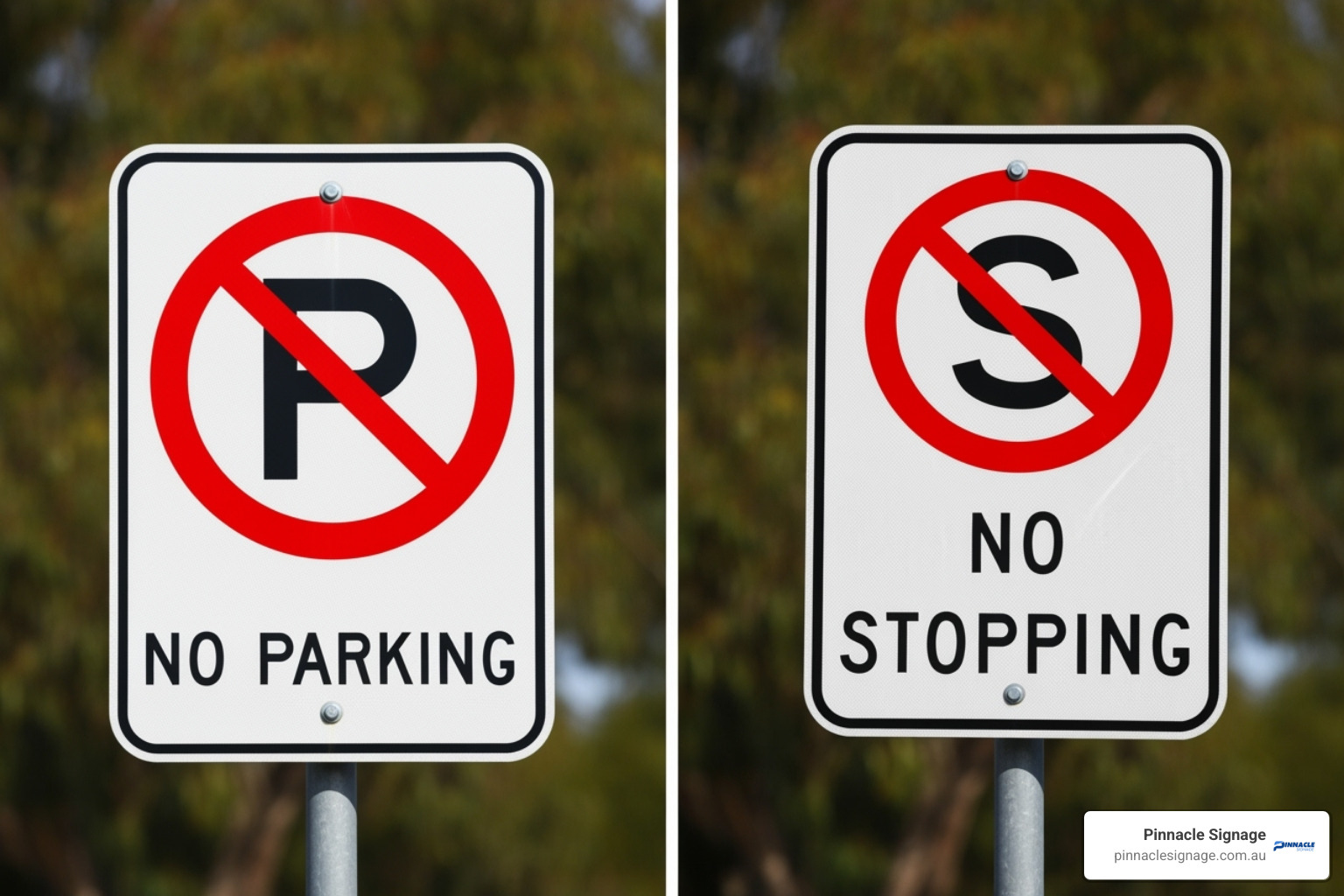
A 'No Stopping' sign (an 'S' in a red circle with a line through it) is the strictest rule. It means you cannot stop your vehicle at all, for any reason, unless you are stopped by traffic. These zones are enforced to prevent dangerous obstructions and maintain traffic flow.
A 'No Parking' sign (a 'P' in a red circle with a line through it) is slightly more lenient. You may stop for a maximum of two minutes to pick up or drop off passengers or goods, but you must stay within three metres of your vehicle. This rule is for quick stops only, not for running errands.
Clearway zones, marked with a 'C' on a red background, also prohibit stopping during specified peak traffic hours, with a high risk of your vehicle being towed.
For private properties, using clear Prohibition Signage is the best way to enforce these important rules and prevent unsafe parking.
Navigating Special Zones and Permit Areas
Special zones are reserved for specific users and purposes. Parking in them without authorisation will result in a fine.
- Loading Zones: Primarily for commercial vehicles loading or unloading goods (usually for up to 30 minutes). Some zones may permit passenger vehicles to stop briefly, but always check the sign.
- Bus and Taxi Zones: These are for the exclusive use of public buses and registered taxis, respectively. Ride-sharing vehicles are generally not permitted in taxi zones.
- Permit Zones: Restricted to vehicles displaying a specific, valid permit (e.g., 'Resident Permit Holders Only'). Without the correct permit, you cannot park here.
- Disability Parking: Marked with a blue international wheelchair symbol, these spaces are only for vehicles displaying a valid Australian Disability Parking Permit where the permit holder is present. Time limits often still apply, though concessions may be offered.
Understanding local permit types is key to avoiding fines. For facilities needing to ensure full accessibility, our range includes disability parking signs and Braille & Tactile Signage compliant with Australian Standards.
Unmarked Areas and Electric Vehicle (EV) Parking Rules
Even where there are no signs, general road rules apply. You must not park:
- Within 20 metres of an intersection with traffic lights, or 10 metres of one without.
- Across or blocking a driveway.
- On a footpath or nature strip.
You must also park parallel to the kerb, facing the direction of traffic.
Electric Vehicle (EV) parking is another growing area with specific rules. Bays marked 'EV Charging Only' are reserved for electric vehicles that are actively charging. It is an offence for non-EVs to use these spots, or for an EV to park without charging. These signs often include time limits.
For businesses implementing EV charging or needing to communicate rules for unmarked areas, customisable Notice Signage can provide clear instructions.
Enforcement, Fines, and The Future of Parking Signage
Parking rules are enforced by local councils and private operators, often using automated camera and sensor technology. Fines can be substantial, ranging from under $100 for overstaying a time limit to over $500 for parking in a disability space without a permit. Towing is also a risk for serious violations, such as in Clearway or No Stopping zones.
A common trap is the 'further offence' rule: in a timed zone, moving your car a few metres within the same area does not reset the clock. You must leave the area entirely.
The future of parking includes digital parking signage, which simplifies rules by displaying only the restrictions currently in effect. For private operators, clearly stating terms of use with signs like Park at Your Own Risk Signs can help manage liability.
Need Clear and Compliant Parking Signage?
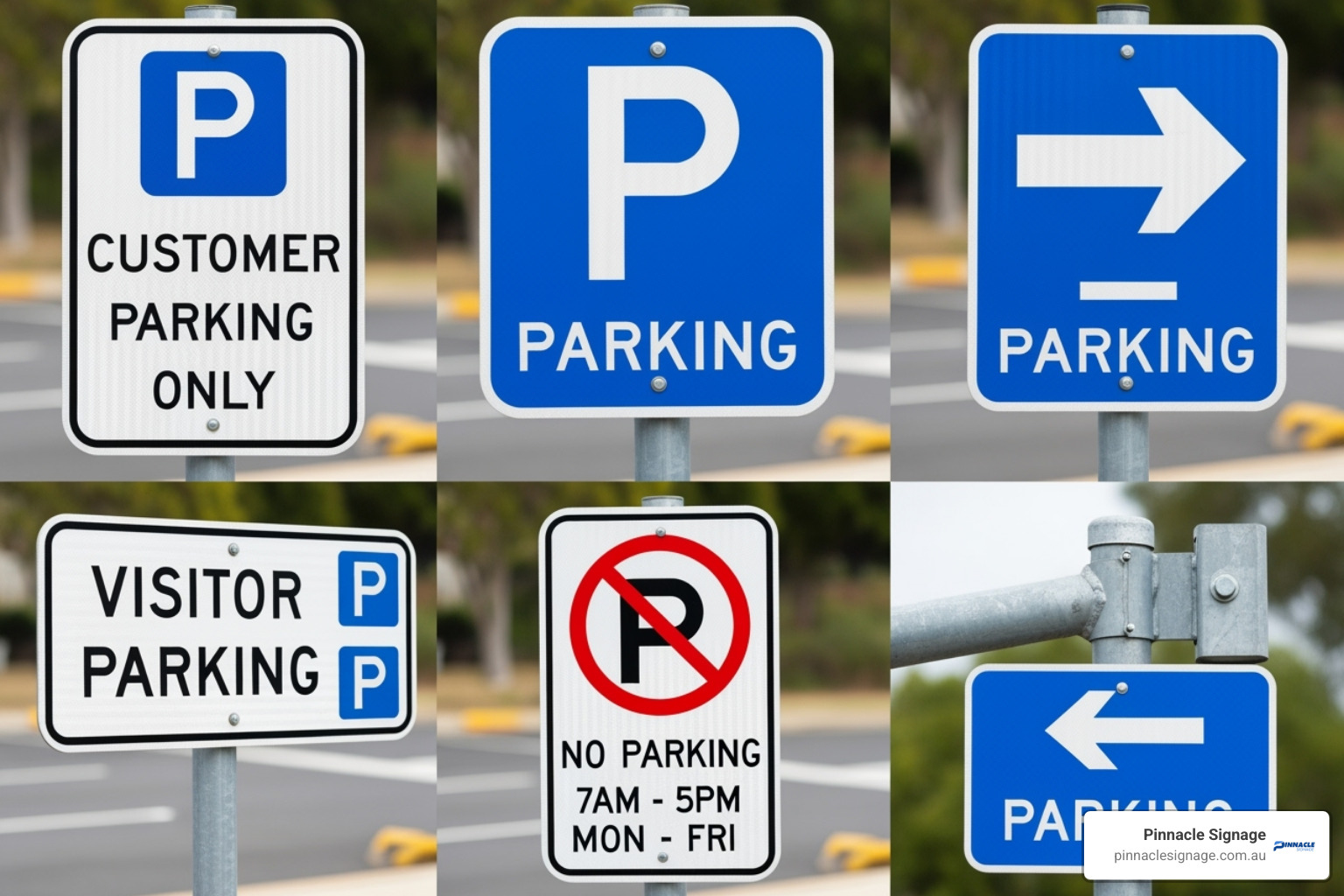
For any business, construction site, or commercial facility, clear parking signage is non-negotiable. Confusing or poorly marked car parks can lead to safety hazards, frustrate customers, and create liability issues.
Pinnacle Signage provides high-quality, durable signage solutions designed to withstand Australian conditions and communicate rules with absolute clarity. The right signage makes an immediate difference by:
- Improving safety and reducing the risk of accidents.
- Enhancing traffic flow and preventing bottlenecks.
- Reducing infringements by making rules unambiguous.
- Managing liability by clearly outlining parking terms.
We offer customisable options to suit your specific needs, from 'Customer Parking Only' signs to complex directional systems for large facilities. As a trusted Australian supplier, we provide premium products with reliable, fast delivery nationwide. We also offer competitive pricing and scalable solutions for organisations, councils, and businesses requiring bulk orders.
Don't let poor signage create problems for your operation. Explore our comprehensive range of Road & Transport Signs or contact us for a custom quote to create a safer, more efficient parking environment.