

Boost Your Safety: Understanding Fire Hydrant Booster Signage
Why Clear Booster Signage is a Critical Fire Safety Tool
Fire hydrant booster signage is essential for identifying booster connections and ensuring emergency responders can quickly access and operate fire suppression systems. These signs indicate where fire hydrants require boosting to increase water pressure, and they provide critical instructions for firefighters during emergencies.
What You Need to Know:
- Purpose: Fire hydrant booster signage marks locations where fire brigade connections can boost water pressure for fire suppression, enabling firefighters to quickly identify and operate these systems during emergencies.
- Key Types: Signs include attack hydrant signs (near booster assemblies), dry fire hydrant booster inlet signs, valve outlet signs, and combined hydrant and sprinkler booster signs.
- Compliance: Australian signage must comply with AS 2419.1:2021 and Building Code of Australia (BCA) requirements, featuring specific wording, minimum lettering heights (typically 25mm or 50mm), and contrasting backgrounds.
- Materials: Common materials include brushed aluminium, acrylic, and stainless steel, chosen for durability, weather resistance, and vandal-proof graphics.
- Installation: Signs must be permanently affixed on cabinets, enclosures, or adjacent to valves (within 200mm), ensuring clear visibility for emergency responders.
Clear and compliant fire hydrant booster signage is critical for ensuring a fast, effective emergency response and protecting both property and lives. In this guide, we'll walk you through everything you need to know about compliant booster signage for your property.
A Complete Guide to Fire Hydrant Booster Signage Requirements
In an emergency, firefighters need to act fast. Clear, accurate signage can mean the difference between a controlled response and a catastrophic outcome. That's where fire hydrant booster signage becomes absolutely critical.
These signs aren't just labels, they're a roadmap that guides emergency responders to the exact equipment they need to boost water pressure and tackle fires effectively. Without them, precious minutes can be lost searching for connections or trying to work out how a system operates.
The Purpose and Types of Booster Signage
The main job of fire hydrant booster signage is simple yet vital: to show firefighters where they can connect their pumps to increase water pressure into a building's fire suppression system.
Think about a multi-storey building where municipal water pressure simply can't reach the upper floors. A booster connection solves this problem by allowing the fire brigade to inject additional pressure, ensuring a strong, continuous water supply throughout the entire building. Without clear signage marking these connection points, emergency responders could waste valuable time searching when every second counts.
At Pinnacle Signage, we see fire hydrant booster signage as absolutely non-negotiable for any robust fire safety strategy. The Building Code of Australia (BCA) explicitly requires these signs on commercial, retail, and residential developments, and for good reason.
You'll encounter several types of booster signage, each serving a specific purpose. Booster inlet signs mark the main connection point where the fire brigade hooks up their hoses to boost the system, typically displayed on the cabinet or enclosure housing the inlet. Attack hydrant signs identify hydrants near booster assemblies that firefighters can use to directly combat a fire, while feed hydrant signs indicate hydrants that supply water to the booster system itself.
The distinction between wet and dry systems is particularly important. Dry fire hydrant systems remain empty until the fire brigade charges them, and their signage must explicitly state 'DRY FIRE HYDRANT' along with clear instructions like 'FILL SYSTEM BEFORE BOOSTING TO WORKING PRESSURE BEFORE USING' or 'BOOST SYSTEM BEFORE USING'. This prevents firefighters from attempting to use an uncharged system, which would waste critical time. Wet fire hydrant systems, in contrast, are constantly charged with water, though they still require booster signage with different operational instructions.
Many modern buildings integrate their fire hydrant and sprinkler systems, and you'll often see combined hydrant and sprinkler booster signs that indicate a single booster connection serves both systems. This streamlines operations for firefighters and simplifies the emergency response.
For a broader understanding of how these fit into the wider safety signage landscape, check out our Essential Guide to Fire and Safety Signs: Types & Meanings.
Decoding Australian Standards for Fire Hydrant Booster Signage
Fire hydrant booster signage must meet strict Australian regulatory requirements. The Building Code of Australia (BCA) and Australian Standard AS 2419.1:2021 for Fire Hydrant Installations don't just specify that signs are needed, they dictate exactly what they should say, how they should look, and where they must be placed.
All fire hydrant system signage must comply with Australian Standard AS 2419.1:2021. This ensures consistency and immediate recognition for emergency services right across Australia, no matter which state or territory they're operating in.
For booster cabinets, the requirements are particularly specific. Doors on hydrant booster cabinets, recesses, or enclosures must display signage stating 'DRY FIRE HYDRANT BOOSTER INLET'. The lettering must be at least 50mm high and displayed on a contrasting background. This large, bold text is essential for quick identification, especially in stressful, low-visibility, or smoky conditions.
Each hydrant valve on a dry fire hydrant system needs its own permanently affixed and engraved sign positioned within 200mm of the valve. This sign must provide a clear warning, such as 'DRY FIRE HYDRANT SYSTEM MUST BE BOOSTED PRIOR TO ANY FIREFIGHTING', with lettering not less than 25mm high on a contrasting background. This ensures firefighters receive an explicit warning about the system's operational state before they attempt to use it.
Signage for fire brigade booster connections on dry systems requires even more detailed information, including instructions like 'FILL SYSTEM BEFORE BOOSTING TO WORKING PRESSURE BEFORE USING', again with lettering not less than 25mm high. These detailed instructions prevent operational errors that could delay fire suppression when time is most critical.
The requirement for contrasting backgrounds isn't just about aesthetics, it's about legibility. Whether it's white text on red or black text on white, the high contrast ensures the message stands out clearly in any lighting condition, including during fires when visibility is compromised.
When the standards specify "permanently affixed and engraved" for valve signs, they mean it. The signage must be robust, durable, and resistant to tampering, fading, or wear, ensuring the information remains clear throughout the system's entire lifetime.
Our expertise at Pinnacle Signage ensures that every fire hydrant booster signage product we manufacture meets all relevant Australian Standards. For more information about fire safety signage in general, read our article All About Fire Signs - Safety.
Key Design and Placement Rules for Fire Hydrant Booster Signage
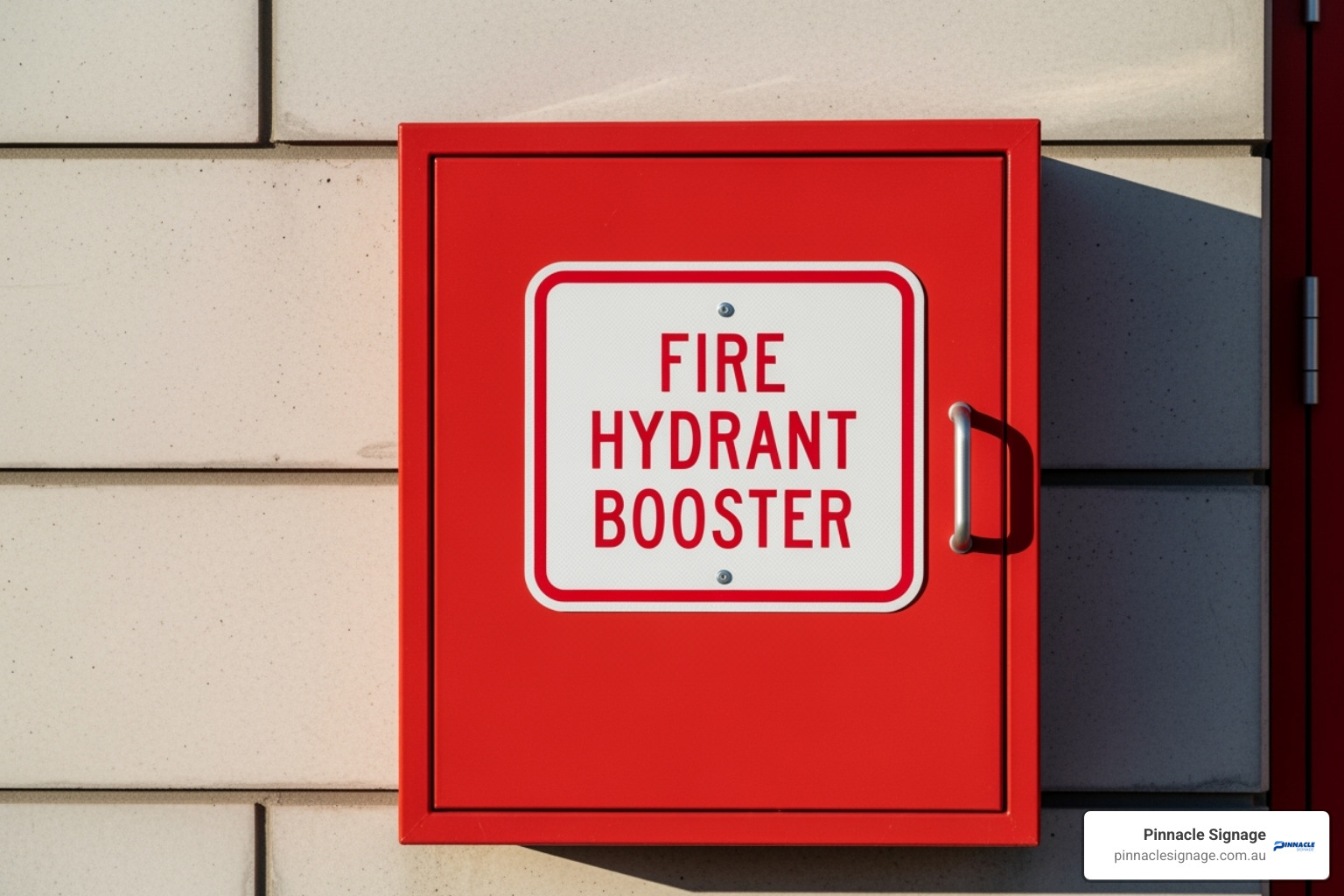
The effectiveness of fire hydrant booster signage depends as much on its physical design and strategic placement as it does on its wording. At Pinnacle Signage, we understand that a sign is only as good as its visibility and durability, particularly when it needs to perform under extreme pressure.
We manufacture fire hydrant booster signs using materials chosen for both longevity and compliance. Brushed aluminium (typically 1.6mm thick anodised aluminium or Aluminium Composite Panel) offers a rigid, heavy-duty solution ideal for permanent indoor and outdoor use. It's lightweight yet robust, making it reliable across various environments. Acrylic signs (usually 3mm thick) provide a sleek appearance and work well for many applications, though we often recommend them for indoor or sheltered outdoor areas. For the harshest conditions, stainless steel (1.2mm thick) delivers exceptional durability and corrosion resistance, perfect for demanding outdoor environments.
One of the most important aspects of our signage is how we apply the graphics. We strongly advocate for vandal-proof graphics achieved through laser engraving or direct UV printing. Unlike vinyl decals that can be picked off, fade in the sun, or shrink over time, engraved or directly printed text ensures the message remains clear and intact for years, even under harsh Australian conditions.
Design considerations go beyond just materials. The size of your signage must be appropriate for its location and viewing distance, with common sizes being 450x150mm or 600x300mm for booster signs. Font legibility is paramount, which is why the standards mandate clear, uppercase fonts with minimum lettering heights of 50mm for cabinet doors and 25mm for valve signs. Colour contrast between text and background is critical for readability, whether that's black on white, white on red, or any other high-contrast combination. For signs in public road areas or locations requiring maximum visibility, reflective materials (Class 1 or Class 2) become essential, with Class 1 reflective material's honeycomb pattern offering superior reflectivity from wide angles.
Placement rules are equally specific and important. The main fire hydrant booster signage should be prominently affixed to the doors of the cabinet, recess, or enclosure housing the fire hydrant booster inlet, as this is the first place firefighters will look. For dry systems, a permanently affixed and engraved sign must be placed within 200mm of each hydrant valve, ensuring critical operational instructions are immediately visible before anyone interacts with the valve. All signage must maintain high visibility, remaining clearly visible and unobstructed by vegetation, parked vehicles, or building features. Signs should ideally be mounted at eye level where practical and designed to catch attention quickly.
We manufacture our fire hydrant booster signage using durable, weather-resistant materials and can supply them with options like 1mm thick double-sided tape for easy mounting or pre-drilled holes for screw fixing. For comprehensive guidance on creating clear and compliant safety signage, explore our Safety Signage Australia: Your Guide to Clear and Compliant Signs.
The Risks of Non-Compliance and Benefits of Customisation
Ignoring regulations for fire hydrant booster signage isn't just a paperwork issue, it carries serious consequences ranging from safety risks to legal penalties. At Pinnacle Signage, we're committed to helping Australian businesses avoid these pitfalls through compliant, effective solutions.
The most critical risk of non-compliance is to the safety of emergency responders themselves. When firefighters can't quickly locate or understand how to operate a booster system due to inadequate or missing signage, their ability to control a fire is severely compromised. This puts their lives at risk and allows fires to escalate. Every minute lost searching for booster connections or deciphering unclear instructions can mean the difference between containing a small fire and catastrophic property loss.
Beyond immediate safety concerns, delayed or ineffective fire suppression directly contributes to greater property damage and potential structural collapse. Non-compliance with the BCA and Australian Standards can also result in substantial fines, legal action, and potential liability if an incident occurs. Building owners and managers have a legal obligation to provide safe premises, and proper fire safety signage is a fundamental part of that duty.
Insurance complications add another layer of risk. Non-compliant fire safety systems, including signage, can lead to denied insurance claims or invalidated policies. A serious fire incident linked to inadequate safety measures can also severely damage a business's reputation and public trust.
Proper fire hydrant booster signage directly contributes to fire response efficiency and firefighter safety by providing immediate, accurate information. This signage works together with exit signs, extinguisher location signs, and general fire hazard warnings to form a comprehensive fire safety system. For guidance on implementing such a system effectively, read our article on Workplace Safety Made Easy: How to Implement Fire Safety Signs.
While standard designs meet most regulatory requirements, custom fire hydrant booster signage offers distinct advantages in certain situations. Some properties have unique layouts or operational procedures that benefit from site-specific instructions, such as particular water pressure requirements or unusual access points. For commercial or residential developments, custom signs can integrate seamlessly with the building's aesthetics using compatible materials, colours, and fonts while maintaining full compliance and clarity.
Custom designs also allow you to incorporate additional information like building names, maintenance contact numbers, or other details helpful for emergency responders or building management. If a booster connection is in an unusual location or presents unique challenges, custom signage can address these specific needs, ensuring maximum visibility and clarity.
We offer customisation options for design, material, size, and colours, ensuring your fire hydrant booster signage meets both regulatory demands and your specific site requirements. Our expert team can provide guidance on design suitability for compliant signage, even if you have a unique vision for your property.
Equip Your Property with Compliant Fire Signage
When it comes to protecting lives and property, fire hydrant booster signage isn't just another box to tick on a compliance checklist. It's a critical safety investment that could mean the difference between a controlled incident and a catastrophic loss. These signs guide firefighters to the exact tools they need, exactly when they need them, ensuring they can act decisively when every second counts.
At Pinnacle Signage, we've built our reputation on understanding what matters most to Australian property owners and managers. We manufacture all our signage right here in Australia, designing each product to withstand our unique climate while meeting every relevant Australian Standard. Our fire hydrant booster signage is built to last, whether it's facing harsh UV exposure in Queensland or salt air on the coast. We use vandal-proof graphics and weather-resistant materials because we know your signage needs to be as reliable on day one thousand as it was on day one.
Whether you're fitting out a single commercial property or managing a large-scale development requiring dozens of signs, we've got you covered. Our facility in East Wagga Wagga, NSW, enables us to offer fast, Australia-wide delivery, and our team is genuinely committed to getting your order right. From standard designs that meet all regulatory requirements to custom solutions custom to your specific site needs, we make the process straightforward and stress-free.
Ready to ensure your property is protected with clear, compliant fire safety signage?
Explore our full range of Fire Signage to see our standard options, or if you need custom designs, project pricing, or have specific questions about your requirements, contact our expert team today. We're here to help you create a safer, more compliant property, and we'll make sure you get exactly what you need, delivered when you need it.