

Don't Build Trouble – Must-Have Hazard Signs for Construction Sites
Why Building Site Hazard Signs Are Your First Line of Defence
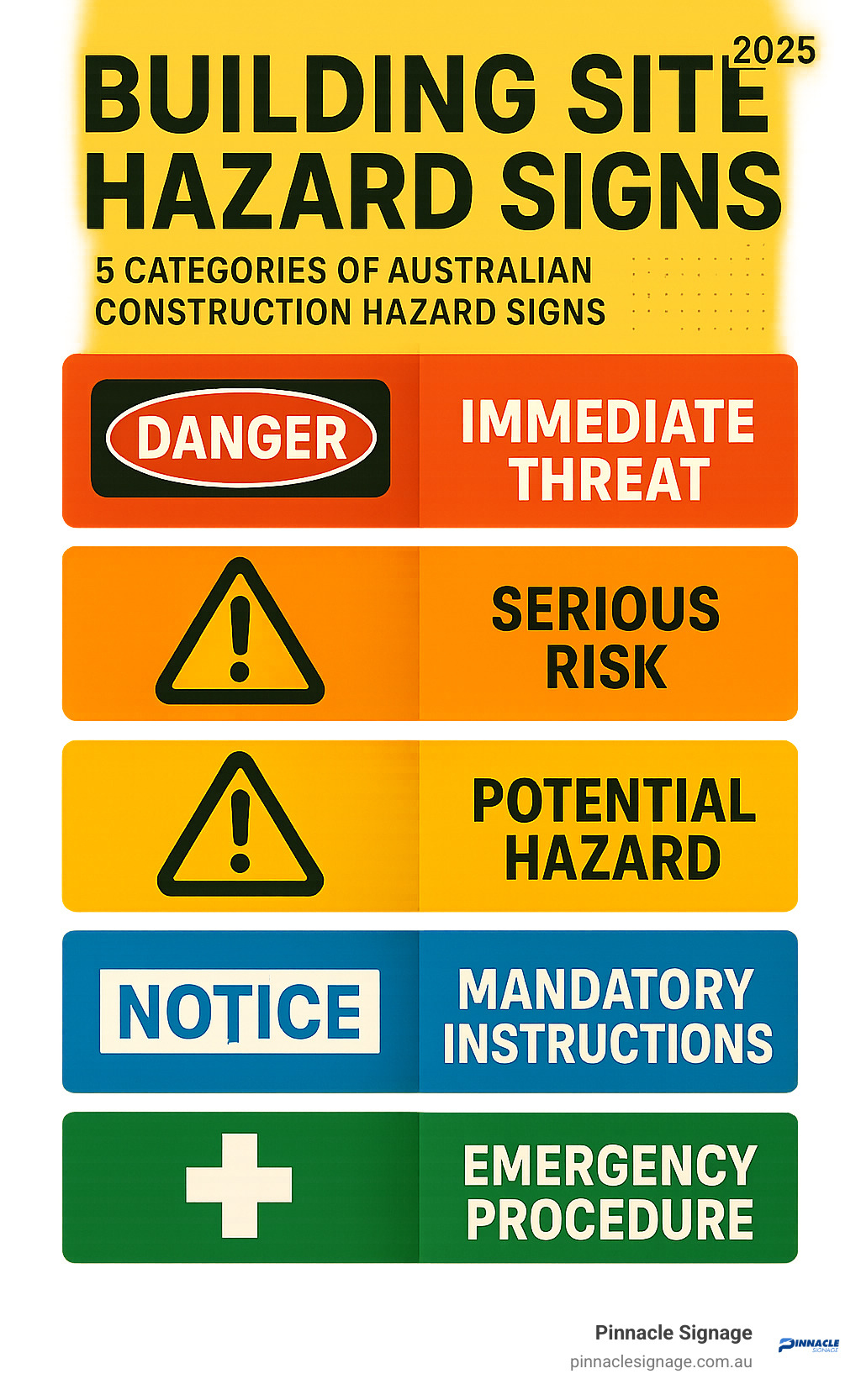
Building site hazard signs are mandatory safety signage that warn workers and visitors about specific dangers on construction sites. These signs must comply with Australian Standards and fall into five main categories:
Essential Building Site Hazard Signs:
- Danger Signs (red) - Immediate life-threatening hazards requiring special precautions
- Warning Signs (orange/black) - Serious risks that could cause injury or death
- Caution Signs (yellow) - Potential hazards requiring attention
- Notice Signs (blue) - Mandatory safety instructions and requirements
- Safety Instruction Signs (green/white) - Emergency procedures and safe condition information
The statistics are sobering. More than 14 worker deaths occur daily across Australian workplaces, with construction accounting for a significant portion of these fatalities. OSHA data shows that about 20% of workplace deaths happen to construction workers, making proper hazard signage absolutely critical for site safety.
Construction sites are inherently dangerous environments with heavy machinery, open trenches, electrical hazards, and falling objects creating risks at every turn. Effective hazard signage serves as the first line of defence, alerting everyone on site to potential dangers before accidents occur.
Beyond preventing injuries, proper signage helps you meet your legal obligations under Work Health and Safety regulations. All safety signs must conform to Australian Standards, making them universally understood across different trades and contractors working on your site.
I'm Doug Lindqvist, and through my years in the safety and industrial supply space, I've seen how proper building site hazard signs can prevent serious accidents and costly project delays. At Pinnacle Signage, we've helped countless construction sites across Australia implement compliant signage solutions that protect workers and keep projects on track.
What are Building Site Hazard Signs and Why Do They Matter?
Building site hazard signs are specialised safety signage designed to communicate specific dangers and safety requirements on construction sites. These signs form a crucial part of the risk control hierarchy, serving as an administrative control that warns people about hazards when elimination or engineering controls aren't feasible.
At their core, hazard signs translate complex safety information into universally understood visual messages. They bridge communication gaps on multi-contractor sites where workers from different trades and backgrounds need to quickly identify and respond to dangers.
The importance of proper signage extends far beyond tick-box compliance. Construction sites are some of the most dangerous workplaces in Australia, with hazards ranging from falls and electrocution to chemical exposure and machinery accidents. When properly designed and positioned, hazard signs can prevent serious injuries and save lives.
Your legal duty of care under Work Health and Safety legislation requires you to provide adequate warning of workplace hazards. SafeWork Australia guidelines emphasise that hazard identification and communication are fundamental responsibilities for persons conducting a business or undertaking (PCBUs).
The scientific research on construction fatalities reveals that many accidents occur because workers weren't adequately warned about specific hazards. Proper signage creates shared situational awareness, helping everyone on site understand what risks they're facing and how to protect themselves.
Effective hazard signs also support your site's safety culture by demonstrating visible commitment to worker protection. When people see clear, well-maintained signage, it reinforces that safety is a genuine priority rather than just paperwork.
12 Must-Have Building Site Hazard Signs (and What They Mean)
Understanding the different types of building site hazard signs is essential for creating a comprehensive safety communication system. Australian Standards define specific colour codes and pictograms that make signs instantly recognisable across different sites and industries.
The five main categories use distinct colour schemes to convey different levels of urgency and types of information. Red indicates immediate danger, orange and black warn of serious risks, yellow signals caution for potential hazards, blue communicates mandatory requirements, and green with white provides safety and emergency information.
Each category serves a specific purpose in your overall safety strategy. Danger signs are reserved for the most serious threats where special precautions are absolutely necessary. Warning signs alert people to significant risks that could cause injury or death if proper care isn't taken. Caution signs highlight potential hazards that require attention but may not be immediately life-threatening.
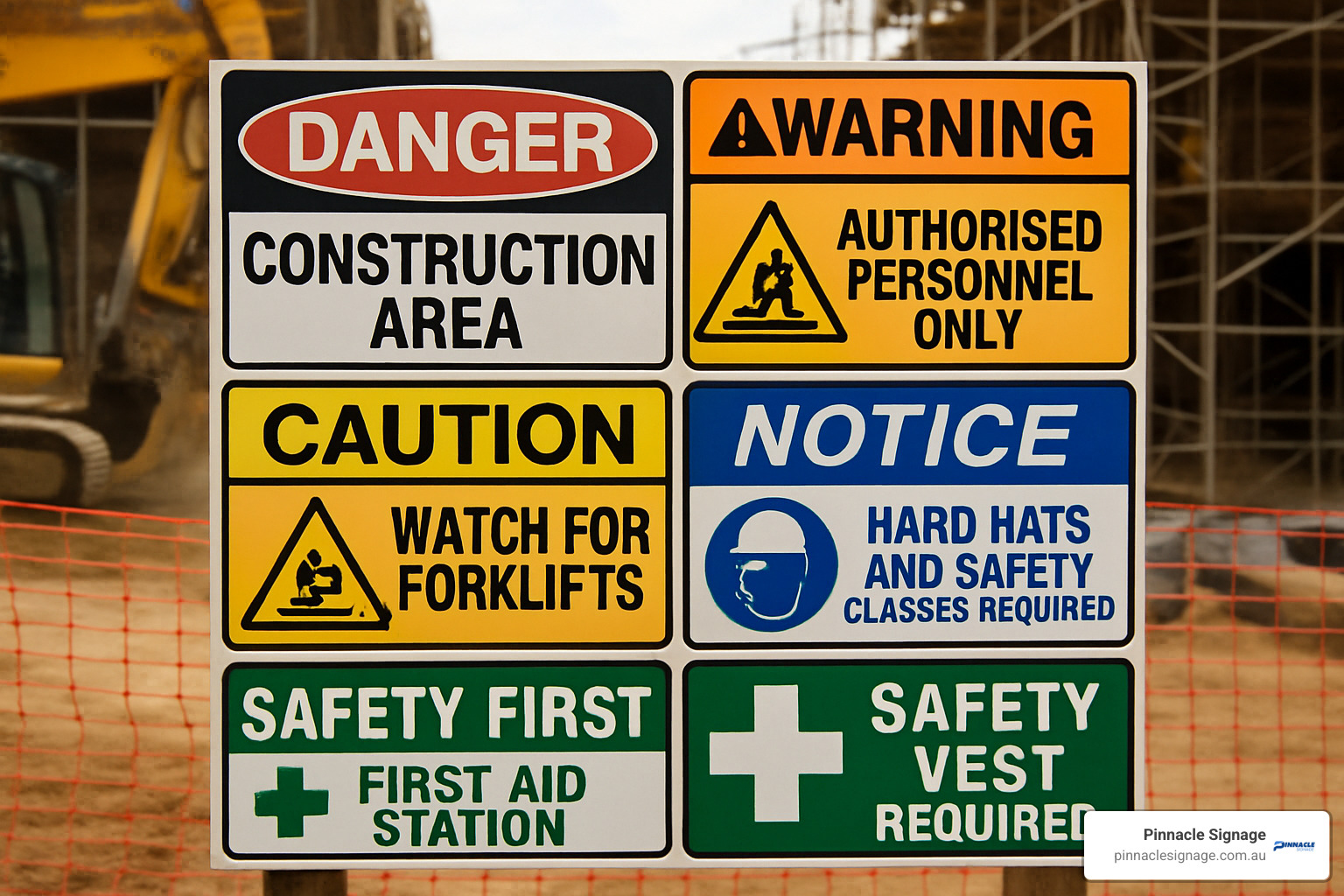
The pictograms used on these signs follow international standards, making them understandable even to workers who may not read English fluently. This universal approach is particularly important on Australian construction sites where diverse workforces are common.
Let's examine the specific types of hazard signs you'll need to keep your site safe and compliant.
1. Danger – Immediate Threats
Danger signs use red backgrounds with white text and are reserved for the most serious hazards where immediate death or severe injury is likely if proper precautions aren't taken. These signs demand immediate attention and special safety measures.
Electrocution hazards are among the most critical dangers on construction sites. "Danger - High Voltage" signs must be placed near electrical equipment, overhead power lines, and any area where electrical work is being performed. These signs often include the lightning bolt pictogram and specific voltage warnings.
Fall hazard signs are essential wherever workers might be exposed to drops of two metres or more. "Danger - Fall Hazard No Access" signs should be positioned at unguarded edges, incomplete floors, and around scaffolding. The falling person pictogram makes the risk immediately clear to anyone approaching the area.
Confined space dangers require specific signage due to the unique risks involved. "Danger - Confined Space Entry by Permit Only" signs must be displayed at tank entries, manholes, and other enclosed spaces where atmospheric hazards or entrapment risks exist.
Other critical danger signs include warnings for asbestos removal areas, explosive atmospheres, and machinery with exposed moving parts. The key is that danger signs are only used where the risk is immediate and potentially fatal.
2. Warning – Serious Risks Ahead
Warning signs use orange backgrounds with black text and pictograms to alert people to serious hazards that could cause injury or death if proper precautions aren't followed. These signs indicate significant risks that require careful attention but may not pose immediate fatal threats.
Asbestos warning signs are legally required in any area where asbestos-containing materials are being disturbed or removed. "Warning - Asbestos Hazard Authorised Personnel Only" signs must be clearly visible at all access points to contaminated areas.
Overhead powerline warnings are essential near electrical infrastructure. "Warning - Overhead Powerlines" signs should be positioned where mobile plant or tall equipment might come into contact with electrical cables. These signs often specify minimum clearance distances.
Blasting area warnings are required on sites where explosives are used. "Warning - Blasting Area" signs must be positioned at safe distances from blast zones, often accompanied by timing information and evacuation procedures.
Warning signs also cover hazards like heavy machinery operation, crane swing areas, and chemical storage zones. The orange colour makes these signs highly visible while indicating that serious caution is required.
3. Caution – Potential Injury Zones
Caution signs use yellow backgrounds with black text to highlight potential hazards that could cause minor to moderate injuries if proper care isn't taken. While less urgent than danger or warning signs, caution signs play an important role in preventing common workplace injuries.
Trip hazard signs are essential in areas with uneven surfaces, cables, or temporary obstacles. "Caution - Trip Hazard" signs should be placed where changes in floor level, temporary barriers, or equipment create walking hazards.
Uneven ground warnings help prevent slips and falls on construction sites where surfaces are constantly changing. "Caution - Uneven Ground" signs are particularly important in excavation areas and around earthworks.
Slippery surface signs are crucial during wet weather or in areas where spills are common. "Caution - Slippery Surface" signs should be positioned near water sources, in covered areas during rain, and anywhere cleaning activities create wet conditions.
Other common caution signs include low clearance warnings, noise hazard alerts, and notifications about dust or debris. These signs help workers stay alert to conditions that might not be immediately obvious but could still cause injuries.
4. Notice & Safety Instructions
Notice signs use blue backgrounds with white text to communicate mandatory safety requirements and instructions. These signs don't warn about specific hazards but instead tell people what they must do to stay safe.
Site office signs help visitors and workers locate important facilities and understand site procedures. "Notice - Report to Site Office Before Entering" signs should be prominently displayed at all site entrances.
PPE requirement signs are essential for communicating what protective equipment must be worn in different areas. "Notice - Hard Hats, Safety Boots and High-Vis Clothing Must Be Worn" signs should be positioned at site entrances and specific work zones.
Authorised personnel signs help control access to restricted areas. "Notice - Authorised Personnel Only" signs should be used to limit access to dangerous areas, equipment storage, and sensitive work zones.
Safety instruction signs using green backgrounds with white text provide information about emergency procedures and safe conditions. These include directions to first aid stations, emergency exits, and assembly points.
5. Fire & Emergency Hazards
Fire and emergency signage combines warning elements with safety instructions to help people respond appropriately to fire-related hazards and locate emergency equipment.
Flammable liquids storage requires specific signage to warn about ignition sources and communicate handling procedures. "Warning - Flammable Liquids No Smoking" signs should be displayed wherever fuel, solvents, or other combustible materials are stored.
Fire extinguisher point signs help people quickly locate firefighting equipment during emergencies. These signs use red backgrounds with white pictograms and should be positioned above or adjacent to fire extinguishers.
First aid station signs use green backgrounds with white crosses to indicate where medical assistance is available. These signs should be clearly visible and include directional arrows where necessary.
Emergency assembly point signs help coordinate evacuation procedures and should be positioned at designated muster points. Clear visibility from multiple directions is essential for these signs.
6. Custom Hazard Signs for Unique Risks
While standard hazard signs cover most common construction risks, many sites have unique hazards that require custom signage solutions. Custom signs allow you to address specific risks while maintaining compliance with Australian Standards.
Crane swing area signs are essential on sites with mobile or tower cranes. "Danger - Crane Swing Area Keep Clear" signs should define exclusion zones and include pictograms showing the crane's operational radius.
Demolition zone warnings need to communicate both the nature of the work and specific access restrictions. "Warning - Demolition in Progress Authorised Personnel Only" signs should be positioned at all approaches to demolition areas.
Custom signs can also address site-specific hazards like underground services, contaminated soil, or unique machinery risks. The key is ensuring that custom signage follows the same colour coding and design principles as standard signs.
We work with clients to develop custom signage that addresses their specific risks while maintaining compliance with Australian Standards. Our design process ensures that custom signs integrate seamlessly with standard signage systems.
Where to Place Hazard Signs for Maximum Impact
Strategic placement of building site hazard signs is just as important as having the right signs in the first place. Poor positioning can render even the best signage ineffective, while thoughtful placement ensures maximum visibility and compliance.
Entry gates are the most critical location for general site safety signage. Every person entering your site should encounter clear information about PPE requirements, general hazards, and reporting procedures before they go any further.
Perimeter fencing should display warning signs that are visible to the public and unauthorised personnel. "Warning - Construction Site Keep Out" signs help prevent trespassing and reduce your liability for injuries to non-workers.
Task zones require specific hazard signage relevant to the work being performed. Excavation areas need fall hazard signs, electrical work zones need electrocution warnings, and lifting operations need overhead hazard alerts.
Eye-level height is crucial for sign effectiveness. Signs positioned too high or too low are easily missed, especially when workers are focused on their tasks. The optimal height range is 1.5 to 2 metres above ground level.
Lighting conditions affect sign visibility throughout the day. Areas with poor natural light may require illuminated signs or reflective materials to ensure 24-hour visibility.
Reflective options are essential for signs that need to be visible in low-light conditions or to vehicle operators. Reflective vinyl and prismatic materials significantly improve visibility during dawn, dusk, and night operations.
Regulatory Rules for Positioning Building Site Hazard Signs
Australian Standards AS 1319 provides specific guidance on safety sign positioning and visibility requirements. These standards ensure that signs are positioned where they can be easily seen and understood by their intended audience.
ISO 7010 standards complement Australian requirements by providing internationally recognised pictograms and design principles. Following these standards ensures your signage is understood by workers from diverse backgrounds.
Work Health and Safety Regulations require that hazard signs be positioned as close as practicable to the hazard they're warning about. This proximity principle ensures that people receive warnings at the right time to take appropriate action.
Visibility distances are specified in the standards based on sign size and intended viewing distance. Larger signs are required where people need to see warnings from greater distances, such as vehicle approach routes.
The standards also specify minimum luminance levels for signs in different lighting conditions. This ensures that signs remain visible throughout all working hours and weather conditions.
Auditing Your Site – Quick Checklist
Regular auditing of your signage system ensures ongoing effectiveness and compliance. We recommend conducting formal sign audits at least monthly, with informal checks as part of daily site inspections.
Monthly inspections should document the condition and positioning of all signs on site. Check for fading, damage, obstruction, and relevance to current site conditions.
Update logs help track when signs were installed, inspected, and replaced. This documentation demonstrates due diligence and helps identify patterns in sign deterioration.
Removal of faded signs is just as important as installing new ones. Faded or damaged signs can actually reduce safety by creating confusion or suggesting that safety isn't a priority.
Your audit checklist should include sign visibility, condition, relevance, positioning, and compliance with current standards. Document any issues and establish timelines for corrections.
Materials, Durability & Maintenance Tips
Choosing the right materials for your building site hazard signs is crucial for longevity and ongoing effectiveness. Australian construction sites present challenging environmental conditions that demand durable signage solutions.
Aluminium composite panels offer excellent durability for permanent installations. These signs resist corrosion, maintain colour stability, and can withstand impacts from flying debris. They're ideal for perimeter fencing and long-term hazard warnings.
Rigid PVC provides a cost-effective option for temporary signage with good weather resistance. These signs are lighter than aluminium alternatives and easier to relocate as site conditions change.
Reflective vinyl is essential for signs that need to be visible to vehicle operators or in low-light conditions. High-quality reflective materials maintain their retroreflective properties for years when properly maintained.
UV resistance is critical for any signage exposed to Australian sunlight. Quality signs use UV-stable inks and substrates that won't fade or become brittle over time.
Cleaning schedules should be established to maintain sign visibility. Dust, mud, and construction debris can quickly obscure important safety messages. Regular cleaning with appropriate methods prevents damage while maintaining effectiveness.
Replacement cycles vary depending on material quality and environmental exposure. Scientific research on sign longevity suggests that quality signs should maintain effectiveness for 5-7 years under normal conditions, but construction sites may require more frequent replacement.
We manufacture our signs using premium materials specifically chosen for Australian conditions. Our aluminium composite signs include UV-stable inks and protective coatings that maintain visibility and legibility throughout their service life.
Training Workers & Visitors to Heed the Signs
Even the best signage is ineffective if people don't understand or follow it. Comprehensive training ensures that everyone on your site knows how to interpret and respond to hazard signs appropriately.
Site inductions should include a comprehensive overview of your signage system. Explain the different colour codes, common pictograms, and what actions are required when people encounter different types of signs.
Toolbox talks provide opportunities to reinforce signage awareness and discuss specific hazards relevant to current work activities. Use actual examples from your site to make the training more relevant and memorable.
Multilingual graphics are particularly important on diverse construction sites. While pictograms help overcome language barriers, consider providing translated safety information for workers who may not be comfortable with English.
Refresher sessions help maintain awareness over time. People can become complacent about familiar signage, so regular reminders about sign significance and proper responses are essential.
Disciplinary policies should clearly outline consequences for ignoring safety signage. Consistent enforcement demonstrates that sign compliance is a serious safety requirement, not just a suggestion.
Training should emphasise that signs are there to protect everyone on site. When workers understand that signage is about their safety rather than just compliance, they're more likely to pay attention and follow instructions.
Consequences of Ignoring or Missing Hazard Signs
The consequences of inadequate hazard signage extend far beyond regulatory compliance. Poor signage can result in serious injuries, legal liability, and significant project disruptions.
WHS fines for inadequate signage can be substantial, particularly if an incident occurs in an area that wasn't properly marked. Regulators take a dim view of preventable accidents that could have been avoided with proper warning signs.
Injuries are the most serious consequence of poor hazard communication. Workers who aren't adequately warned about specific dangers are more likely to be injured, creating personal tragedy and workplace trauma.
Project delays often result from safety incidents that could have been prevented with proper signage. Investigations, remediation work, and increased regulatory scrutiny can significantly impact project timelines.
Insurance costs may increase following safety incidents, particularly if inadequate signage is identified as a contributing factor. Some insurers also offer premium discounts for sites with comprehensive safety programs.
Prosecution under WHS legislation is possible where inadequate hazard communication contributes to serious injuries or fatalities. Directors and senior managers can face personal liability for safety failures.
Boosting Compliance Through Smart Design & Placement
Effective hazard signage goes beyond minimum compliance requirements. Smart design and strategic placement can significantly improve safety outcomes and reduce the risk of incidents.
Consistent colours throughout your site help people quickly identify different types of hazards and required responses. Avoid mixing different colour schemes or using non-standard colours that might confuse workers.
Clear icons that follow international standards ensure universal understanding. Avoid text-heavy signs where pictograms can convey the same information more effectively.
Lighting can dramatically improve sign visibility, particularly in areas with poor natural light or during early morning and evening work. Solar-powered LED signs are increasingly popular for remote locations.
Reflective coatings improve visibility for vehicle operators and workers using headlamps. High-quality retroreflective materials remain effective for years when properly maintained.
The goal is to make building site hazard signs so clear and visible that ignoring them requires deliberate effort. When signage is obvious and easy to understand, compliance becomes the natural choice.
Frequently Asked Questions about Building Site Hazard Signs
Do Australian Standards dictate specific colours and shapes?
Yes, Australian Standards AS 1319 specifies exact colour combinations and shapes for different types of safety signs. Danger signs must use red backgrounds with white text, warning signs use orange backgrounds with black text, caution signs use yellow backgrounds with black text, notice signs use blue backgrounds with white text, and safety instruction signs use green backgrounds with white text.
The standards also specify geometric shapes for different sign categories. Prohibition signs are circular with a diagonal line, warning signs are triangular, mandatory signs are circular, and safe condition signs are rectangular or square.
These standardised colours and shapes ensure universal recognition across different sites and industries. Workers who understand the system can quickly identify hazard types and required responses regardless of where they're working.
How often should hazard signs be replaced on a live site?
Sign replacement frequency depends on several factors including material quality, environmental exposure, and site conditions. High-quality signs in protected locations may last 5-7 years, while signs exposed to harsh conditions may need replacement annually.
Monthly inspections should assess sign condition and identify any that need immediate replacement. Signs showing fading, damage, or poor visibility should be replaced regardless of age.
Temporary signs for specific activities should be removed or updated as soon as conditions change. Leaving outdated signs in place can create confusion and reduce the effectiveness of your overall signage system.
Can I create custom hazard signs and still stay compliant?
Yes, custom signs can be fully compliant with Australian Standards provided they follow the correct colour coding, pictogram standards, and design principles. Custom signs are often necessary to address site-specific hazards that aren't covered by standard signage.
The key is ensuring that custom designs use appropriate colours for the hazard level, include relevant pictograms where available, and maintain the same visual standards as standard signs. Working with experienced signage providers ensures compliance while meeting specific site requirements.
Custom signs should complement rather than replace standard signage. A mix of standard and custom signs often provides the most comprehensive hazard communication system.
Conclusion
Building site hazard signs are far more than regulatory requirements – they're essential tools for protecting lives and maintaining productive work environments. The statistics speak for themselves: proper hazard communication can prevent many of the 14 daily workplace fatalities that occur across Australian workplaces.
Creating an effective signage system requires understanding the five main sign categories, choosing appropriate materials for your conditions, and positioning signs where they'll have maximum impact. Regular auditing and maintenance ensure ongoing effectiveness, while comprehensive training helps everyone on site understand and respond to hazard warnings.
Your quick action plan should include:
- Audit your current signage against the 12 must-have sign types
- Identify any gaps in hazard communication
- Develop a replacement schedule for damaged or faded signs
- Implement regular training and refresher programs
- Establish maintenance procedures to keep signs visible and effective
At Pinnacle Signage, we understand the unique challenges of Australian construction sites. Our experience across New South Wales helps us provide signage solutions that withstand harsh conditions while maintaining compliance with Australian Standards. We manufacture high-quality, durable signs with fast turnaround times to keep your projects on schedule.
Don't let poor signage become the weak link in your safety system. Proper building site hazard signs are an investment in your workers' safety, your project's success, and your organisation's reputation.
More info about construction signage is available on our website, where you can explore our full range of safety signage solutions designed specifically for Australian construction sites. You can also find our signs on Bunning's website.