

Hazchem Signs Explained: Your Quick Guide to Safety Symbols
What is Hazchem Signage and Why Does it Matter?
Hazchem signage meaning refers to the specialized warning placards and labels used across Australia to identify hazardous chemicals and guide emergency response. These signs use a standardized system of codes, numbers, and symbols to quickly communicate critical information about dangerous substances to workers, visitors, and first responders. At its core, a Hazchem sign tells you three things: what the chemical is (via the UN Number and substance name), what hazards it presents (shown by the hazard class diamond), and how to respond in an emergency (indicated by the Emergency Action Code).
Key Components of a Hazchem Placard:
- Emergency Action Code (EAC) - A 2-3 character code (e.g., '3YE') that tells emergency services which fire suppressant to use, what protective equipment is needed, and whether evacuation is required
- UN Number - A four-digit international identifier for the specific chemical (e.g., UN 1203 for petrol)
- Hazard Class Diamond - A coloured diamond symbol showing the type of danger (flammable, toxic, corrosive, etc.)
- Substance Name - The proper shipping name or common name of the chemical
- Emergency Contact - Phone number for specialist advice in case of incident
Understanding hazchem signage meaning is non-negotiable for any Australian business handling, storing, or transporting hazardous materials. These signs aren't just regulatory checkboxes, they're the visual language that can save lives when seconds count. Whether you're managing a construction site, running a fuel depot, or overseeing a chemical warehouse, knowing what these signs mean ensures your team can work safely and emergency services can respond effectively.
Decoding the Hazchem Placard: A Component-by-Component Breakdown
When you're standing in front of a Hazchem placard, you're looking at a carefully designed piece of safety communication that can save lives. Every element on that sign is there for a reason, speaking a universal language that emergency responders can read and act on within seconds. Let's break down what each part means and why it matters.
The HAZCHEM Emergency Action Code (EAC)
The Emergency Action Code sits right at the top of a Hazchem placard, and it's arguably the most critical piece of information for first responders. This simple alphanumeric code, like '3YE' for petrol, packs an enormous amount of emergency guidance into just two or three characters.
The first number tells firefighters which suppression method to use. A '1' means water jets are safe and effective. A '2' calls for water fog or fine spray. A '3' indicates foam is needed. And a '4' means water is off the table entirely, you'll need a dry agent like powder or CO2. This is crucial for substances that react violently with water or for electrical fires. The system allows responders to use a higher-numbered method if needed (foam instead of fog, for example), but never a lower one.
The letter that follows guides everything else about the response. It tells emergency crews what personal protective equipment they need, whether the substance can be diluted or must be contained, and how dangerous the chemical's reactions might be. For instance, the 'Y' in '3YE' means breathing apparatus is mandatory and the substance must be contained, not washed away into drains or waterways. The Australian Dangerous Goods Code has refined these interpretations over time, and now certain letter codes (S, T, Y, Z) automatically require breathing apparatus at large incidents, even if there's no fire.
Then there's the 'E' at the end, and that's your evacuation signal. If you see that final 'E', like in '3YE', it means the public is at risk. Emergency services may need to warn nearby residents to stay indoors or even evacuate the area, potentially up to 250 metres away. This single letter transforms a contained emergency into a public safety event.
The beauty of the EAC system is its efficiency. It transcends language barriers and delivers complex emergency protocols in a format that's instantly understood by trained responders anywhere in Australia. It's the difference between confusion and coordinated action when every second counts.
Want to understand more about how chemical hazards are communicated in the workplace? Our guide on GHS Signage Made Simple covers the broader landscape of chemical labelling.
The UN Number
Just below the Emergency Action Code, you'll find a four-digit number that's recognised around the world. This is the UN Number (United Nations Number), and it's your universal identifier for the substance in question.
The UN Number cuts through the confusion of multiple names and regional variations. Take petrol, for example. In some places it's called gasoline, in others it might be referred to as motor spirit or benzine. But everywhere on Earth, UN 1203 means exactly the same thing. This standardisation is invaluable when chemicals cross borders, when emergency crews from different regions respond to the same incident, or when someone needs to quickly look up detailed safety information.
This number is your key to accessing the Safety Data Sheet (SDS), the comprehensive document that tells you everything about how to handle, store, and respond to emergencies involving that particular substance. Emergency responders use it to confirm exactly what they're dealing with, especially when containers are damaged or labels are unclear.
Getting the UN Number right on your signage isn't just about ticking a compliance box, it's about making sure everyone, from your warehouse staff to visiting emergency services, knows precisely what substance they're working with. For more detailed guidance on making sure all your Hazchem signage elements are correct, have a look at our Step-by-Step Guide to Hazchem Signage Compliance.
Hazard Class Diamonds: The Visual Cues
Hazard class diamonds are the instantly recognisable symbols that catch your eye before you've even read a word. These diamond-shaped signs, with their bold colours and clear pictograms, communicate the primary danger at a glance. In Australia, we use nine distinct classes of dangerous goods, each with its own diamond.
Class 1 covers Explosives, marked by an orange diamond with an exploding bomb symbol. These are your ammunition, fireworks, and flares, substances that can rapidly produce gas at temperatures and pressures that cause serious damage.
Class 2 is for Gases, broken into three subclasses. Class 2.1 shows flammable gases like LPG and acetylene on a red diamond with a flame. Class 2.2 covers non-flammable, non-toxic gases like nitrogen and oxygen, displayed on a green diamond with a gas cylinder. Class 2.3 warns of toxic gases like chlorine on a white diamond with the skull and crossbones, these can kill or seriously injure through inhalation alone.
Class 3 identifies Flammable Liquids with a red diamond and flame symbol. This is your petrol, diesel, kerosene, and alcohol, liquids with a flash point below 60°C that can ignite easily.
Class 4 covers Flammable Solids in three categories. Class 4.1 shows readily combustible solids like matches on red and white stripes. Class 4.2 warns of spontaneously combustible materials like white phosphorus on a white-over-red background, these can ignite just from contact with air. Class 4.3 signals substances that are dangerous when wet, like sodium and calcium, shown on a blue diamond, they emit flammable gases when they get wet.
Class 5 deals with Oxidising Substances and Organic Peroxides. Class 5.1 oxidising agents like pool chlorine appear on a yellow diamond with a flame over a circle, they're not flammable themselves but they can cause or intensify combustion in other materials. Class 5.2 organic peroxides like benzoyl peroxide are shown on a split red-and-yellow diamond, these are thermally unstable and can decompose in a dangerous, self-accelerating reaction.
Class 6 covers Toxic and Infectious Substances. Class 6.1 toxic substances like cyanide, mercury, and arsenic use the white diamond with skull and crossbones, warning that they can cause death or serious injury through inhalation, skin contact, or ingestion. Class 6.2 infectious substances, marked with the biohazard symbol, cover pathogens like bacteria, viruses, and fungi.
Class 7 is for Radioactive Material, shown on a yellow-over-white diamond with the distinctive trefoil symbol. These materials emit ionising radiation and have special transport requirements beyond the standard ADG Code.
Class 8 identifies Corrosive Substances with a white-over-black diamond showing liquid pouring onto a hand and metal. Substances like nitric acid and sodium hydroxide can cause severe damage to living tissue or materials on contact.
Class 9 is the catch-all for Miscellaneous Dangerous Goods, displayed as black and white stripes. This covers substances that present a transport hazard but don't fit the other eight classes, things like lithium batteries, dry ice, and asbestos.
These diamonds are designed for instant recognition, even from a distance. When a substance has multiple hazards, you might see subsidiary risk labels displayed alongside the primary hazard diamond. Understanding hazchem signage meaning through these visual cues is essential for anyone working with or around hazardous materials.
For a deeper exploration of these and other hazard symbols, check out our comprehensive guide: Know Your Hazard Symbols: A Guide to Chemical Signage.
The Complete Guide to Hazchem Signage Meaning and Types
Hazchem signage isn't a case of slapping up one generic sign and calling it done. Different locations and situations call for different types of signs, each serving a specific purpose. Understanding where each type fits, and what information it needs to convey, is essential for creating a truly safe workplace.
Outer Warning Placards
Think of outer warning placards as your site's first handshake with emergency services. These signs are positioned at every entrance where emergency responders might enter your premises, whether that's a vehicle gate or a pedestrian entry point. Their job is simple but critical: to immediately alert anyone approaching that hazardous chemicals are present on site.
If your workplace stores or handles hazardous chemicals above certain threshold quantities (defined by WHS Regulations as 'placard quantities'), you're legally required to display these outer warning placards. They're typically rectangular signs featuring the word 'HAZCHEM' in bold red letters, at least 100 mm high, set against a white or silver background. This high-contrast design ensures they're visible from a distance, even in poor conditions.
These placards don't necessarily list every specific chemical on site. Instead, they serve as a general warning that dangerous goods are present, prompting emergency services to proceed with appropriate caution and seek more detailed information. For businesses looking to ensure their entrance signage is clear and compliant, we stock a comprehensive range of warning signs. You can view our range of Danger Signs at Bunnings to find options that suit your workplace needs.
Bulk Storage and Container Placards
Once you move beyond the entrance, more detailed placarding becomes necessary. Bulk storage placards are required when you're storing hazardous chemicals in significant quantities, typically in containers exceeding 500 litres or 500 kilograms, or when storing an undivided quantity over 500 kilograms for solids.
These placards must display specific, detailed information about the substances they're marking. This includes the proper shipping name of the chemical, its UN Number, the HAZCHEM Emergency Action Code, and the appropriate ADG Code class label along with any subsidiary risk labels. The lettering must be black on a white background and stand at least 100 mm high, while the hazard class diamonds need sides of at least 250 mm to ensure they're clearly visible.
For example, a large storage tank holding Liquified Petroleum Gas would display a placard showing its Emergency Action Code (such as '2YE'), its UN Number (1075), and the distinctive red "Flammable Gas" Class 2.1 diamond. This level of detail allows workers and emergency responders to understand exactly what they're dealing with, not just that it's hazardous.
When it comes to intermediate bulk containers (IBCs) and other packaged goods, the placards are typically displayed at the entrance to the storage area rather than on each individual container. These signs must be large enough to accommodate all required class labels side by side, with sides no less than 100 mm, and they must feature that distinctive white or silver background.
Getting these details right isn't just about ticking regulatory boxes, it's about creating a workplace where everyone can quickly access the information they need to stay safe. We manufacture durable, weather-resistant placards designed for Australian conditions. You can shop for Chemical Storage Signs at Bunnings to protect your storage areas with signage that lasts.
Understanding the Hazchem Signage Meaning for Transport
When hazardous goods hit the road, the hazchem signage meaning becomes even more critical. Transport vehicles carrying dangerous goods must display Emergency Information Panels (EIPs), which are the transport industry's version of Hazchem placards. These signs ensure that everyone sharing the road, and especially emergency services responding to an incident, can quickly identify what's being transported and the risks involved.
Transport EIPs are comprehensive, displaying the full suite of information: the Hazchem Emergency Action Code, the UN Number, the proper chemical name, and emergency contact details. These panels must follow the precise specifications laid out in the Australian Dangerous Goods (ADG) Code, which dictates everything from their size and placement to the exact format of information they display.
It's worth noting that the ADG Code's diamond-shaped class labels are specifically required for transport placarding. The pictograms from the Globally Harmonized System (GHS), which you'll see on workplace labels and Safety Data Sheets, are generally not appropriate for vehicle placarding. The ADG Code's system is designed for the unique challenges of transport, where quick visual identification from a distance is paramount.
For instance, a tanker truck carrying petrol will display an EIP featuring the '3YE' Hazchem code, UN 1203, the word "PETROL," and the bright red Class 3 Flammable Liquid diamond. This combination of information allows emergency responders to make rapid, informed decisions, such as using foam for fire suppression and considering public evacuation, as the '3YE' code indicates.
Understanding these transport requirements is essential for anyone involved in moving dangerous goods. For comprehensive guidance on all aspects of transport placarding, consult the Australian Dangerous Goods (ADG) Code directly.
Ensuring Compliance: Australian Regulations and Best Practices
Staying compliant with Hazchem signage isn't just about ticking boxes or avoiding fines. It's fundamentally about creating a safer workplace for everyone. When you get your signage right, you're giving emergency responders the information they need to save lives and protect property. Here's what Australian businesses need to understand about the regulatory landscape.
Key Australian Standards and Regulations
Hazchem signage meaning in Australia is shaped by several interconnected frameworks. Australian Standard AS1216 specifically governs the Hazchem emergency action code system, providing the foundation for those critical alphanumeric codes we discussed earlier. The Australian Dangerous Goods (ADG) Code then sets out the detailed requirements for transporting dangerous goods by road and rail, covering everything from placard dimensions to the exact specifications for those distinctive class labels.
The Work Health and Safety (WHS) Regulations bring it all together at the workplace level. These national regulations mandate that Hazchem placards must be displayed if your hazardous chemicals exceed certain quantities, known as placard quantities. Schedule 13 of the model WHS Regulations spells out these requirements in detail. Safe Work Australia, our national body for workplace safety policy, provides practical guidance to help businesses understand their obligations and implement them correctly.
These regulations align with the Globally Harmonised System (GHS) for chemical classification and labelling, though their application in Australia has specific nuances that matter. Getting it wrong can have serious consequences beyond regulatory penalties. Improper or missing signage can lead to incorrect handling of dangerous goods, and in an emergency, it can mean the difference between a controlled response and a catastrophic outcome.
For comprehensive official guidance on your placarding obligations, visit Safe Work Australia's Hazardous Chemicals Signs (Placards) page.
The Difference Between Hazchem and GHS Signage
One of the most common sources of confusion in chemical signage is understanding when to use Hazchem placards versus GHS labels. While both systems deal with chemical hazards, they serve distinctly different purposes in the Australian context.
The Globally Harmonised System (GHS) is an internationally agreed framework for classifying and labelling chemicals. Its primary role is ensuring consistent hazard communication on chemical container labels and Safety Data Sheets within workplaces worldwide. GHS labels feature nine distinct hazard pictograms, such as the flame for flammable substances or the skull and crossbones for toxic materials. They also include signal words like DANGER or WARNING, along with specific hazard and precautionary statements. In Australia, hazardous chemicals in the workplace must carry GHS labelling.
Hazchem signage, particularly the placards used for bulk storage and transport, operates under the Australian Dangerous Goods (ADG) Code. These placards display the iconic diamond-shaped class labels, the UN Number, the Hazchem Emergency Action Code (EAC), and the proper shipping name. Here's the critical distinction: the ADG Code specifically states that GHS pictograms are not to be used for placarding in Australia. Instead, the traditional ADG Code class diamonds are mandatory for transport and bulk storage purposes.
The Hazchem system, with its unique Emergency Action Code, is the specific system required in Australia for communicating emergency response actions for bulk chemicals and transport.
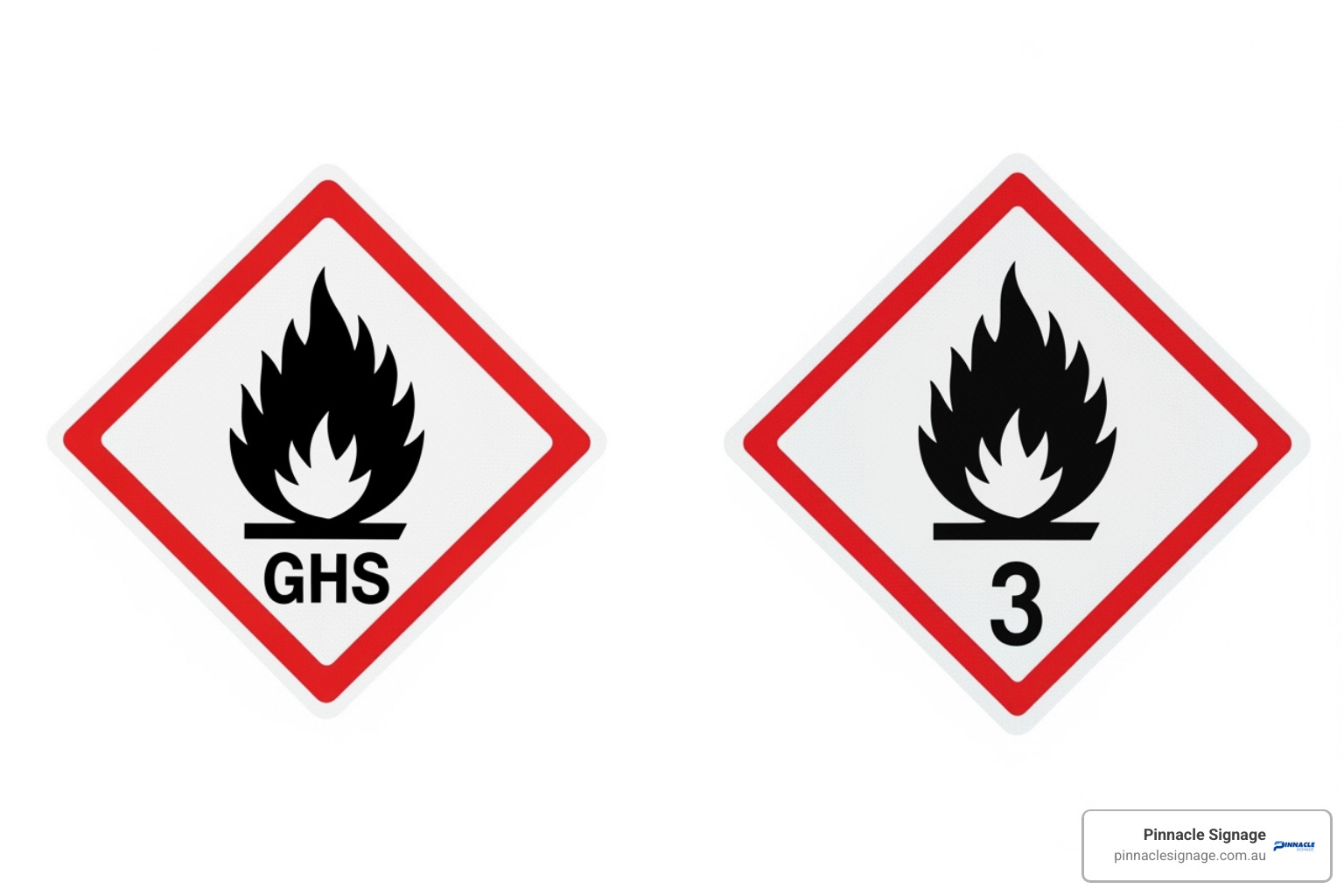
Think of it this way: GHS provides harmonised labels for chemical containers within your workplace, while Hazchem placards under the ADG Code provide critical emergency response information for transport and bulk storage locations. They're complementary systems designed to cover different aspects of chemical hazard communication, and understanding which to use where is essential for compliance.
To ensure you're using the right symbols for the right application, our guide on Hazard Label Symbols Demystified offers further clarity.
Common Mistakes to Avoid with Hazchem Signage
Even well-intentioned businesses can stumble when it comes to Hazchem signage. Here are the pitfalls I see most often, and how to avoid them.
Using outdated signs is surprisingly common. Regulations and chemical classifications do change, and relying on old Hazchem codes or outdated hazard diamonds can provide incorrect information to emergency responders. This isn't just a compliance issue, it's genuinely dangerous. Always ensure your signage reflects the latest ADG Code and WHS Regulations.
Poor visibility or placement renders even the best signage useless. A placard tucked behind a forklift or in dim lighting won't help anyone in an emergency. Outer warning placards must be clearly visible at every vehicle and pedestrian entrance where emergency services might enter. Think about sight lines, lighting conditions, and potential obstructions.
Many businesses misunderstand the placard quantity rules. Hazchem placards are required only when hazardous chemicals exceed specific thresholds. Some businesses assume they don't need placards when they actually do, while others display them unnecessarily. Knowing the specific thresholds for each chemical you store is vital.
Confusing GHS labels with placards is another frequent mistake. As we've just discussed, GHS pictograms belong on workplace container labels, while ADG Code diamonds are for transport and bulk storage placards. Using GHS pictograms on bulk storage or transport placards is non-compliant and creates confusion for responders who are trained to read ADG signage.
Not updating signs when chemicals change is a serious oversight. If you introduce a new hazardous chemical, change storage quantities, or stop storing a particular substance, your Hazchem signage must be updated immediately. A placard showing information for a chemical that's no longer on site, or missing for a newly introduced one, creates significant safety risks.
Finally, watch out for incomplete information. Missing a UN Number, an Emergency Action Code, or an emergency contact number can severely hamper emergency response efforts. All required components must be present, accurate, and clearly legible.
Avoiding these common mistakes isn't complicated, but it does require attention to detail and regular reviews of your signage. For more detailed guidance on specific requirements, refer to our article on Hazardous Chemicals Sign Requirements 101.
Find the Right Hazchem Signs for Your Business
Choosing the correct, high-quality signage is a critical step in your safety and compliance strategy. At Pinnacle Signage, we make it easy to get the signs you need, with durable, Australian-made products designed to meet regulatory standards. We understand the unique needs of Australian businesses, from small workshops to large industrial sites across the country.
Conveniently Available at Bunnings
We're proud to partner with Bunnings to bring our high-quality Hazchem and dangerous goods signs to you, both in-store and online across Australia. This means you can pick up the compliant signage you need during your regular Bunnings run, or have it delivered straight to your door.
Our range at Bunnings covers all the essentials for hazardous chemical management. You'll find dangerous goods class diamonds for all nine classes, specific hazard warnings like oxidising agents and corrosive substances, and general chemical storage warnings. Whether you need a single sign for a small workshop or multiple signs for a larger facility, the convenience of Bunnings makes it simple.
You can explore our full selection of safety and Hazchem signage by visiting the Pinnacle Signage range at Bunnings. For example, if you're storing oxidising gases and need compliant signage, you can easily Buy Oxidising Gas Signs at Bunnings directly. It's that straightforward.
Custom and Bulk Order Solutions
While Bunnings offers fantastic convenience for immediate needs, we know that many businesses require something more custom. Large industrial sites, agricultural operations, and organisations with multiple locations often need custom Hazchem signage that goes beyond off-the-shelf solutions.
That's where Pinnacle Signage really shines. We specialise in creating custom signage with specific text, your company logo, particular colours to match your branding, or non-standard dimensions, all while ensuring full compliance with Australian standards. This flexibility is particularly valuable for large industrial sites that need consistent signage across extensive facilities, agricultural businesses requiring custom biosecurity and chemical storage signs for farms and stockyards, and organisations managing multiple locations or specific projects.
For our valued resellers and distributors, we offer special distributor pricing and competitive margins, making Pinnacle Signage an ideal Australian-made supply partner. We understand the importance of reliable, quality products that your customers can trust, backed by fast, Australia-wide shipping.
To discuss your specific needs or to request a quote for a custom solution, you can Request a custom Hazchem sign through our website. For bulk order enquiries or to learn more about distributor opportunities, please Contact us directly. We're here to help you get the right hazchem signage meaning clearly communicated at your workplace, with warehouse pickup available from our East Wagga Wagga NSW location for added convenience.