

Everything You Need to Know About Construction Warning Signs
Why Construction Warning Signs Are Critical for Site Safety
Warning signs for construction are essential safety tools that protect workers and the public by communicating hazards, directing traffic, and ensuring regulatory compliance on Australian worksites. These signs serve five primary functions:
- Hazard identification - Alert people to specific dangers like falling objects or unstable surfaces.
- Traffic management - Guide vehicles and pedestrians safely around work zones.
- Worker protection - Remind staff about required PPE and safe work practices.
- Public safety - Keep unauthorised personnel away from dangerous areas.
- Legal compliance - Meet workplace safety obligations under Australian standards.
Construction sites are dynamic environments with constantly shifting hazards from heavy machinery, temporary structures, and changing traffic patterns. Without clear warning signs, the risks to workers and the public increase significantly.
Research shows that many worksite fatalities and injuries are caused by workers being struck by vehicles. Construction signs are crucial for managing traffic with speed limits and detours, highlighting hazards, and communicating safety rules for immediate understanding.
This guide will break down everything you need to know about choosing, placing, and maintaining construction warning signs to keep your site safe and compliant.
Warning signs for construction terms made easy:
A Guide to Essential Warning Signs for Construction
Walk onto any Australian construction site, and you'll notice the visual language of safety communicated through warning signs for construction. These are your silent guardians, working around the clock to keep everyone safe.
The Critical Role of Signage in Site Safety
Think of warning signs for construction sites as the unsung heroes of workplace safety. Every day, they prevent accidents that could change lives forever.
Worker protection is paramount. Construction is one of Australia's most high-risk industries, and signs like "Hard Hat Area" or "High Voltage" are constant reminders of lurking dangers. Clear signage helps cut through the noise and activity to deliver life-saving messages instantly, reducing the risk of workers being struck by vehicles or mobile equipment, a leading cause of injury.
Public and pedestrian safety is critical where sites border public spaces. Signs directing pedestrians or warning "Keep Out - Authorised Personnel Only" create protective barriers, guiding people safely around active work areas.
These signs act as powerful visual reminders that combat complacency. A well-placed safety sign provides a split-second reminder about PPE or a nearby hazard that can prevent a serious incident.
Effective traffic management relies on construction signage. Signs indicating reduced speed limits, lane closures, and detours prevent chaos as drivers steer changing road conditions around active worksites.
From a business perspective, proper signage ensures legal compliance with Australian workplace safety regulations, fostering a culture where everyone goes home safely.
For more on implementing effective safety signage, see our Ultimate Guide to Construction Safety Signage.
Understanding the Main Categories of Construction Signs
Australian Workplace Health and Safety regulations organise warning signs for construction sites into clear categories based on the level of risk.
Danger signs indicate potentially life-threatening hazards. They feature a distinctive red oval with "DANGER" in white text and are reserved for the most severe risks, like high-voltage areas.
Warning signs alert people to hazards that could cause serious, but not life-threatening, injury. They use a yellow background with a black triangle and symbol for quick recognition, such as "Warning: Forklift Traffic."
Caution signs address hazards that might cause minor to moderate injuries. Like warning signs, they typically use a yellow background with black text and symbols for messages like "Caution: Wet Floor." We stock a comprehensive range of caution signs. For more details, read our Caution Signs You Can't Miss on a Construction Site: Full Guide.
Mandatory signs specify required actions, such as "Wear Hard Hat." They have a blue circle with a white pictogram on a white background.
Prohibition signs forbid dangerous actions. These feature a red circle with a diagonal line over a black pictogram, as seen on "No Entry" signs.
Notice signs provide general information or instructions, like "Notice: All Visitors Must Report to Site Office." They typically have a blue panel with white text.
Emergency information signs guide people to safety equipment and exits. They use a green background with white text and pictograms for "First Aid Station" or "Emergency Exit."
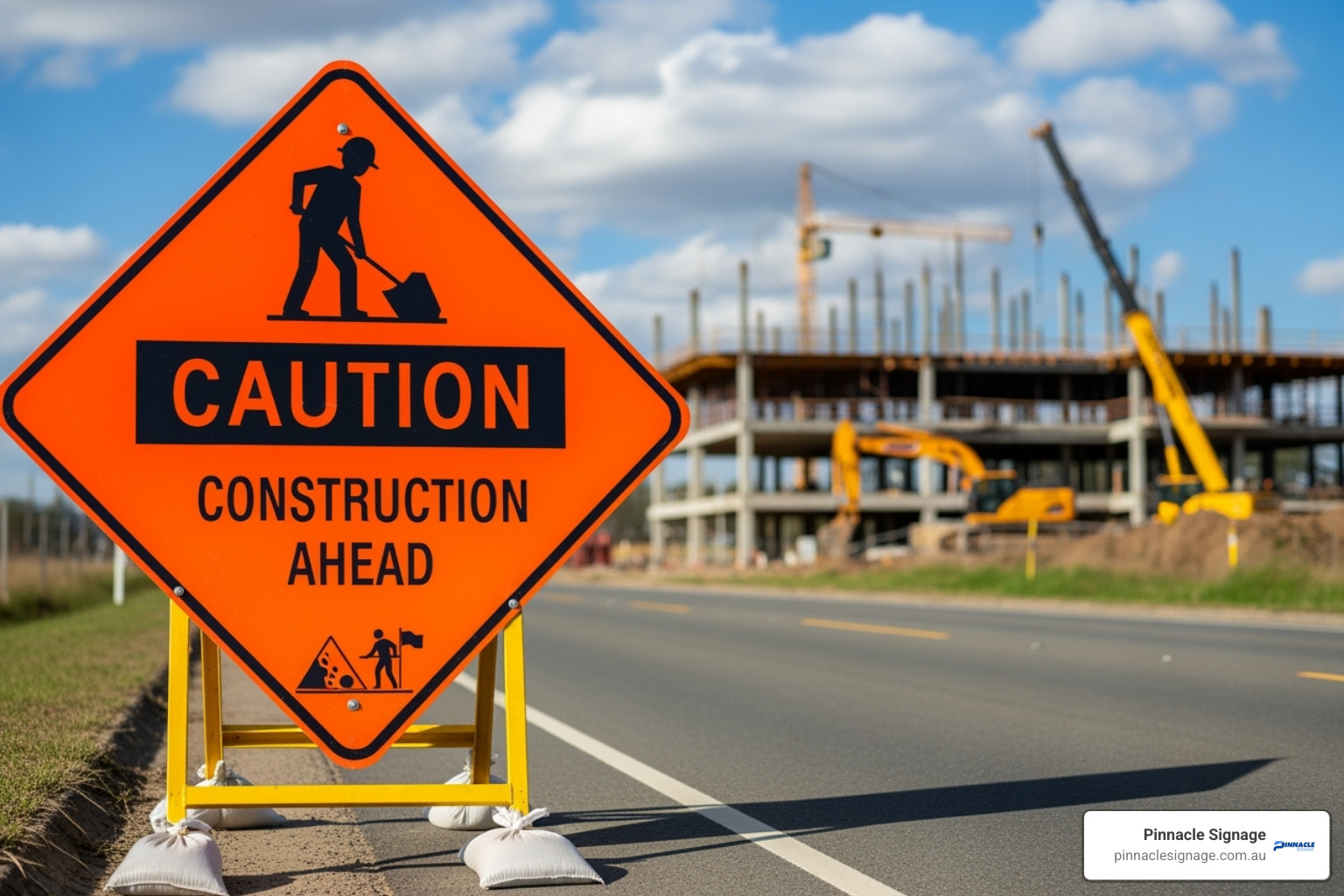
Beyond these, sites use other signs for traffic and site management, including regulatory signs (e.g., "Stop"), informational signs (e.g., "Construction Zone Ahead"), and temporary traffic control signs to manage flow through detours and lane shifts.
Common Warning Signs for Construction and Their Meanings
Every warning sign for construction sites is designed for instant understanding, combining symbols, colours, and text.
- Road Work Ahead: Gives drivers advance warning to reduce speed and prepare for changing conditions.
- Detour: Guides drivers along a safe alternative route when a road is closed.
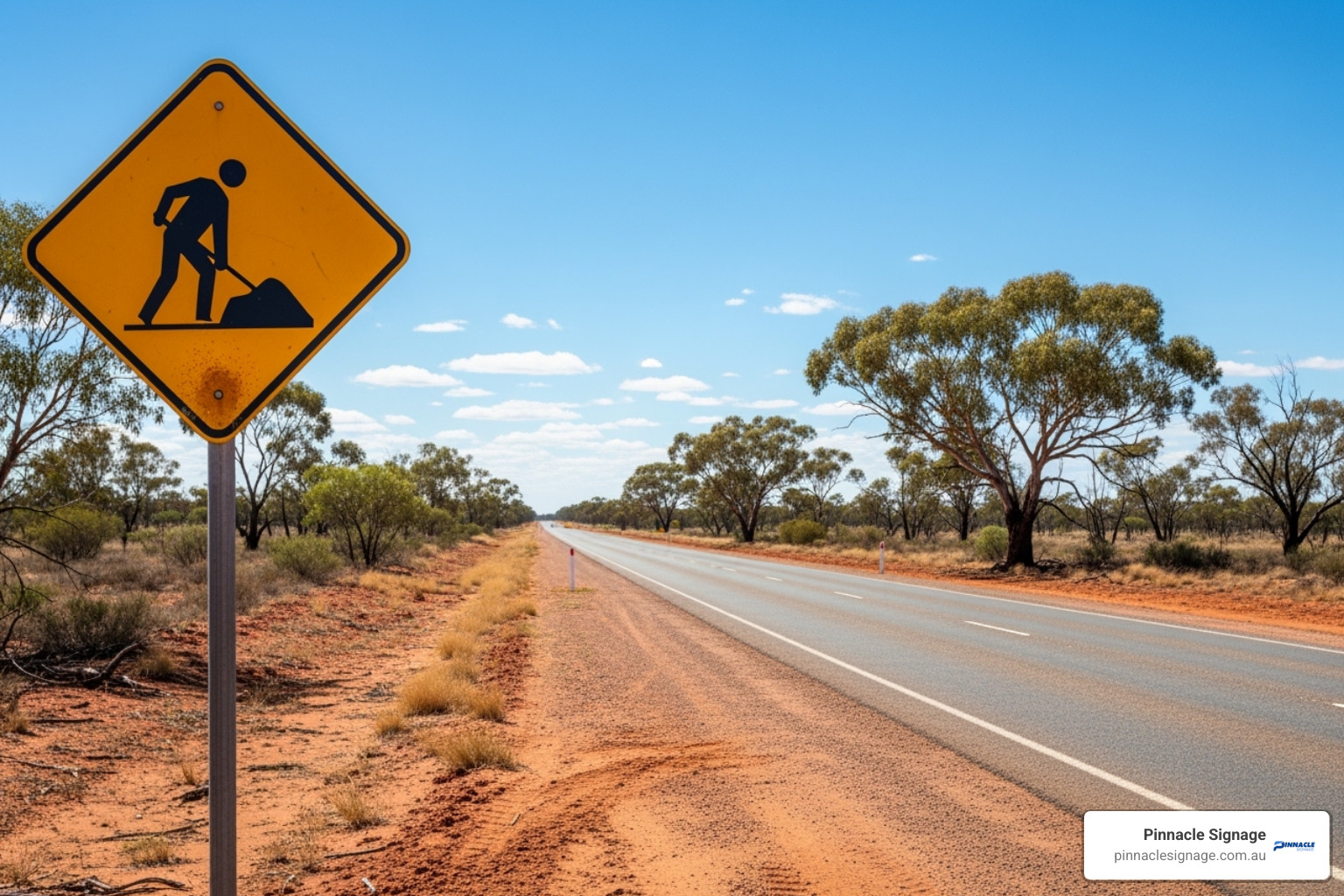
- Workers Ahead: Alerts drivers to the presence of personnel on or near the road, requiring extreme caution.
- Reduce Speed Limit: Mandates a lower speed within the construction zone for the safety of workers and drivers.
- Prepare to Stop: Warns drivers of potential sudden stops due to flaggers or equipment.
- Lane Closed/Ends: Indicates upcoming lane restrictions, requiring drivers to merge safely.
- No Entry: Strictly forbids access to dangerous areas, limiting entry to authorised personnel.
- Caution - Heavy Vehicles Turning: Alerts road users to wide-turning construction vehicles.
- Pedestrian Detour: Directs foot traffic along a safe path away from work areas.
- Safety Gear Required: Specifies the personal protective equipment (PPE) that must be worn in an area.
- Danger - Construction Area: Marks high-risk environments where access is strictly limited.
For more on how these signs impact road safety, explore our guide: Road Construction Traffic Signs Explained Without Driving You Crazy.
Ensuring Compliance and Effectiveness on Your Site
Having the right warning signs for construction areas is only the first step. To be effective, they must be correctly placed, maintained, and respected.
Best Practices for Sign Placement and Maintenance
Effective signage comes down to visibility, placement, and upkeep.
- High visibility is non-negotiable. Signs must stand out with bright colours like fluorescent orange, bold lettering, and reflective materials for roadside use in all conditions.
- Strategic placement means positioning signs well ahead of hazards and at key decision points to give people enough time to react.
- Correct height and angle are crucial. Mount signs where they won't be blocked by vehicles or equipment, angled slightly towards oncoming traffic for better readability.
- Regular inspection should be part of your daily site routine. Check for damage, fading, or dirt that could obscure the message.
- Prompt cleaning and replacement are essential. A dirty or damaged sign is ineffective and reflects poorly on your site's safety standards. Replace worn signs immediately.
- Durable materials save time and money. Quality signs are built to withstand Australia's harsh climate, from UV radiation to heavy rain.
Common Mistakes to Avoid with Warning Signs for Construction
Avoiding common pitfalls can prevent safety incidents and compliance issues.
- Using the incorrect sign type: A "Caution" sign for a life-threatening hazard understates the risk. Always match the sign to the hazard's severity.
- Poor placement or obstructed signs: If a sign is hidden behind equipment or vegetation, it serves no purpose. Ensure a clear line of sight.
- Leaving up irrelevant signs: Outdated signs lead to "sign fatigue," causing people to ignore all signage. Remove them as soon as a hazard is gone.
- Using worn-out or faded signs: A sign that is difficult to read is a liability. Inspect and replace damaged signs promptly.
- Not updating signage for site changes: Construction sites are dynamic. Your signage plan must evolve as new hazards emerge and old ones disappear.
- Overlooking bilingual needs: On a multicultural worksite, bilingual signs ensure every worker understands critical safety messages.
Understanding why standards exist is key to compliance. Learn more about Understanding Australian Standards for Safety Signs.
How to Choose and Order the Right Construction Signs
Selecting the right warning signs for construction zones should be straightforward. At Pinnacle Signage, we've streamlined the process to help you get what you need for any project size.
First, assess your site hazards to determine which signs you need. This includes specific requirements like hazchem signage for dangerous goods, which we design in accordance with the Australian Dangerous Goods (ADG) Code, or signage for chemical hazards that complies with Australian workplace safety laws.
We offer customisable options for site-specific needs, allowing you to add custom text, logos, and colours to match your requirements.
Our signs are made from durable materials for Australian conditions, ensuring they withstand harsh weather and busy worksites, saving you on replacement costs.
For bulk orders, we offer competitive pricing and special distributor rates for resellers. We are set up to be your primary supplier for large-scale projects.
We provide fast Australia-wide shipping, with most items dispatched within 48 hours. Delivery times are reliable, typically 1-2 days to major cities and 3-9 days to regional and remote areas. We use reputable couriers, and a signature is required on delivery. For items over 50kg, tailgate delivery is included for residential addresses.
Free shipping is available on orders over $100 Australia-wide for most items, though some bulky items may incur extra charges for remote areas.
If you're local, warehouse pickup is available at Unit 4/28 Nagle Street, East Wagga Wagga NSW, from 8am to 5pm on weekdays.
Ready to get started? Explore our full range of construction signs or contact our team for a custom quote.
Ready to Improve Your Site Safety?
Your workers and the public deserve to be safe. Investing in high-quality, compliant warning signs for construction isn't just a regulatory task, it's a commitment to protecting people.
Clear, professional signage tells a story of care and commitment to safety standards. Faded or missing signs suggest otherwise. The right sign, in the right place, works 24/7 to prevent accidents by alerting drivers, reminding workers about PPE, and keeping unauthorised people out of dangerous areas.
At Pinnacle Signage, we understand that every project has unique challenges. We provide warning signs for construction that are not only compliant with Australian standards but also durable enough for our harsh climate and busy worksites.
Explore our full range of construction signs today to find exactly what your site needs. From standard signs to custom solutions, we have you covered with fast, Australia-wide delivery.
Our experienced team is here to help you create a comprehensive safety communication system for your site. Whether you need a few signs or a complete package for a major project, we will work with you to find the right solution.
Contact our team for a custom quote. We look forward to helping you make your construction site safer and more professional.