

Oversize Load Signs 101: Don't Get Left in the Dust
What Are Oversize Load Signs and When Are They Required in Australia?

Oversize load signs are legally required warning signs displayed on the front and rear of any vehicle transporting a load that exceeds standard road dimension limits in Australia. Here is a quick summary of when they apply:
- Width over 2.5 metres - oversize signage is required
- Height over 4.3 metres - oversize signage is required
- Length exceeding prescribed limits - varies by state and load type
- Signs must be retro-reflective, typically Class 2, with a yellow background and black lettering
- Signs must be displayed on both the front and rear of the transporting vehicle
- Escort or pilot vehicles may also be required to carry signage, depending on load dimensions
These requirements exist to protect other road users, particularly on regional and rural highways where heavy haulage is common.
Oversized transport is a high-stakes operation. A load that is not clearly marked puts other drivers, cyclists, and pedestrians at serious risk - especially on narrow country roads where reaction times are short and overtaking distances are tight. Getting the signage wrong does not just create a safety hazard. It can void your transport permit, attract fines, and put your operation on the wrong side of your state's heavy vehicle regulator.
This article details the technical requirements for oversize load signs in the Australian context - covering legal requirements, standard specifications, mounting, materials, and maintenance.
I am Doug Lindqvist, General Manager of Pinnacle Signage, an Australian-owned manufacturer based in Wagga Wagga, NSW, and my background in the safety and industrial supply space has given me insight into the compliance gaps businesses face when it comes to oversize load signs. In the sections below, I will share practical, no-nonsense information to help ensure compliance.
Oversize load signs terms explained:
The Legal Role of Warning Signage in Australian Transport
In Australia, the National Heavy Vehicle Regulator (NHVR) sets the pace for how we move big gear across state lines. The primary purpose of oversize load signs is communication. When you are hauling a massive harvester or a pre-fab building through the Riverina, you are essentially asking other drivers to change their behaviour. You want them to slow down, move over, and pay attention.
Legally, these signs are a condition of your access permit. If you are operating under a Class 1 permit, having the correct signage is just as important as having the right bridge clearances. Without them, you are technically operating an unpermitted vehicle, which opens a massive can of worms regarding liability and insurance.
Beyond just "having a sign," the law specifies that the signage must be effective. This is where the concept of "Stay Safe Stay Compliant" comes in. You can find more about the importance of these standards in our guide on how to Stay Safe, Stay Compliant, Get Information About Oversized Vehicle Signs.
In simple terms, if a driver cannot see your sign from a safe distance because it is faded, dirty, or the wrong size, you are not compliant. The regulations aren't there to be a nuisance; they are based on human reaction times. A driver travelling at 100km/h needs a certain amount of warning before they realise they are approaching a load that might be taking up half their lane.
Standard Specifications and Materials for Oversize Load Signs
Oversize load signs are manufactured to specific standards and are not merely yellow plates. There are very specific Australian Standards that dictate how these signs are made.
Dimensions and Reflectivity
The most common sizes you will encounter are:
- 1200mm x 600mm: This is the heavy-duty standard for the rear of trailers and the front of prime movers.
- 1200mm x 450mm: Often used where space is a bit tighter, but still meets the visibility requirements for many applications.
- 600mm x 600mm: Usually used in pairs (one on each side) when a single large sign cannot be mounted.
Reflectivity is the big one. In Australia, we use Class 2 (also known as Engineer Grade) reflective material as the baseline. This ensures that even at dusk or in heavy rain, the sign "pops" when hit by headlights. We manufacture our signs to meet these rigorous standards because we know that a sign that fails at 2:00 AM on the Sturt Highway is worse than no sign at all.
For more details on specific sign types, you can check our post on the Wide Load Sign.
Material Options
At Pinnacle Signage, we focus on durability. Here are the materials we typically work with:
- Aluminium: The gold standard. It doesn't rust, it's rigid, and it handles the vibration of a diesel engine for years. We often use 1.6mm or 2mm thick aluminium to ensure the sign doesn't "oil-can" or flap in the wind.
- Vinyl and Retro-Reflective Fabric: These are great for temporary loads or when you need to roll the sign up and stick it behind the seat. They often come with eyelets for easy bungeeing.
- Hinged Steel or Aluminium: Perfect for trucks that switch between oversized and standard loads. You just flip the sign down when you don't need it.
Choosing Between Aluminum and Mesh Oversize Load Signs
This is a common question we get from our agricultural customers in the Wagga Wagga area. Do you go for the solid plate or the mesh?
- Aluminium Signs: These are best for permanent or semi-permanent mounting on trailers and prime movers. They offer the best reflectivity and the longest life. If you are a professional heavy haulier, this is your bread and butter.
- Mesh Signs: These are fantastic for high-wind environments or when the sign is mounted in a spot that may experience significant drag. Because they are porous, the wind goes through them rather than trying to rip them off the mount. However, they can be harder to keep clean, and the reflectivity can degrade faster if they are constantly flapping.
For machinery transport, where you might be tying the sign directly to a piece of equipment rather than a flatbed, a heavy-duty vinyl or mesh banner is often the most practical choice.
Proper Mounting and Display for Maximum Road Safety
You could have the most expensive sign in the world, but if it's tucked behind a spare tyre or covered in grease, it's useless.
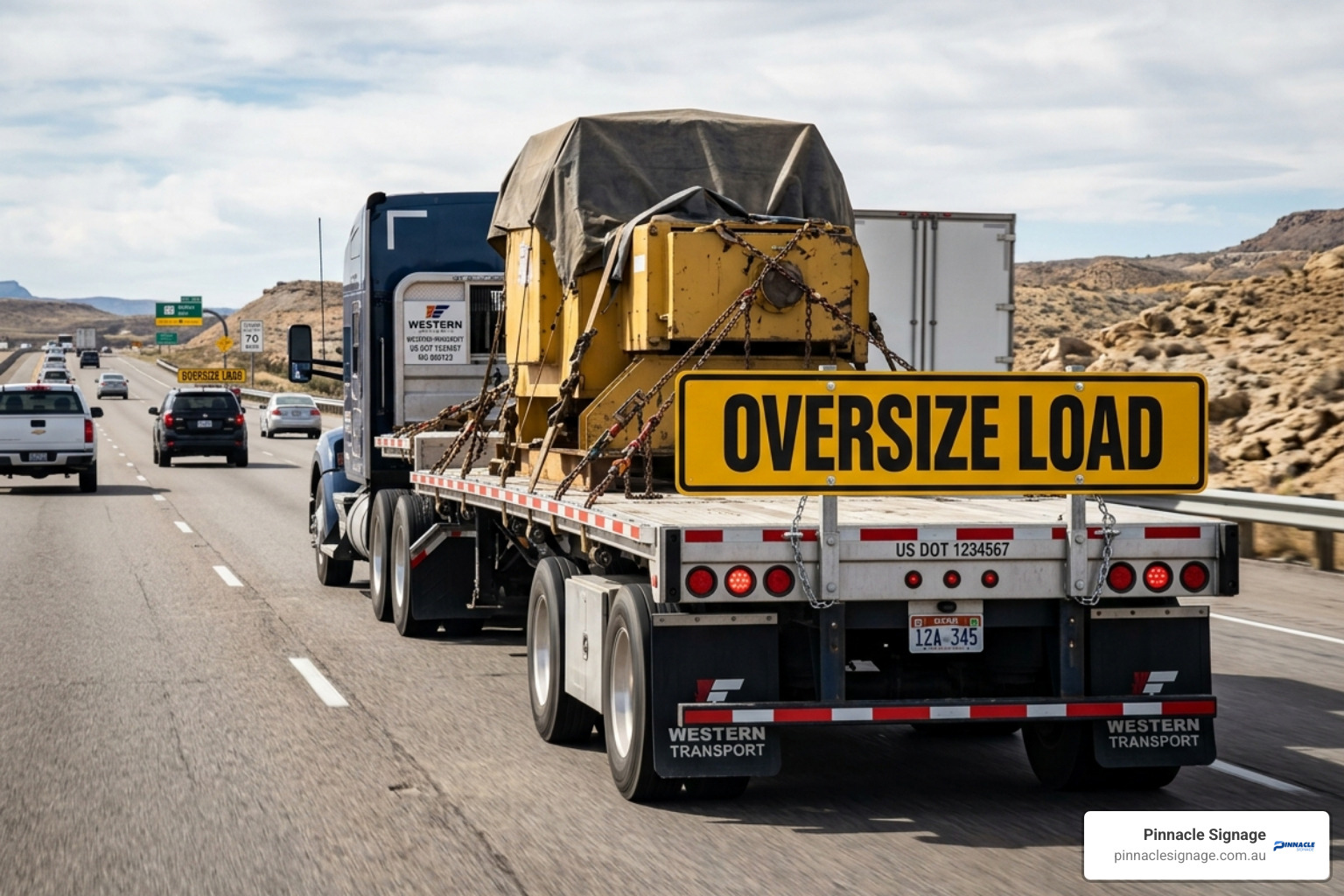
Front and Rear Placement
The law is clear: you need a sign at the front and a sign at the rear.
- Front Sign: Usually mounted on the bull bar or the front of the cab. It needs to be as low as possible without being obscured, but high enough to be seen over the crest of a hill.
- Rear Sign: Mounted on the rear of the load or the trailer. If the load overhangs the trailer significantly, the sign must be on the load itself.
Visibility Distances
A standard oversize load sign must be legible from at least 30 metres away in normal daylight. However, the reflective properties should make the presence of the vehicle obvious from much further away at night.
Secure Attachment
Don't rely on a bit of old baling twine. Use:
- Stainless steel bolts with nylon nuts (to prevent vibration loosening).
- Heavy-duty magnets (only for stationary or low-speed escort use).
- Rated bungee cords for vinyl banners.
If a sign falls off mid-transit, you are no longer compliant. It's that simple.
Positioning Oversize Load Signs on Escort Vehicles
Escort vehicles (or pilot cars) play a different role. They are the "scouts" that warn oncoming traffic of the danger ahead. Their signage requirements are slightly different.
Signs on escort vehicles are usually roof-mounted and must be visible from both the front and the rear. These are often smaller than the truck signs but are accompanied by high-intensity amber beacons. Communication between the pilot and the truck driver is vital to ensure the signs are doing their job. We offer specialised kits for this, which you can read about here: Escort Vehicle Pilot Sign Kits Essential For Managing Oversize Loads In Australia.
Essential Safety Equipment Beyond the Sign
Signs are the foundation, but they aren't the whole house. To be truly safe and compliant, you need a full safety suite.
Warning Flags
Flags are required for any load that is overwidth.
- Size: Typically 450mm x 450mm.
- Colour: Fluorescent orange or red.
- Placement: At the widest points of the load. If your load is 3.5 metres wide, those flags need to be right on the edge so a driver knows exactly how much room they have to give you.
Amber Beacons
Rotating or flashing amber lights are mandatory for almost all oversized movements. They must be visible for 500 metres in all directions. If your load is tall and blocks your roof lights, you need additional lights at the rear.
For those working in the road sector, integrating these with Road Construction Signage ensures a cohesive safety plan for the entire site.
Maintenance and Compliance for Long-Term Use
Living in a regional hub like East Wagga Wagga, we know how tough the conditions are. Dust, mud, and UV rays are the enemies of signage.
- Keep it Clean: A layer of red dust from the paddock can reduce a sign's reflectivity by 80%. Use warm, soapy water, and a soft cloth. Avoid harsh chemicals or high-pressure washers, as these can delaminate the reflective coating.
- Check for Damage: Vibrations can cause metal fatigue around bolt holes. If a sign is cracking, replace it. A flying sign is a lethal projectile.
- Reflectivity Test: Every few months, do a "torch test." Shine a light on the sign from 20 metres away at night. If it doesn't "glow" back at you, the glass beads in the reflective material have worn out.
- Storage: If you use removable signs, don't just throw them in the back of the ute where they can get scratched. Store them flat or rolled loosely (for vinyl) in a dry place.
For more maintenance tips, refer back to our Stay Safe Stay Compliant article.
Frequently Asked Questions about Oversized Transport
What is the difference between Oversize and Wide Load signs?
In the past, "Wide Load" was the common term. However, under the current Australian National Heavy Vehicle Law, Oversize Load signs (or simply "OVERSIZE") are the standardised wording. "Oversize" covers width, height, and length, making it a more universal warning. While you might still see "Wide Load" signs on older trailers, "OVERSIZE" is the preferred and most compliant option for new gear.
When are escort vehicles required for oversized loads in Australia?
This depends on the "Envelope" (the total dimensions) and the route. Generally, in NSW, once you exceed 3.5 metres in width or 25 metres in length, you need to start looking at pilot requirements. If you are over 4.5 metres wide, you will almost certainly need at least one escort vehicle. Always check your specific NHVR permit for the "Conditions of Operation."
How do I clean reflective signage without damaging the surface?
Use a mild detergent and plenty of water. The reflective surface is made of tiny prisms or glass beads. If you use an abrasive cleaner or a stiff brush, you will scratch these prisms, and the sign will lose its ability to reflect light. Think of it like cleaning the paint on a new car—be gentle!
Signs of the Times: Your Oversize Load Wrap-Up
Hauling oversized loads across the vast distances of Australia is a massive responsibility. At Pinnacle Signage, we take pride in knowing that our products help keep our local drivers and transport operators safe. Based in East Wagga Wagga, NSW, we understand the unique challenges of regional logistics and agricultural transport.
Whether you need a single aluminium plate or a full fleet of escort vehicle kits, we offer high-quality, durable products with a fast turnaround. We dispatch most orders within 48 hours and offer free shipping on orders over $100 (exceptions apply).
For custom orders or expert advice on your transport signage needs, call our team on 1300 40 45 50 or contact us. You can also visit our warehouse in East Wagga Wagga, NSW, from 8 am to 5 pm, Monday to Friday. We are here to help you stay safe, compliant, and ready for the road.