
Why You Need a Chemical Compatibility Chart for Safe Chemical Storage
Understanding Chemical Hazard Signage: A Safety Essential
A dangerous chemicals sign is a standardized visual warning that communicates chemical hazards to workers, visitors, and emergency responders. These signs are critical safety tools in workplaces where hazardous chemicals are stored, used, or transported.
What is a dangerous chemicals sign?
- Purpose: Alerts people to chemical hazards and provides crucial safety information
- Types: GHS pictograms, NFPA 704 diamonds, HAZCHEM signs, and chemical compatibility charts
- Elements: Includes hazard symbols, signal words (Danger, Warning, Caution), and safety instructions
- Legal requirement: Mandated by WHS Regulations and Australian Standards for workplaces with hazardous chemicals
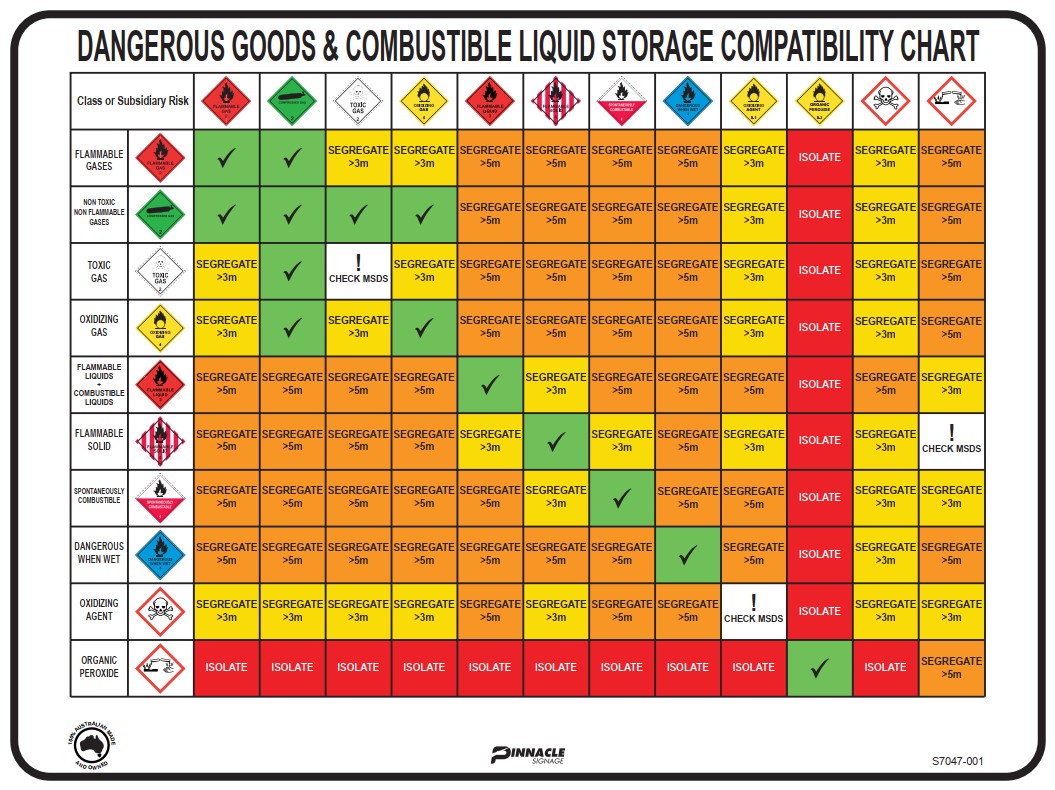
The Chemical Compatibility Chart from Pinnacle Signage (priced from $69.95) is particularly important as it shows which chemicals can and cannot be stored together, helping prevent dangerous reactions that could lead to fires, explosions, or toxic releases.
According to SafeWork Australia, proper chemical signage is not just a legal requirement—it's a critical safety measure. The worst chemical accidents often occur when incompatible substances come into contact, creating reactions that can be unpredictable and dangerous.
Why are these signs essential?
- Prevent accidental mixing of incompatible chemicals
- Guide emergency responders during incidents
- Reduce the risk of chemical exposure to workers
- Ensure compliance with Australian WHS regulations
- Support proper chemical management practices
I'm Doug Lindqvist, General Manager of Pinnacle Signage, with extensive experience implementing dangerous chemicals sign solutions across industrial sites, laboratories and warehouses throughout Australia. Our Chemical Compatibility Chart has become an essential tool for businesses seeking to maintain safe chemical storage practices while meeting their compliance obligations.
Why Storage Compatibility Matters
Have you ever had neighbours who just couldn't get along? Chemical storage works much the same way—except the consequences are far more serious than a fence dispute.
Some chemicals simply don't play well together, and when incompatible substances meet, the results can be truly catastrophic. Each year, according to SafeWork Australia, more than 32 million workers globally face potential exposure to chemical hazards in their workplace. What's particularly concerning is that many serious incidents occur not from a single dangerous chemical, but from incompatible substances accidentally coming into contact.
The Science Behind Chemical Incompatibility
When incompatible chemicals meet, they can trigger dangerous reactions that put lives at risk. These reactions might generate excessive heat, release toxic or flammable gases, form unstable compounds, build pressure inside containers, or even corrode through storage vessels.
Consider what happens when oxidisers like hydrogen peroxide meet flammable substances—you're looking at potential rapid combustion or even explosions. Similarly, when acids and bases come together, they can react violently, generating significant heat and dangerous splashing that puts everyone nearby at risk.
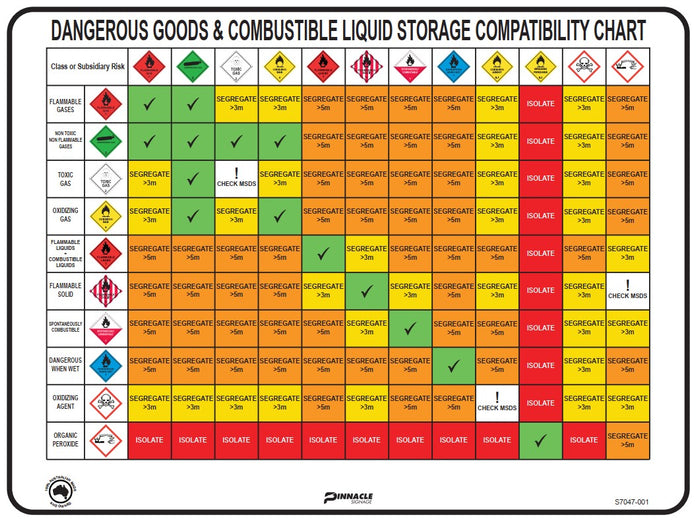
This is precisely why our Chemical Compatibility Chart is such an essential workplace tool. It provides clear, visual guidance on which chemicals must be kept apart and the safe distances required between incompatible substances.
During emergencies, first responders rely heavily on proper signage to quickly assess risks. The National Fire Protection Association (NFPA) 704 system appears on millions of chemical containers and storage areas worldwide, providing critical hazard information at a glance.
Hidden Costs of Getting It Wrong
The consequences of improper chemical storage extend far beyond immediate safety concerns. The true costs can be devastating for businesses:
Financial Costs can quickly spiral out of control through workplace injury claims, property damage from fires or chemical releases, environmental clean-up expenses, regulatory fines, increased insurance premiums, and lost production time.
Regulatory Consequences might include substantial non-compliance penalties under WHS Regulations, potential criminal charges for negligence, mandatory workplace improvements, and increased scrutiny from regulatory bodies.
Perhaps most damaging is the Reputational Damage that follows a chemical incident. Your business might face a significant loss of customer and supplier confidence, negative media coverage, difficulty attracting quality staff, and community concerns about your environmental and safety practices.
At Pinnacle Signage, we've seen how proper chemical storage signage helps businesses avoid these costly mistakes. Our Chemical Compatibility Chart is specifically designed to provide clear, at-a-glance guidance that helps keep your workplace safe and compliant.
With prices starting from $69.95, this dangerous chemicals sign is one of the most cost-effective safety investments you'll make—especially when you consider what's at stake.
Anatomy of a Dangerous Chemicals Sign
A dangerous chemicals sign is more than just a warning—it's a sophisticated communication tool designed to convey critical safety information quickly and universally. Understanding the components of these signs is essential for anyone working with or around hazardous chemicals.
Key Components of Chemical Hazard Signs
1. Signal Words Signal words indicate the relative level of severity of the hazard:
- DANGER: Indicates a hazardous situation that, if not avoided, will result in death or serious injury
- WARNING: Indicates a hazardous situation that, if not avoided, could result in death or serious injury
- CAUTION: Indicates a hazardous situation that, if not avoided, could result in minor or moderate injury
2. Hazard Statements These are standardised phrases that describe the nature and degree of the hazard, such as "Highly flammable liquid and vapour" or "Causes severe skin burns and eye damage."
3. Precautionary Statements These provide recommended measures to minimise or prevent adverse effects from exposure, such as "Keep away from heat/sparks/open flames" or "Wear protective gloves/eye protection."
4. Pictograms and Symbols Visual elements that quickly communicate the type of hazard present.
Symbols and Colours on a Dangerous Chemicals Sign
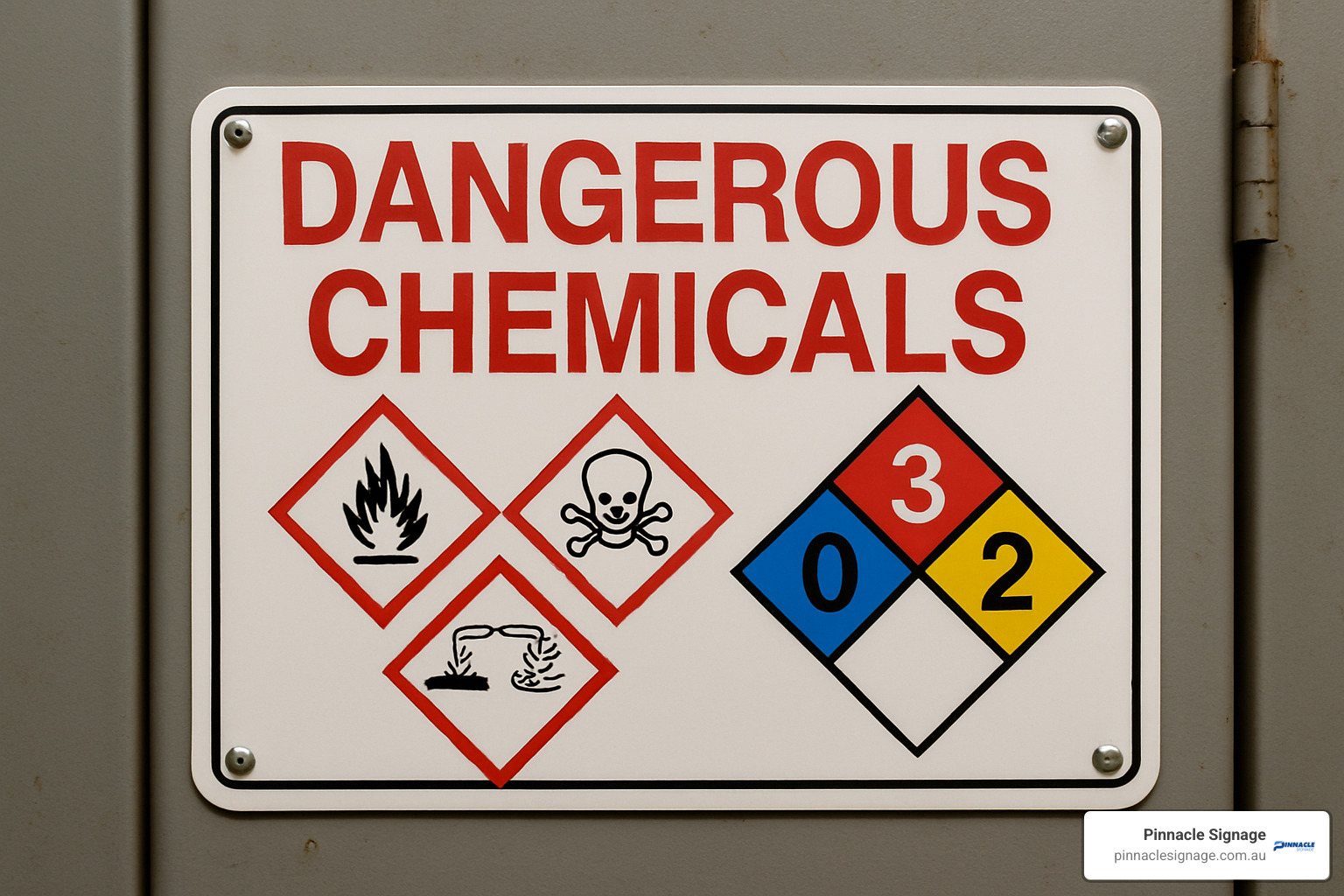
The Globally Harmonized System (GHS) of Classification and Labelling of Chemicals has standardised chemical hazard communication worldwide with nine distinct pictograms:
GHS Pictograms and Their Meanings:
-
Skull and Crossbones (Black symbol on white background with red border)
- Indicates acute toxicity that may be fatal or toxic if swallowed, inhaled, or in contact with skin
-
Flame (Black symbol on white background with red border)
- Indicates flammable gases, aerosols, liquids, or solids
- Self-reactive substances and mixtures
- Pyrophoric liquids or solids
- Self-heating substances and mixtures
-
Exploding Bomb (Black symbol on white background with red border)
- Indicates explosives
- Self-reactive substances and mixtures
- Organic peroxides
-
Corrosion (Black symbol on white background with red border)
- Indicates corrosive to metals
- Causes severe skin burns and eye damage
-
Gas Cylinder (Black symbol on white background with red border)
- Indicates gases under pressure
-
Health Hazard (Black symbol on white background with red border)
- Indicates carcinogenicity
- Respiratory sensitisation
- Reproductive toxicity
- Target organ toxicity
-
Exclamation Mark (Black symbol on white background with red border)
- Indicates skin/eye irritation
- Skin sensitisation
- Acute toxicity (harmful)
- Specific target organ toxicity (single exposure)
-
Environment (Black symbol on white background with red border)
- Indicates aquatic toxicity
-
Oxidiser (Black symbol on white background with red border)
- Indicates oxidising gases, liquids, or solids
NFPA 704 Diamond: The National Fire Protection Association's hazard identification system uses a diamond-shaped diagram divided into four coloured sections:
- Red (top): Flammability hazard (0-4)
- Blue (left): Health hazard (0-4)
- Yellow (right): Reactivity/instability hazard (0-4)
- White (bottom): Special hazards (OX for oxidisers, W for water reactives, etc.)
Each section contains a number from 0 (minimal hazard) to 4 (severe hazard) to indicate the degree of risk.
Decoding the Chemical Compatibility Chart
The Chemical Compatibility Chart from Pinnacle Signage is a powerful tool that simplifies the complex world of chemical storage compatibility. This chart is essential for facilities that store multiple classes of dangerous goods.
Key Features of Our Chemical Compatibility Chart:
-
Class Diamonds: The chart displays the nine classes of dangerous goods with their distinctive hazard diamonds:
- Class 1: Explosives (orange)
- Class 2: Gases (red, green, or white)
- Class 3: Flammable Liquids (red)
- Class 4: Flammable Solids (red/white striped, blue, or blue/white striped)
- Class 5: Oxidising Substances (yellow)
- Class 6: Toxic Substances (white with skull and crossbones)
- Class 7: Radioactive Materials (yellow/white)
- Class 8: Corrosives (black and white)
- Class 9: Miscellaneous Dangerous Goods (black and white striped)
-
Compatibility Matrix: The heart of the chart is a colour-coded grid showing which classes can be stored together and which must be separated:
- Green: Compatible - can be stored together
- Yellow: Segregate - store in separate areas within the same room
- Red: Separate - require dedicated storage areas or rooms
- Blue: Isolate - require significant separation distances
Segregation Distances: Where applicable, the chart provides recommended minimum separation distances for incompatible substances.
Subclass Information: For certain classes (like gases), the chart differentiates between subclasses that have different compatibility requirements.
This chart is an indispensable reference that helps facility managers, safety officers, and workers make quick, informed decisions about chemical storage, reducing the risk of dangerous interactions while ensuring compliance with Australian regulations.
Our Chemical Compatibility Chart is available at https://pinnaclesignage.com.au/products/chemical-compatibility-chart-dangerous-goods-separation and is an essential guide for any facility handling multiple chemical classes.
Compliance & Placement Guidelines
Let's face it – nobody gets excited about regulations, but when it comes to dangerous chemicals sign requirements, they're literally lifesavers. In Australia, displaying proper chemical hazard signage isn't just good practice – it's the law.
I've seen how proper signage can make all the difference during emergencies. The right sign, in the right place, can prevent accidents and save lives.
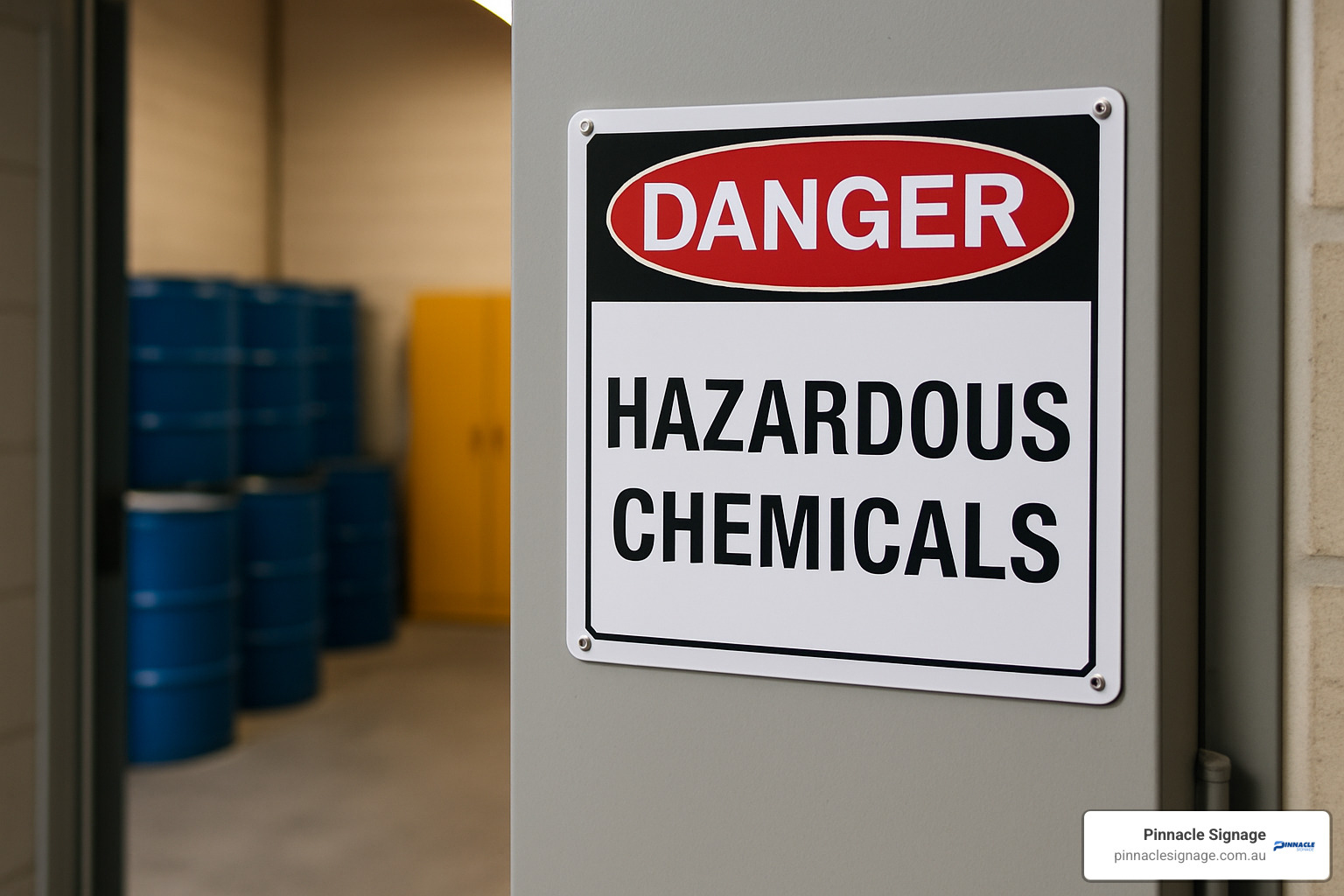
Australian WHS Regulations are crystal clear about your obligations. Your business must identify hazardous chemicals, ensure proper labelling, display appropriate safety signs, make Safety Data Sheets readily available, and maintain a chemical register. Australian Standard AS 1319 takes this further by specifying exactly how these signs should look – their design, colours, symbols, and text requirements.
When it comes to placarding (those larger signs for significant chemical quantities), the requirements kick in once you exceed specific thresholds. These thresholds vary by chemical class, with higher quantities triggering additional documentation requirements. The key is ensuring these placarded areas are unmistakably identified.
Where to Position a Dangerous Chemicals Sign
The effectiveness of a dangerous chemicals sign depends heavily on its placement. According to SafeWork Australia guidelines, strategic positioning is essential:
Entry points are your first line of defence. Signs should be clearly visible before anyone enters a hazardous area, typically mounted at eye level (about 1.5 metres from the floor). This gives people crucial information before they potentially expose themselves to danger.
Storage areas need direct signage too. Whether it's on or above chemical cabinets, each storage area should have appropriate warnings. For dedicated storage areas, use class-specific signs that clearly communicate the exact hazards present.
Transport containers carrying hazardous materials must display appropriate placards visible from multiple angles. This is particularly important for emergency responders who might approach from any direction.
PPE stations need clear signage indicating what protective equipment is required. These signs should be positioned at entry points to hazardous areas, giving workers a visual reminder to gear up before proceeding.
Emergency equipment locations should be clearly marked. Signs pointing to eyewash stations, safety showers, and spill kits must be visible from work areas so people can quickly find them when seconds count.
When mounting your signs, consider these practical factors: ensure good illumination (signs are useless if they can't be seen), position them where they won't be obscured by equipment or doors, maintain consistent placement throughout your facility, mount at appropriate heights (typically 1.5-2 metres from the floor), and ensure outdoor signs can withstand weather exposure.
Our Chemical Compatibility Chart deserves special attention in your placement strategy. This essential guide should be prominently displayed wherever chemical storage decisions are made – storage areas, loading docks, and chemical handling zones. Its clear, colour-coded format makes it easy to reference quickly, helping your team make safer storage decisions on the fly.
The chart is available in various materials to suit different environments, ensuring it remains visible and legible whether it's installed indoors or exposed to the elements. You can find our durable Chemical Compatibility Chart at Pinnacle Signage – it's an investment in safety that pays dividends every day.
Selecting, Installing & Caring for Your Chemical Compatibility Chart
Choosing the right Chemical Compatibility Chart isn't just about ticking a compliance box—it's about investing in a safety tool that will serve your workplace for years to come. At Pinnacle Signage, we've designed our charts to withstand everything from busy warehouse environments to harsh outdoor chemical storage areas.
Material Options for Chemical Charts
When selecting your Chemical Compatibility Chart, durability matters. Our chart comes in several material options to match your specific needs:
Aluminium is our premium option, offering 7-10 years of outdoor life and 10+ years indoors. It won't corrode, maintains vibrant colours, and stands up to harsh conditions—perfect for outdoor installations or areas with chemical exposure. Priced from $89.95, it's an investment in long-term safety.
For indoor environments, our Polypropylene option delivers excellent value with 3-5 years of indoor durability. It's lightweight, chemical resistant, and easily cleaned—ideal for laboratories and indoor storage areas at just $69.95.
Budget-conscious operations might prefer our Corflute option at $59.95. While more economical, it still delivers 1-2 years of indoor performance and features the same clear, high-contrast printing as our premium options.
All our Chemical Compatibility Charts include UV-resistant inks, rounded safety corners, and pre-drilled mounting holes for hassle-free installation. You can find our full range at our Chemical Compatibility Chart product page.
Choosing the Right Dangerous Chemicals Sign for Your Site
Selecting the perfect dangerous chemicals sign comes down to understanding your specific environment:
Consider environmental exposure first—will your sign face harsh sunlight, rain, or chemical vapours? For outdoor or harsh industrial settings, our aluminium option offers superior resistance to the elements.
Think about viewing distance too. Our standard 600mm × 450mm size works well for most applications, but we offer larger 900mm × 600mm charts when visibility from a distance matters. Custom sizes are also available—just ask!
Your expected lifespan requirements matter as well. If you're looking for a set-and-forget solution, aluminium delivers the longest service life. For areas that undergo frequent remodelling, a more economical option might make sense.
Finally, consider your mounting situation. All our charts come with pre-drilled holes, but think about the surface you'll be mounting to and whether the sign might need relocation in future.
Maintaining Visibility and Compliance
Even the best dangerous chemicals sign needs a bit of TLC to stay effective:
Schedule monthly visual inspections to check for fading, damage or obstruction. This simple routine keeps your safety signage in top condition and ensures compliance with regulations.
Keep your signs clean with mild soap and water—avoid harsh chemicals or abrasive cleaners that might damage the surface or printing. For aluminium signs, a soft cloth prevents scratching and maintains that professional appearance.
Know when it's time for replacement. Signs showing significant fading or damage should be replaced immediately. Even without visible damage, outdoor signs typically benefit from replacement every 5-7 years. Keep spare signs on hand for quick swaps when needed.
Document your sign maintenance as part of your safety programme. Keep records of inspections, cleaning, and replacements—this documentation proves invaluable during safety audits and helps demonstrate your commitment to workplace safety.
FAQs About Dangerous Chemicals Signs
How often should chemical hazard signs be inspected?
Monthly inspections are recommended, with more frequent checks in harsh environments. Look for fading, damage, or anything that might make the sign hard to read—safety depends on clarity.
Can signs be customised for specific chemicals?
Absolutely! At Pinnacle Signage, we regularly create custom signs for facilities with specific chemical needs. Whether you're handling uncommon substances or need additional information displayed, we can design a solution that works for your unique situation.
What are the penalties for non-compliance with chemical signage regulations?
The consequences can be severe. Under Australian WHS laws, corporations can face fines up to $3 million for serious breaches, while individuals might face imprisonment and substantial fines. Even minor non-compliance can result in penalties reaching hundreds of thousands of dollars—making proper signage a wise investment.
How do I know if my chemical storage requires a Chemical Compatibility Chart?
If you're storing multiple classes of dangerous goods, particularly in the same area, you need a Chemical Compatibility Chart. It's especially important for warehouses, manufacturing facilities, laboratories, and educational institutions—anywhere staff might need guidance on safe chemical storage without extensive chemical training.
Do digital versions of chemical hazard signs meet compliance requirements?
While digital displays can supplement your safety programme, Australian regulations typically require permanent, physical signage that remains visible during power outages or emergencies. Electronic systems are valuable additions but shouldn't replace compliant physical signs.
How do chemical hazard signs relate to Safety Data Sheets (SDS)?
Think of signs as your first line of defence, providing immediate visual warnings, while SDS documents offer detailed handling and emergency information. Both are essential components of a compliant hazard communication system, and the information should be consistent between them.
What's the difference between GHS and NFPA labelling systems?
The GHS system focuses on everyday handling and use, while the NFPA 704 diamond system is designed primarily for emergency responders during incidents. Many Australian facilities use both systems to provide comprehensive hazard communication for all situations.
Conclusion
When it comes to handling chemicals, there's simply no room for guesswork. A Chemical Compatibility Chart from Pinnacle Signage isn't just another piece of paper on your wall—it's a vital safety tool that could prevent a workplace disaster while keeping you on the right side of compliance.
Key Takeaways
Throughout this guide, we've seen why proper chemical storage matters so much. Those colourful squares on our Chemical Compatibility Chart represent real safety boundaries that protect your team, your facility, and ultimately your business.
Safety is non-negotiable when it comes to chemical storage. The potential for fires, explosions, and toxic releases isn't theoretical—these incidents happen regularly in workplaces where incompatible chemicals are improperly stored together. Our chart gives you clear, visual guidance to prevent these dangerous scenarios before they develop.
Compliance isn't optional, either. Australian WHS Regulations require proper signage and separation of incompatible chemicals, with significant penalties for businesses that don't meet these obligations. Our chart helps you steer these requirements with confidence.
Material quality matters tremendously in signage that needs to perform in challenging environments. Whether you choose our premium aluminium option for maximum durability or our more budget-friendly alternatives, you're getting signage designed to remain visible and effective throughout its intended lifespan.
Regular maintenance of your chemical hazard signs isn't just good practice—it's essential for ongoing safety. Even the most durable signs need periodic inspection to ensure they're still doing their job effectively.
At Pinnacle Signage, we're not just selling signs—we're providing peace of mind. Our Chemical Compatibility Chart (https://pinnaclesignage.com.au/products/chemical-compatibility-chart-dangerous-goods-separation) is crafted to withstand the demanding environments where chemicals are stored, offering years of reliable guidance when you need it most.
With locations across New South Wales including our Wagga Wagga headquarters, we're positioned to deliver your chemical hazard signage quickly, helping you maintain compliance without the wait. We understand that when safety is concerned, tomorrow might be too late.
The right dangerous chemicals sign does more than tick a compliance box—it creates a safer workplace where everyone can focus on their job without worrying about preventable chemical incidents. It's an investment in protection that pays dividends every day nothing goes wrong.
For more information about our complete range of chemical signage solutions or to discuss your specific requirements, visit our website at https://pinnaclesignage.com.au/search?q=chemical or reach out to our team directly. We're here to help you steer the complex world of chemical hazard communication with practical, compliant solutions custom to your needs.