

No Entry Signs Demystified
The Unmistakable Command: An Introduction to No Entry Signs
No Entry signs are prohibitory traffic and safety signs used to restrict or prevent access to specific areas, roads, or zones. They serve a critical role in traffic management, workplace safety, and property security across Australia.
Quick Reference: Types of No Entry Signs
- Vehicular Traffic Signs - Red circle with white bar, used on one-way streets and road exits
- General "Do Not Enter" Signs - Text or symbol-based warnings for restricted areas like construction sites or private property
- Authorised Personnel Only - Restricts access to staff-only zones in workplaces
- Conditional Entry Signs - Specifies requirements like permits or PPE before entry
As a leading Australian supplier of compliant signage solutions, Pinnacle Signage has extensive experience working with businesses to ensure their sites are safe and well-managed. Clear No Entry signs are fundamental to preventing accidents, protecting property, and ensuring smooth operations across construction sites, commercial facilities, and rural properties.
Understanding Prohibitory Signs: The Rules of Restriction
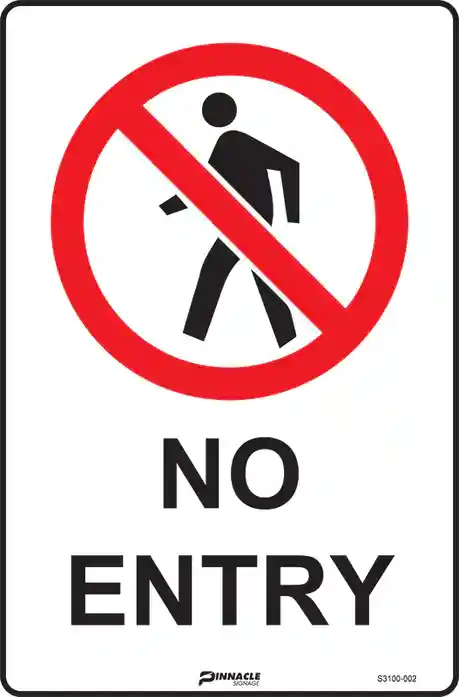
When you see that bold red circle with a slash cutting through it, your brain instantly knows: don't do that. That's the power of prohibitory signage, and No Entry signs are among the most critical examples of this category.
Prohibitory signs exist to regulate behaviour, prevent hazards, and maintain order across every environment imaginable. Whether you're navigating busy city streets, managing a construction site, or overseeing an industrial facility, these signs deliver clear, unambiguous commands that everyone can understand at a glance.
The design elements are deliberately simple and universal. A white background provides a clean canvas. The red annulus (that circular band) with its diagonal slash creates the unmistakable symbol of prohibition. And beneath it, a black pictogram shows exactly what's forbidden, whether that's smoking, pedestrian access, or vehicle entry. This visual language transcends literacy levels and language barriers, making it incredibly effective for protecting people and property.
In Australia, these signs are designed to align with national standards, which ensures consistency across workplaces and public spaces. This standardisation means that whether you're in Sydney, Perth, or a remote mining site in the Northern Territory, the message is immediately recognisable. That instant recognition can be the difference between a safe workday and a serious incident.
Think about how quickly you process a "No Smoking" sign, a cigarette crossed out in red. Or a "No Pedestrians" sign near a loading dock. These aren't suggestions or polite requests. They're essential safety controls that keep operations running smoothly and people safe. For more insight into how these signs function across different settings, have a look at our guide on Understanding Prohibition Signs in the Workplace and Public Spaces.
Decoding the Variations: Types of No Entry Signs and Their Meanings
The term "No Entry sign" isn't as straightforward as it might first appear. While every sign in this category shares the common goal of restricting access, the specific context, design, and intended audience can vary quite significantly. Understanding these nuances is essential for choosing the right sign for your site and ensuring everyone understands exactly what's prohibited.
What makes No Entry signs particularly versatile is how they adapt to different environments. The visual design changes depending on whether you're managing vehicular traffic, controlling pedestrian access, or enforcing conditional restrictions. You'll encounter these signs everywhere, from busy construction sites and quiet hospital corridors to private farm gates and industrial loading docks.

The Classic "No Entry for Vehicular Traffic" Sign
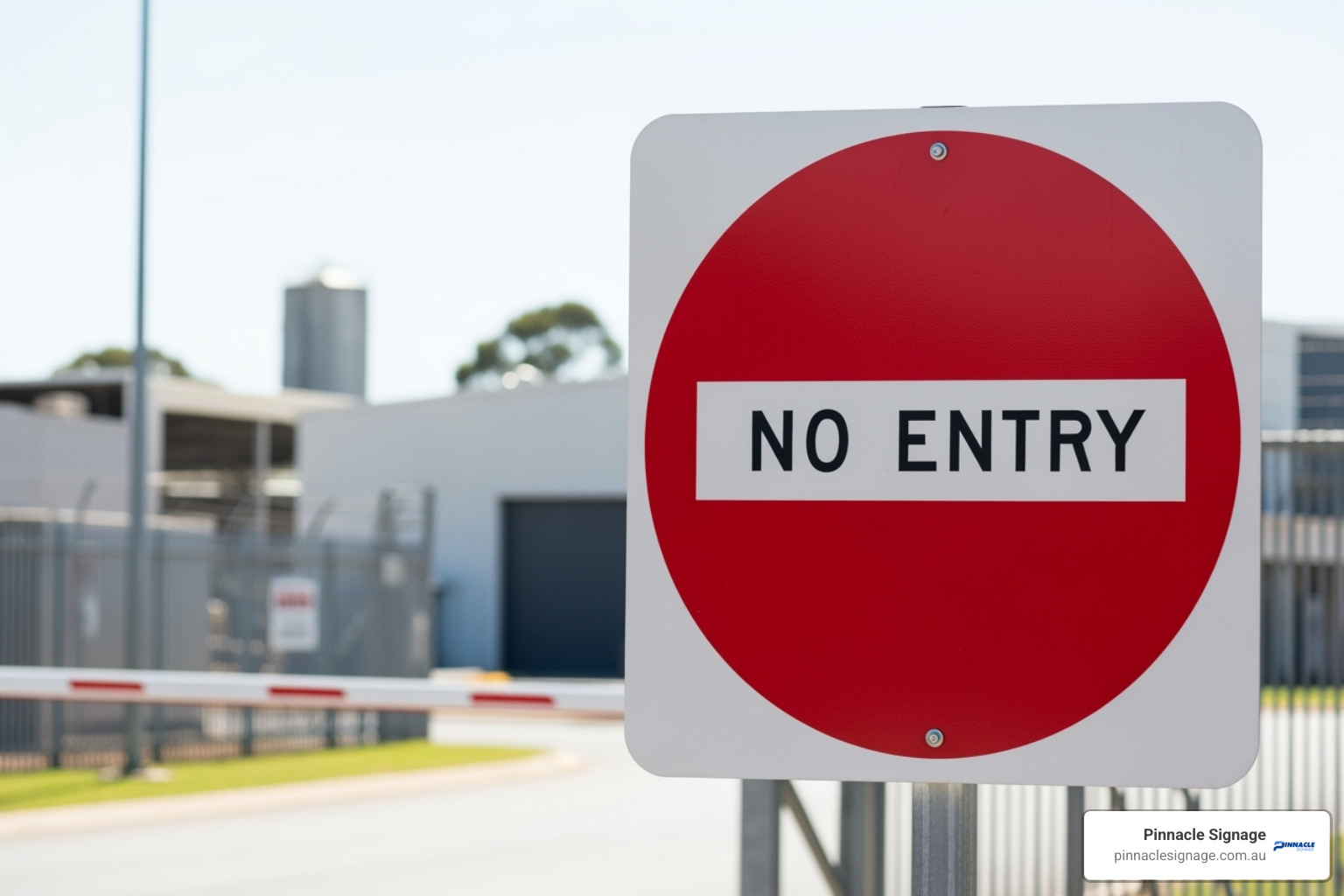
This is the No Entry sign most Australians instantly recognise. Its design is internationally recognised, featuring that distinctive red circle with a bold horizontal white bar across the centre. This sign is specifically for vehicles, not pedestrians.
The purpose is simple but critical: prevent cars from entering roads or areas where entry would be dangerous or illegal. You'll commonly see these signs marking one-way streets, car park exits, or highway off-ramps that are designed exclusively for outgoing traffic. Ignoring this sign can have serious consequences, particularly the risk of head-on collisions in high-speed zones.
Around Australia, these signs appear at the entrance to one-way streets, service lanes, and car park exits to stop vehicles from driving against the flow of traffic. They're often paired with "Wrong Way" signs to really drive the message home.
"Do Not Enter": The All-Purpose No Entry Sign
While it shares the same basic intent as the classic vehicular sign, the "Do Not Enter" sign takes a different approach. These signs typically use text or combine text with symbols to communicate their message. This flexibility makes them incredibly useful across a much wider range of situations beyond just road traffic.
You'll find "Do Not Enter" signs wherever safety or security is a priority. Construction sites rely on them to keep unauthorised people away from dangerous machinery and hazardous work zones. Private property owners use them to clearly mark restricted areas where public access isn't allowed. These signs are direct and unambiguous, which is exactly what you need when someone's safety is at stake.
A construction site, for example, might display a prominent "Danger - Construction Site - Do Not Enter" sign to warn of active hazards and prevent injuries. These signs are available in durable materials suitable for outdoor use. You can find quality versions like our Danger - Construction Site - Do Not Enter sign at Bunnings. For more guidance on securing restricted zones effectively, have a look at our guide: Restricted Means Restricted: Top Picks for Area Safety Signs.
"Authorised Personnel Only": Restricting Access
Sometimes you don't need to keep everyone out, just people who aren't supposed to be there. That's where "Authorised Personnel Only" signs come in. These No Entry signs restrict access to individuals who have explicit permission, usually employees or credentialed workers.
These signs are vital for maintaining security in commercial and industrial environments. Think staff rooms, maintenance closets, IT server rooms, or loading docks. The goal is twofold: protecting valuable equipment and sensitive information, and keeping untrained individuals away from potentially dangerous areas. By clearly marking these zones, you're not just following good security practice, you're actively preventing accidents before they happen.
This type of signage forms an essential part of broader access control strategies in modern workplaces. We explore this topic in more detail in our article: Beyond the Barricade: Decoding Access Control Door Signage.
Conditional and Specific Prohibitions
Sometimes a basic "No Entry" message isn't quite enough. Certain situations call for more specific information about who can enter or under what conditions access is permitted. These conditional and specific prohibition signs add important context to the restriction.
These signs include additional text or symbols that spell out exactly what's required. "No Entry Without Permit" signs are common in controlled access zones where you need formal authorisation. "No Entry Without PPE" appears in industrial settings where personal protective equipment like hard hats, safety glasses, or high-visibility vests are mandatory. You might also encounter vehicle-specific restrictions such as "No Heavy Goods Vehicles" or "No Motorcycles," which clearly indicate what types of vehicles aren't allowed.
Confined spaces present their own unique challenges, requiring signs that warn that only trained and authorised personnel with specific entry procedures can access these areas. Agricultural properties often use biosecurity signs to prevent the spread of diseases or contaminants. For sites handling hazardous materials, our Hazchem Signage collection includes specialised signs for areas with restricted entry due to chemical hazards.
These detailed signs strike the right balance: keeping areas secure while allowing necessary operations to continue safely and legally under the right conditions.
The Legal and Safety Importance of the No Entry Sign
A No Entry sign isn't just a suggestion painted on metal or plastic. It carries real legal weight and serves as a critical safety tool in workplaces, on roads, and across public and private property throughout Australia. These signs represent our first line of defence against accidents, unauthorised access, and the legal headaches that can follow when things go wrong.
Under Australian workplace safety laws, displaying clear and compliant No Entry signs is often a legal requirement, not an optional extra. They play a vital role in risk management and public liability protection. When properly placed and maintained, these signs communicate boundaries, warn of dangers, and direct behaviour in ways that keep workers, visitors, and the general public safe.
Consequences of Disregarding a No Entry Sign
Ignoring a No Entry sign can trigger consequences ranging from minor fines to serious injury or even legal action. On public roads, driving past a No Entry sign typically results in traffic infringements, fines, and demerit points. Depending on the circumstances and jurisdiction, you could even face licence suspension.
In workplace settings, the consequences shift but remain serious. Employees who disregard a No Entry sign can face disciplinary action, including warnings, suspension, or termination. After all, ignoring safety protocols puts everyone at risk and breaches fundamental workplace safety obligations.
The most sobering consequence is physical harm. Entering a restricted or hazardous area without authorisation puts people in direct danger, particularly around construction sites, industrial zones, or areas with dangerous machinery. These signs exist to keep people away from genuine threats, from moving equipment to toxic substances to unstable structures.
For site managers and property owners, the stakes are equally high. If an unauthorised person is injured in an area marked with a No Entry sign, the site owner or manager could face significant legal liability. This can include substantial fines, lawsuits, and even criminal charges if they're found to have neglected their duty of care. And for anyone who enters private property or a restricted area against the clear instruction of a No Entry sign, trespassing charges can result in fines or other legal penalties.
These aren't hypothetical scenarios. They happen regularly across Australia, which is why respecting and properly implementing No Entry signs matters so much.
Best Practices for Sign Placement and Visibility
A No Entry sign only works if people can actually see it, understand it, and respond to it in time. This means thinking carefully about where and how you install these signs.
Strategic placement is fundamental. Position signs at the precise point where entry is prohibited, whether that's at eye level at the entrance of a one-way street, before a hazardous zone, or at a restricted doorway. The goal is to give people adequate warning and time to react. Make sure nothing blocks the view of your No Entry sign. Overgrown vegetation, parked vehicles, or other signage can all obstruct sightlines and render even the most compliant sign useless.
Height matters too. Mount signs at a level that's easily visible to your intended audience, whether that's drivers in vehicles or pedestrians on foot. Consider typical sightlines and ensure the sign sits squarely in the field of view.
For locations used at night or in low-light conditions, adequate lighting is essential. This might mean external lighting or using reflective materials. At Pinnacle Signage, our high-quality aluminium signs feature reflective materials that significantly improve visibility during dawn, dusk, and nighttime hours. Different grades of reflectivity, such as Engineering Grade Prismatic, High Intensity Prismatic, or Diamond Grade, offer varying visibility distances, allowing you to select the best option for your specific environment.
Sign size and text height should match the expected viewing distance. Larger signs with clear, bold text are necessary for high-speed roads, while smaller signs work fine for pedestrian pathways. And don't forget regular maintenance. Inspect signs routinely for damage, fading, or dirt accumulation. A faded or damaged sign loses effectiveness and can compromise safety.
Proper placement and visibility aren't just best practices, they're essential components of effective access control and safety management. For more guidance on this, our article on Entry and Exit Signs 101 offers valuable insights.
Modern Advancements in Signage Technology
While the classic No Entry sign remains a staple of safety and traffic management, modern technology has introduced innovations that improve effectiveness, particularly in challenging environments or dynamic situations.
Electronic LED signs offer variable messaging capabilities, allowing messages to be changed or updated remotely. This flexibility is particularly useful for temporary restrictions, changing traffic conditions, or emergency alerts. You can communicate different messages at different times without physically changing the sign.
Solar-powered signs provide a sustainable and reliable solution for remote locations or areas without easy access to power. They're especially beneficial in agricultural settings or on unlit roads where traditional power sources are impractical. Our Illuminated Stock Ahead Signs demonstrate how solar power and LED technology can be combined to improve safety in rural areas.
Continuous improvements in materials science have also led to signs that offer superior reflectivity and durability. Modern No Entry signs are more weather-resistant and maintain their visibility even in harsh Australian conditions, from scorching sun to driving rain.
These technological advancements allow us to implement more flexible, visible, and environmentally friendly No Entry sign solutions, catering to a wider range of needs while improving overall safety across different environments.
Common Locations: Where You'll Find No Entry Signs
No Entry signs are everywhere, quietly doing their job to keep us safe, maintain order, and manage traffic flow across Australia. From the moment you drive down a city street to when you walk through a shopping centre or visit a hospital, these signs are working in the background to guide behaviour and prevent accidents.
You'll spot the classic red circle with a white bar at the entrance to one-way streets, preventing drivers from heading the wrong way into oncoming traffic. Car park exits rely on these signs to stop vehicles from entering against the flow, and highway off-ramps use them to keep traffic moving safely in the right direction. Private roads and farm gates often display No Entry signs to keep unauthorised vehicles out and protect property.
Construction sites are another common home for these signs. Here, they serve a critical purpose: keeping the public and unauthorised workers away from heavy machinery, excavations, and other hazards. Industrial facilities use them extensively to control access to restricted zones, machinery areas, chemical storage facilities, and loading docks, where only trained personnel should enter.
In commercial buildings, you'll find them on doors leading to staff-only areas, plant rooms, server rooms, or sections under maintenance. Hospitals and healthcare facilities rely on No Entry signs to protect sterile areas, operating theatres, and infectious disease zones, where unauthorised access could compromise patient safety or spread infection.
Agricultural properties use these signs at farm gates, sheds, and biosecurity checkpoints to prevent unauthorised entry and protect livestock, crops, and equipment. Biosecurity is particularly important in rural Australia, where the spread of disease or contaminants can have devastating consequences.
Even in public parks and recreational areas, you'll encounter No Entry signs closing off dangerous zones, areas under repair, or sections reserved for specific activities. Shopping centres display them at service entrances, loading bays, and areas under renovation to keep shoppers safe and operations running smoothly. And at airports, they're essential for maintaining high security in restricted zones, baggage handling areas, and operational sections where public access is strictly forbidden.
The consistent presence of these signs across such diverse environments highlights just how vital they are for maintaining safety, security, and order in our daily lives.
Find the Right Signage Solution for Your Site
When it comes to No Entry signs and other prohibition signage, quality and durability make all the difference. At Pinnacle Signage, we manufacture signs from robust, weather-resistant materials designed to withstand the harsh Australian climate while maintaining maximum visibility year after year. Whether you're managing a construction site in the Northern Territory or a commercial facility in Melbourne, our signs are built to perform.
We understand that every site has unique requirements. That's why we offer customisable options, allowing you to tailor your No Entry signs with specific text, logos, or colours to match your exact needs. From standard vehicular prohibition signs to specialised workplace access control signage, we can create solutions that work for your operation. With fast turnaround times and Australian-made quality, you'll get the signs you need when you need them.
For businesses, councils, co-ops, and agri-businesses looking to order in bulk, we offer competitive margins and scalable solutions. Our team works with organisations across Australia to provide consistent, compliant signage for multiple sites, helping you maintain safety standards across your entire operation. Browse our comprehensive Prohibition Signage collection to see the full range of options available.
We're also proud to announce that Pinnacle Signage products are now available at Bunnings, both in-store and online across Australia. This partnership makes accessing premium, compliant signage more convenient than ever. Whether you need a single sign for your business or a bulk order for multiple locations, you can now shop our range at your local Bunnings or have it delivered straight to your door. Visit the Pinnacle Signage brand page at Bunnings today to explore our products and find the right signage solutions for your site.
Need Help with Your Signage?
Selecting the right No Entry sign for your specific situation isn't always straightforward. Between understanding placement requirements, choosing appropriate materials for your environment, and ensuring compliance with relevant standards, there's a lot to consider. That's exactly where our team at Pinnacle Signage comes in.
We've worked with businesses across Australia, from construction companies and councils to agricultural operations and retail centres, helping them implement effective signage solutions that actually work. Whether you're managing a single site or coordinating signage across multiple locations, our team can provide personalised advice custom to your unique requirements.
Need custom No Entry signs with specific text, logos, or dimensions? Looking to develop a comprehensive traffic management plan for your site? Want to ensure your workplace meets current safety compliance standards? We're here to guide you through the process and recommend the most practical, cost-effective solutions for your needs.
As your reliable Australian-made supply partner, we're committed to more than just selling signs. We want to help you create safer, more efficient environments, whether that's a busy warehouse, a construction site, or a commercial property. Our team understands the local regulations, environmental challenges, and practical realities of Australian workplaces, and we're ready to put that knowledge to work for you.
Contact our expert team today to discuss your signage needs. We're always happy to answer questions, provide recommendations, or work with you on a custom solution that fits your site perfectly.