

Is It Wide or Oversize? The Ultimate Signage Showdown
What Is a Wide Load Sign and When Do You Need One?

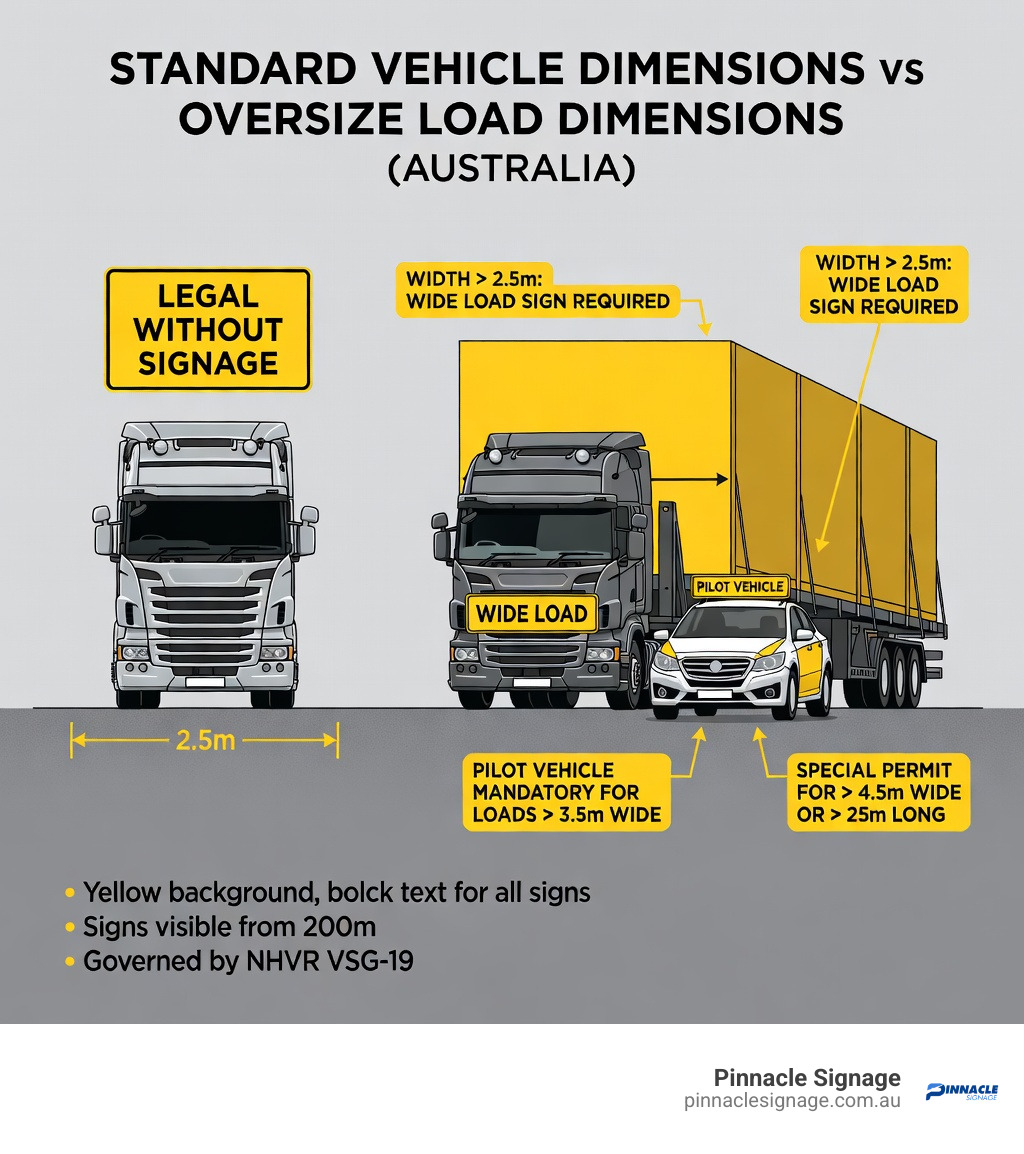
A wide load sign is a mandatory warning sign displayed on heavy vehicles or their loads when the vehicle or load exceeds standard legal dimensions on Australian roads. Here is a quick overview of when one is required:
- Width over 2.5 metres: A wide load sign is generally required.
- Displayed front and rear: Signs must be clearly visible to other road users from both directions.
- Yellow background, black lettering: This is the standard colour combination for oversize load signage in Australia.
- Pilot vehicle may be required: Depending on the size of the load, an escort vehicle with its own signage may also be compulsory.
- Governed by the NHVR: In Australia, oversize and overmass (OSOM) vehicle signage requirements are set out by the National Heavy Vehicle Regulator (NHVR) under Vehicle Standards Guide 19 (VSG-19).
Whether you are hauling construction equipment, prefabricated buildings, or heavy machinery, getting your signage right is not just about compliance. It is about keeping other road users safe and keeping your operation running without costly delays or fines.
I'm Doug Lindqvist, General Manager of Pinnacle Signage, and through my years in the safety and industrial supply space, I've seen firsthand how often businesses underestimate the importance of a correctly spec'd wide load sign, only to face compliance issues at the worst possible time. In this guide, I will break down exactly what you need to know so your fleet is always road-ready.
Understanding the Wide Load Sign and Legal Requirements
In heavy transport, the rules are there for a reason. In Australia, the National Heavy Vehicle Regulator (NHVR) provides the framework we must all follow. Specifically, the Vehicle Standards Guide 19 (VSG-19) outlines the technical requirements for warning signs on oversize vehicles.
Any vehicle or load that exceeds 2.5 metres in width or 25 metres in length is generally classified as an Oversize or Overmass (OSOM) vehicle. For these loads, a wide load sign is not just a suggestion, it is a legal necessity. These signs serve as a critical communication tool, alerting other drivers that they need to give you extra space or be prepared for a slower-moving vehicle.
For those operating in New South Wales, it is vital to stay updated with the Official NSW OSOM vehicle requirements. We also recommend checking out our detailed guide for more info about oversized vehicle signs to ensure your fleet meets every local standard.
Choosing the Right Material for Your Wide Load Sign
When we manufacture these signs at our East Wagga Wagga facility, we focus on durability. Australian roads are harsh, and your signage needs to withstand high-speed winds, UV exposure, and road grime.
- Aluminium: This is the gold standard for permanent or frequent use. We use high-quality, weather-resistant aluminium that does not rust and remains rigid even at highway speeds.
- Vinyl Mesh: For temporary loads or when weight is a concern, heavy-duty vinyl mesh is a popular choice. The mesh allows air to flow through the sign, which reduces the "sail effect" and prevents the sign from flapping or tearing.
- Class 2 Reflective: To be compliant for night-time travel or low-visibility conditions, your sign must feature Class 2 reflective material. This ensures that the sign "pops" when caught in the headlights of approaching vehicles.
Mandatory Dimensions and Lettering
The NHVR is very specific about how a wide load sign should look. You cannot just hand-paint a piece of plywood and call it a day.
- Size: The standard size for an Australian oversize sign is 1200mm wide by 600mm high.
- Lettering: The word "OVERSIZE" must be in black, sans-serif lettering. The letters must be at least 440mm high.
- Colour: The background must be a specific shade of highway yellow. This high-contrast combination ensures maximum visibility from a distance of at least 200 metres.
Wide Load vs. Oversize Load: The Key Differences
One of the most common questions we get is, "What is the difference between a wide load and an oversize load?" While the terms are often used interchangeably in casual conversation, they carry different weights in a legal context.
Here is a breakdown of the differences:
- Wide Load: Specifically refers to a load that exceeds the standard 2.5-metre width but may still fit within other standard dimensions (like height or length).
- Oversize Load: A broader category that includes any load exceeding standard width, height (4.3 metres), or length (19 metres for a single vehicle).
- Terminology: In Australia, the legal sign usually reads "OVERSIZE LOAD" or simply "OVERSIZE." The term "WIDE LOAD" is more common in international regions, but for NHVR compliance, "OVERSIZE" is the required text.
- Pilot Vehicles: Very large loads (usually over 3.5 metres wide) require one or more pilot vehicles to travel ahead of or behind the truck to manage traffic.
When to Use Reversible Banners
If your business hauls a variety of loads, you might find that a reversible or hinged sign is your best friend. We manufacture hinged aluminium signs that can be folded over when not in use. This protects the reflective surface and prevents you from displaying an "Oversize" warning when your truck is empty, which is actually a requirement, you must cover or remove these signs when you are not hauling an oversize load.
Pilot Vehicle Requirements for Large Loads
When a load reaches a certain size, usually exceeding 3.5 metres in width, a pilot vehicle is required. These vehicles act as the "eyes and ears" for the truck driver. They must be equipped with their own signage and warning lights.
Pilot vehicles must feature:
- A roof-mounted "OVERSIZE LOAD AHEAD" sign.
- Two rotating orange beacons or LED strobes.
- Clear communication equipment to stay in contact with the truck driver.
You can find more info about pilot vehicle sign kits on our blog, where we detail the specific light and sign configurations needed for escort duties.
Essential Accessories for Oversized Transport
A wide load sign is the centrepiece, but it is rarely the only thing you need. To be fully compliant and safe, you need a complete kit of accessories.
- Red-Orange Flags: These must be attached to the outermost corners of your load.
- LED Beacons: Rotating or flashing amber lights are often required on the roof of the cab or the rear of the load.
- Height Sticks: If you are hauling a tall load, a telescopic height stick allows you to manually check clearances before passing under bridges or power lines.
Safety Flags and Mandated Colours
In Australia, safety flags must be at least 450mm square. The colours are strictly mandated to be either fluorescent orange or scarlet red. These flags must be placed at the "extreme extremities" of the load. If your load is wider than the trailer, the flags tell other drivers exactly where your load ends so they do not clip it while passing.
Lighting and Warning Devices
Visibility is your best defence on the road. For night-time operations, your wide load sign must be reflective, but you also need active lighting. This includes rotating amber beacons that are visible from 360 degrees.
For those operating across the ditch or looking for international comparisons, you can see how our standards align with the NZTA vehicle mounted sign standards. While similar, always ensure you are following the specific NHVR rules for Australian soil.
How to Properly Mount and Maintain Your Signage
Even the highest-quality sign will fail if it is not mounted correctly. Loose signs can become dangerous projectiles, and obscured signs offer no protection.
Mounting Your Wide Load Sign for Maximum Visibility
- Placement: Signs must be mounted at the front and rear of the vehicle. For the front, the bumper is the most common spot. For the rear, the sign should be attached to the trailer or the load itself.
- Horizontal Alignment: The sign must be level. A tilted sign is harder to read and looks unprofessional.
- No Obstructions: Ensure the sign does not block your headlights, indicators, or number plates. Covering a number plate can lead to a fine, even if you are trying to be safe with your signage.
- Rigidity: If using a flexible mesh banner, use brass grommets and heavy-duty bungee cords to keep the banner tight. A flapping banner will wear out quickly and is difficult to read.
Maintenance and Durability Features
We design our signs with reinforced hems and water-resistant inks to ensure they last for years. However, you still need to do your part:
- Cleaning: Road salt, mud, and diesel soot can dull the reflective surface. Clean your signs regularly with mild soap and water.
- Inspection: Before every trip, check for cracks in aluminium signs or fraying on mesh banners.
- Storage: When not in use, store vinyl signs rolled up (not folded) to prevent permanent creases.
Common Mistakes in Oversized Load Signage
We have seen it all on the road. Avoid these common blunders to keep the authorities happy:
- Displaying signs when empty: If you are not hauling an oversize load, the sign must be removed or covered.
- Faded signage: If the yellow has turned to a pale cream or the black letters are grey, the sign is no longer compliant.
- Incorrect sizing: Using a small "Wide Load" sign meant for a ute on a prime mover is a major error.
- Loose attachments: Using a thin string or tape to hold a sign is a recipe for disaster. Always use rated bungees or brackets.
- Obscuring lights: Never let your sign hang over your brake lights or indicators.
Where to Find Quality Signage for Your Fleet
When you need a wide load sign that you can trust, you have two convenient ways to get Pinnacle Signage products.
First, we are proud to announce that our range is now available at Bunnings. You can find our high-visibility safety signs and transport accessories both in-store and online across Australia. This is a great option for those who need a sign today. You can Shop Pinnacle Signage at Bunnings to see the full range of available stock.
Second, for custom requirements or bulk orders for large fleets, you can deal with us directly. We offer customisable options, including custom text and logos, with a fast 48-hour turnaround on most orders.
Frequently Asked Questions about Wide Load Signs
When is a pilot vehicle legally required for a wide load?
In most Australian states, a pilot vehicle is required once a load exceeds 3.5 metres in width. However, this can vary based on the specific route and the "Level" of the oversize permit. Always check your permit conditions.
Can I use a vinyl banner instead of a metal sign?
Yes, as long as it meets the size and reflectivity requirements of VSG-19. Vinyl mesh is actually preferred for many rear-load applications because it is lighter and easier to secure to irregular shapes.
What is the standard size for an Australian oversize sign?
The standard size is 1200mm x 600mm. Some smaller signs (1200mm x 300mm) are used in specific multi-message scenarios, but the 600mm high version is the standard for heavy vehicles.
Get Your Compliant Signage Today
Ready to kit out your fleet? We make it easy.
- Browse the Range: Visit the Pinnacle Signage Brand Page on the Bunnings website for immediate availability.
- Custom Solutions: Need something specific? Explore our Custom Signage Solutions for tailored text and dimensions.
- Site Safety: While you are at it, ensure your loading zones are safe with a Danger Construction Site Sign.
Make the Right Call on Load Signage
At Pinnacle Signage, we take pride in being a reliable Australian-made partner for the transport industry. From our warehouse in East Wagga Wagga, we dispatch premium, NHVR-compliant signage to every corner of the country.
We understand the pressures of the transport industry, which is why we offer a 48-hour dispatch on most items. Whether you are picking up from our warehouse at Unit 4/28 Nagle Street or taking advantage of our free shipping on orders over $100, we are here to help you stay safe and compliant.
Don't leave your safety to chance. Invest in a high-quality wide load sign today and drive with the confidence that you are meeting the highest Australian standards.