

Braille Signage 101: Understanding Tactile Signs for Accessibility
Why Braille Signs are Essential for Australian Workplaces
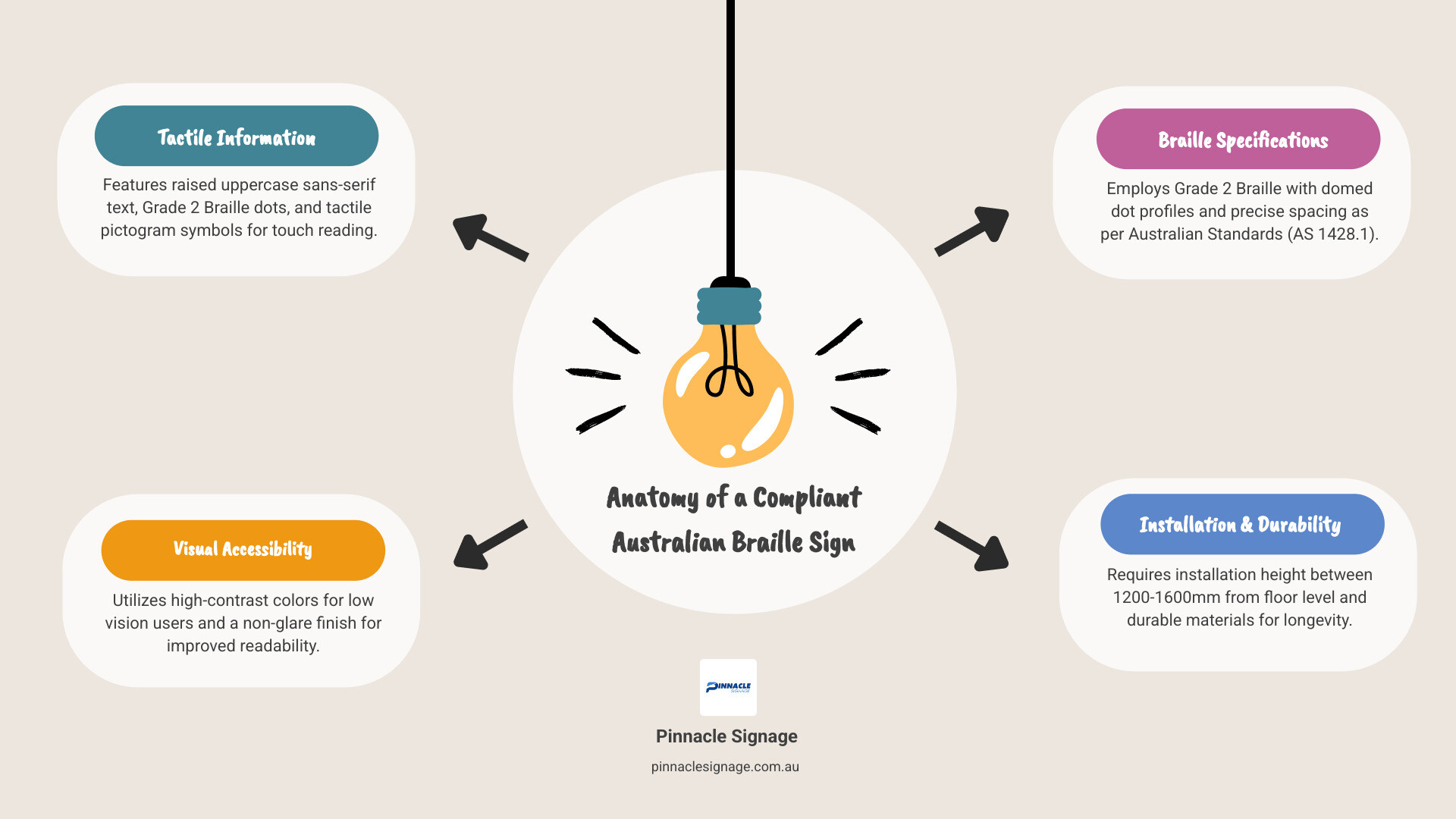
What are braille signs? They are accessibility signs that feature tactile raised lettering and Grade 2 Braille translations, designed to enable people with vision impairments to read information by touch.
Key Features of Braille Signs:
- Tactile raised text in uppercase, sans-serif fonts
- Grade 2 Braille dots positioned below corresponding text
- High-contrast colours for visual accessibility
- Domed dot profile meeting Australian Standards
- Non-glare finish for improved readability
- Pictogram symbols with tactile text descriptors
For most people, reading signs is an afterthought. However, for the estimated 7.6 million visually impaired people across Australia and New Zealand, accessible signage isn't just helpful, it's essential for independence and safety.
Braille signs serve as critical wayfinding tools in public and commercial spaces, helping people steer buildings, identify rooms, and access important safety information without assistance. These signs combine visual elements for people with low vision and tactile components for those who are blind, creating truly inclusive environments.
In Australia, braille signage must comply with the Building Code of Australia (BCA) and Australian Standard AS 1428.1, which set specific requirements for design, placement, and installation. Understanding these requirements is crucial for facilities managers, construction supervisors, and business owners to ensure their buildings meet accessibility obligations while creating welcoming spaces for all users.
Find more about "what are braille signs?":
What is the Difference Between Tactile and Braille Signage?
While often used together, "tactile" and "braille" refer to distinct elements on accessible signs. Understanding this difference is key to ensuring your signage is compliant and helpful.
Tactile signage features raised characters (tactile text) and symbols (pictograms) that can be read by touch. These raised elements allow people with low vision or blindness to trace the shapes of letters and symbols. Tactile text is typically uppercase, in a sans-serif font, and raised at least 1mm from the sign's surface.
Braille signage uses the system of raised dots representing letters and numbers. Australian standards require Grade 2 Braille, a contracted form that makes reading faster for experienced users. Each character is formed by a specific arrangement of dots within a cell.
Essentially, all braille is tactile, but not all tactile elements are braille. Most compliant signs combine both, raised text and pictograms for visual and touch-reading, with a braille translation below. This dual approach provides maximum accessibility for a diverse range of vision impairments.
At Pinnacle Signage, we design our signs to integrate both elements seamlessly for comprehensive accessibility solutions.
To dig deeper into this topic, explore our guide on What are Braille Tactile Signs? A A Simple Guide to Accessibility.
Why is Accessible Signage Important for Your Business?
Implementing accessible signage isn't just a regulatory checkbox; it's a fundamental aspect of building an inclusive, safe, and reputable business.
Fostering Independence and Inclusivity: Accessible signage grants independence to people with vision impairments. It empowers them to steer buildings, locate facilities, and access information without assistance, creating a welcoming environment where everyone feels valued.
Enhancing Customer Experience and Brand Reputation: Catering to the needs of all patrons builds a positive brand image. A commitment to accessibility can differentiate your business, improve customer loyalty, and attract a broader customer base.
Ensuring Safety for All: In an emergency, clear signage is paramount for a safe evacuation. Braille and tactile exit signs provide crucial guidance for visually impaired individuals, helping them find the nearest exit quickly. This isn't just about compliance; it's about protecting lives.
Meeting Legal Obligations and Avoiding Penalties: Australian businesses have legal obligations under the Disability Discrimination Act 1992 (DDA), the Building Code of Australia (BCA), and Australian Standard AS 1428.1:2009. Non-compliance can lead to legal challenges, fines, and reputational damage. Proactively investing in compliant signage is far better than facing the consequences.
At Pinnacle Signage, we pride ourselves on helping businesses not only meet but exceed these obligations. Our Tactile Braille Signs at Pinnacle Signage: Enhancing Accessibility and Safety are designed with these critical factors in mind.
What are Braille Signs and Their Compliance Requirements in Australia?
When we discuss "what are braille signs?", we're referring to precisely engineered tools that must meet strict Australian standards to be effective. Every element, from the dot height to wall placement, is regulated under the Building Code of Australia (BCA) and Australian Standard AS 1428.1:2009.
This regulatory consistency is key. A person who reads braille can enter any compliant building in Australia and know exactly where to find signs and how to read them. This predictability is essential for independence and safety.
Understanding these requirements is about more than ticking boxes; it's about creating spaces where everyone can steer confidently and safely.
Answering "What are Braille Signs?": Key Design Elements
Effective braille signage combines several key design elements to ensure accessibility for various types of vision impairment.
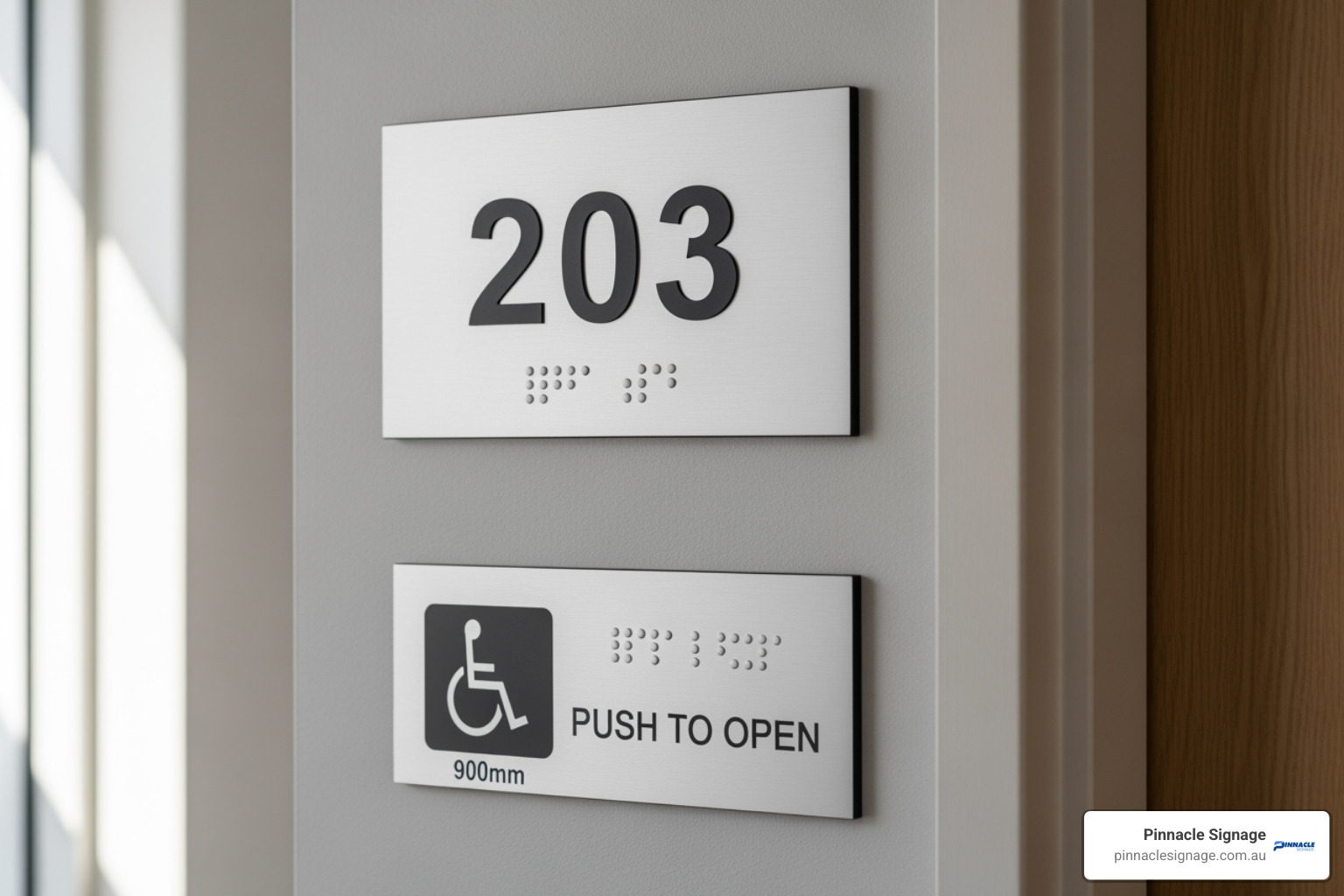
A compliant sign begins with tactile characters. These are raised letters in uppercase text using a simple sans-serif font. Decorative fonts are unsuitable as they are difficult to read by touch. Characters must be raised at least 1mm from the background for easy detection.
The braille component must use Grade 2 Braille, a contracted form that allows for faster reading. Each braille dot must have a domed profile for comfortable reading and durability.
For those with low vision, visual features are critical. High colour contrast between the sign's elements and its background improves readability, while a non-glare finish prevents reflections.
If pictogram symbols (e.g., for toilets or exits) are used, they must also be raised and include both tactile text and braille translations directly below. This ensures the sign is universally understood.
The Tactile and braille street signs user guide - City of Sydney provides excellent examples of how these elements integrate in real-world applications.
Placement and Location: Where are Braille Signs Required?
Getting the placement right is just as crucial as the sign design itself. Australian standards specify exact locations and mounting requirements because consistency helps people steer independently and safely.
Where braille signage is required: Use on permanent rooms and spaces that will not change function. This includes toilets and accessible facilities, with male, female, unisex, and accessible symbols. Exit and emergency routes need clear identification for exit doors, stairways, and fire exits. Lifts require signage for floor numbering and emergency communication devices.
Room identification covers reception areas, staff rooms, first aid facilities, conference rooms, and any other permanent spaces. Stairways and assistance points also require proper tactile signage to ensure safe navigation.
To be effective, signs must be mounted at a consistent height and position, typically on the wall next to the door's handle, so they can be easily found and read. There must also be clear space in front of each sign to allow easy access for everyone, including wheelchair users.
These placement guidelines ensure that every braille sign functions as intended, providing reliable information exactly where people expect to find it. For comprehensive guidance on purchasing compliant solutions, explore our Buy Tactile Signs Online with Pinnacle Signage.
Ensuring Compliance and Readability
While the technical standards are complex, their purpose is simple: to create signs that are consistent, readable, and durable. At Pinnacle Signage, we ensure all our braille signs are manufactured to meet these exacting standards, guaranteeing compliance and true accessibility for your facility.
For broader information about Australian safety signage compliance, refer to our Safety Signage Australia: Your Guide to Clear and Compliant Signs.
Choosing the Right Braille Signage for Your Needs
Choosing the right braille signage involves more than picking from a catalogue; it's about creating an inclusive, compliant environment that suits your facility's unique needs. The question isn't just "what are braille signs?", but which signs are best for you.
Fortunately, modern braille signage can complement your aesthetic vision while ensuring full compliance. The key is to partner with a supplier who understands both the technical standards and the practical needs of Australian businesses.
Find Compliant and Custom Braille Signs
At Pinnacle Signage, we help Australian businesses balance compliance, function, and design. We focus on understanding your needs to provide solutions that work.
Premium Materials: We use durable polycarbonate, high-grade plastic laminate, and premium aluminium to ensure longevity and performance. Our single-piece moulded polycarbonate signs are particularly vandal- and fade-resistant, ideal for high-traffic or outdoor areas.
Customisation Without Compromise: While we stock standard signs for common applications, we specialise in custom solutions. We can match your branding with custom colours, unique room names, and specific designs, all while maintaining full AS 1428.1 compliance.
Expert Guidance: Navigating accessibility standards can be complex. Our experienced team helps you understand your requirements and choose the right solutions for your budget and aesthetic.
Fast Turnaround: We manufacture many signs at our East Wagga Wagga facility, allowing for dispatch or pickup within 2-4 business days to keep your project on schedule.
Straightforward Installation: Our signs are designed for easy installation. Most come with high-quality 3M double-sided tape for flat surfaces, and we offer backing plates for textured surfaces like brick.
The result is compliant, functional signage that integrates seamlessly into your environment, backed by the expertise of a trusted Australian supplier.
Have specific requirements or questions about what are braille signs? for your particular situation? Contact us today to discuss your needs. Our team is ready to help you create an accessible, compliant, and welcoming environment that works for everyone.