

Don't Get Lost: The Essential Guide to Emergency and Evacuation Signs
Why Clear Evacuation Signage is Non-Negotiable
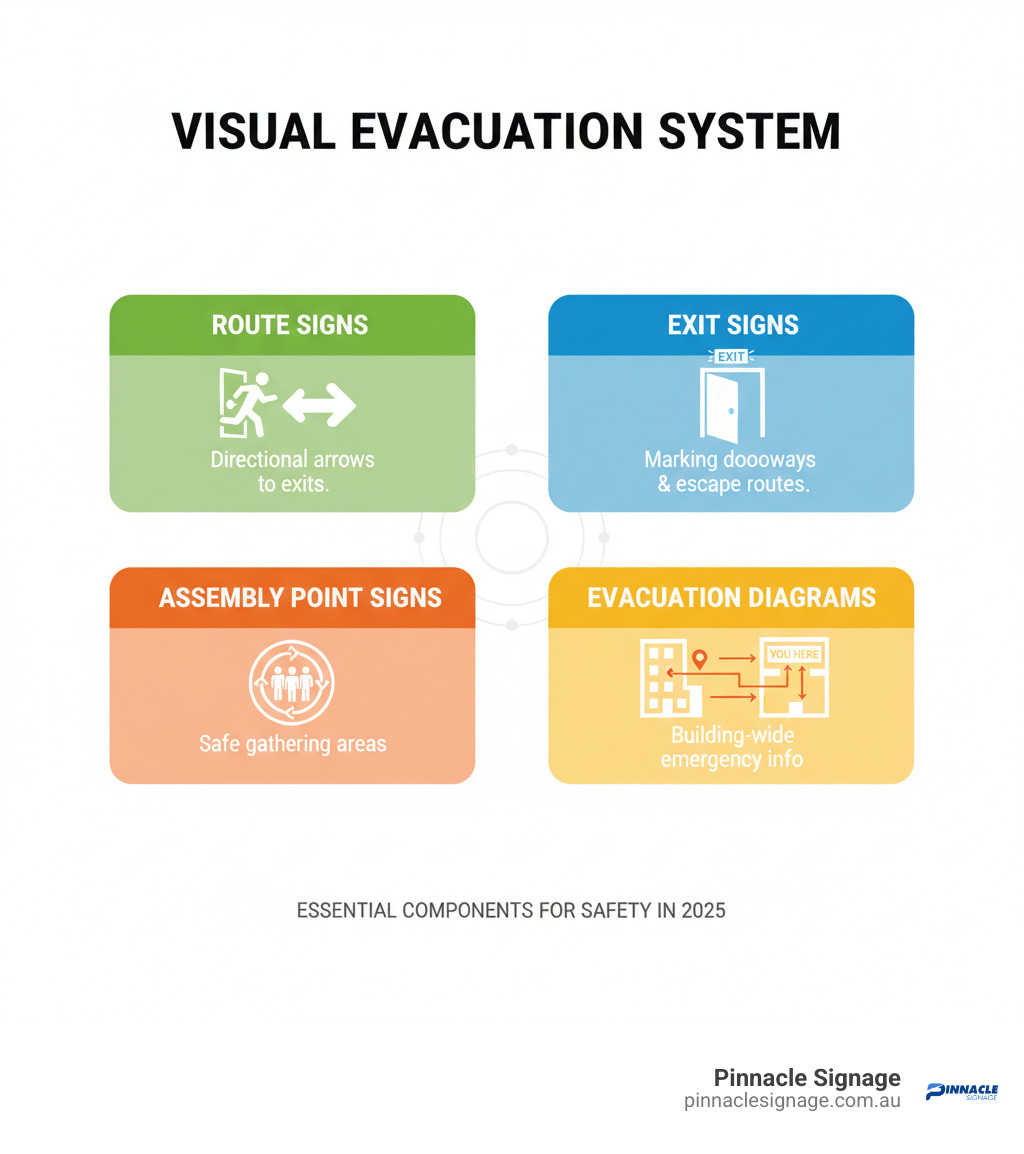
Evacuation route signs are essential safety devices that guide people to safe exits during emergencies. By preventing panic and ensuring an orderly evacuation, they form a critical part of any emergency management system, helping to protect lives and meet legal safety requirements.
Key Components of Effective Evacuation Route Signs:
- Clear directional arrows pointing towards the safest exit route.
- High-contrast colours like green and white for instant recognition.
- Durable, weather-resistant materials for reliable performance.
- Strategic placement at decision points and along escape routes.
- Compliance with Australian Standards such as AS 1319.
- Visibility features like photoluminescent or reflective properties for low-light conditions.
In an emergency, be it a fire, flood, or chemical spill, clear signage can be the difference between a controlled evacuation and chaos. Australia's varied climate presents unique challenges, from bushfires in rural areas to flash floods in coastal regions. A robust evacuation signage system must account for these threats, ensuring everyone can find the safest escape route quickly.
Beyond protecting lives, proper evacuation signage is a legal requirement under workplace safety legislation. Safe Work Australia guidelines mandate clear emergency procedures, and effective signage is a key component of demonstrating due diligence in emergency preparedness.
Evacuation route signs helpful reading:
A Comprehensive Guide to Evacuation Route Signs and Systems
When an emergency strikes, every second counts. That's when evacuation route signs become hypercritical, guiding people to safety when panic could otherwise take hold. They are the pivotal link between your emergency procedures and the people who need to follow them.
The Role of Signage in Your Emergency Evacuation Plan
An emergency evacuation plan is only effective if people can follow it in a crisis. Evacuation route signs serve as the visual backbone of your safety strategy, translating written procedures into clear, actionable directions.
When alarms are sounding and stress is high, people need immediate guidance. Signage bridges this gap by:
- Ensuring orderly movement: Instead of a rush to the nearest exit, signs direct people along predetermined, safe routes.
- Reinforcing training: They act as constant reminders of evacuation procedures for your team.
- Guiding visitors: They provide crucial directions for contractors, clients, and anyone unfamiliar with your facility's layout.
Without this visual guidance, even the most detailed evacuation plan can fail when it matters most. For more on integrating signage into your safety framework, see our guide on how to implement fire safety signs.
Types of Evacuation Signs and Their Meanings
A comprehensive evacuation system uses several types of signs, each with a specific purpose.
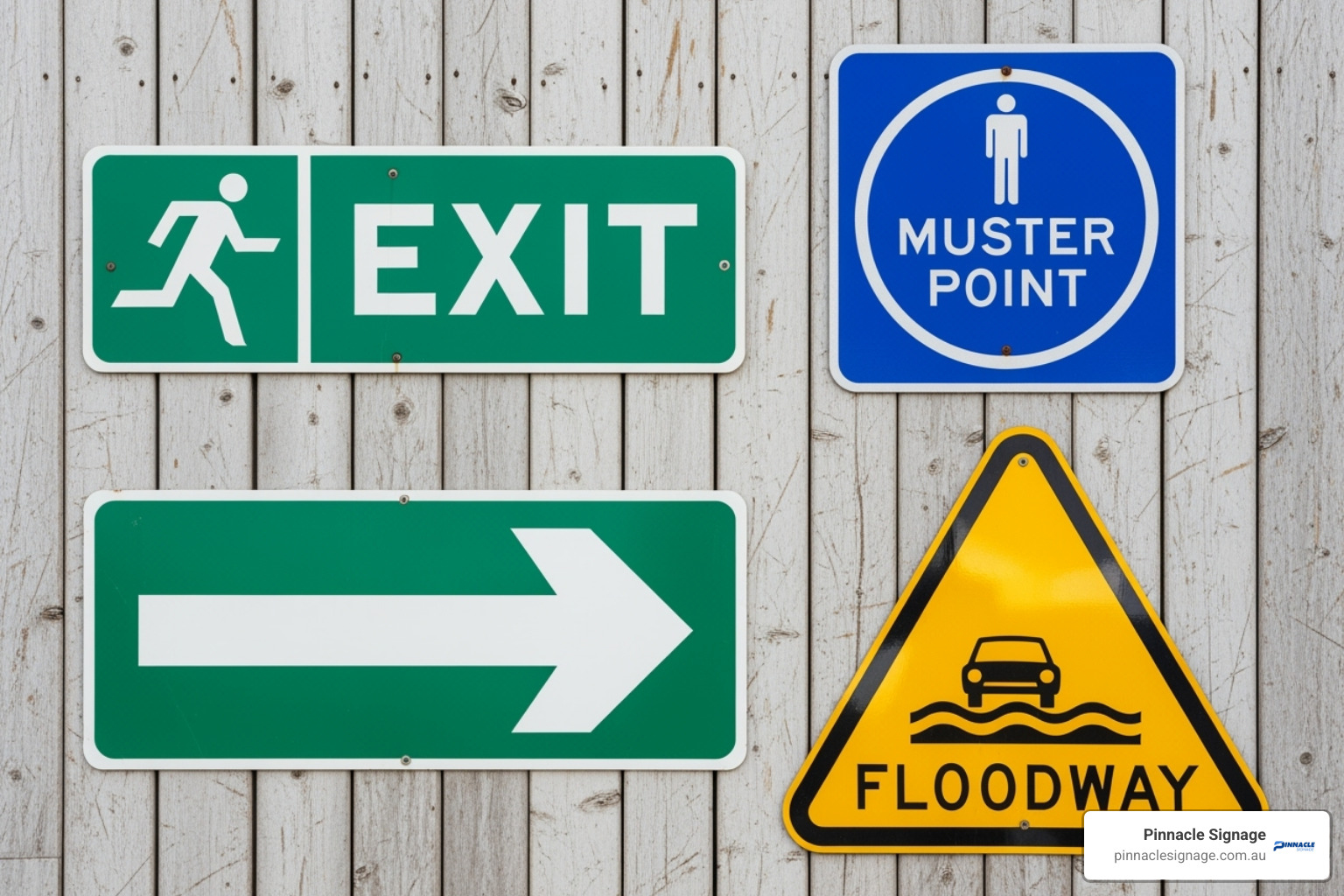
- Exit Signs: These familiar green and white signs mark the final point of exit from a building. They are often illuminated to ensure visibility during power outages.
- Directional Evacuation Signs: Featuring arrows on a green background, these signs guide people along the safest path toward an exit. They are essential at intersections, stairwells, and any point where the route is unclear. Learn more about fire exit directional signs.
- Muster Point Signs: Once outside, these signs designate safe assembly areas where everyone can be accounted for. Find why they are crucial in keeping your team safe in emergencies.
- Hazard-Specific Signs: Australia's unique environment requires signs for specific threats. These include flood evacuation signs for flood-prone areas, bushfire evacuation signs for rural properties, and chemical hazard evacuation signs for facilities with hazardous materials. While GHS Signage identifies chemical hazards, evacuation signs direct people away from them. Official resources like the NSW SES Local Flood Emergency Sub Plan show how such signage is integrated into regional planning.
Choosing the Right Materials for Durability and Visibility
The reliability of your evacuation route signs depends heavily on the materials used. Signs must withstand Australia's harsh conditions, from intense sun to coastal salt spray, to perform flawlessly in an emergency.
We offer a range of durable, weather-resistant materials suitable for both indoor and outdoor applications, ensuring longevity and compliance. Key visibility features include:
- Photoluminescent Signs: These "glow-in-the-dark" signs absorb ambient light and remain visible during power outages or in smoky conditions, providing critical guidance when it's needed most. Learn more about these life-saving fire signs.
- Reflective Materials: Essential for outdoor and low-light environments, reflective signs are highly visible to pedestrians and drivers at night, making them ideal for rural evacuation routes and large industrial sites.
The size of the sign must also be appropriate for its viewing distance to ensure it is easily noticed and read during an evacuation.
Best Practices for Placing Your Evacuation Route Signs
Even the best evacuation route signs are useless if they aren't seen. Strategic placement is key to creating an effective guidance system.
- Place signs at decision points: Install signs with clear directional arrows at every intersection, change in direction, and stairwell entrance.
- Ensure a clear line of sight: Mount signs where they won't be obstructed by doors, equipment, or other objects. They must be visible from all approach angles.
- Use appropriate installation heights: Signs should typically be mounted at least 2.1 metres above ground level, with specific placement varying between urban and rural environments.
- Maintain continuity: Use periodic signs along long corridors or complex routes to reassure people they are on the right path.
- Conduct regular maintenance: Keep signs clean, visible, and in good repair. Damaged or faded signs should be replaced immediately.
For more insights, read about the importance of muster point signage.
Advanced Systems: Dynamic Signs and Map Displays
Modern technology offers advanced solutions to supplement static evacuation route signs, especially during complex emergencies.
- Dynamic Message Signs (DMS): These electronic displays provide real-time updates, such as road closures, alternative routes, or changing threat levels during events like floods or bushfires.
- Evacuation Map Holders: These frames protect and display detailed facility diagrams. While signs guide people along routes, maps provide the "big picture," showing building layouts, exit locations, and assembly points.
- Accessibility: To ensure your emergency plan is inclusive, consider Braille & Tactile Signage options, which make route information accessible to visually impaired individuals.
For more on creating a complete system, see our guide to evacuation centre signage.
Understanding Australian Standards for Evacuation Route Signs
Complying with Australian Standards ensures your evacuation route signs are effective, recognisable, and legally sound. These standards create a uniform system that emergency services and the public can rely on.
Key standards and bodies include:
- AS 1319: This standard ensures all safety signs use a consistent, recognisable design. For evacuation signs, this means the familiar green and white format, which helps people understand them instantly in an emergency.
- Safe Work Australia: Provides national guidance on emergency procedures and signage for all workplaces.
- Building Code of Australia (BCA): Outlines requirements for emergency exits and signage within buildings.
Adhering to these standards is not just about avoiding penalties; it's about effectiveness. Compliant signage is often a requirement for insurance policies and, most importantly, it provides clear guidance that saves lives. Australian facilities must adhere to local standards to ensure consistency and compatibility with our emergency services.
For more on compliance, explore The ultimate guide to exit fire signs.
Equip Your Facility for Safety: Find Your Signage Solution
At Pinnacle Signage, we manufacture high-quality, durable evacuation route signs right here in East Wagga Wagga, NSW. Our products are designed to withstand Australia's harsh environments, ensuring reliability when it matters most.
Whether you need standard exit signs, muster point markers, or custom solutions for specific hazards, we have the expertise to keep your people safe. We offer scalable solutions and competitive pricing for bulk orders, with customisable options to suit your facility's unique requirements. For example, our Customised Hazchem Signage can integrate your specific procedures.
Don't leave safety to chance. Partner with Pinnacle Signage for compliant, Australian-made products and reliable Australia-wide delivery.
Ready to improve your facility's safety? Browse our Exit & Entry Signage collection or explore our comprehensive Fire Signage solutions. For custom solutions or bulk orders, contact our expert team today.
Shipping & Pick Up Information
For most deliveries within Australia, we use courier services such as FEDEX; please note that couriers cannot deliver to PO Boxes, so provide a valid daytime delivery address. To ensure safe delivery, a signature is required upon receipt. You must be available to accept courier deliveries; re-delivery charges will apply if you are not present. Include a daytime phone number with your shipping details if we need to contact you about your delivery. For items weighing over 50kg, a tailgate delivery is usually required for residential addresses. This service is included in our standard shipping. Alternatively, you can choose to pick up the item from a nearby depot.
Free shipping is available for orders over $100 AU Wide. Free shipping applies to most items on the site. However, some bulky items additional shipping costs will apply for deliveries to WA, North QLD, NT, TAS, and island areas. Our staff will reach out to you after your order if these charges apply.
Pinnacle Signage dispatches most items within 48 hours of receiving your order and payment confirmation. Delivery times are estimated as follows:
- 1 - 2 days: Sydney, ACT, Melbourne, Brisbane, Gold Coast
- 2 - 4 days: Rest of NSW, Rest of VIC
- 3 - 6 days: SA, North QLD, Perth
- 5 - 9 days: TAS, NT, WA
Pickup is available at our warehouse, located at Unit 4/28 Nagle Street, East Wagga Wagga NSW. The warehouse is open from 8am to 5pm Monday through Friday. We are closed on weekends and public holidays.