

Don't Get Fined for Your Signs: NFPA and OSHA Compliance
Understanding Australian Exit Sign Regulations and the NCC

Exit sign regulations in Australia set the minimum requirements for how exit signs must look, where they must be placed, and how they must perform during an emergency.
Here is a quick summary of the key requirements:
| Requirement | Standard |
|---|---|
| Minimum illumination duration | 90 minutes on backup power |
| Testing frequency | Every 6 months by a licensed professional |
| Applies to | Workplaces over 300m2, Class 5-9 buildings, fire-isolated exits |
| Governing standard | AS 2293 (Australian Standard for emergency escape lighting) |
| Key national framework | National Construction Code (NCC) |
| Sign colour | Green and white |
| Must be on 24/7 | Yes, exit signs above doorways and stairwells |
The rules exist to make sure that when something goes wrong - a fire, a blackout, a building emergency - every person in your facility can find their way out quickly and safely. That applies whether your building houses a small office team, a warehouse crew, or hundreds of members of the public.
For facilities managers, construction supervisors, and building owners across Australia, getting exit signage wrong is not just a compliance risk. It is a genuine safety risk. Non-compliant signs, poor placement, or failed backup power can slow an evacuation at the worst possible moment.
I'm Doug Lindqvist, General Manager of Pinnacle Signage, and my background in the safety and industrial supply space has given me a front-row seat to how often businesses struggle with exit sign regulations - from understanding what is actually required to sourcing signs that hold up in demanding environments. In this guide, I'll walk you through everything you need to know to keep your facility compliant and your people safe.
Quick look at exit sign regulations:
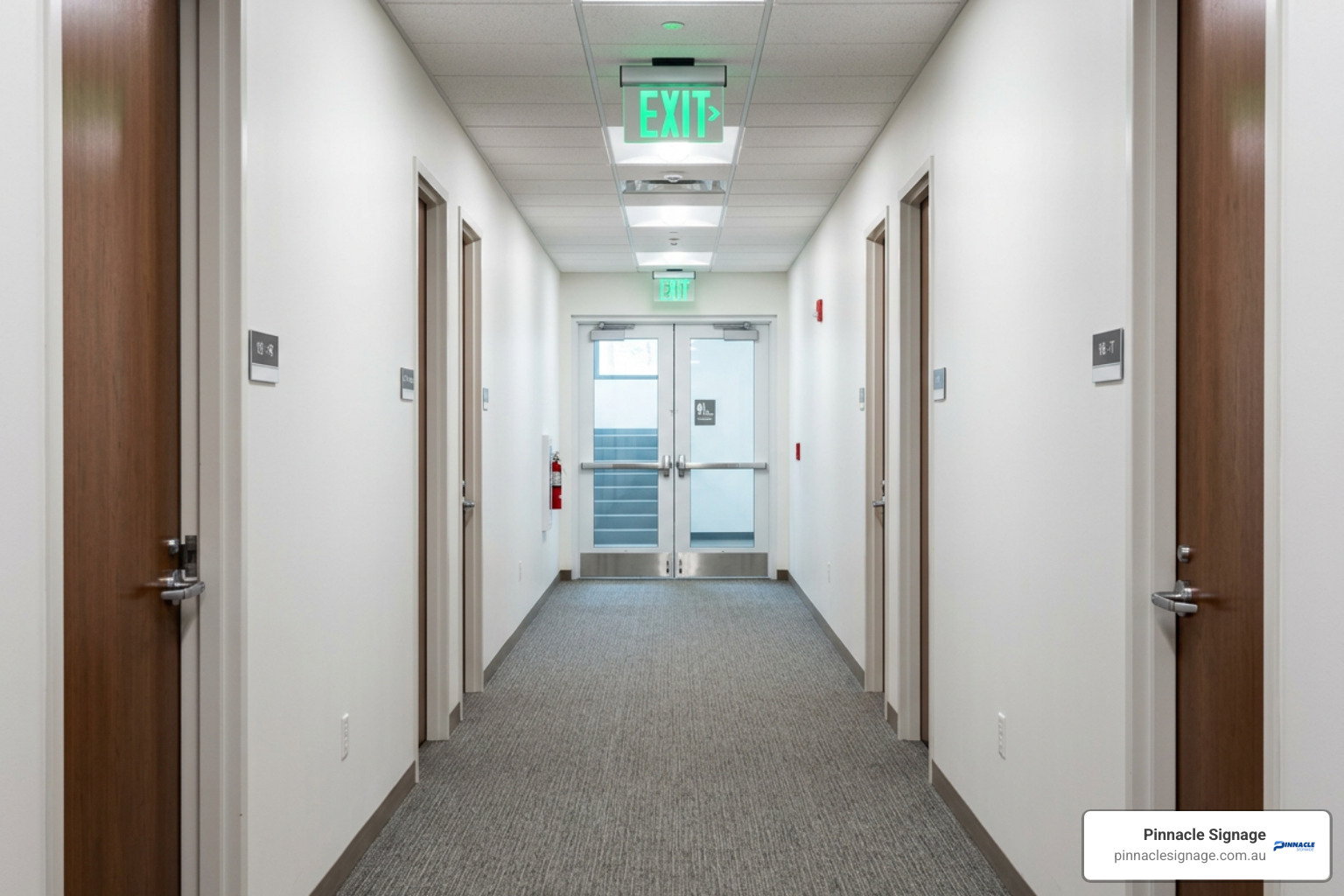
In Australia, the framework for building safety is primarily governed by the National Construction Code (NCC), formerly known as the Building Code of Australia (BCA). When we talk about exit sign regulations, the NCC provides the legal mandate for where these signs must be installed based on the building's size, class, and use.
However, the technical "how-to" for the signs themselves is found in the Australian Standard AS 2293. This standard is the bible for emergency escape lighting and exit signs. It covers everything from the design and construction of the sign to its installation and ongoing maintenance. If you are operating a commercial property in New South Wales or anywhere else in Australia, staying on the right side of these rules is non-negotiable for workplace safety.
To dive deeper into the basics of how these signs function within a building, check out our entry and exit signs 101 guide.
The Role of AS 2293 in Australian Workplaces
AS 2293 is split into several parts. Part 1 focuses on the design, installation, and operation of the system. In an Australian workplace, this means ensuring that every exit sign is not just a piece of plastic on the wall, but a functioning light fitting. Under this standard, exit signs must be green and luminous, ensuring they remain visible even if the main power grid fails during a storm or fire.
We ensure our products are manufactured to help you meet these Australian Standards. Whether you need a standard "EXIT" sign or a specific directional arrow, the goal is to provide a clear, unmistakable path to safety. You can find more details on choosing the right types in our entry and exit signs 101 resource.
Why Exit Sign Regulations Matter for Business Owners
For a business owner or site manager, compliance is about more than just avoiding a fine from a local council or fire inspector. It is about protecting your most valuable assets: your people. In a high-stress emergency, like a sudden power outage or a chemical spill, panic can set in quickly. Clear, compliant signage acts as a "silent guide," helping occupants find the exit without hesitation.
From a legal perspective, failing to adhere to exit sign regulations can lead to significant liability if an injury occurs during an evacuation. Insurance companies also look closely at safety system maintenance records during claims. To help you stay organised, we have put together a cheat sheet to compliant exit entry signage that breaks down the essentials for Australian facilities.
Visibility and Placement Standards for Egress Paths
Proper placement is just as important as the sign itself. If a sign is tucked behind a pallet rack or mounted too high to see through rising smoke, it might as well not be there. In Australia, the bottom of an exit sign should generally be mounted no more than 2030mm (about 6 feet 8 inches) above the top edge of the doorway or egress opening.
Visibility must be maintained from any direction of travel. This means if you are standing in a corridor, you should be able to see an exit sign or a directional indicator at all times. AS 2293.2-2019 outlines strict requirements for the illumination levels of these signs, ensuring they provide enough light to be seen clearly without being obstructed by decorations or other building features.
Lettering and Symbol Requirements
While some international standards vary, Australian exit sign regulations are very specific about dimensions to ensure legibility.
- Letter Height: The word "EXIT" must have letters at least 15.2cm (6 inches) high.
- Stroke Width: The principal strokes of the letters must be at least 1.9cm wide.
- Symbols: The ISO 7010 "running man" symbol is the standard pictogram used alongside or in place of text. It features a green background with a white figure moving toward a door.
- Contrast: There must be a high level of contrast between the green and white elements to ensure visibility for those with vision impairments.
Strategic Placement for Non-Obvious Exits
If the path to the nearest exit isn't immediately obvious, you must use directional signage. This is common in large warehouses, complex office layouts, or shopping centres.
- Corridor Intersections: A sign must be placed where hallways meet to show which way to turn.
- Change in Direction: Any time the path of travel turns, a sign with a chevron arrow is required.
- Stairwell Entrances: Every entrance to a fire-isolated stairwell must be clearly marked.
- Floor Proximity Signs: In some high-risk buildings, signs are mounted near the floor (between 150mm and 455mm high) because smoke rises, and the floor may be the only place with clear visibility during a fire.
Explore our full Pinnacle Signage Exit and Entry Collection to find signs that fit these specific placement needs.
Maintenance and Testing Protocols for Safety Systems
An exit sign that doesn't light up during a power failure is a major hazard. That is why exit sign regulations mandate a strict testing schedule. Every exit sign in a commercial building must be able to operate on its backup battery for at least 90 minutes.
Maintenance isn't just a "set and forget" task. It involves:
- Monthly Visual Checks: Ensuring the signs are physically intact and the "charge" light is on.
- Six-Monthly Functional Tests: A licensed professional must trigger a "discharge test" to ensure the battery holds up for the full 90-minute duration.
Mandatory Testing Schedules for Exit Sign Regulations
Under AS 2293.2, these six-monthly tests are a legal requirement for all commercial buildings in Australia. During the test, the main power to the exit lights is cut, and the signs must remain illuminated solely by their internal batteries. Written records of these tests must be kept on-site for inspection by fire authorities.
Manual testing is common, but some modern systems use self-testing or computer-monitored diagnostics that can alert you to a battery failure automatically. Regardless of the method, the goal is 100% functionality.
Directional Signage and Exit Sign Regulations for Complex Layouts
In buildings with confusing layouts, directional signs with chevron indicators are your best friend. These arrows must be identifiable from a distance (often up to 40 metres, depending on the sign size).
It is also vital to label doors that look like exits but lead to dead ends or hazardous areas. Doors leading to storage rooms, electrical cupboards, or boiler rooms should be marked with "Not an Exit" or "No Exit" signs to prevent people from becoming trapped during a rush to evacuate. For a deeper dive into these requirements, read the ultimate guide to exit fire signs.
Different Types of Compliant Exit Signage
When selecting signs for your facility, you generally have two main choices: electrically powered signs or photoluminescent (glow-in-the-dark) signs. Both have their place in Australian safety systems, but they function differently.
Choosing Between Electrical and Photoluminescent Options
- Electrically Powered: These are the most common. They are wired into the building's 240V power and contain a battery backup. "Maintained" signs stay on 24/7, while "non-maintained" signs only kick in when the power fails. We recommend maintaining systems for maximum safety.
- Photoluminescent: These signs don't require wiring or batteries. Instead, they "charge" using the ambient light in the room. To stay compliant with exit sign regulations, these signs must be exposed to a reliable light source (at least 54 lux) while the building is occupied so they can provide a 1.5-hour glow during a blackout. They are durable, have no moving parts, and are great for areas where running electrical wiring is difficult.
You can find a variety of these options, including those available at Pinnacle Signage at Bunnings, to suit your specific building needs.
Tactile and Braille Signage for Accessibility
Accessibility is a core part of Australian safety. Under AS 1428.1, certain exit signs must be accessible to people who are blind or have low vision.
- Placement: These signs are usually mounted on the wall adjacent to the latch side of the door.
- Height: The centre line of the sign should be approximately 1200mm to 1600mm above the floor.
- Features: They must include raised (tactile) lettering and Braille.
We offer Braille and Tactile Signage that is fully compliant with Australian Standards, ensuring your facility is inclusive and safe for everyone.
Frequently Asked Questions about Exit Signs
How long must exit signs stay lit during a power outage?
Under AS 2293, all emergency exit signs in Australia must remain illuminated for a minimum of 90 minutes on backup power. This provides enough time for occupants to evacuate and for first responders to sweep the building.
Do all commercial buildings need illuminated exit signs?
Generally, yes. The NCC mandates illuminated exit signs for any workplace with a floor area over 300m2. They are also required in Class 5 to 9 buildings (offices, shops, warehouses, factories), in any fire-isolated exit, and in any area where the path to the exit is not readily apparent.
Can I use "Not an Exit" signs on regular doors?
Yes, and you should! If a door could reasonably be mistaken for an exit during a panic, such as a door to a large storage closet or an electrical room, it must be marked with a "Not an Exit" sign to prevent confusion and potential entrapment.
Stay Compliant and Keep People Safe
At Pinnacle Signage, we understand that navigating exit sign regulations can feel like a chore, but it is one of the most critical parts of your building's safety system. From our warehouse in East Wagga Wagga, NSW, we manufacture premium, durable signage designed to withstand the tough conditions of Australian workplaces.
Whether you need a single replacement sign or a bulk order for a new construction project, we offer customisable text, logos, and dimensions to ensure you get exactly what you need. With our fast 48-hour dispatch and Australian-made quality, you can secure your facility without the long wait times.
Secure Your Facility with Pinnacle Signage
For high-quality, durable signage that meets Australian Standards, contact our team on 1300 40 45 50. We offer free shipping on orders over $100 AU Wide (excluding bulky items) and convenient warehouse pickup in East Wagga Wagga, NSW.
You can also find a selection of our range at Bunnings in-store and online at Pinnacle Signage at Bunnings. If you need something specific, you can search custom signage options or contact us for a quote today. Let us help you light the way to safety.