

Cheat Sheet to Compliant Exit & Entry Signage
Why Clear Signage is Non-Negotiable
Exit & Entry Signage is more than a compliance requirement - it's a critical safety tool that guides people through buildings and road networks every day. For any warehouse, construction site, or commercial property, clear signage ensures people know where to go, especially when seconds count.
Effective exit and entry signs serve several key functions:
- Guide people safely to exits during emergencies and normal operations.
- Direct facility traffic to entry points, restricted areas, and authorised zones.
- Support emergency evacuations by providing clear, visible pathways.
- Create positive first impressions for visitors, staff, and customers.
- Meet legal obligations under Australian Standards and building codes.
From photoluminescent glow-in-the-dark signs to LED-illuminated options, modern signage offers solutions for any environment, from office buildings to industrial facilities. Inside, they ensure people can evacuate quickly, even in low visibility. On roads, they help drivers navigate safely, particularly at complex interchanges.
The right signage reduces confusion, prevents accidents, and ensures that during an emergency, everyone knows exactly where to go. Poor or outdated signs can lead to dangerous delays and unnecessary risk. This guide will walk you through everything you need to know to make informed decisions and keep your people safe.
Quick look at Exit & Entry Signage:
The Language of Signs: Decoding Colour, Shape, and Text
Effective Exit & Entry Signage uses a visual language of colour, shape, and symbols to communicate instantly in high-stress situations. These standardised elements are designed for immediate recognition, helping to save lives.
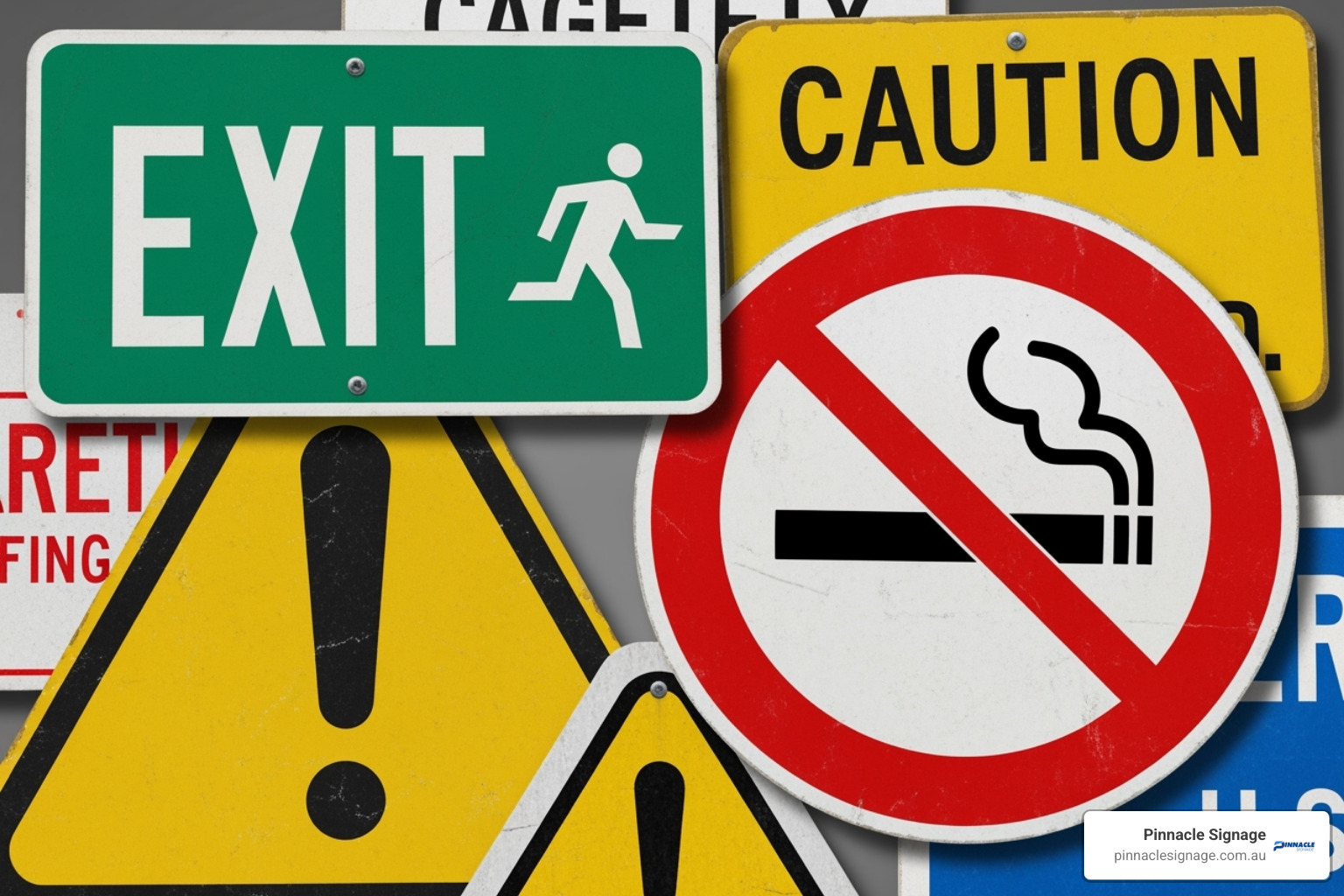
Colour Psychology in Signage
Colour is processed faster than text, making it a powerful tool for safety communication.
- Green: Universally means safety and "go," used for emergency exits to guide people to safety.
- Red: Signals danger, prohibition, or "stop," used for "No Entry" markers and stop signs.
- Yellow: Warns of hazards and urges caution, like on signs for uneven surfaces.
- Blue: Provides mandatory instructions or information.
- Orange: Indicates temporary conditions, such as roadwork zones or detours.
Shape Recognition
Shapes also provide instant meaning, often associated with specific instructions.
- Rectangles and Squares: Used for regulatory and directional information, like highway destination signs.
- Diamond: Warns of potential hazards ahead.
- Octagon: Exclusively used for stop signs.
- Triangle: Signals "yield" or give way.
- X-Shape: Reserved for railway crossings.
- Pentagon: Used for school zones.
Text and Symbols
While clear text is crucial, symbols like the running man on an exit sign transcend language barriers. Legibility is key, requiring appropriate text size for the viewing distance, high contrast, and simple, sans-serif fonts. In an emergency, text must be instantly readable, even through smoke or from a distance. For more detailed information about fire escape signage design, have a look at our guide: An Essential Guide to Fire Escape Signs.
A Guide to Exit & Entry Signage in Different Environments
The Exit & Entry Signage you need depends on the environment. A highway interchange requires different solutions than an office building or farm. Understanding these distinctions helps you choose effective signage that works for your specific needs.

Essential Signage Inside Your Building
Inside buildings like warehouses, offices, or shopping centres, signage must guide people safely and efficiently, especially during an emergency.
- Emergency exit signs: These are the backbone of building safety, marking the quickest escape routes. Many are illuminated to remain visible during power failures. Our Ultimate Guide to Exit Fire Signs offers more detail.
- Pathfinding signs: Directional arrows are critical in complex buildings, creating an intuitive visual path for evacuation. Learn more with our guide on Fire Exit Directional Signs.
- Entry and exit door labels: Simple signs like "Entry" or "Exit" manage daily traffic flow and prevent congestion.
- Restricted area signs: These improve security and safety by marking zones for authorised personnel only. View our range of Restricted Area Signage.
Navigating Roads and Work Sites
On Australian roads, signage must communicate clearly to drivers at speed to prevent accidents and ensure smooth traffic flow.
- Highway exit and interchange signs: These provide advance information about upcoming exits, route numbers, and destinations, helping drivers position themselves correctly.
- Advance guide signs: Appearing well before an exit, these signs use arrows to show which lanes lead off the freeway, giving drivers ample time to prepare.
- Temporary condition signs: Distinctive orange signs warn of road work, detours, or lane closures, keeping workers and drivers safe.
- Information and direction signs: Green rectangular signs inform drivers about distances and destinations. For detailed guidance, refer to Traffic Signs | Transport for NSW.
Specialised Exit & Entry Signage Applications
Signage also plays a vital role in more specialised Australian contexts.
- Farm and property entry: Signs can mark private property, direct vehicles, or provide instructions for visitors. The slow-moving vehicle sign is a common example on rural roads.
- Biosecurity checkpoints: These signs are crucial for preventing the spread of pests and diseases on farms and at processing plants by communicating entry and exit protocols. Explore Biosecurity Signs.
- Construction site access: Signage directs authorised personnel to specific entry points while keeping the public safely away from hazards.
- Event entry and exit management: Temporary signage is critical for guiding large crowds, preventing bottlenecks, and ensuring safe evacuation at events. Our guide to Evacuation Center Signage explores this further.
Key Considerations for Effective Signage
Choosing and installing Exit & Entry Signage requires careful thought to ensure visibility, durability, and compliance. Poorly planned signage can be as ineffective as no signage at all.

Visibility
A sign is only useful if it can be seen and understood quickly. Consider placement height, viewing distance, and potential obstructions. Signs must be legible from across the intended space and have an unobstructed view. Lighting is also critical, as a sign visible in daylight may disappear at night or during a power outage.
Durability and Materials
The right material ensures your signage lasts. For outdoor use, weather-resistant materials are essential to withstand the sun and rain. In public spaces, consider vandal-resistant options that can handle tampering or impacts. Choosing materials designed for the specific environment, whether indoor or outdoor, is key to longevity.
Technology and Innovation
Modern technology has greatly improved signage effectiveness.
- Photoluminescent signs: These "glow-in-the-dark" signs absorb ambient light and emit it in darkness, providing a reliable, power-free guide during outages or in smoke.
- LED illuminated signs: Bright and energy-efficient, LED signs are impossible to miss. They are highly effective in large facilities or car parks where absolute clarity is needed. See how LED technology improves safety with our Illuminated Stock Ahead Signs.
Accessibility
Inclusive design ensures everyone can steer your facility safely.
- Bilingual signs: In areas with diverse populations, adding a second language or using universal symbols improves comprehension.
- Braille and tactile signs: Required for compliance with Australian accessibility standards, these signs feature raised lettering and Braille, enabling navigation through touch for visually impaired individuals. Learn more about Braille & Tactile Signage.
Ensuring Your Signage is Compliant and Safe
Proper Exit & Entry Signage is about protecting lives and meeting your duty of care. When done right, it provides clear direction during an emergency. When done poorly, the consequences can be severe.
Legal Implications and Safety Responsibilities
Facility managers and property owners have a legal responsibility to provide a safe environment. Incorrect or missing signage can delay evacuations during a fire or other emergency, leading to injury, fines, and reputational damage. Effective signage is the foundation of any emergency plan. For detailed guidance on workplace safety obligations, refer to Safe Work Australia.
Australian Standards and Regulations
In Australia, signage must meet specific standards for consistency and effectiveness. Our products are designed to meet these requirements, ensuring your signage is both legally sound and effective.
Practical Compliance Checks
Installation is just the beginning. Ongoing maintenance is essential.
- Regular inspections: Routinely walk through your facility to check for fading, damage, or obstructions. Ensure signs are clean and clearly visible from the intended distance.
- Maintenance routines: Test illuminated signs monthly to ensure battery backups are working. Check that photoluminescent signs are not covered and can charge properly.
- Documentation: Keep records of all inspections and maintenance. This demonstrates due diligence and helps you stay organised.
Common Mistakes to Avoid
- Incorrect placement: A sign placed too high, too low, or in an obscured location is useless. Always consider sightlines.
- Poor visibility: Signs that are too small, faded, or poorly lit will not be seen in a high-stress situation.
- Outdated or damaged signs: Cracked, broken, or graffitied signs suggest neglect and can cause confusion or mislead people.
- Non-compliant designs: Using signs that don't meet Australian standards for colour, shape, or symbols can reduce effectiveness and create legal issues.
Frequently Asked Questions about Exit & Entry Signage
We often receive similar questions about Exit & Entry Signage. Here are answers to some of the most common ones.
How often should I inspect my exit signs?
Regular inspections ensure your signs will work when needed.
- Visual checks: On a daily or weekly basis, look for obvious issues like damage, dirt, or obstructions.
- Function tests: For illuminated signs, simulate a power failure monthly to confirm the battery backup works.
- Annual maintenance: A qualified professional should conduct a comprehensive annual test to ensure your system meets requirements. Keep detailed records of these tests.
What's the difference between an 'Exit' sign and a 'Not an Exit' sign?
This distinction is critical in an emergency.
- An 'Exit' sign marks a designated route that leads to a place of safety outside the building. These are mandatory for evacuation routes.
- A 'Not an Exit' sign is used to prevent confusion. It indicates that a door or path, which may look like an exit, is not part of the official evacuation plan, such as a door to a storeroom. This prevents people from entering dead ends or hazardous areas. For similar concepts, see our Prohibition Signage options.
Can I create custom entry and exit signs for my business?
Yes, and it is often a great idea. Custom signs allow you to maintain brand consistency with your company's colours and logo. More importantly, they let you convey specific instructions that standard signs cannot, such as "Deliveries Entry Only" or directions unique to your facility's layout. The key is to ensure your custom designs remain effective for their purpose. Our team can help you create a solution that works for your specific needs. Request a quote for Custom Signage.
Find the Right Signage Solution for Your Needs
Choosing the right Exit & Entry Signage partner is crucial for protecting people and meeting your legal obligations. At Pinnacle Signage, we deliver high-quality, durable signage solutions that Australian businesses depend on.
Exit & Entry signage guides people to designated points, ensuring safe evacuations and smooth navigation. Featuring clear arrows and recognisable symbols, these signs help people move quickly and confidently during emergencies. We manufacture our products in Australia, ensuring premium quality and fast turnarounds for orders of any size.
Running a business comes with enough challenges, your signage should not be one of them. Browse our full range of Exit & Entry Signage or shop selected products via Pinnacle Signage at Bunnings to find what you need. For bulk orders or specific requirements, we offer competitive margins for resellers and special distributor pricing. Get in touch for a custom quote and request a pricelist for your team.
Shipping & Pickup Information
We dispatch most items within 48 hours of order and payment confirmation. Our estimated delivery times across Australia are:
- 1 - 2 days: Sydney, ACT, Melbourne, Brisbane, Gold Coast
- 2 - 4 days: Rest of NSW, Rest of VIC
- 3 - 6 days: SA, North QLD, Perth
- 5 - 9 days: TAS, NT, WA
We use couriers like FEDEX for most deliveries. Please provide a valid daytime delivery address, as we cannot deliver to PO Boxes. A signature is required upon receipt, and re-delivery charges will apply if you are not present to accept the delivery. For items over 50kg, a tailgate delivery may be required for residential addresses, which is included in our standard shipping.
Free shipping is available for orders over $100 AU Wide on most items. For some bulky items, additional shipping costs may apply to WA, North QLD, NT, TAS, and island areas. Our staff will contact you if these charges apply.
If you prefer to collect your order, warehouse pickup is available at Unit 4/28 Nagle Street, East Wagga Wagga NSW. The warehouse is open from 8am to 5pm, Monday to Friday.