

Construction PPE Signs and Warnings You Can't Ignore
What Are Construction Site Warning Signs - and Why Do They Matter?

Construction site warning signs are standardised visual notices used to communicate hazards, enforce safety rules, and protect workers, visitors, and the public on active job sites.
Here is a quick overview of the most common types and what they mean:
- Danger signs - Red top panel with white text. Used for immediate, life-threatening hazards only.
- Caution signs - Yellow background with black triangle. Used for moderate or potential hazards.
- Mandatory signs - Blue circle with white symbol. Indicate required actions, such as wearing a hard hat or high-visibility vest.
- Prohibition signs - Red circle with a diagonal slash. Indicate actions that are not permitted.
- Emergency signs - Green background with white pictogram. Mark first aid stations and evacuation routes.
- Fire equipment signs - Red with white pictograms. Identify fire extinguishers and related equipment.
These sign categories are defined under AS 1319, the Australian standard governing safety signs in workplaces, including construction sites.
Construction sites are some of the most hazardous workplaces in Australia. Heavy machinery, open excavations, overhead work, and high foot traffic all create serious risks - not just for workers, but for anyone who comes near the site boundary. Clear, correctly placed signage is one of the most practical and legally important tools a site manager has to manage those risks.
Poor or missing signage does not just put people in danger. It also exposes your business to significant liability if something goes wrong.
I'm Doug Lindqvist, General Manager of Pinnacle Signage, and my background in the safety and industrial supply space has shown me how often the right construction site warning signs are the difference between a compliant, safe site and a costly incident. In the sections below, we will break down exactly what signs you need, where to place them, and what to look for when ordering.
Simple construction site warning signs word guide:
The Role of Construction Site Warning Signs in Workplace Safety
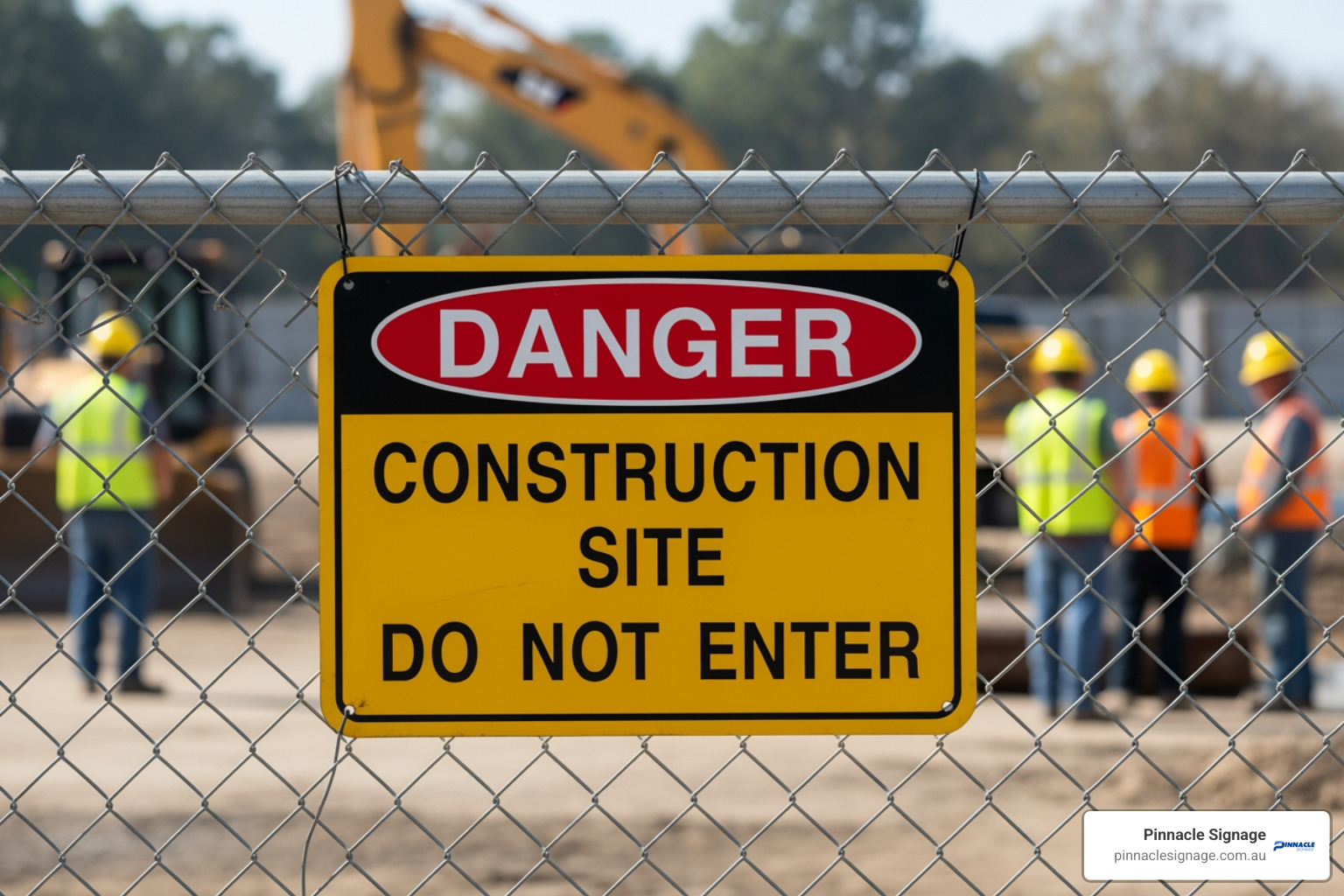
In the Australian construction industry, safety is not just a suggestion, it is a legal obligation. For businesses managing worksites, construction site warning signs support day-to-day hazard communication and help reinforce site rules for workers, contractors, visitors, and the public. When signage follows AS 1319 compliance, communication is more consistent and easier to understand across different worksites.
Accident prevention starts with clear communication. On a busy site in East Wagga Wagga or anywhere across NSW, there are constant changes in traffic flow, work areas, equipment movement, and access conditions. Signage acts as a visible reminder of site expectations and hazards, supporting safer behaviour throughout the day. For broader guidance on workplace signage, refer to official Australian government resources such as Safe Work Australia.
These signs also play an important role in public protection. A clearly positioned "Danger - Construction Site" or restricted access sign helps warn pedestrians and unauthorised visitors before they enter a hazardous area. For site managers and project teams, this supports a more organised safety system and can help demonstrate that practical risk controls were in place.
If you are reviewing signage across a worksite, Pinnacle Signage offers a wide range of standard and custom options through the Pinnacle Signage website and via Pinnacle Signage products at Bunnings.
Identifying Hazards with Construction Site Warning Signs
The main job of a safety sign is to identify a hazard before someone is exposed to it. Different sign categories are used to match the seriousness of the risk. Essential danger signs are intended for severe hazards, such as high voltage areas, deep excavations, or overhead crane work, where the consequences could be serious.
Caution signs are used for lower-level but still important hazards, such as uneven surfaces, trip points, or temporary obstructions. Using the right category matters. If every sign on site uses the strongest warning level, people are more likely to tune them out. Good visual communication relies on matching the sign to the hazard and placing it where a person can act on it in time.
Restricted access messages are also part of this system. Prohibition and notice signage can help separate authorised personnel from active work zones, plant movement areas, chemical storage spaces, and delivery zones.
Mandatory PPE Requirements and Construction Site Warning Signs
Personal protective equipment is a core part of construction site safety, but only when workers and visitors know what is required in each area. Construction site warning signs support this by displaying mandatory instructions at entry points and at the boundary of higher-risk zones.
- Hard Hat Zones: Used where overhead works or falling object risks are present.
- High-Visibility Vests: Important in areas with plant, deliveries, or vehicle movement.
- Protective Eyewear: Suitable for work zones involving dust, cutting, grinding, or splash risks.
- Hearing Protection: Common around demolition works, compressors, and other loud equipment.
Using a checklist for building site signs can help identify where mandatory messages are needed. These signs use the standard blue mandatory symbol format so the instruction is recognised quickly, even in busy environments.
For sites that need branded or site-specific instructions, Pinnacle Signage can provide customised signage with custom text, logos, colours, and dimensions.
Standard Colours and Shapes for Australian Site Signage
To maintain safety across different industries, Australia uses a standardised system of colours and shapes for signage. This ensures that a worker moving from a site in Sydney to a project in Wagga Wagga will immediately recognise the warnings.
- Danger Signs: These feature a red oval inside a black rectangle with the word "DANGER" in white. They indicate life-threatening conditions.
- Caution Signs: These use a yellow background with a black equilateral triangle and a pictogram. They warn against potential hazards.
- Mandatory Signs: These are blue circles with white symbols, indicating that a specific action or PPE is required.
- Prohibition Signs: These feature a red circle with a diagonal crossbar over a black symbol, showing what is not allowed (e.g., "No Entry").
- Emergency Information: Green signs with white text or symbols used for first aid and exits.
- Fire Signs: Bright red signs used to locate fire extinguishers, hoses, and alarms.
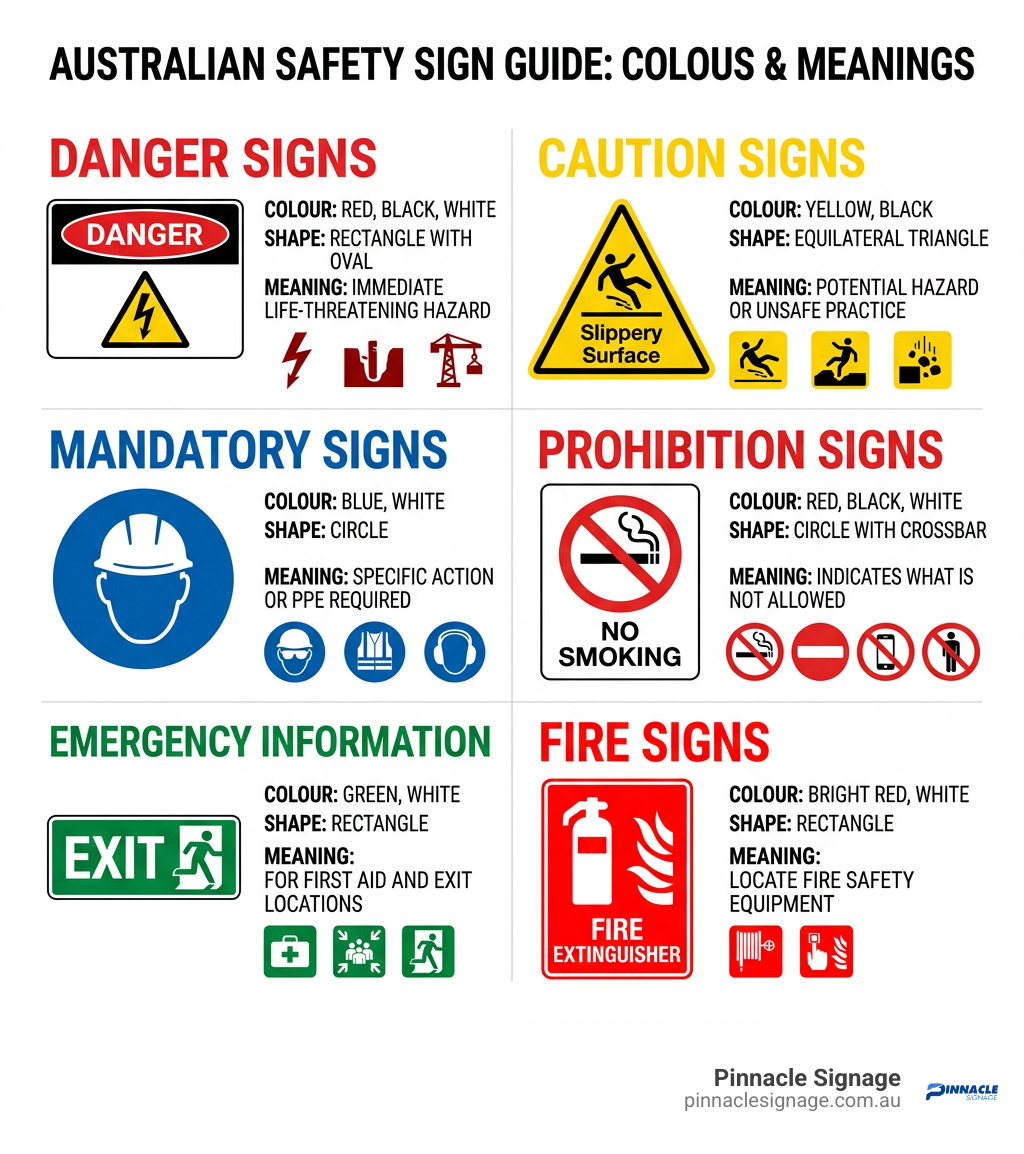
Australian Safety Sign Quick Reference
| Category | Standard colours | What it means |
|---|---|---|
| Danger | Red, black, and white | An immediate hazard that could cause serious injury or death |
| Caution | Yellow and black | A possible hazard or unsafe condition that needs care |
| Mandatory | Blue and white | A required action, such as wearing specific PPE |
| Prohibition | Red, white, and black | Something is not allowed, such as entry or certain activities |
| Emergency | Green and white | First aid, emergency exits, safety equipment, or safe conditions |
| Fire | Red and white | Fire alarms, extinguishers, hoses, and other firefighting equipment |
Strategic Placement for Maximum Visibility and Compliance
A sign is only effective if people can see it, read it, and understand it early enough to respond. That is why strategic placement matters just as much as the wording on the sign itself.
The first priority is usually the site entry and exit points. This is where site managers communicate key conditions of entry, required PPE, directional information, and restricted access messages. Perimeter fencing is another critical location, especially where the public may pass close to the work area. Clear warning and prohibition signs can help reduce the risk of unauthorised access.
Inside the site, signs are most useful where people make decisions, change direction, or approach a hazard. That includes high-traffic walkways, loading zones, temporary storage areas, electrical boards, excavations, and amenities access points.
When positioning signs, consider the following:
- Sight lines: Make sure signs are not hidden by materials, fencing mesh, machinery, or parked vehicles.
- Mounting height: For pedestrian areas, signs are generally easiest to read when mounted around eye level, often about 1.5 m to 1.8 m from ground level.
- Low light visibility: In dim conditions, night works, or roadside areas, reflective faces can improve visibility.
- Traffic interaction: Where signs face roads or vehicle routes, they should be suitable for a driver's viewing distance and site conditions.
For temporary setups, portable formats such as metal A-frame signs, cones and stands, barriers and bunting, and other worksite safety signage can help communicate changing conditions without altering the permanent site layout. If the job involves traffic interfaces or public-facing works, official Australian guidance should be checked through the relevant state authority or Safe Work Australia.
If you need standard site safety signs or tailored messages for a particular project, you can explore Pinnacle Signage's range online at Pinnacle Signage or through Pinnacle Signage at Bunnings.
Durable Materials for Harsh Australian Environments
Australia's conditions can be hard on outdoor signage. Sun exposure, dust, wind, rain, and changing temperatures can all reduce legibility over time, which is why construction site warning signs need to be made from durable, weather-resistant materials suited to the job.
The right material often depends on how long the sign will stay in place and where it will be installed:
- Weather-resistant poly: A practical choice for many outdoor construction environments because it is durable, lightweight, and suited to general site use.
- Metal signage: Often chosen where a tougher, longer-lasting sign is needed. For example, metal danger signs are a reliable option for exposed worksites.
- Corflute: Useful for temporary projects, short-term hazard messaging, or changing site conditions where lightweight signage is preferred.
- Reflective finishes: Helpful where visibility is needed in low light, around vehicle movement, or during early morning and evening work.
The fixing method also matters. Heavy-duty fixings help keep signs secure on fences, gates, walls, and temporary structures, particularly on exposed sites or in windy areas.
For businesses managing multiple sites or changing work zones, it can also be useful to combine permanent safety panels with temporary products such as cones and stands, barriers and bunting, warning and regulatory signage, or portable worksite formats already available through Pinnacle Signage.
If you want to compare available options, see Pinnacle's range of work zone signs for sale or browse Pinnacle Signage products at Bunnings. For site-specific requirements, custom options are available here: Pinnacle Signage.
Frequently Asked Questions about Construction Signage
What is the difference between Danger and Caution signs?
The difference lies in the level of risk. Danger signs are used for immediate hazards that could result in death or serious injury (like high voltage). Caution signs are for potential hazards or unsafe practices that could result in minor to moderate injury (like a trip hazard).
How often should site safety signs be inspected for damage?
We recommend a formal inspection at least once a month, or immediately following severe weather. Check for fading, physical damage, or any obstructions that might hide the sign. If a sign is no longer legible, it must be replaced immediately to maintain compliance.
Are bilingual safety signs necessary for diverse workforces?
While not always a strict legal requirement in every scenario, they are highly recommended for sites with a diverse workforce. Safety is about communication; if a worker cannot read the warning, the sign has failed. Using universal pictograms alongside text helps bridge this gap, but custom bilingual signs offer the highest level of protection.
Conclusion and Ordering Information
At Pinnacle Signage, we understand that every construction project has unique challenges. Whether you need standard site safety panels or customised signage featuring your company logo and specific site instructions, we are here to help.
Our products are manufactured to the highest standards, ensuring they stand up to the rigours of the Australian worksite. We offer a fast turnaround, with most orders dispatched within 48 hours. Plus, we provide free shipping on orders over $100 (excluding some bulky items) Australia-wide.
You can find a wide range of our Pinnacle Signage products at Bunnings both in-store and online for your convenience. If you are local to the Riverina, you can also opt for warehouse pickup at our facility in East Wagga Wagga, NSW, open Monday to Friday.
Ready to secure your site? Browse our full range online or contact our expert team today.
- Website: https://pinnaclesignage.com.au/
- Custom Orders: Get a custom quote here