

From Explosions to Biohazards: A Comprehensive Look at Safety Symbols
Why Understanding Danger Symbols Could Save Lives
A danger symbol is a critical visual warning designed to prevent workplace accidents, injuries, and fatalities. These internationally recognised pictograms communicate hazards instantly, transcending language barriers to deliver life-saving information at a glance.
Common danger symbols you'll encounter include:
- GHS Pictograms - Nine standardised symbols for chemical hazards (explosive, flammable, toxic, corrosive)
- Biohazard Symbol - Three interlocking circles warning of biological risks
- Radiation Trefoil - Three-blade symbol indicating ionising radiation
- High Voltage Symbol - Lightning bolt warning of electrical danger
- Skull and Crossbones - Universal symbol for deadly toxic substances
Across all Australian industries, from construction to healthcare, danger symbols are the backbone of workplace safety communication. More than just a regulatory requirement, they are a first line of defence against preventable accidents.
Understanding these symbols allows teams to identify risks and respond appropriately, preventing severe consequences like chemical burns, electrical shock, or long-term health issues.
Decoding the Danger Symbol: Types, Meanings, and Standards
A danger symbol is more than a picture; it's a piece of visual communication that could save your life. These symbols form a universal language, speaking directly to our instincts about hazards. Whether you're on a construction site in Darwin or in a chemical facility in Melbourne, understanding these symbols is essential for keeping your team safe and your business compliant.
Common Types of Danger Symbols and Their Meanings

At the heart of chemical safety are the GHS pictograms, nine standardised symbols from the Globally Harmonised System of Classification and Labelling of Chemicals.
Here are the essential symbols you'll see in Australian workplaces:
- Explosive (GHS01): An exploding bomb warns of substances that can detonate from heat, shock, or friction.
- Flammable (GHS02): A flame indicates materials that easily catch fire. Our Flammable GHS Design helps communicate this risk.
- Oxidising (GHS03): A flame over a circle marks materials that can intensify fires.
- Gas Under Pressure (GHS04): A gas cylinder warns of compressed gases that can explode if heated.
- Corrosive (GHS05): This symbol shows material destroying skin and metal, representing acids and alkalis.
- Acute Toxicity (GHS06): The skull and crossbones indicates substances that can cause death or serious harm.
- Health Hazard (GHS08): A person with a starburst on their chest warns of long-term risks like cancer or organ damage.
- Irritant (GHS07): An exclamation mark signals less severe hazards like skin irritation.
- Environmental Hazard (GHS09): A dead tree and fish show a substance is harmful to the environment.
Beyond GHS, other critical signs include the biohazard symbol (interlocking circles) for biological risks, the radiation trefoil (three-blade design) for ionising radiation, and the high voltage symbol (lightning bolt) for fatal electrical dangers. For compliant chemical safety signage, explore our GHS Signage collection.
The Science of Sight: Design Principles of an Effective Danger Symbol
An effective danger symbol uses a fascinating blend of psychology and design to communicate risk instantly.
Colour is fundamental. Red signals immediate danger, triggering an urgent response, while yellow serves as a caution, telling us to be aware and proceed carefully. This colour psychology is deeply embedded in human biology.
Shape also conveys meaning: triangles for warnings, diamonds for transport visibility, and circles for prohibitions. The most effective symbols are simple and universally recognisable, like a flame for fire, ensuring they are understood in a split second, regardless of language or culture.
Understanding the nuanced differences between warning levels is crucial. For deeper insights, check out our guide on Caution vs. Danger vs. Warning: What's the Difference?.
A Brief History and Evolution of Warning Symbols
The history of the danger symbol reflects our response to new, man-made threats. The skull and crossbones, for example, evolved from medieval imagery to become the universal poison symbol.
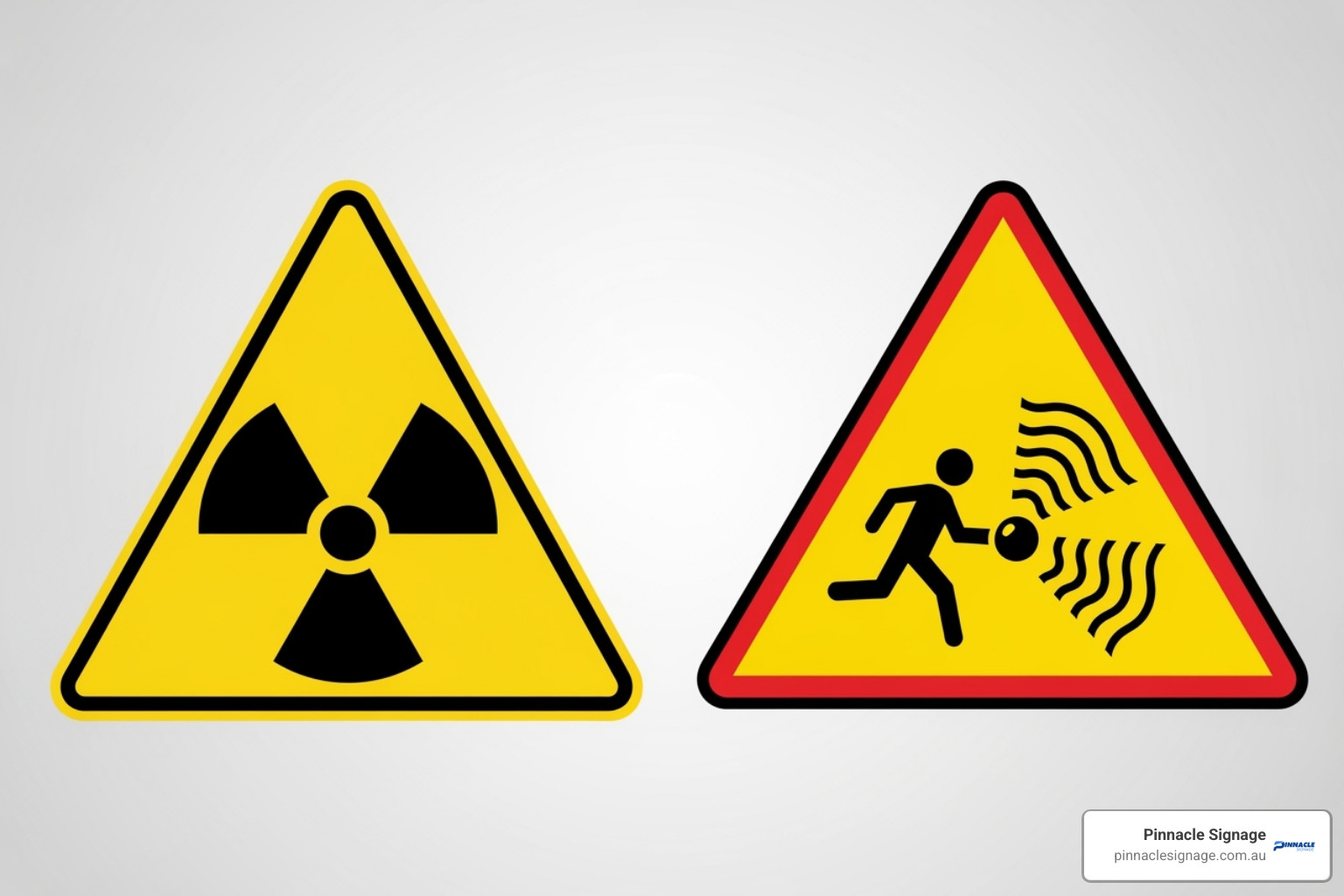
Modern symbols have more precise origins. The radiation trefoil was created in 1946, chosen for its unique design to be associated only with radiation. Recognising it required education, the IAEA later introduced a supplemental symbol with more intuitive imagery. You can read more in A Symbolic History of the radiation symbol.
Similarly, the biohazard symbol was developed by Dow Chemical in 1966 through a process that tested for memorability. Its initially meaningless design ensured it wouldn't be confused with other symbols. More on its origins can be found in the Biohazard Symbol History. Today's challenge is designing warnings for nuclear waste that can be understood for 10,000 years, pushing symbol design to its limits.
Standardisation: Ensuring Universal Understanding
Without standardisation, a chemical hazard could be represented differently from one workplace to the next, leading to dangerous confusion. Key standards create a universal language for safety.
- The Globally Harmonised System (GHS) ensures chemical hazards are communicated consistently worldwide.
- In Australia, AS 1319 sets the local framework, defining the use of Danger Signs (red oval for life-threatening hazards) and Warning Signs (yellow for less severe risks).
- The Hazchem code system on transport vehicles gives emergency responders immediate information for handling incidents. Our Hazchem Signage meets these strict requirements.
Standardisation means that once learned, these symbols work everywhere, protecting workers and emergency responders across projects and borders. For more on identifying and communicating hazards, explore The Definitive Guide to Safety Sign Hazard Identification.
Choosing the Right Signage for Your Workplace
When it comes to implementing a danger symbol in your workplace, the decision goes far beyond simply meeting compliance requirements. It's about creating an environment where every person who enters your site immediately understands the risks they might face. At Pinnacle Signage, we've worked with businesses across Australia to ensure their safety signage isn't just compliant - it's genuinely effective at protecting lives.
Common Applications Across Australian Industries
Every industry faces its own unique set of hazards, and understanding these specific risks is crucial for selecting the right danger symbol for your workplace.
Construction sites are dynamic environments requiring multiple signs. These include high voltage warnings, deep excavation alerts, confined space entry protocols, and warnings for overhead cranes and demolition work. For more guidance, see our article on Essential Danger Signs for Work in Progress Areas.
Healthcare facilities rely on biohazard symbols for infectious materials and radiation warnings for areas with X-ray or MRI equipment to protect staff and patients from exposure.
Agricultural properties need clear signage for chemical storage areas to protect people, livestock, and crops. Biosecurity signage has also become vital for preventing the spread of pests and diseases. Our Biosecurity Signs are designed to help maintain these important protocols.
Manufacturing plants use a comprehensive range of signs for forklift operating areas, corrosive and flammable materials, and toxic substances to manage machinery and chemical hazards effectively.
Your Partner in Workplace Safety
Selecting the right safety signage is an investment in your people. At Pinnacle Signage, we provide solutions that meet Australian standards and withstand our harsh local conditions.
We manufacture our signs in Australia using high-quality, weather-resistant materials built to last, from tropical humidity to harsh sun. We offer a comprehensive range of standard danger symbol signs and also specialise in custom solutions. If you need specific text, logos, or dimensions, we can create signage that meets your exact needs while remaining compliant.

For organisations requiring bulk orders, such as construction companies, mining operations, or agricultural cooperatives, we offer special distributor pricing. Our streamlined production means we can dispatch most orders within 48 hours.
Beyond supplying signs, we offer genuine expertise. If you're unsure about regulatory requirements or need guidance, our experienced team is ready to help. For a comprehensive guide, we recommend reading Warning: Your Ultimate Guide to Workplace Hazard and Danger Signs.
Investing in quality danger symbol signage is investing in peace of mind. Don't leave workplace safety to chance. For a custom quote or to discuss distributor pricing, please Contact Us for a custom quote.
Shipping & Pickup Information
We dispatch most items within 48 hours of receiving your order and payment confirmation. Delivery times are estimated as follows:
- 1 - 2 days: Sydney, ACT, Melbourne, Brisbane, Gold Coast
- 2 - 4 days: Rest of NSW, Rest of VIC
- 3 - 6 days: SA, North QLD, Perth
- 5 - 9 days: TAS, NT, WA
For most deliveries within Australia, we use courier services such as FEDEX. Please note that couriers cannot deliver to PO Boxes, so provide a valid daytime delivery address. To ensure safe delivery, a signature is required upon receipt. You must be available to accept courier deliveries; re-delivery charges will apply if you are not present. Include a daytime phone number with your shipping details if we need to contact you about your delivery. For items weighing over 50kg, a tailgate delivery is usually required for residential addresses. This service is included in our standard shipping. Alternatively, you can choose to pick up the item from a nearby depot.
Free shipping is available for orders over $100 AU Wide. This applies to most items on the site. However, for some bulky items, additional shipping costs will apply for deliveries to WA, North QLD, NT, TAS, and island areas. Our staff will reach out to you after your order if these charges apply.
Pickup is available at our warehouse, located at Unit 4/28 Nagle Street, East Wagga Wagga NSW. The warehouse is open from 8am to 5pm, Monday through Friday, and is closed on weekends and public holidays.