

How to Use Health and Safety Signs in the Workplace Effectively
Why Clear Signage is Non-Negotiable for Workplace Safety
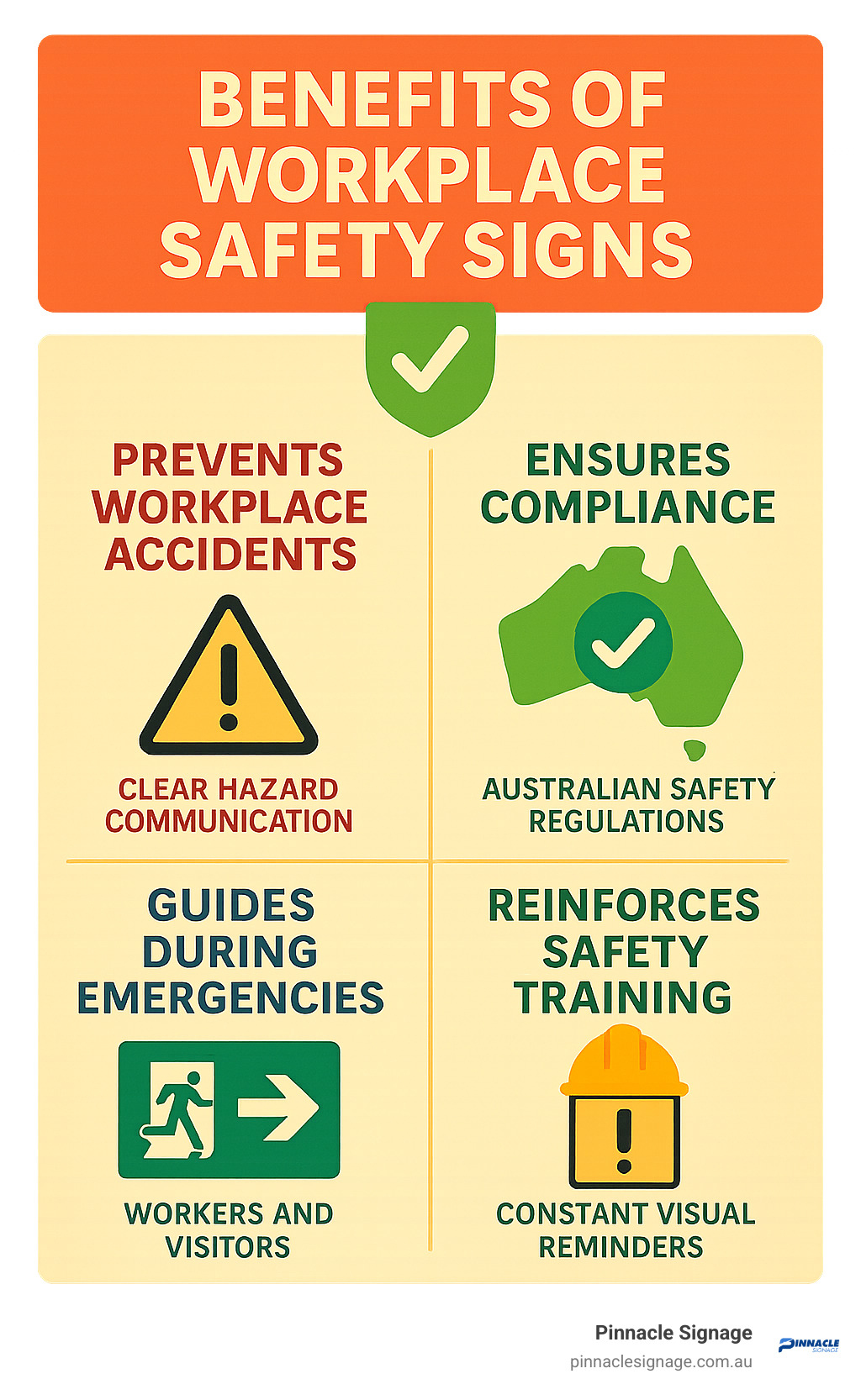
Health and safety signs in the workplace are a first line of defence against accidents and injuries. These visual tools instantly alert workers and visitors to potential hazards, mandatory actions, and emergency procedures, communicating critical information without relying on verbal instructions.
The five main types of workplace safety signs are:
- Prohibition signs (Red circle) - Tell people what they must NOT do.
- Warning signs (Yellow triangle) - Alert to potential hazards and dangers.
- Mandatory signs (Blue circle) - Show what people MUST do for safety.
- Safe condition signs (Green rectangle) - Guide to safety equipment and exits.
- Fire safety signs (Red rectangle) - Indicate fire equipment locations.
According to Safe Work Australia, many of the workplace injuries that cost the Australian economy billions each year are preventable through better hazard communication. Clear, compliant signage reduces these risks by providing instant visual cues that transcend language barriers.
From construction sites with heavy machinery to office buildings with evacuation routes, effective safety signage creates safer environments. An investment in quality signs pays dividends through fewer incidents, a stronger safety culture, and demonstrating due diligence to regulators. The right signage, delivered quickly and built to last, makes the difference between a reactive and a proactive safety approach.
A Guide to Health and safety signs in the workplace
In any well-managed Australian workplace, clear signage acts as a silent safety guardian. Health and safety signs in the workplace are not just decorations; they are essential tools that work around the clock to prevent accidents.
In critical moments, these signs provide a constant, reliable voice of safety. They communicate instantly across language barriers, which is invaluable in Australia's diverse workforce. Clear visual guidance helps create an environment where people feel safe and can focus on their work, knowing that risks are clearly communicated.
Decoding the Colours and Shapes: Types of Safety Signs Explained
The colours and shapes on safety signs are a universal language designed for instant recognition, whether you're on a Sydney construction site or in a Perth warehouse.
- Prohibition signs use a bold red circle with a diagonal line to mean "stop" or "do not." When you see a "No Smoking" or "Do Not Enter" sign, the message is an absolute restriction.
- Warning signs feature an eye-catching yellow triangle to signal caution. This shape instinctively makes us slow down and pay attention to messages like "Slippery Surface" or "High Voltage."
- Mandatory signs use a calm but authoritative blue circle to indicate a required action. Signs like "Wear Eye Protection" or "Safety Helmets Must Be Worn" communicate a necessary step for safety.
- Safe condition signs offer reassurance with a green rectangle. Green universally means "safe" or "go," guiding people to an "Emergency Exit" or "First Aid Kit" with a sense of direction.
- Fire safety signs use a red rectangle to clearly mark the location of fire equipment. This makes signs for "Fire Extinguisher" or "Fire Hose Reel" easy to spot, even in an emergency.
This consistent system ensures that once someone understands the basics, they can steer any properly signed workplace safely. For more details, see The Definitive Guide to Safety Sign Hazard Identification and learn All About Fire Signs: Safety.
Understanding Chemical and Hazard Communication Symbols
A universal system of pictograms is used to communicate chemical hazards worldwide. These symbols, with their distinctive red borders, tell clear stories about risk.
Key pictograms for chemical hazards include:
- Exploding Bomb: For explosion or reactivity hazards.
- Flame: For flammable materials.
- Flame Over Circle: For oxidising hazards.
- Gas Cylinder: For gases under pressure.
- Corrosion: For materials that cause skin burns or corrode metal.
- Skull and Crossbones: For substances with acute toxicity (can be fatal).
- Health Hazard: For long-term risks like carcinogenicity.
- Exclamation Mark: For less severe hazards like skin irritation.
- Environment: For hazards to the aquatic environment.
Understanding these symbols empowers workers to take the right precautions. For a deeper dive, read our Know Your Hazard Symbols: A Guide to Chemical Signage or consult official resources on the classification and labelling of chemicals.
Choosing the Right Materials for Durability and Visibility
A safety sign is only effective if it remains clear and legible. In Australia's harsh conditions, from intense sun to coastal humidity, material choice is critical.
- Aluminium signs are the gold standard for durability. They resist rust, impact, and extreme temperatures, making them ideal for outdoor and industrial use.
- Laminated vinyl offers great versatility, conforming to curved or irregular surfaces. The lamination protects against UV damage, chemicals, and abrasion.
- Polypropylene is a cost-effective and flexible option that handles moisture and many chemicals well, suitable for environments requiring frequent cleaning.
The right material ensures your health and safety signs in the workplace remain effective for their entire service life. Learn more about Making Your Workplace Safe and Secure with High-Quality Safety Signage.
Common Mistakes to Avoid with Health and safety signs in the workplace
Even with good intentions, common mistakes can undermine your signage. Avoid these pitfalls:
- Incorrect placement: Signs must be at eye level, well-lit, and in a person's direct line of sight. If a sign is hard to find, it has already failed.
- Obstructed signs: Regularly check that signs are not blocked by equipment, stacked inventory, or dirt. A partially visible sign is an ineffective one.
- Outdated information: Signs must reflect current procedures and hazards. Outdated signs erode trust in your safety system.
- Sign clutter: Too many signs in one area create "visual noise," causing important messages to be ignored. Prioritise essential signs over quantity.
- Poor visibility: Use signs that are large enough for the viewing distance and have sufficient colour contrast.
- Using worn-out signs: Faded, peeling, or damaged signs suggest that safety is not a priority. Replace them promptly.
- Neglecting employee training: Signs reinforce training; they don't replace it. Ensure your team understands the meaning behind each sign.
Avoiding these errors ensures your signs are powerful tools for accident prevention. For more tips, read Workplace Safety Signs That Speak Louder Than Words.
Fostering a Culture of Safety with Effective Signage
Health and safety signs in the workplace are more than just compliance tools; they are ambassadors for your safety culture. When employees see clear, well-maintained signage, it sends a powerful message that their well-being is a genuine priority.
These visual cues work around the clock, reinforcing training and combating complacency. A well-placed sign can snap someone out of autopilot, prompting them to pause and take precautions. This builds trust and encourages employees to actively participate in safety practices, rather than just comply with rules.
Keeping Your Signage Effective and Your Team Informed
Installing signs is the first step. To ensure they remain effective, ongoing attention is required.
- Regular audits: Walk through your site periodically to check that signs are still visible, relevant, and in good condition.
- Sign maintenance: Keep signs clean from dust and grime that can reduce visibility. Even durable materials like aluminium and laminated vinyl benefit from occasional cleaning.
- Update as hazards change: As your workplace evolves with new equipment or processes, your signage must keep pace to remain accurate.
- Employee training: Ensure everyone understands what each sign means and the actions required. This is especially important for specialised signs like those for Personal Protective Equipment signs.
- Reinforce safety messages: Encourage team members to report missing or damaged signs. This shared responsibility strengthens your safety culture.
Find the Right Health and safety signs in the workplace for Your Business
Every Australian workplace has unique challenges, from the harsh sun in Queensland to busy warehouses in Melbourne. At Pinnacle Signage, we understand these local conditions and manufacture our signs to meet the demands of your environment.
Whether you manage a construction site in regional NSW, a retail store in Adelaide, or a medical facility in Perth, we have the right health and safety signs in the workplace for your needs. Our signs meet Australian standards and are built to last.
We know safety is urgent. Our stock products ship within one day, and custom orders typically ship within 2 to 5 days. With free shipping on orders over $29.95, keeping your workplace safe and compliant is simple.
Ready to upgrade your workplace safety signage? Explore our full range of high-quality safety signage and find what your business needs to create a safer environment.