

Rally Points and Refuge: Everything You Need to Know About Assembly Signs
Guiding Your Team to Safety in an Emergency
An emergency evacuation assembly point sign is a critical safety tool that designates a safe location for people to gather during an evacuation. Featuring a green background with white text and symbols, these signs direct everyone to a specific meeting point away from potential hazards.
When an emergency strikes, every second counts. Clear signage can mean the difference between an orderly evacuation and dangerous confusion. Assembly point signs guide your team to safety, help emergency services locate everyone, and ensure accountability during critical moments.
Strategically placed signs ensure everyone can quickly find the designated area, facilitating efficient headcounts and safety. Without them, people may scatter, making it impossible to provide assistance where needed.
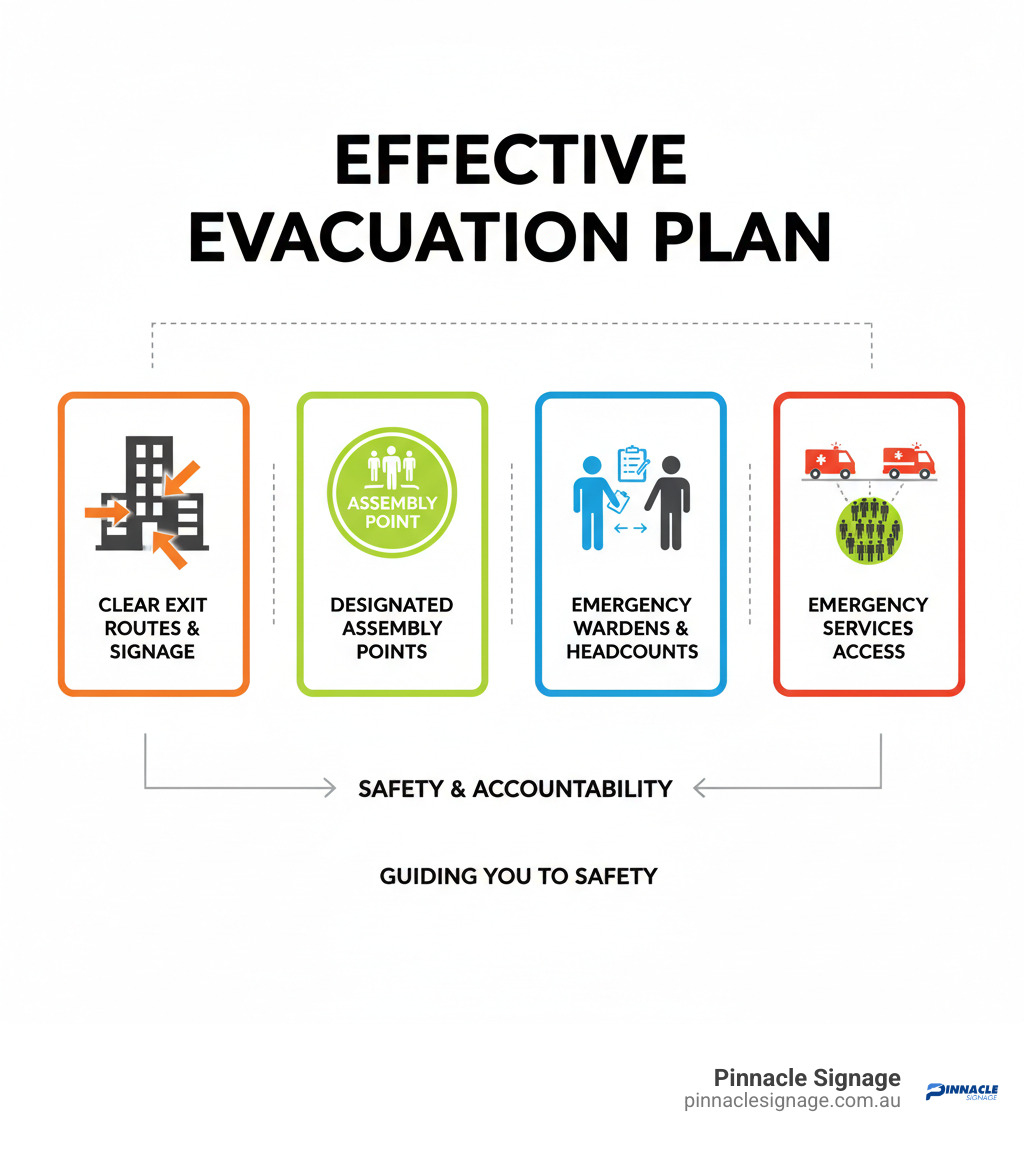
Emergency evacuation assembly point sign definitions:
Your Complete Guide to the Emergency Evacuation Assembly Point Sign
What Are Assembly Point Signs and Why Are They Crucial?
An emergency evacuation assembly point sign acts as your workplace's safety guide during a crisis. When alarms sound, these signs eliminate confusion by marking a designated safe location—often called a "muster point", where all personnel should gather.
Without a clear direction, people might scatter, creating a dangerous and chaotic situation. Assembly point signs prevent this by providing a visible target for everyone to reach safely. They are the cornerstone of effective emergency preparedness, enabling an orderly evacuation, simplifying headcounts for accountability, and ensuring emergency services can access the site and get information efficiently. The assembly point also becomes a central communication hub for providing updates and instructions.
For a deeper understanding of these critical safety zones, explore our comprehensive guide: Muster Points Explained: Keeping Your Team Safe in Emergencies.
Key Features of an Effective Emergency Evacuation Assembly Point Sign
To ensure your emergency evacuation assembly point sign is effective and compliant in Australia, it must follow guidelines based on Australian Standards (AS 1319:1994). These standards focus on clear, immediate communication during a crisis. Key features include:
- Recognisable Design: Signs use a green background with white symbols and text, a colour scheme universally understood for safety and emergency information.
- Clear Symbols: They feature simple pictograms of people gathering, often with arrows, which are easily understood by everyone, regardless of language.
- Simple Wording: The message is reinforced with clear text like "Emergency Assembly Point" or "Muster Point."
- High Visibility: Signs must be large and clear enough to be read from a distance, ensuring they are visible during a stressful evacuation.
- Lasting Durability: They are made from materials designed to resist fading and damage, ensuring they remain reliable in their specific environment.
Choosing a sign with these features ensures it meets Australian compliance standards and works effectively when you need it most.
For comprehensive information about Australian safety sign standards, review our detailed guide: Safety Signs Australia: Your Guide to Clear and Compliant Signs.
Choosing the Right Material for Your Signage
The effectiveness of your emergency evacuation assembly point sign depends on choosing the right material for your environment.
- Aluminium and Aluminium Composite Panel (ACP): Offer exceptional strength and durability for demanding outdoor environments. They are rust-proof and resistant to chemicals and extreme temperatures, making them ideal for long-term installations.
- Polypropylene (Rigid Plastic): A popular choice that balances durability and cost-effectiveness. This lightweight material is suitable for both indoor and many outdoor applications.
- Corflute (Corrugated Plastic): Provides great value for temporary or short-term installations. Its lightweight construction makes it ideal for construction sites or events where signage needs change frequently.
- Self-adhesive Vinyl Stickers: A versatile and cost-effective option for application on smooth, clean surfaces. They are easy to apply and suitable for a wide range of indoor uses.
- Photoluminescent Materials: These signs glow in the dark after being exposed to light, making them invaluable during power outages or in low-light conditions. They are available in both rigid plastic and vinyl formats.
For signs in challenging environments, an over-laminate can be applied to protect against abrasion, sunlight, and chemicals, significantly extending their lifespan.
To make the best material choice for your specific requirements, explore our comprehensive guide: How to Choose the Right Signage for Your Australian Business.
Best Practices for Placement and Visibility
A perfectly compliant emergency evacuation assembly point sign is useless if it can't be seen. Strategic placement is key to its effectiveness.
- Clear Sightlines: Signs must be visible from all evacuation routes. Use smaller directional signs along corridors and stairwells to guide people toward the main assembly point.
- Safe Distance from Hazards: The assembly point must be located far enough from the building to protect evacuees from fire, smoke, or falling debris.
- Accessibility: The path to the assembly point should be clear and navigable for everyone, including those with mobility challenges.
- No Obstructions: Regularly check that signs are not blocked by parked vehicles, overgrown plants, or stored equipment.
- Adequate Lighting: Ensure the assembly point and its signage are well-lit for night-time visibility. Consider photoluminescent signs or external lighting for 24/7 effectiveness.
- Correct Height: Install signs at eye level, approximately 1.6 metres from the floor, to maximise visibility.
For additional insights into effective signage placement throughout your site, refer to The Ultimate Guide to Site Safety Signs.
Integrating Signs into Your Emergency Preparedness Plan
An emergency evacuation assembly point sign is most effective when it's part of a comprehensive emergency plan. Signage should reinforce your written procedures and be integrated with regular training.
- Training and Drills: Use signs to guide participants during evacuation drills. Regular practice helps staff respond instinctively and correctly in a real emergency.
- Employee and Visitor Awareness: Ensure all employees, contractors, and visitors know the location of assembly points. Cover this information during site inductions, safety briefings, and display evacuation maps in prominent locations.
- Accountability and Management: The assembly point is where headcounts are conducted to ensure everyone is safe. It also serves as a central point for managers to communicate updates and coordinate with emergency services.
Properly implemented signs become visible anchors for your emergency plan, guiding everyone to safety when it matters most.
For deeper insights into the broader strategy behind these crucial safety markers, read Clear and Safe: The Importance of Muster Point Signage.
Common Mistakes to Avoid with Assembly Point Signage
Avoid these common pitfalls to ensure your emergency evacuation assembly point sign is effective.
- Obstructed Signs: A sign blocked by equipment, vehicles, or overgrown landscaping is invisible and useless in an emergency.
- Poor Assembly Point Placement: Locating points too close to the building, in the path of emergency services, or in a hazardous area defeats their purpose.
- Faded or Damaged Signs: Illegible signs create confusion and suggest a poor safety culture. Regularly inspect and replace worn-out signage.
- Non-Compliant Designs: Using incorrect colours, symbols, or text can cause misinterpretation, especially for visitors or those who speak other languages.
- Lack of Staff Awareness: If people don't know what the signs mean or where to go, even the best signage system will fail. Training is essential.
- Infrequent Maintenance: Workplaces change. Regularly review your signage and assembly point locations to ensure they are still appropriate and visible.
- No Directional Signage: A single sign at the assembly point isn't enough. Use directional signs along evacuation routes to guide people there.
Find the Right Assembly Point Signage for Your Business
Investing in a proper emergency evacuation assembly point sign is a clear statement that you prioritise safety. At Pinnacle Signage, we understand the unique demands of Australian workplaces, from the harsh sun to unpredictable weather.
We manufacture premium, durable products because when an emergency strikes, there's no room for second-rate solutions. Our range includes:
- Aluminium Composite Panels for maximum durability in harsh outdoor environments.
- Polypropylene for versatile and cost-effective general safety applications.
- Corflute for temporary or budget-conscious projects.
- Photoluminescent options that glow in the dark for critical low-light visibility.
We know no two workplaces are the same. Whether you need a standard design that complies with Australian Standards or a custom sign to fit your site's specific needs, we can help. Your signage should be a reliable guide that leads everyone to safety.
Ready to improve your workplace safety? Explore our range of Fire Signage to build a complete emergency system. Also, view our First Aid Signage collection to ensure medical assistance points are clearly marked.
For unique challenges, our team is ready to assist. Contact us for custom signage solutions and let's create the perfect fit for your business.
Fast, Australia-Wide Shipping and Local Support
Getting your emergency evacuation assembly point sign shouldn't be complicated. At Pinnacle Signage, we've streamlined our delivery to ensure your critical safety signage reaches you quickly, no matter where you are in Australia.
How We Get Your Signs to You
We partner with reliable couriers like FEDEX for deliveries across Australia. Please provide a valid daytime delivery address as we cannot deliver to PO Boxes. A signature is required upon delivery, so please ensure someone is available to accept the order to avoid re-delivery charges. Including a daytime phone number helps our team contact you if needed.
Free Shipping
We offer free shipping for orders over $100 Australia-wide on most items. Please note that some bulky items may incur extra shipping charges for deliveries to WA, North QLD, NT, TAS, and island areas. Our team will contact you if these charges apply.
When to Expect Your Signs
Most items are dispatched within 2-4 business days. Estimated delivery times are:
- 1-2 days: Sydney, ACT, Melbourne, Brisbane, Gold Coast
- 2-4 days: Rest of NSW, Rest of VIC
- 3-6 days: SA, North QLD, Perth
- 5-9 days: TAS, NT, WA
Local Support and Pickup
You can collect your order from our warehouse at Unit 4/28 Nagle Street, East Wagga Wagga NSW, open 8am to 5pm, Monday to Friday. If you have any questions about your order, delivery times, or need assistance choosing the right signage, please get in touch with our experienced team via our contact page.