

The Atom's Warning: A Deep Dive into the Radioactive I, II, and III Signs
Understanding the Radioactive Sign: An Essential Guide
A radioactive sign is more than just a symbol; it is a critical warning that communicates potential danger and helps prevent harm. These signs are essential for safely managing materials that emit ionising radiation. They alert individuals to the presence of radioactive substances, guiding safe handling and ensuring compliance with strict safety regulations. Understanding these symbols is vital for anyone working with or near radioactive materials, from medical professionals to transport and logistics personnel.
Here’s a quick overview of what radioactive signs signify:
- Primary Purpose: To warn of the presence of ionising radiation or radioactive materials.
- Universal Trefoil Symbol: The iconic black or magenta trefoil on a yellow background, indicating general radiation hazard.
- IAEA Supplementary Symbol: A more intuitive warning for high-activity sources, universally understood as "Danger - Run Away - Do Not Touch!".
- Transport Labels (I, II, III): Specific labels (Radioactive I, II, or III) used on packages for transport, indicating different levels of radioactive content and associated risks.
- Location: Found in medical facilities, industrial sites, research laboratories, and on transport vehicles carrying radioactive materials.
As an Australian-owned manufacturer specialising in safety and general signage, Pinnacle Signage understands the critical need for reliable, high-quality radioactive sign solutions. Our experience in the safety and industrial supply space has shown us how vital these signs are for maintaining workplace safety.
Decoding the Different Types of Radioactive Sign
When we talk about a radioactive sign, we're actually referring to a whole family of symbols, each carefully designed to communicate specific information about radiation hazards. These symbols work together as a universal language of safety, ensuring that whether you're in Darwin or Dubai, the message of caution comes through loud and clear. Let's explore the different types you're likely to encounter across Australia.
The Universal Symbol: The Radiation Trefoil
The most recognisable radioactive sign is undoubtedly the radiation trefoil - that distinctive three-bladed symbol that's become synonymous with radiation hazards worldwide. This isn't just any old design; it has a fascinating backstory and very deliberate meaning.
Back in 1946, scientists at the University of California Radiation Laboratory in Berkeley faced a challenge: how do you warn people about something they can't see, smell, or feel? Their solution was the trefoil, and it was brilliant in its simplicity. The central circle represents an atom, while the three blades radiating outward symbolise the three main types of ionising radiation we need to worry about: alpha (α), beta (β), and gamma (γ). It's a perfect example of how good design can turn complex science into something everyone can understand at a glance.
The colour scheme has quite a story too. Originally, the symbol was magenta on a blue background, but extensive testing showed that blue wasn't universally recognised as a danger colour. Through trial and feedback, they landed on the now-standard vibrant yellow background with a black or magenta trefoil. This combination isn't just eye-catching, it immediately signals caution and aligns perfectly with established safety colour conventions.
The global importance of this standardisation really can't be overstated. In 2011, the International Organization for Standardization (ISO) formally registered the trefoil, cementing its status as the internationally recognised symbol for 'Warning; Radioactive material or ionising radiation'. This means that whether you're working in a Sydney hospital or visiting a research facility overseas, this radioactive sign delivers exactly the same urgent message.
For comprehensive hazard identification solutions, we offer an extensive range of Danger Signs and Caution Signs, all manufactured to Australian standards. You can also dive deeper into general hazard identification with our comprehensive guide: The Definitive Guide to Safety Sign Hazard Identification.
For Extreme Danger: The IAEA Supplementary Symbol
While the trefoil works brilliantly for those familiar with radiation hazards, what about members of the general public who might stumble across a high-risk radioactive source? This is where the IAEA supplementary symbol comes into play - a radioactive sign designed to be universally understood, regardless of education or background.
Introduced in 2007 by the International Atomic Energy Agency (IAEA) and ISO, this supplementary symbol was created with one clear mission: to scream "Danger - Run Away - Do Not Touch!" in a way that transcends language and cultural barriers. The design achieves this through powerful, instinctive imagery, a red triangle containing a skull, radiation waves emanating from a central point, and a running figure. It's impossible to misinterpret.
This radioactive sign isn't meant for everyday use, it's specifically reserved for high-activity radioactive sources, particularly those classified in IAEA categories 1, 2, and 3. These are the serious ones, where exposure could cause death or severe injury. The goal is crystal clear: prevent accidental exposure by making the danger unmistakable, even to someone with no radiation safety training.
Understanding where this symbol belongs is crucial. The IAEA specifically recommends that it should not appear on the external surfaces of shipping packages, freight containers, transport vehicles, or building entrances. Instead, it serves as a secondary warning, think of it as the last line of defence. You'll typically find it on the radioactive source itself, inside radiation shields, or under the covers of devices containing these extremely hazardous materials. It's there to stop someone in their tracks if they're about to make a potentially fatal mistake.
Transporting Materials: The Radioactive I, II, and III Labels
When radioactive materials hit the road, rail, or sea, a completely different system kicks in. This is where Radioactive I, II, and III labels become absolutely essential. These transport-specific signs are governed by the Australian Dangerous Goods (ADG) Code and do much more than simply indicate the presence of radioactive material; they communicate the exact level of hazard and radiation intensity.
These labels are lifesavers for emergency responders, transport workers, and logistics personnel. In a split second, they can assess potential risks and implement the right safety measures. The system is built around both the radiation level at the package surface and something called the Transport Index (TI), which indicates the maximum radiation level in millisieverts per hour (mSv/h) at one metre from the package.
Radioactive I (White-I) represents the lowest level of external radiation hazard. Packages with this crisp white label have minimal surface radiation and are generally safe to handle with basic safety precautions. The Transport Index for these packages is 0, meaning virtually no radiation risk at one metre distance.
Radioactive II (Yellow-II) steps things up with a bright yellow label indicating moderate external radiation hazard. These packages require more careful handling and specific storage requirements, including separation distances from people and photographic materials. The TI ranges from greater than 0 but not exceeding 1.
Radioactive III (Yellow-III) represents the highest transport category, with significant surface radiation levels requiring stringent controls. These yellow-labelled packages need special stowage arrangements and careful separation distances during transport. Their TI exceeds 1, demanding serious respect and professional handling.
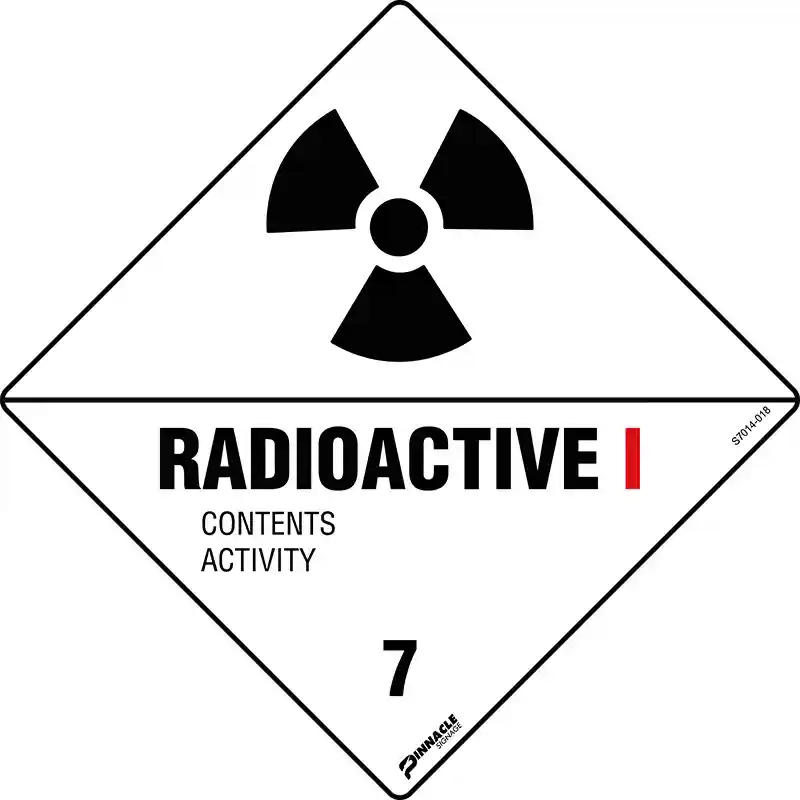
The clarity and durability of these transport labels can literally be a matter of life and death on Australian roads and in our logistics networks. For all your dangerous goods labelling requirements, explore our range of Hazchem Signage, manufactured to meet Australian standards.
Where You'll Find a Radioactive Sign in Australia
The presence of a radioactive sign across Australia reflects the widespread beneficial use of radioactive materials in essential industries. These aren't necessarily danger zones, more often, they're places where radiation technology is being used safely and beneficially under strict controls.
Medical facilities are probably where most Australians encounter radioactive signage. Hospitals and clinics use these signs extensively in departments utilising ionising radiation for diagnosis and treatment. Think radiology departments with their CT scanners and X-ray equipment, nuclear medicine units using radioactive tracers, and radiotherapy departments treating cancer patients. The medical uses of ionising radiation are vast and life-saving, making clear signage essential for protecting both patients and healthcare workers.
Industrial sites across Australia rely heavily on radioactive sources for quality control and safety applications. Mining operations, construction sites, and manufacturing facilities often use radioactive gauges for density and moisture measurement - critical tools for ensuring structural integrity in major projects. Other industrial applications include sterilising medical equipment, food irradiation for safety, and non-destructive testing of welds and materials.
Research laboratories at universities and scientific institutions handle radioactive isotopes for groundbreaking experiments and studies. A radioactive sign in these environments indicates areas where materials are stored, used, or processed, ensuring researchers follow strict safety protocols while keeping unauthorised personnel safely away.
Transport and logistics operations showcase the Radioactive I, II, and III labels we discussed earlier. Whether it's road transport, rail freight, shipping, or air cargo, any vehicle or container carrying radioactive materials will prominently display the appropriate radioactive sign to ensure safe handling throughout the entire journey.
This diversity of applications highlights exactly why consistent, clear signage is so crucial for health and safety across Australia. To learn more about industries that depend on robust safety signage, check out our article on Top Industries That Rely on the Right Health Safety Signage.
Ensure Your Site is Safe and Compliant
The presence of radioactive materials, even in small quantities, demands a comprehensive approach to workplace safety. As an Australian business owner or site manager, ensuring your facility is both safe and compliant isn't just about ticking regulatory boxesit's about protecting the people who matter most and maintaining operational integrity.
The Importance of Correct Hazard Communication
Picture this scenario: a maintenance worker enters what appears to be an ordinary storage area, unaware that radioactive materials are present nearby. Without proper radioactive sign placement, they could unknowingly expose themselves to ionising radiation, with consequences ranging from minor health effects to severe, life-threatening conditions.
This is precisely why effective hazard communication through clear, compliant signage serves as your most critical line of defence. Unlike many workplace hazards that you can see, hear, or smell, ionising radiation is completely invisible, making proper signage absolutely essential.
Preventing accidental exposure starts with immediate visual alerts that guide behaviour and promote adherence to established safety procedures. When workers can quickly identify restricted areas or hazardous materials, they naturally adopt the cautious approach that keeps everyone safe.
Visibility and strategic placement cannot be overlooked when radiation is involved. Your radioactive sign must be positioned where it can be easily seen from multiple approaches, using appropriate sizes and high-contrast colours that remain legible even in varying lighting conditions or challenging weather.
Regulatory compliance under Australian standards, including the ADG Code requirements, isn't optional, it's mandatory. Non-compliance can result in significant fines, operational shutdowns, and serious reputational damage. More importantly, inadequate signage increases the risk of workplace injuries and potential legal action.
Worker safety remains our highest priority. Clear, well-positioned radioactive signage demonstrates your commitment to their wellbeing and helps foster a genuine culture of safety throughout your organisation. Public awareness is equally important, particularly in healthcare facilities where patients and visitors need protection while navigating unfamiliar environments.
Understanding the broader context of hazardous materials communication can strengthen your overall safety program. For comprehensive guidance, explore our resource: Know Your Hazard Symbols: A Guide to Chemical Signage.
Your Partner for High-Quality Safety Signage
At Pinnacle Signage, we recognise that every radioactive sign we manufacture plays a vital role in protecting Australian workers and the public. As a proudly Australian-owned and operated company, we're committed to delivering signage solutions that meet the demanding requirements of industries handling radioactive materials.
Our approach centres on durable, weather-resistant materials that withstand Australia's harsh environmental conditions while maintaining clear legibility year after year. Being Australian-made means we maintain strict quality control standards while supporting local manufacturing jobs and ensuring rapid response to your signage needs.
Regulatory compliance is built into every product we create. Our signs adhere to relevant Australian standards and codes, giving you confidence that your site meets all necessary requirements. We prioritise clear communication through universally recognised symbols, appropriate text sizing, and high-contrast colour schemes that deliver immediate understanding.
We understand that every facility has unique requirements, which is why we offer customisable signage solutions including specific text, corporate logos, varied colours, and dimensions custom to your exact specifications. For organisations requiring bulk orders, we provide scalable solutions with competitive pricing that makes us an ideal primary supplier for councils, co-operatives, and large-scale operations.
Special distributor pricing is available for signage resellers and distributors seeking profitable margins on quality Australian-made products. Contact our team to discuss how we can support your business with reliable supply and competitive rates.
When workplace safety is at stake, compromise simply isn't an option. For comprehensive guidance on all types of hazard signage, read our detailed guide: Warning: Your Ultimate Guide to Workplace Hazard and Danger Signs.
For all your hazard identification needs, browse our extensive collection of Danger Signs or contact our team for expert advice and custom solutions.
Shipping & Pickup Information
We understand that getting your safety signage quickly and reliably is crucial. Pinnacle Signage dispatches most items within 48 hours of receiving your order and payment confirmation.
Estimated Delivery Times:
- 1 - 2 days: Sydney, ACT, Melbourne, Brisbane, Gold Coast
- 2 - 4 days: Rest of NSW, Rest of VIC
- 3 - 6 days: SA, North QLD, Perth
- 5 - 9 days: TAS, NT, WA
Delivery Details: For most deliveries within Australia, we use courier services such as FEDEX. Please note that couriers cannot deliver to PO Boxes, so provide a valid daytime delivery address. To ensure safe delivery, a signature is required upon receipt. You must be available to accept courier deliveries; re-delivery charges will apply if you are not present. Include a daytime phone number with your shipping details if we need to contact you about your delivery. For items weighing over 50kg, a tailgate delivery is usually required for residential addresses. This service is included in our standard shipping. Alternatively, you can choose to pick up the item from a nearby depot.
Free Shipping: Free shipping is available for orders over $100 AU Wide. This applies to most items on the site. However, for some bulky items, additional shipping costs will apply for deliveries to WA, North QLD, NT, TAS, and island areas. Our staff will reach out to you after your order if these charges apply.
Warehouse Pickup: Pickup is available at our warehouse, located at Unit 4/28 Nagle Street, East Wagga Wagga NSW. The warehouse is open from 8am to 5pm, Monday through Friday, and is closed on weekends and public holidays.