

Safety Escort Signs: Leading the Way Without Losing Your Mind
Why Trucking Safety Signs Are Essential for Every Australian Fleet

Trucking safety signs are a legal and practical requirement for any heavy vehicle operator in Australia - covering everything from hazardous materials placards and oversize load warnings to mandatory wheel chock and engine shutoff instructions.
Here is a quick overview of the main categories:
- Oversize and wide load signs - required when a vehicle or its load exceeds standard width or length limits
- Hazchem placards and Emergency Information Panels (EIP) - mandatory under the Australian Dangerous Goods (ADG) Code when transporting regulated dangerous goods
- Mandatory instruction signs - direct drivers to chock wheels, set brakes, and turn off engines before loading or unloading
- Traffic management signs - control vehicle movement at loading docks, warehouses, and facility entrances
- Escort and pilot vehicle signs - required for oversize load convoys to warn other road users
Getting these signs right protects your drivers, other road users, and your business from fines, liability, and serious accidents.
Heavy vehicle transport is one of Australia's most safety-critical industries. A single missing or non-compliant sign can mean the difference between a smooth operation and a costly incident - whether that is a runaway trailer on a loading dock or an unmarked dangerous goods vehicle on a public road.
In this guide, we cover every major category of trucking safety signage, the regulations that govern them, and how to make sure your fleet and facility are fully covered.
I'm Doug Lindqvist, General Manager of Pinnacle Signage, an Australian-owned manufacturer based in Wagga Wagga, NSW - and my background in the safety and industrial supply space means I have seen first-hand how gaps in trucking safety signs create real compliance headaches for fleet operators and facilities managers across the country. Throughout this guide, I will draw on that experience to help you navigate the requirements with confidence.
Key Trucking safety signs vocabulary:
Essential Categories of Trucking Safety Signs
In Australia, the transport and logistics sector is a powerhouse, but it is also one of the most hazardous industries to work in. While many people think mostly of road accidents, the risks extend to loading docks, chemical handling, and the transport of massive agricultural machinery. Trucking safety signs act as the first line of defence, communicating critical information at a glance.
Compliance starts with understanding the Australian Dangerous Goods (ADG) Code and AS 1319, which dictates the safety colours and layouts we use. For example, a red circle with a slash always means a prohibition, while a blue disc indicates a mandatory action. For those in our local Riverina region, agricultural machinery transport signage is a frequent necessity, ensuring that headers and tractors moving between paddocks are visible to other motorists.
Visibility is the name of the game. Whether it is a wide load sign or rear marking plates with their distinctive red and yellow reflective patterns, these tools ensure that a heavy vehicle’s footprint is respected on the road.

To learn more about the specific requirements for larger vehicles, you can read more info about oversized vehicle signs.
Mandatory Trucking Safety Signs for Daily Operations
Safety isn't just about what happens on the highway; it's about what happens when the wheels stop turning. Mandatory signs are used to specify an instruction that must be carried out. These signs typically feature a white symbol on a blue circular background.
In a busy warehouse environment, we often see signs like "Truck Drivers Must Chock Wheels" or "Engines Must Be Turned Off During Loading." These aren't just suggestions. They are critical procedural reminders that prevent "trailer creep" or accidental drive-offs while a forklift is still inside the pan. Setting the handbrake and chocking wheels are non-negotiable safety steps in any professional transport yard.
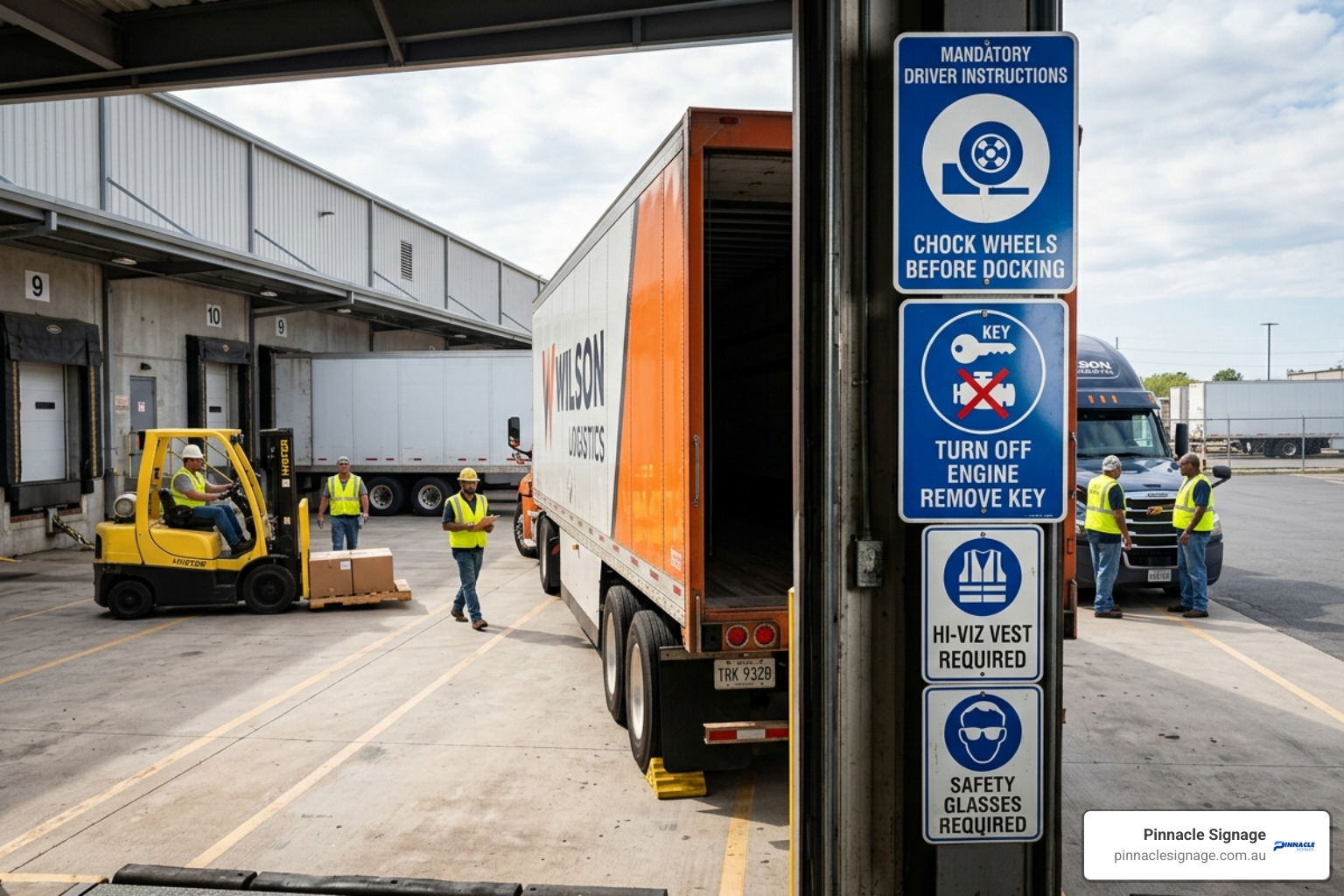
For site managers looking for durable options, the Pinnacle Metal Danger Sign at Bunnings provides a heavy-duty solution that stands up to the rigours of a loading dock environment.
Managing Traffic Flow with Trucking Safety Signs
A well-organised facility is a safe facility. Traffic management signs are essential for directing the flow of heavy vehicles from the moment they enter your gate. Clear exit and entry signage prevents confusion and reduces the risk of head-on "near misses" in tight driveways.
Low clearance is another major risk. Clearance height markers should be placed well in advance of any overhead obstructions to prevent the catastrophic damage (and social media fame) that comes with hitting a bridge or awning. Furthermore, "No Idling" signs are becoming increasingly important for both environmental health and noise regulation compliance in built-up areas.
Whether you are managing a permanent depot or a temporary site, a construction traffic sign can help maintain order among diverse vehicle types.
Navigating Hazchem and Dangerous Goods Requirements
When a truck is carrying hazardous materials, the signage requirements become significantly more complex. The ADG Code requires specific Hazchem signage to be displayed so that emergency services know exactly what they are dealing with in the event of a spill or fire.
The most critical component here is the Emergency Information Panel (EIP). A standard EIP includes:
- The proper shipping name of the substance.
- The UN Number (a four-digit code identifying the chemical).
- The Hazchem Code (providing immediate action info for fire brigades).
- The Dangerous Goods Class diamond.
- Emergency contact details.
For those carrying unique or uncommon loads, customised hazchem signage ensures all specific legislative requirements are met without guesswork.
GHS Compliance in Transport
While the ADG Code governs the transport of "Dangerous Goods," the Globally Harmonised System (GHS) handles the classification and labelling of chemicals more broadly. In a transport context, these two systems often overlap.
Flammable liquid placards, corrosive material signs, and oxidising agent diamonds must be clearly visible and manufactured from weather-resistant materials. Because these signs are often exposed to harsh Australian sun and road grime, using high-quality GHS signage is vital for long-term legibility.
Radioactive and Toxic Material Identification
Certain hazard classes require even stricter oversight. Materials that fall under "Acute Toxicity" or "Radioactive" categories must be identified with the correct GHS labels and class diamonds.
For example, acute toxicity GHS signage uses the skull and crossbones symbol to warn of immediate danger upon exposure. These signs are not just for the back of the truck; they should also be used on the containers themselves and at any storage points within your facility to ensure a seamless chain of safety information.
Escort Rules and Pilot Vehicle Signage Standards
Moving an oversize load is a team effort. When a vehicle exceeds certain dimensions, it requires pilot or escort vehicles to lead and follow the load, providing a buffer and warning for other motorists.
The signage on these escort vehicles is strictly regulated. High-visibility "Oversize Load Ahead" signs, often accompanied by rotating amber lights, are mandatory. At Pinnacle, we manufacture escort vehicle pilot sign kits that meet Australian standards, ensuring that pilot drivers can focus on the road rather than worrying about whether their gear is compliant. These kits usually include the necessary flags, signs, and mounting hardware to get a pilot vehicle road-ready quickly.
Best Practices for Loading Dock and Facility Safety
The loading dock is where the worlds of trucking and warehousing collide, often in a very small space. To keep everyone safe, we recommend a "layered" approach to signage.
First, establish pedestrian exclusion zones. Using danger signs to mark areas where forklifts and trucks operate helps keep office staff and visitors out of harm's way. Speed limit signs (usually 5 or 10 km/h) should be posted at eye level for drivers.
One of the most effective but overlooked tools is mirrored text signage. These signs are printed in reverse so that when a driver is looking in their side-view mirror while backing into a bay, the text appears correctly. This allows for clear communication of "Stop" or "Bay Number" instructions during the most difficult part of the driver's job.
Frequently Asked Questions about Trucking Safety Signs
What materials are best for heavy vehicle signs?
For the Australian climate, aluminium is the gold standard. It is rust-free, lightweight, and incredibly durable. When combined with Class 1 or Class 2 reflective vinyl, it ensures that trucking safety signs remain visible at night and in poor weather conditions. While plastic or corflute might work for temporary indoor use, any sign mounted to a vehicle or an outdoor gate should be metal to prevent cracking and fading.
How do mirrored signs improve loading dock safety?
Mirrored signs solve the "reversing riddle." When a driver is backing a 19-metre semi-trailer, their primary source of information is their mirrors. Standard signs appear backwards in a mirror, which can lead to hesitation or mistakes. Mirrored signs ensure that critical safety instructions are instantly readable, reducing the risk of collisions with dock equipment or, worse, personnel.
Are Hazchem placards mandatory for all transport?
Not necessarily. Whether you need a placard depends on the "placard quantity" of the dangerous goods you are carrying, which is defined in the ADG Code. However, if you are over that limit, it is a strict legal requirement. Even if you are under the limit, many safety-conscious fleets choose to use signage anyway as a best-practice measure to inform first responders in case of an accident.
Signs, Safety, and Staying Sane
Mastering trucking safety signs is about more than just ticking a box for a roadside inspection; it is about building a culture of safety that extends from the warehouse floor to the open highway. By using high-quality, compliant signage, you protect your most valuable assets - your people.
At Pinnacle Signage, we take pride in being a premier manufacturer located in East Wagga Wagga, NSW. Because we produce our signs locally, we understand the specific needs of Australian transport operators and can offer a 48-hour dispatch on our stock items. Whether you are looking for a standard warning construction sign or a complex set of Hazchem placards, we have the expertise to help.
We offer free shipping on orders over $100 AU wide (with some exceptions), and for our local customers in the Riverina, warehouse pickup is available Monday to Friday, 8 am to 5 pm. You can also find a range of our products through our partnership with Bunnings Warehouse, both in-store and online.
If you have a specific fleet requirement or need a custom solution for your facility, please contact us for custom solutions. Let's work together to keep Australian roads and workplaces safe.