

Ultimate Checklist for Danger Construction Site Signage
Why Construction Sites Need Clear Danger Signage
Danger construction site signage is essential for preventing accidents, protecting workers and the public, ensuring regulatory compliance, and maintaining efficient site operations.
Quick Answer: Essential Danger Construction Site Signage
- Site Entry Signs - Authorised personnel only, visitor instructions, and general safety rules
- Hazard-Specific Danger Signs - Fall hazards, deep excavation, electrical risks, moving machinery
- Mandatory PPE Signs - Hard hats, safety boots, high-visibility clothing requirements
- Prohibition Signs - No smoking, no entry, restricted access zones
- Emergency Information - First aid stations, fire equipment, evacuation routes, muster points
Construction sites are among the highest-risk work environments in Australia. With heavy machinery, electrical hazards, fall risks, and hazardous materials, the potential for serious injury is ever-present. Without clear, compliant signage, workers and visitors face unnecessary danger, while site managers risk significant legal and financial liability.
Proper danger construction site signage serves multiple critical functions. It communicates immediate hazards, guides safe behaviour, enforces safety requirements, and provides essential emergency information. Accidents on poorly signed sites often lead to project delays, WorkSafe investigations, and costly legal action.
Implementing an effective signage system doesn't need to be complicated. With the right checklist and access to quality, compliant signs, you can protect your team, meet legal obligations, and keep your project running smoothly. This guide will walk you through exactly what you need to keep your site safe and compliant.
Why Danger Signage is the First Line of Defence on Your Site
Danger construction site signage is a primary safety tool, ensuring everyone from experienced tradies to first-time visitors understands the risks and how to stay safe. Think of these signs as silent safety officers, working around the clock to communicate critical hazards. Clear, visible danger signs can significantly reduce accident risks, keeping people safe and projects on track.
Construction sites are inherently dangerous. Heavy machinery, electrical hazards, and fall risks create an environment where serious injury is always possible. Danger construction site signage is your first line of defence, protecting workers and the public from these hazards.
Proper signage also protects your business. Inadequate signage can lead to substantial fines from SafeWork authorities and serious legal liabilities. Accidents on poorly signed sites often cause project-halting investigations and severe financial and reputational costs. A well-signed site, however, demonstrates a commitment to safety and professionalism.
For a deeper dive into the importance of clear safety communication, explore our guide on Safety Signage Australia.
The Critical Difference: Danger, Warning, and Caution
Understanding the hierarchy of safety signs is crucial for effective hazard communication. The colour coding and format of Danger, Warning, and Caution signs are standardised under AS 1319, ensuring instant recognition of the risk level.
Using the wrong sign type can cause unnecessary alarm or fail to convey a serious threat. Here’s how to tell them apart:
Danger signs are for the most severe situations where hazards will cause serious injury or death. They feature a red oval inside a black rectangle with 'DANGER' in white text, signalling workers to stop and assess the risk. Examples include "Danger: High Voltage" or "Danger: Deep Excavation". We offer a range of standard danger signs, including the Danger Deep Excavation Sign available at Bunnings, with custom designs available.
Warning signs indicate hazards that could cause serious injury but are not immediately life-threatening. They use a black triangle on a yellow background with a black pictogram, conveying caution for situations like overhead work.
Caution signs alert people to potential hazards or unsafe practices that might cause minor or moderate injuries. They have a yellow background with 'CAUTION' in black text, often with a black triangle and symbol. These are for less severe hazards like low headroom.
For a comprehensive understanding of these distinctions, refer to our detailed article: Caution vs. Danger vs. Warning: What's the Difference.
Your Essential Checklist for Danger Construction Site Signage
Getting your site signage right from the start creates a clear, organised environment where everyone knows the risks and how to stay safe. A comprehensive approach covers site entry, specific hazards, and emergency procedures.
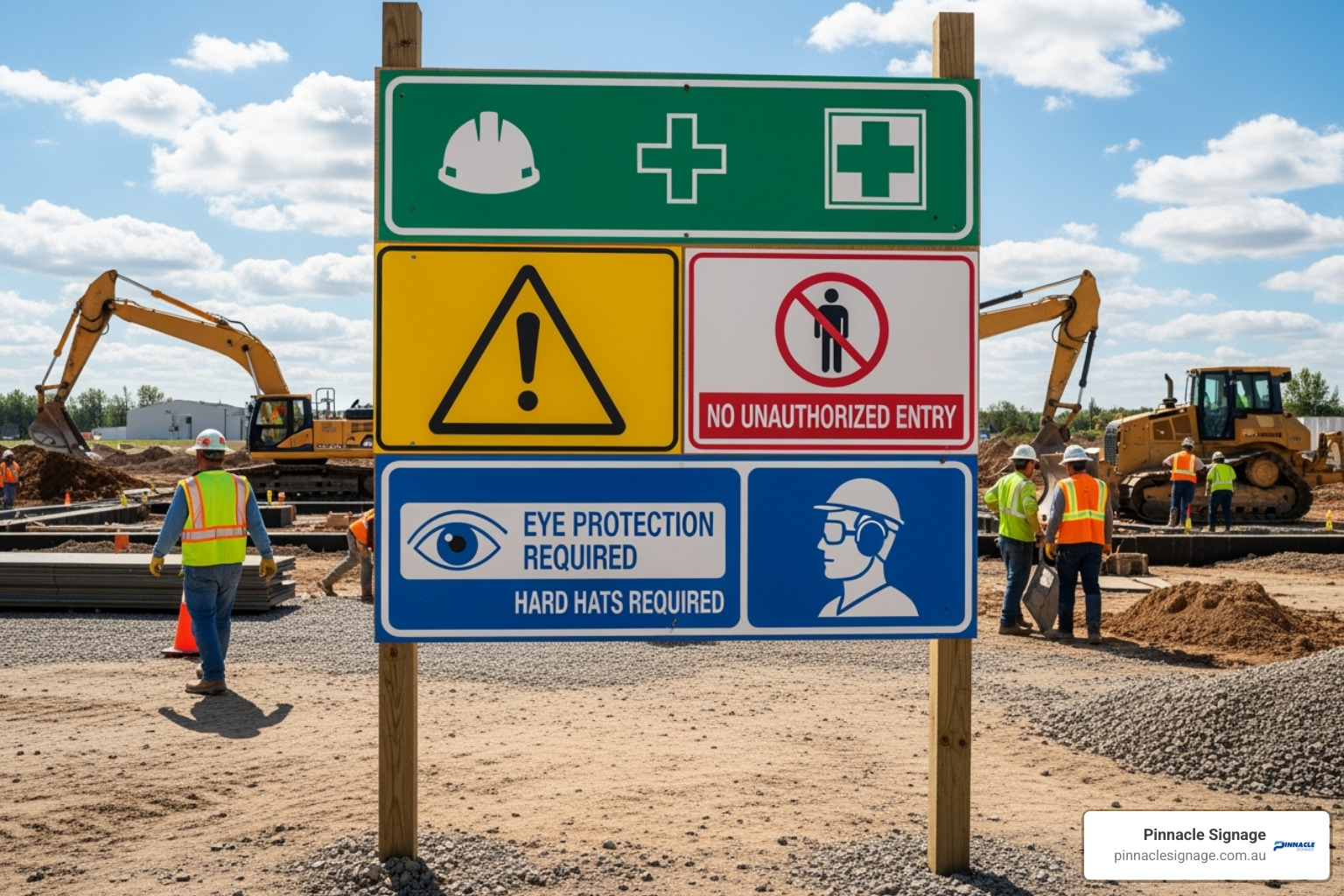
Think of your danger construction site signage strategy in layers. Site entry signs set rules and control access. Hazard-specific signs warn of immediate threats. Mandatory and prohibition signs reinforce safe behaviours. Finally, emergency signage provides clear instructions when things go wrong.
Together, these layers create a complete safety system that protects your workers, visitors, and business. Let's break down what you need in each category.
Many essential signs are readily available. For instance, you can find a Danger Construction Site Do Not Enter Sign at Bunnings for immediate perimeter protection. For larger orders or custom needs, our team can help develop a complete signage solution for your site.
1. Site Entry and Perimeter Signage
Clear site entry and perimeter signs are your primary tool for managing access, setting safety expectations, and protecting everyone from the moment they arrive. They act as gatekeepers, controlling who enters and establishing a culture of safety.
Authorised personnel only signs are your first line of defence, restricting access to maintain security and safety, especially around active work areas.
Visitor check-in instructions direct legitimate visitors to the site office. This step helps track who is on site and ensures they receive a safety briefing.
Site contact details, including the contractor's name and emergency numbers, should be prominently displayed at the main entrance for urgent communication and to show accountability.
General safety rules at the entry point set the tone for the entire operation, covering speed limits, no smoking policies, or other site protocols. PPE requirements must also be clearly stated. For example, any rules about hard hats, safety boots, and high-visibility clothing should be listed before anyone enters.
A perfect example of effective entry signage is the Danger Construction Site Do Not Enter Sign, available at Bunnings. This sign immediately communicates restricted access in a compliant format. Our Notice signs can also communicate site-specific information like operating hours.
Proper site entry and perimeter signage creates a safer, more controlled environment.
2. Hazard-Specific Danger Construction Site Signage
Since hazards on a construction site can change daily, hazard-specific danger construction site signage is critical. These targeted messages alert workers and visitors to immediate, life-threatening dangers in specific locations. Here are the most common hazards to address:
Fall hazards are a leading cause of serious injury. Signs like "Warning: Fall Protection Required" and "Danger: Scaffold in Use" are constant reminders to use proper equipment near unprotected edges, open floors, or when working at height.
Open pits and deep excavations pose a serious risk due to unstable ground. Our Danger Deep Excavation Sign, available at Bunnings, provides a clear warning for these areas, ensuring workers keep a safe distance unless authorised.
Electrical hazards require immediate recognition. Signs like "Danger: High Voltage" and "Danger: Buried Cable" protect against electrocution and should be placed near power lines, substations, or where electrical work is underway.
Heavy machinery operation creates risks of crushing injuries. "Danger: Heavy Machinery Operating" signs alert everyone to stay vigilant and maintain safe distances, especially where pedestrian and vehicle traffic intersect.
Overhead work can lead to falling tools or debris. Signs such as "Danger: Falling Objects" or "Overhead Work in Progress – Hard Hat Zone" are essential to protect those below scaffolding, cranes, or lift work platforms.
Hazardous materials or chemicals require proper GHS signage, as mandated under Australian WHS regulations. These symbols communicate specific chemical hazards at a glance. We offer a range of compliant GHS signage, including for Acute Toxicity, Corrosive, Chronic Health Hazards, and Flammable substances. These are also vital for emergency responders.
Assess your site regularly and update your danger construction site signage as hazards evolve.
3. Mandatory and Prohibition Signage
While danger signs warn of hazards, mandatory and prohibition signage sets clear rules. These signs tell people what they must do and what they must not do, helping to prevent accidents by enforcing safe behaviours.

Mandatory signs state which actions are required, such as wearing Personal Protective Equipment (PPE). Recognisable by their blue and white pictogram on a white background, they include signs like "Hard Hats Must Be Worn," "Safety Boots Required," and "High Visibility Clothing Must Be Worn." These are non-negotiable reminders that protect your team.
You can learn more about the full range of these essential signs in our guide: The A-Z of Mandatory Safety Signs.
Prohibition signs forbid actions that could compromise site safety. They feature a red-outlined circle with a diagonal slash over a black pictogram. Common examples on construction sites include "No Smoking or Open Flames," "Do Not Enter," and "No Unauthorised Access."
These signs are essential for preventing high-risk behaviours. We offer a comprehensive range of standard prohibition signs, with custom designs available to address unique site requirements.
4. Emergency and First Aid Signage
In an emergency, clear signage can mean the difference between a controlled response and confusion. Signage guiding people to first aid, fire equipment, and evacuation routes is as critical as signs that warn of hazards.
Emergency and first aid signs are typically green with white text and pictograms for instant recognition. They must be visible, well-positioned, and legible.
First aid stations should be clearly marked so anyone can locate medical supplies quickly. The First Aid Signage available at Bunnings is a practical option, while our broader First Aid Signage collection offers solutions for larger projects.
Fire extinguisher locations must be clearly identified for quick response to small fires. Our Fire Signage collection covers extinguisher markers, fire hose reels, and fire blanket signs. You can also search for specific signs like Fire Extinguisher on our site.
Evacuation routes and muster points are non-negotiable. In a serious incident, workers need to know where to go. Post clear evacuation maps at entries and break areas, and mark the designated muster point with bold signage for headcounts.
Display emergency contact numbers prominently in key locations like site offices and first aid stations. Having these numbers visible can save precious time in a crisis.
Best Practices for Effective Signage
Even compliant danger construction site signage is ineffective if it can't be seen or understood. Effective signage depends on three factors: design, materials, and placement. For a comprehensive guide, read How to Use Health and Safety Signs in the Workplace Effectively.
Design for Maximum Impact
Signage messages must be understood instantly. Effective design focuses on clarity and immediate recognition.
- Legible fonts and high-contrast colours (like black on yellow or white on red) ensure visibility in all conditions.
- Use symbols and pictograms specified by Australian Standards to transcend language barriers and communicate hazards quickly. Combine them with concise text for clarity.
- Keep messaging simple and direct, avoiding jargon or lengthy explanations.
- Ensure all signage adheres to AS 1319, the Australian Standard for safety signs, for legal compliance and universal understanding. Our article on Understanding Australian Standards for Safety Signs offers more insight.
Choosing the Right Materials
Construction sites are harsh environments, so selecting durable, weather-resistant materials is critical for long-term effectiveness.
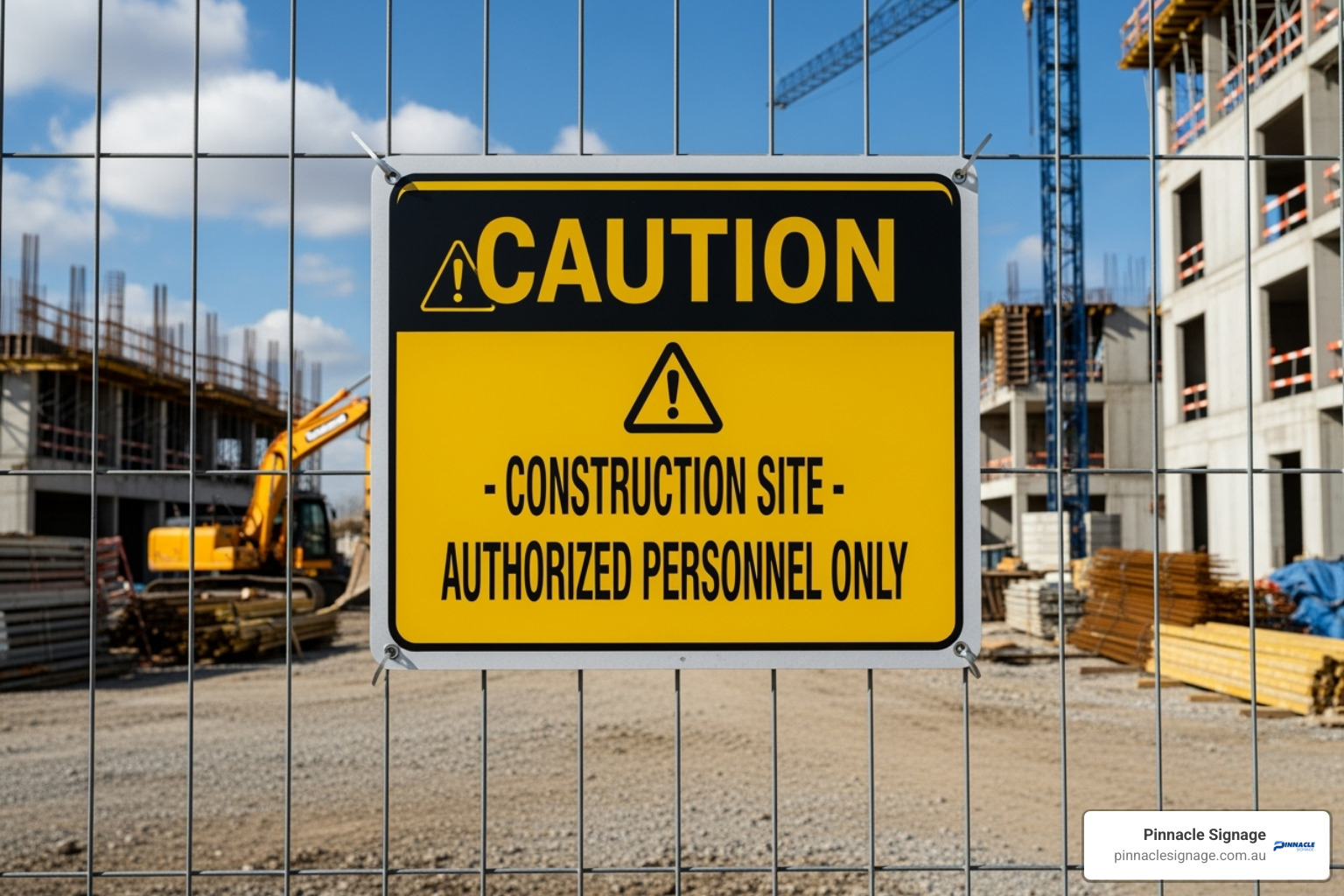
We use materials chosen for Australia's climate. Outdoor danger construction site signage requires robust, UV-resistant, and weatherproof options to prevent fading and degradation. While different materials like polypropylene, corflute, and aluminium are available, we recommend contacting our team for guidance on the best choice for your project.
Strategic Placement for Visibility
A sign in the wrong location is useless. Proper placement ensures messages are seen when needed.
- Position signs at eye level and in close proximity to the hazards they describe.
- Ensure clear lines of sight from multiple angles, free from obstructions. For night work or low-light areas, use well-lit or reflective signs.
- Conduct regular inspections as part of your daily safety routine. Clean, repair, or replace signs that are dirty, damaged, or no longer relevant.
These steps turn your signage from a checkbox into an effective safety tool. For more best practices, visit our article on construction safety signage best practices.
Frequently Asked Questions about Danger Construction Site Signage
Here are answers to common questions about construction site signage.
What are the consequences of not having proper danger signage?
Inadequate danger construction site signage significantly increases the risk of accidents, serious injuries, and fatalities. This can lead to project delays, WorkSafe investigations, and immense personal suffering. Beyond the human cost, non-compliance can result in substantial fines, legal liabilities, and reputational damage that affects future contracts. The investment in proper signage is minimal compared to the potential costs of an accident.
How often should construction site signs be inspected?
We recommend inspecting signs daily as part of routine site safety checks. Construction sites are dynamic, and hazards can change quickly. During inspections, signs should be cleaned and immediately replaced if damaged, faded, or no longer relevant. Daily checks are a small investment of time that ensures your site accurately reflects current conditions and remains as safe as possible.
Can I create custom danger signs for my site?
Yes, custom signs are an excellent way to address unique, site-specific hazards not covered by standard signs. However, it is crucial that any custom signs still comply with Australian Standards for colour, format, and symbols. This ensures they are instantly recognisable and legally compliant. A non-compliant custom sign might confuse workers or fail to communicate the hazard's urgency. We can help you design custom signs that meet these standards. For more information, explore The Ultimate Guide to Custom Danger Signs.
Equip Your Site for Safety Today
A comprehensive danger construction site signage plan is the foundation of a safe work environment. It allows your crew to work confidently and ensures visitors understand the risks. By following this checklist, you are not just meeting regulatory requirements, you are actively protecting lives, reducing liability, and keeping your project running smoothly.
Ready to get your site properly signed? For a complete range of compliant and durable construction signs, explore the Pinnacle Signage collection online. Many of our essential danger construction site signage products are also available for convenient purchase through the Pinnacle Signage brand page on the Bunnings website.
For larger projects requiring bulk orders or custom solutions, contact our team today. We'll work with you to create a signage plan that covers every corner of your site.
Shipping & Pickup Information
Getting your signage quickly is crucial for keeping your project on track.
Production & Shipping Times: Most orders are dispatched within 48 hours. Once shipped, delivery times are typically:
- 1 - 2 days: Sydney, ACT, Melbourne, Brisbane, Gold Coast
- 2 - 4 days: Rest of NSW, Rest of VIC
- 3 - 6 days: SA, North QLD, Perth
- 5 - 9 days: TAS, NT, WA
Delivery Details: We use trusted couriers like FEDEX. Please provide a valid daytime delivery address, as couriers cannot deliver to PO Boxes and a signature is required. Re-delivery charges will apply if you are not available to sign. For items over 50kg to residential addresses, tailgate delivery is included at no extra cost, or you can arrange depot pickup.
Free Shipping: Orders over $100 ship free Australia-wide for most items. For some bulky items to WA, North QLD, NT, TAS, or island areas, additional shipping costs may apply. Our team will contact you if this is the case, so there are no surprises.
Warehouse Pickup: You can collect your order from our warehouse at Unit 4/28 Nagle Street, East Wagga Wagga NSW, from 8am to 5pm, Monday to Friday. We are closed on weekends and public holidays.