

Chemical Signs 101
Why Chemical Signs are a Universal Language for Safety
Chemical signs are the first line of defence in workplaces where hazardous substances are present. Whether you're managing a hospital, overseeing a construction site, or running a manufacturing facility, these signs provide instant, visual warnings about the materials you're handling. They transcend language barriers, using standardised symbols and colours to communicate critical safety information at a glance. Without them, workers face unnecessary risks, and businesses leave themselves vulnerable to compliance breaches and preventable accidents.
Quick Answer: What Are Chemical Signs?
Chemical signs are safety signs that identify hazardous chemicals and communicate specific dangers through:
- Pictograms - Standardised symbols showing the type of hazard (e.g., flame, skull and crossbones, corrosion)
- Signal words - "Danger" or "Warning" indicating severity level
- Hazard statements - Brief descriptions of the specific risk
- Precautionary statements - Instructions on safe handling, storage, and emergency response
- Hazchem codes - Alphanumeric codes for emergency responders
These signs are found across Australian workplaces including farms, hospitals, warehouses, laboratories, and transport hubs. They're governed by the Globally Harmonised System (GHS) and Australian WHS laws.
Chemical hazards exist in nearly every industry. From petrol stations to pathology labs, farms to food processing plants, dangerous substances are part of daily operations. The GHS system, adopted internationally and integrated into Australian Work Health and Safety legislation, provides nine standardised pictograms that alert workers to everything from flammable liquids to carcinogenic materials. Eight of these are mandatory in Australia for workplace hazard communication. These signs don't just tick compliance boxes. They prevent burns, poisonings, explosions, and long-term health damage. They guide emergency responders during incidents. They protect the environment from contamination. And when properly implemented, they create a culture where safety is visible, understood, and respected.
The importance of proper chemical signs in preventing workplace incidents cannot be overstated. This understanding is at the core of why Pinnacle Signage was founded, with a mission to ensure Australian businesses have access to compliant, durable signage that actually protects their people.
Decoding the Message: Key Elements of a Chemical Hazard Sign
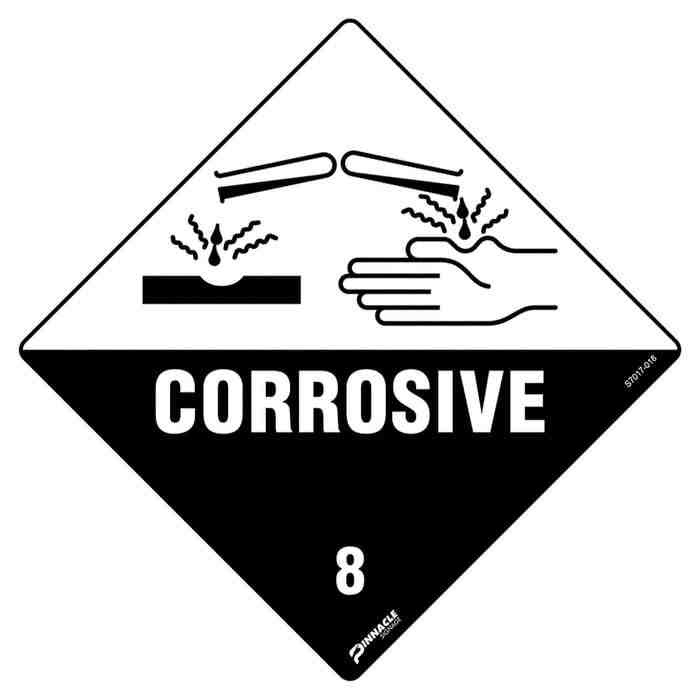
When you first glance at a chemical sign, you're looking at more than just a warning, you're reading a carefully designed message that could save someone's life. These signs don't just grab attention with bold colours and striking symbols. They deliver layered information that tells you exactly what you're dealing with and how to stay safe.
Think of it like reading a road sign. You don't need to stop and study it for minutes. The design ensures you get the critical information in seconds. That's the beauty of standardised chemical signs, every element has a purpose, and together they create a complete safety message.
Pictograms are what you'll notice first. These diamond-shaped symbols feature a red border, white background, and a black hazard icon. They're designed to communicate the type of danger instantly, whether it's a flame warning you about flammable materials or a skull and crossbones indicating acute toxicity. You don't need to read a word to understand there's a serious hazard present.
But the pictogram is just the beginning. Look a bit closer and you'll find signal words prominently displayed, either "DANGER" or "WARNING." These aren't interchangeable. "DANGER" means you're dealing with a more severe hazard, something that could cause serious harm or death. "WARNING" indicates a less severe but still significant risk. It's like the difference between a storm warning and a storm watch, both matter, but one demands immediate action. If you're curious about how these warning levels work across different types of safety signage, our guide on Caution vs Danger vs Warning: What's the Difference breaks it down clearly.
Hazard statements give you the specific details. These are brief, standardised phrases that describe exactly what the chemical can do. You might see "Highly flammable liquid and vapour" or "Causes severe skin burns and eye damage." No guessing, no ambiguity, just straightforward information about the risk you're facing.
Then come the precautionary statements, the instructions that tell you how to handle the chemical safely. These cover everything from prevention ("Wear protective gloves/eye protection/face protection") to emergency response ("IF SWALLOWED: Immediately call a POISON CENTER/doctor") to proper storage and disposal. They're your action plan for working safely with the substance.
You'll also find the product identifier (the chemical name or code) and supplier information including the manufacturer's name, address, and contact details. These aren't just administrative details, they're critical if you need to track down more information or report an incident.
Now, while the sign itself gives you essential information, the full story lives in the Safety Data Sheet (SDS). This comprehensive document (formerly called the Material Safety Data Sheet or MSDS) provides detailed information about the chemical, including safe handling procedures, storage requirements, emergency protocols, and long-term health effects. The sign is your quick reference, the SDS is your complete resource.
For Australian workplaces dealing with larger quantities of hazardous chemicals, particularly in transport and storage, you'll encounter Hazchem codes. These alphanumeric codes are specifically designed for emergency responders. They provide rapid access to information about fire suppression methods, required protective equipment, and containment procedures. If you're responsible for bulk chemical storage or transport, understanding these codes is essential. Our guide on Hazchem Signage Compliance explains what you need to know.
When all these elements work together, they create a powerful communication system. Whether you're a warehouse worker checking a drum of solvent, a hospital staff member handling cleaning chemicals, or an emergency responder arriving at an incident, you have the information you need to act safely and decisively. That's why properly designed and compliant chemical signs aren't just regulatory requirements, they're essential tools that protect lives every single day.
The GHS: A Global Standard for Chemical Hazard Communication
Picture this: a truck driver transporting chemicals from Melbourne to Singapore encounters an emergency. The labels on the containers look completely different from what they're used to seeing back home. Different symbols, different warnings, different everything. In a crisis, those few seconds of confusion could be catastrophic.
This is exactly the problem the Globally Harmonised System (GHS) was designed to solve. Developed by the United Nations, the GHS creates a universal language for chemical signs and labels that works the same way whether you're in Adelaide or Amsterdam, Perth or Paris. It's about making sure that a flammable substance is recognised as flammable everywhere, with the same red diamond pictogram and the same hazard warnings, regardless of which country you're in.
The beauty of the GHS lies in its simplicity and consistency. It classifies chemicals based on their actual risks to health, physical safety, and the environment, then communicates those risks through standardised labels and Safety Data Sheets. No more guessing. No more translation errors. Just clear, reliable information that everyone can understand.
Here in Australia, the GHS has been woven into our Work Health and Safety (WHS) laws under the model WHS Regulations. This means any business that manufactures, imports, or supplies hazardous chemicals must classify and label their products according to GHS criteria. For companies operating across borders, this harmonisation makes life significantly easier. But more importantly, it means Australian workers get the same level of clear hazard communication that's protecting people in workplaces around the world.
Safe Work Australia provides clear guidance on implementing the Globally Harmonised System of Classification and Labelling of Chemicals, helping you understand your WHS obligations and keep your workplace correctly labelled, documented, and equipped.
At Pinnacle Signage, we manufacture our chemical signs and labels to meet current GHS requirements under Australian WHS laws and the UN standard. Compliance is not a box-tick; it is how you keep people safe with signage that is clear, durable, and instantly recognisable.
A Visual Guide to Common Chemical Signs and Pictograms
The heart of the GHS system beats in its pictograms. These nine distinct diamond-shaped symbols with their distinctive red borders and white backgrounds have become the international language of chemical hazards. In Australia, eight of these nine pictograms are mandatory for workplace chemical labelling, with the environmental pictogram being optional but highly recommended for responsible businesses.
Each pictogram tells a story at a glance. Whether you're a warehouse manager, a farm worker, or a laboratory technician, these symbols cut through language barriers and deliver immediate, life-saving information. They're designed to be instantly recognisable, even from a distance or in poor lighting conditions.
Let's explore these crucial visual cues in detail. For a more comprehensive exploration of each symbol and how to implement them in your workplace, our Know Your Hazard Symbols: A Guide to Chemical Signage provides additional insights.
Physical Hazard Chemical Signs
Physical hazards are the dramatic dangers, the ones that can cause immediate, violent harm. These chemical signs warn you about substances that can explode, burn, or react in dangerous ways.
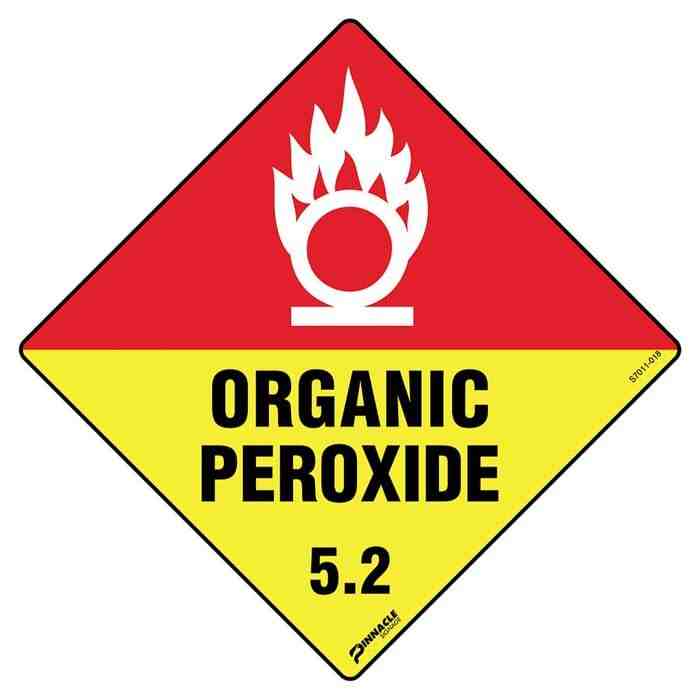
The Exploding Bomb pictogram is as serious as it sounds. This symbol warns of explosives, self-reactive substances, and organic peroxides. These chemicals are inherently unstable and can explode without any external trigger, even without exposure to air. They represent a severe risk of sudden, forceful energy release that can cause catastrophic damage and injury.
When you see the Flame pictogram, you're looking at materials that can easily catch fire. This covers flammable liquids, solids, and gases, as well as pyrophoric substances that ignite spontaneously in air. It also includes self-heating substances and those that emit flammable gases when they contact water. These materials must be kept well away from heat sources, sparks, and open flames.
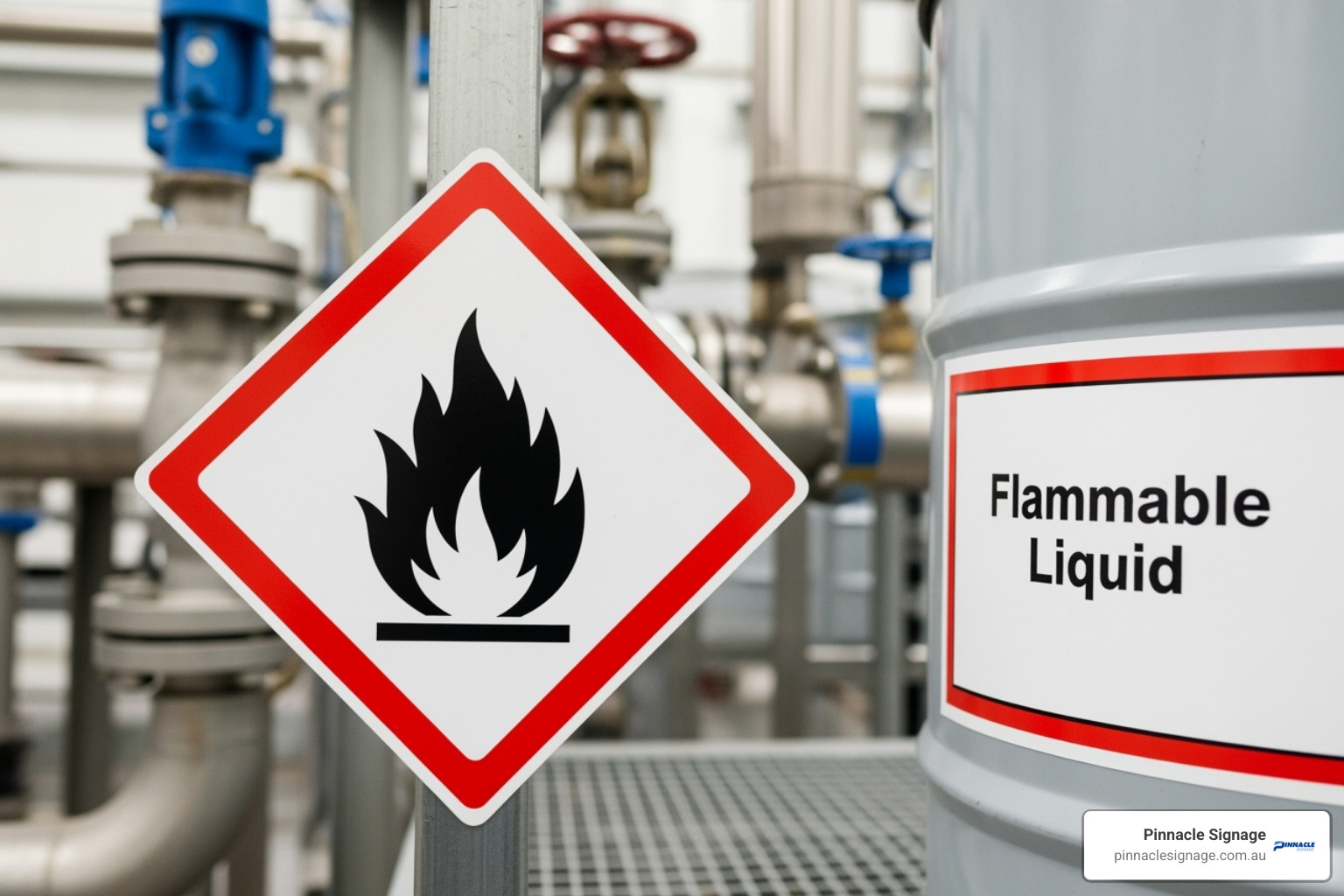
If your workplace handles flammable materials, proper signage is essential. Compliant Flammable GHS Signs are used to clearly mark these hazardous areas.
The Flame Over Circle pictogram identifies oxidising agents. While these chemicals might not be flammable themselves, they're dangerous in a different way. They release oxygen, which makes other materials burn more fiercely and for longer. Store an oxidiser near flammable materials, and you've created a recipe for disaster.
The Gas Cylinder pictogram warns of gases under pressure. This includes compressed gases, liquefied gases, refrigerated liquefied gases, and dissolved gases. The risks here are twofold. First, if the cylinder is heated, the pressure can build up and cause an explosion. Second, refrigerated liquefied gases can cause severe cold burns, and any rapidly escaping gas jet poses a serious danger.
When the Corrosion pictogram appears in the context of physical hazards, it's warning you that the chemical can corrode metals. This means it can eat through containers, pipes, or other equipment, potentially causing leaks or structural failures.
Health Hazard Chemical Signs
Health hazards are often less dramatic but equally dangerous. These chemical signs warn about substances that can harm your body, either immediately or over time.
The Skull and Crossbones is the most universally recognised danger symbol. It signals acute toxicity, meaning the chemical can cause severe, immediate harm or death if swallowed, inhaled, or absorbed through the skin. These are highly poisonous substances that demand extreme caution.
The Corrosion pictogram, when indicating health hazards, warns that a chemical can cause severe skin burns and eye damage. Direct contact means irreversible tissue damage. Personal protective equipment isn't optional with these substances, it's essential for safety. Our guide on Identifying Corrosive Material Signs provides detailed information on these hazards.
The Exclamation Mark pictogram is the versatile warning symbol for less severe but still significant health hazards. It might indicate skin or eye irritation, skin sensitisation (allergic reactions), lower-level acute toxicity, specific target organ toxicity from single exposure, or respiratory tract irritation. While these effects might not be immediately life-threatening, they still require careful handling and appropriate precautions.
The Health Hazard pictogram, showing a silhouette of a human torso, is your warning about serious, long-term health effects. This symbol covers carcinogenicity (can cause cancer), mutagenicity (can cause genetic defects), reproductive toxicity (can harm fertility or unborn children), respiratory sensitisation (can cause allergy or asthma), specific target organ toxicity from repeated exposure, and aspiration hazards (can be fatal if swallowed and enters airways). These are the silent dangers, the ones that might not show their effects for years but can have devastating consequences.
Environmental Hazard Signs
Protecting the environment is just as crucial as protecting people. The Environment pictogram, featuring a dead tree and fish, warns of chemicals hazardous to aquatic environments. These substances can cause significant and lasting damage to marine life, waterways, and entire ecosystems.
While this pictogram isn't mandatory in Australia under GHS, it's widely used and highly recommended for responsible businesses. If a chemical carries this warning, proper handling, storage, and spill containment become paramount. A single spill can contaminate water sources and destroy ecosystems for years to come.
Safe Work Australia provides guidance on Hazardous chemicals signs (placards), including information relevant to environmental protection.
Understanding these pictograms gives you a powerful tool for instantly assessing and managing the risks associated with various chemicals in your workplace. They're not just regulatory requirements, they're your first line of defence in keeping people and the environment safe.
Staying Compliant with Chemical Signs in Australia
In Australian workplaces, keeping your chemical signs up to date and compliant isn't just about ticking boxes, it's about protecting your people and your business. Work Health and Safety (WHS) laws across all states and territories set clear expectations for how hazardous chemicals must be classified, labelled, and displayed. Get it right, and you create a safer workplace. Get it wrong, and you're exposing your team to unnecessary risks while leaving your organisation vulnerable to penalties.
The foundation of compliance starts with the Globally Harmonised System (GHS). As we've discussed, Australia has adopted this international standard, which means every hazardous chemical in your workplace must carry GHS-compliant labelling. This applies not only to the original containers from suppliers but also to any secondary containers where chemicals have been decanted. If you're pouring a chemical into a smaller bottle or different container, it needs proper GHS labelling, plain and simple.
Safety Data Sheets (SDS) are your detailed instruction manual for every hazardous chemical. These comprehensive documents go well beyond what a label can show, covering everything from first aid measures to environmental precautions. The law requires you to keep current SDSs for every hazardous chemical on site, and more importantly, your workers need easy access to them. Store them in a central location, make sure everyone knows where they are, and review them regularly to ensure they're up to date.
When you're storing or handling larger quantities of hazardous chemicals, placarding requirements kick in. These are the bigger signs you'll see on storage areas, buildings, and transport vehicles, designed to give emergency services critical information at a glance. They typically display Hazchem codes, UN numbers, and class diamonds. If you're unsure about your placarding obligations, our guide to Hazardous Chemicals Sign Requirements breaks down what you need to know.
Transporting dangerous goods brings another layer of requirements under the Australian Dangerous Goods (ADG) Code. This code governs how hazardous chemicals must be packaged, labelled, and placarded when they're being moved by road or rail. At Pinnacle Signage, all our dangerous goods diamond signs are designed and manufactured in accordance with the ADG Code 7.6 2018, so you can trust they'll meet regulatory requirements.
Compliance isn't a set-and-forget exercise. Your chemical inventory changes, regulations get updated, and quantities fluctuate. That's why regular audits of your chemical signs and chemical storage are essential. Walk through your workplace with fresh eyes every few months. Are all the signs still legible? Have you added new chemicals that need signage? Are quantities still accurate? Staying proactive here prevents problems before they start. For more guidance on meeting Australian requirements, our Essential Guide to Australian Standards for Safety Signs provides helpful context.
Finally, even the best signage in the world won't protect anyone if your team doesn't understand it. Training is crucial. Make sure every worker knows what the GHS pictograms mean, can identify signal words, understands hazard statements, and knows exactly what to do in an emergency. This training should be part of every new worker's induction and refreshed regularly.
By taking these steps seriously, you're not just meeting legal obligations, you're building a workplace where safety is visible, understood, and embedded in your daily operations. And that's good for everyone.
Ensuring Quality and Durability in Chemical Signage
For chemical signs to be effective, they must remain legible and compliant over time. Signage needs to be accurate, up-to-date with current Australian standards, and durable enough for its intended environment. Factors like sun exposure on a farm, salt spray at a coastal facility, or the corrosive atmosphere of an industrial plant can degrade signs quickly. Therefore, selecting signs made from high-quality, weather-resistant materials is crucial for long-term safety and compliance.
Key considerations for effective signage include material durability, compliance, and visibility. For outdoor use or harsh indoor environments, weather-resistant materials that resist fading, cracking, or corrosion are necessary. All signage must meet the latest Australian WHS regulations and the GHS, including specific requirements like the Australian Dangerous Goods (ADG) Code for transport. Furthermore, visibility and placement are critical. A sign is only effective if it can be seen clearly. Factors such as size, colour contrast, and potential need for illumination should be considered to ensure strategic placement for maximum visibility.
Need help? Contact us or shop Pinnacle Signage at Bunnings.