

Don't Get Hung Up: Mastering ADA Braille Signage Height
The Australian Standard for Accessible Signage
In Australia, accessible signage is governed by the National Construction Code (NCC) and Australian Standard AS 1428.1. These guidelines are crucial for ensuring compliance and creating inclusive spaces. Key specifications include:
- Height range: 1200mm to 1600mm from finished floor level to tactile characters
- Location: On the latch side of the door (or nearest adjacent wall)
- Clear floor space: Minimum 1000mm x 1000mm in front of the sign
- Tactile characters: Raised 1mm to 1.5mm, sans-serif fonts
- Braille: Grade 1 (uncontracted) positioned below text
This guide explains the correct height and location for braille signage to ensure your premises are compliant and accessible. For facilities managers and construction supervisors, getting braille signage right the first time saves costly reinstallation and ensures your building meets accessibility requirements.
Whether you're working on a new build, refurbishment, or retrofit project, understanding these requirements is essential. Let's break down what you need to know to get your braille signage installation right.
Key Braille Signage Height and Location Requirements in Australia
When it comes to creating truly accessible spaces, braille signage isn't just about compliance, it's about ensuring everyone can steer your building safely and independently. In Australia, the National Construction Code (NCC) and Australian Standard AS 1428.1 provide clear, practical guidance that makes this possible.
The Core Rule: Braille Signage Height Requirements
The most important measurement for braille signage is its height. In Australia, the NCC and AS 1428.1 provide clear, straightforward specifications.
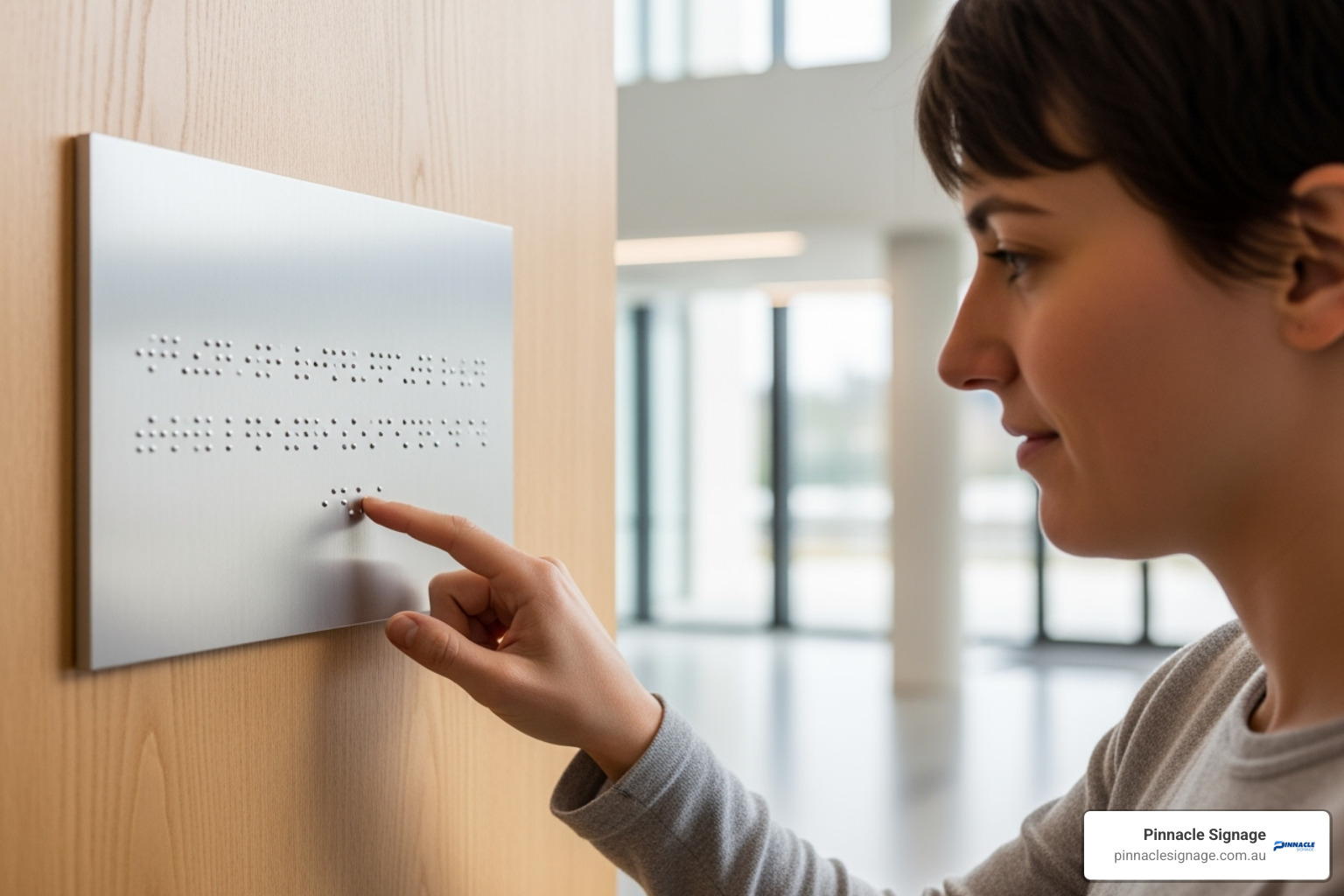
The NCC specifies that tactile characters must be mounted between 1200mm and 1600mm from the finished floor level. A key detail is that this measurement is taken to the raised tactile text itself, not to the top or bottom edge of the sign panel.
This range is designed so that most adults can comfortably locate and read signs by touch at a natural height. At Pinnacle Signage, we design every braille sign with this exact specification in mind, ensuring the tactile elements sit perfectly within this regulatory range once installed.
For more background on how tactile signs work, our guide "What are Braille Tactile Signs? A Simple Guide to Accessibility" provides a helpful foundation.
Where to Mount Your Signs: Location is Everything
Height is only half the story. Where you position your braille sign is equally critical for it to be easily found and safely read.
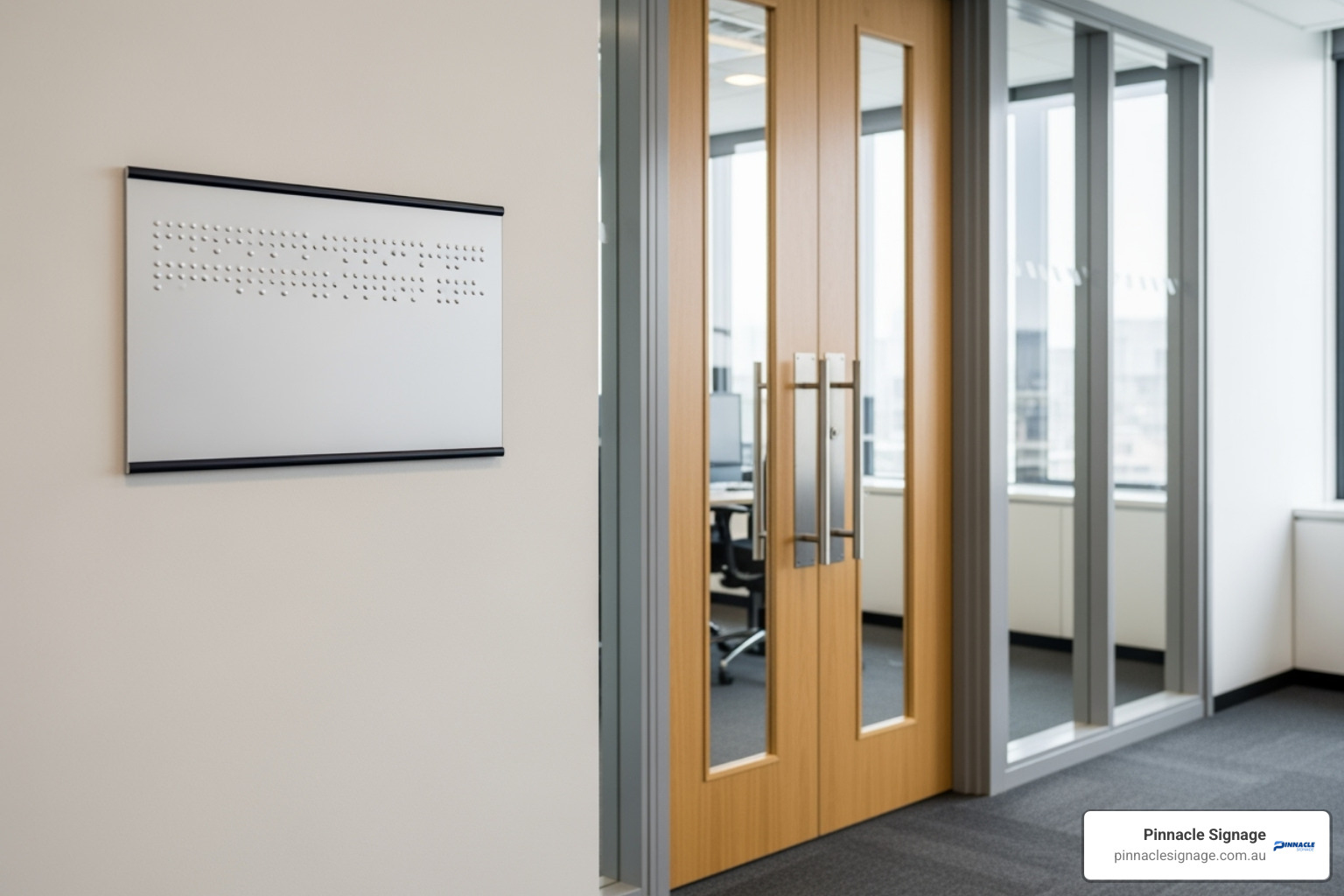
- Single doors: The sign goes on the wall on the latch side. A minimum clear floor space of 1000mm x 1000mm is required in front of the sign.
- Double doors: If both doors are active, place the sign to the right of the right-hand door. If only one leaf is used, mount the sign on the inactive leaf.
- Outward swinging doors: The sign must be positioned on the wall outside the arc of the door's swing, with the 1000mm x 1000mm clear space extending beyond the swing.
As a general rule, avoid mounting braille signs directly on doors, as a moving surface makes tactile reading difficult. Wall mounting is almost always the better choice. The underlying principle is predictability, allowing people to steer independently with confidence.
Our "An Essential Guide to Informational Signs" explores how effective placement improves the function of all types of signage.
Beyond Height: Essential Design and Character Requirements
Once you've got the height and location sorted, the sign's design elements are crucial. Australian standards set specific requirements for both tactile and visual readers:
- Tactile characters: Must be raised between 1mm and 1.5mm, using uppercase sans-serif fonts (like Helvetica or Arial) with heights between 15mm and 55mm. Spacing is also regulated to improve legibility.
- Visual contrast: Text and background need adequate colour contrast (at least 30% luminance contrast is recommended). The sign surface must be matte or non-glare.
- Braille: Grade 1 (uncontracted) braille is the standard. It must sit directly below the corresponding tactile text. Braille dots must be dome-shaped and conform to specific dimensions.
- Pictograms: When used for permanent rooms (e.g., a toilet symbol), they must be on a field at least 60mm high and include tactile text descriptors and braille below.
These specifications are the foundation of genuinely accessible signage. Every sign we manufacture at Pinnacle Signage adheres to these Australian standards. You can explore our full range at "Tactile Braille Signs at Pinnacle Signage: Enhancing Accessibility and Safety".
Common Questions About Braille Signage Requirements
Navigating the specifics of accessible signage can sometimes raise a few questions. Here, we address some of the most common queries we encounter from our clients, helping you ensure your premises meet Australian accessibility standards.
Are Braille signs required in stairwells?
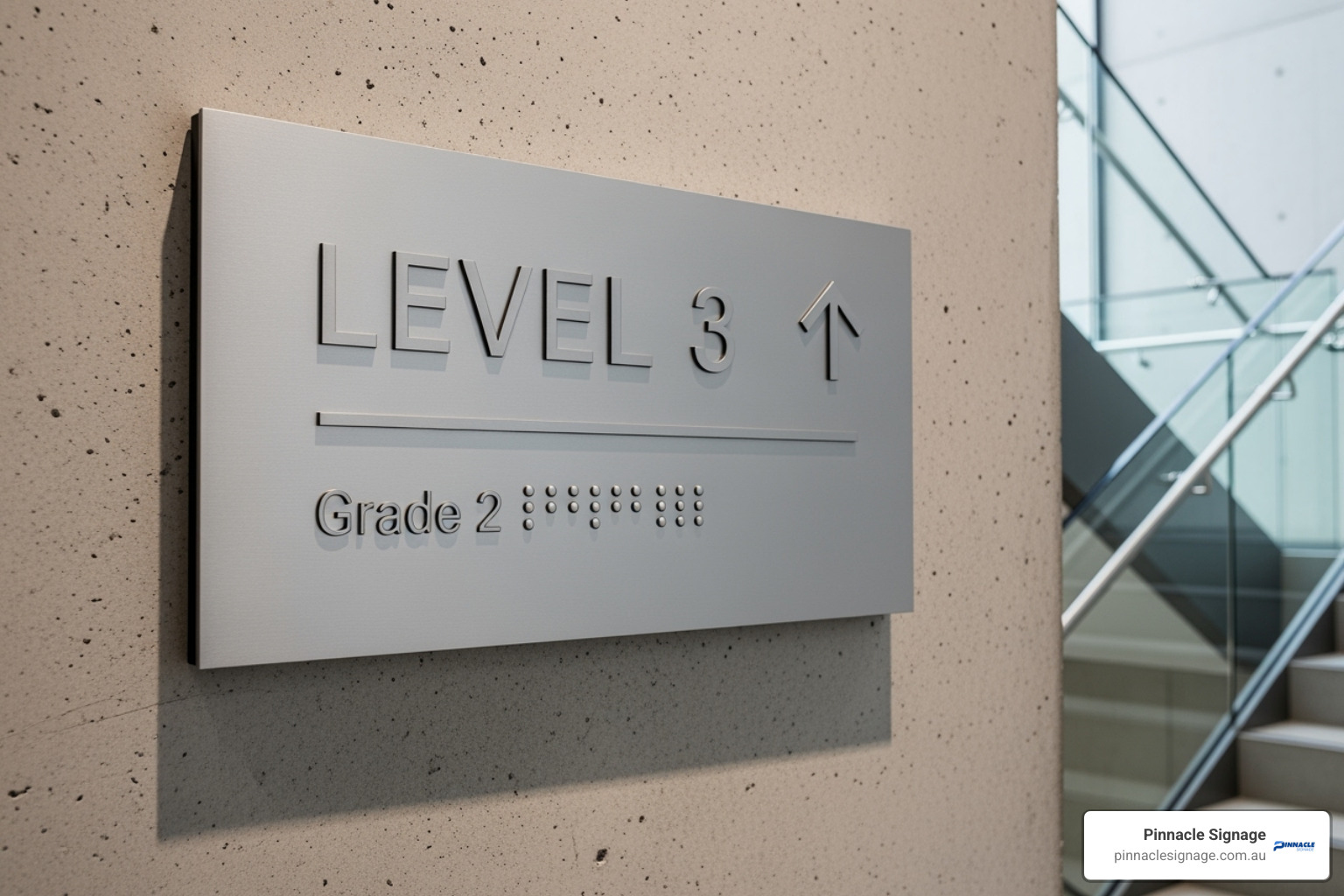
Yes. Stairwell signs are critical for safety, identifying the floor level and exit level for navigation and emergencies. They must adhere to the standard 1200mm to 1600mm height requirement and include tactile characters. Always check with local fire authorities for any additional requirements.
Which signs don't need braille or tactile elements?
Signs that are temporary (displayed for less than seven days), purely informational (like menus), or building directories are generally exempt. However, they must still meet visual legibility criteria like good contrast and non-glare finishes. If a sign identifies a permanent room or space, it requires tactile characters and braille.
What about accessible parking signs?
These follow their own guidelines under AS 2890.6. The bottom edge of the sign should be at least 2000mm from the ground to be visible over parked vehicles. If a space is 'van accessible', this must be clearly indicated on the sign.
Do overhead signs have different requirements?
Yes. Overhead signs must have a minimum headroom clearance of 2000mm. Signs projecting from a wall cannot protrude more than 100mm into a pathway if their leading edge is between 1000mm and 2000mm from the floor. This prevents head-level hazards. For detailed specifications, refer to Specification D3.6 Braille and tactile signs from the NCC.
How do requirements differ for permanent room signs versus directional signs?
Permanent room identification signs (e.g., toilets, offices) must have tactile characters and braille. Directional signs (e.g., pointing to reception) generally only require visual legibility, though some facilities add tactile elements to key directional signs for improved wayfinding.
What about pictograms?
Pictograms labelling permanent rooms must be on a field at least 60mm high and be accompanied by tactile text and braille below. This ensures the meaning is clear to all users. Informational pictograms do not require tactile descriptors but must meet visual contrast and non-glare requirements.
What are the best installation tips for braille signs?
Measure twice to ensure the correct height and use a level. Maintain the 1000mm x 1000mm clear floor space, free from obstructions. Use appropriate fixings for your wall type to secure the sign. Consistency in height and placement throughout your facility is key for creating a predictable environment.
Who enforces these requirements?
Local councils and building certifiers enforce compliance with the NCC and AS 1428.1 during building approvals and inspections. Non-compliance can lead to rectification orders and project delays, so getting it right from the start is crucial.
Ensuring Compliance and Finding the Right Solution
Getting your accessible signage right isn't just about meeting regulatory requirements; it's about creating genuinely inclusive and safe environments for everyone. It reflects a commitment to community and best practice.
Common Mistakes to Avoid During Installation
Even with the best intentions, some common errors can lead to non-compliant or ineffective braille signage. Being aware of these can save you time and money:
- Incorrect Height: Measuring to the sign panel instead of the tactile characters. The 1200mm to 1600mm range applies to the text itself.
- Wrong Location: Mounting on the hinge side of a door or on the door itself instead of the latch side wall.
- Obstructed Access: Blocking the required 1000mm x 1000mm clear floor space with furniture, plants, or other items.
- Poor Visibility: Using signs with reflective surfaces or poor colour contrast between the text and background.
- Incorrect Braille: Using the wrong grade of braille (contracted instead of uncontracted) or incorrect dot dimensions.
- Ignoring Door Swing: Placing the sign within the arc of an outward-swinging door, creating a safety hazard.
By avoiding these pitfalls, you're well on your way to a fully compliant and accessible signage installation.
Your Partner for Compliant Braille Signage
At Pinnacle Signage, we understand Australian accessibility standards and provide high-quality, durable signage solutions to ensure your facility is compliant and accessible.
We offer a complete range of braille signs, from room identification to stairwell signs, all manufactured to meet AS 1428.1. Our signs feature durable materials and clear, tactile lettering to support your project's needs.
For all your accessibility needs, browse our extensive range of Braille Tactile Signage. We offer custom designs with your specific text, logos, and colours while adhering to all requirements.
For custom solutions or bulk orders, contact our team today. We're here to help you get it right the first time with fast, Australia-wide shipping.
Shipping & Pickup Information
Production & Shipping Times: Pinnacle Signage dispatches most items within 48 hours of receiving your order and payment confirmation. Delivery times are estimated as follows:
- 1 - 2 days: Sydney, ACT, Melbourne, Brisbane, Gold Coast
- 2 - 4 days: Rest of NSW, Rest of VIC
- 3 - 6 days: SA, North QLD, Perth
- 5 - 9 days: TAS, NT, WA
Delivery Details: For most deliveries within Australia, we use courier services such as FEDEX. Please note that couriers cannot deliver to PO Boxes, so provide a valid daytime delivery address. To ensure safe delivery, a signature is required upon receipt. You must be available to accept courier deliveries; re-delivery charges will apply if you are not present. Include a daytime phone number with your shipping details if we need to contact you about your delivery. For items weighing over 50kg, a tailgate delivery is usually required for residential addresses. This service is included in our standard shipping. Alternatively, you can choose to pick up the item from a nearby depot.
Free Shipping: Free shipping is available for orders over $100 AU Wide. This applies to most items on the site. However, for some bulky items, additional shipping costs will apply for deliveries to WA, North QLD, NT, TAS, and island areas. Our staff will reach out to you after your order if these charges apply.
Warehouse Pickup: Pickup is available at our warehouse, located at Unit 4/28 Nagle Street, East Wagga Wagga NSW. The warehouse is open from 8am to 5pm, Monday through Friday, and is closed on weekends and public holidays.