

OSHA-Approved & Awesome: Meeting Your Safety Signage Requirements
Understanding Australian Safety Signage Requirements
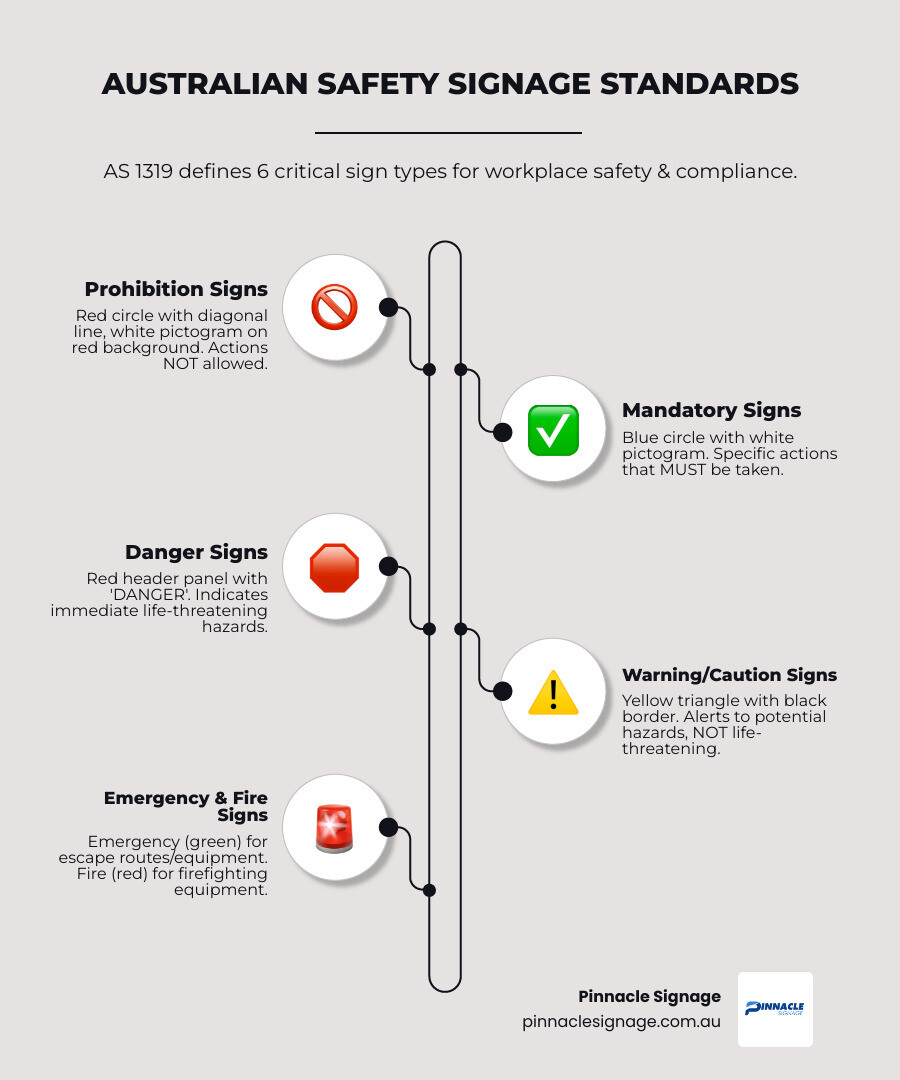
Safety signage requirements in Australia are governed by Australian Standard AS 1319, which mandates specific design, colour, and placement criteria for workplace signs. Here are the essential requirements:
- Prohibition signs: Red circle with a diagonal line over a black pictogram on a white background.
- Mandatory signs: Blue circle with a white pictogram, indicating a required action.
- Danger signs: A red oval inside a black rectangle with the word "DANGER", for immediate life-threatening hazards.
- Warning signs: Yellow triangle with a black border, alerting to potential hazards.
- Emergency signs: Green background with a white pictogram, showing escape routes and safety equipment.
- Fire signs: Red background with a white pictogram, identifying firefighting equipment.
Every Australian workplace must keep people safe and comply with Work Health and Safety (WHS) laws. Businesses must follow local WHS legislation and Australian Standard AS 1319-1994, which sets out specific requirements for safety signs in occupational environments. These are not just suggestions—they are legal requirements that protect your workers and your business from costly incidents and compliance issues.
The language of safety is universal, but the rules are local. Whether you manage a construction site, manufacturing facility, or office, understanding these requirements is key to maintaining a compliant workplace. This guide breaks down the regulatory landscape into practical steps for facilities managers and safety coordinators.
Safety signage requirements word roundup:
Decoding Australian Safety Signage Requirements (AS 1319)
When it comes to workplace safety in Australia, Australian Standard AS 1319-1994 is the comprehensive guide for "Safety signs for the occupational environment." This standard ensures safety messages are clear, consistent, and instantly recognisable across all Australian workplaces, helping to prevent accidents and injuries.
Adherence to AS 1319 is essential for meeting your safety signage requirements effectively, as it is custom for our local conditions, legal landscape, and workplace culture.
Key Safety Sign Classifications and Colour Codes
AS 1319 classifies safety signs into distinct categories, each using specific colours and shapes to communicate information quickly. Understanding these classifications is the foundation of meeting your safety signage requirements.
Prohibition Signs tell people what not to do. They feature a red circle with a diagonal line over a black pictogram on a white background, like a "No Smoking" sign, to prevent hazardous actions.
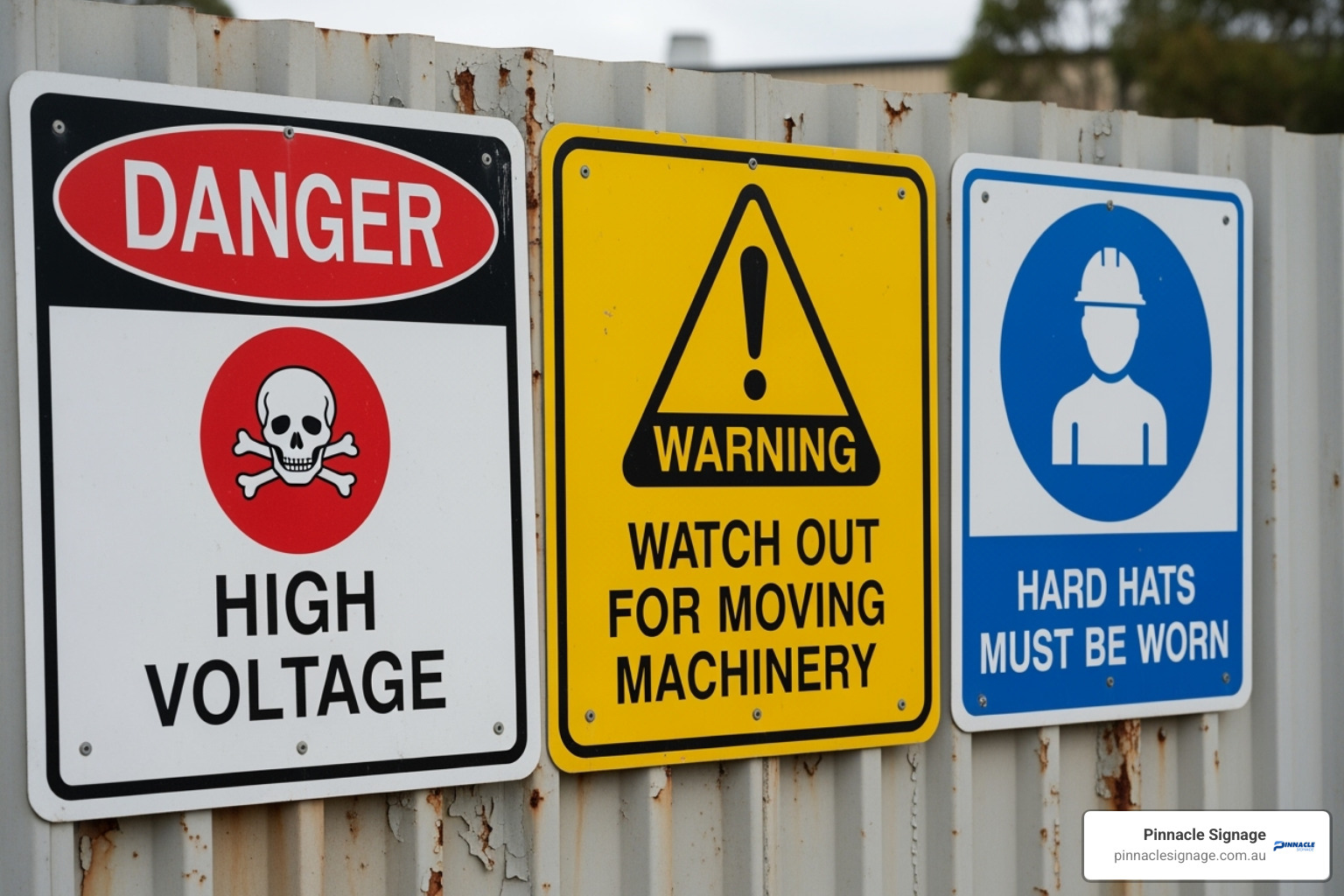
Mandatory Signs indicate required actions. Characterised by a blue circle with a white pictogram, they include signs like "Eye Protection Must Be Worn" to ensure workers take necessary precautions.
Danger Signs are for immediate, life-threatening hazards. They feature a red oval inside a black rectangle with the word "DANGER" in white. These signs demand attention in high-risk areas, such as those with high voltage. Our comprehensive range of Danger Safety Signs in Australia covers these critical hazard warnings.
Warning Signs alert people to hazards that are not immediately life-threatening but could cause injury. They use a yellow triangle with a black symbol and text, such as for "Wet Floor" or "Forklift Traffic". For a deeper understanding of hazard levels, our guide on Caution vs Danger vs Warning provides valuable insights.
Emergency Information Signs guide people to exits and facilities like first aid stations. Their green background with white text and pictograms makes them instantly recognisable, which is vital for a quick response. Our First Aid Signs Australia range ensures compliance and visibility.
Fire Signs identify the location of firefighting equipment. They have a red background with white text and pictograms, helping people find items like fire extinguishers quickly.
These distinct requirements ensure the message is conveyed visually, transcending language and literacy barriers.
Essential Design and Legibility: Meeting Your Safety Signage Requirements
Effective safety signage requirements go beyond colours and shapes; a sign's design and legibility are crucial for it to communicate its message instantly.
Pictograms and symbols are vital for clear communication, crossing language barriers in Australia's diverse workplaces.
Wording on safety signs should be brief and clear. Positive instructions (e.g., "Wear Eye Protection") are often more effective than negative ones.
Sans serif fonts are used for maximum readability, ensuring text is clear from a distance and in various lighting conditions.
Letter height and viewing distance are critical for effectiveness. AS 1319 provides guidelines on sign sizing to ensure they are legible from the required distance. Signs must be large enough for the text and symbols to be easily read, with larger signs needed for greater viewing distances or in poor lighting conditions. Our guide, The Definitive Guide to Safety Sign Hazard Identification, offers more insights into this.
Strategic Placement for Maximum Effectiveness
Strategic placement is a crucial part of safety signage requirements. Safe Work Australia principles and AS 1319 provide clear guidance for positioning signs for maximum impact.
Visibility is the golden rule. Signs must be clearly visible and unobstructed where hazards exist. Temporary signs should be removed when the hazard is gone.
Adequate illumination is essential. Use supplemental lighting or photo-luminescent materials if natural or artificial light is insufficient.
Placement height is best around eye level, ensuring signs do not obstruct movement or cause injury.
Proximity to hazards is key. Position signs as close as safely possible to the relevant hazard.
Avoiding obstructions and clutter is important. Ensure signs are not blocked or placed on movable objects like doors for fixed hazards. Avoid "sign blindness" by grouping related signs and preventing clutter.
For further guidance, resources from SafeWork NSW provide valuable insights.
Specialised Signage: From Biohazards to Safety Tags
Beyond general classifications, specific hazards demand specialised safety signage requirements.
Safety tags serve as temporary warnings for equipment or machinery, such as "Danger" or "Out of Service" tags used during maintenance. They must be legible and clearly communicate the temporary hazard.
Biological hazard signs, featuring the universal biohazard symbol, are essential in healthcare, research, and agricultural settings to prevent contamination.
Slow-moving vehicle emblems are often required for agricultural machinery or oversized loads to improve road safety, as per state road authority guidelines.
Chemical hazards demand specialised signage. This includes GHS Signage for globally harmonised communication and Hazchem Signage for identifying hazardous materials in line with the Australian Dangerous Goods (ADG) Code.
Ensuring Compliance and Enhancing Workplace Safety
Meeting safety signage requirements goes beyond simply following rules. It's a fundamental commitment to protecting your team, preventing accidents, and fostering a workplace where safety is a core value.
The Importance of Adhering to Safety Signage Requirements
Compliance with safety signage requirements is a fundamental part of an employer's duty of care under the Work Health and Safety (WHS) Act. It's about more than avoiding fines; it's about ensuring everyone goes home safely.
Failing to provide adequate signage can lead to significant legal obligations, including potential fines and penalties for businesses and, in severe cases, imprisonment for individuals. These consequences underscore the seriousness of workplace safety in Australia.
Beyond legal issues, a lack of clear signage increases the risk of workplace incidents, leading to preventable injuries that disrupt operations, damage morale, and harm a company's reputation.
On the positive side, investing in correct signage protects workers and offers business advantages. A strong safety record can lead to lower insurance premiums, as insurers recognise a reduced risk in well-signed, safety-conscious workplaces.
Most importantly, visible, high-quality signage helps build a positive safety culture. It shows a commitment to safety, boosting morale and making safety an integral part of the company's identity.
Your Partner in Compliant Safety Signage
At Pinnacle Signage, we help you get safety signage requirements right, so you can protect your team and focus on your business without compliance worries.
Our reputation is built on high quality materials. Our durable signs are made to withstand Australia's harsh conditions, resisting fading and wear to ensure long-term legibility.
Every sign we produce is manufactured to meet AS 1319 compliance standards, giving you full confidence that your signage meets Australian regulations.
We also offer customisable options to suit your specific site. We can add custom text, logos, or create signs in specific dimensions to address unique hazards and maintain brand consistency.
Our team provides expert guidance to help you identify the right solutions. For more advice, see our guide on How to Choose the Right Signage for Your Australian Business.
For organisations, groups, and businesses looking to order in bulk, we offer scalable solutions and competitive margins. Signage resellers and distributors can also access special distributor pricing, making us a reliable partner for profitable business relationships.
Shipping and Pickup Information
Getting your signage shouldn't be a headache, which is why we've streamlined our delivery and pickup processes to work around your schedule.
Production and shipping times are designed for efficiency. We dispatch most items within 48 hours of receiving your order and payment confirmation. Our estimated delivery times across Australia are straightforward: 1 to 2 days for Sydney, ACT, Melbourne, Brisbane, and Gold Coast; 2 to 4 days for the rest of NSW and Victoria; 3 to 6 days for SA, North Queensland, and Perth; and 5 to 9 days for Tasmania, NT, and WA.
For most deliveries within Australia, we use reliable courier services such as FEDEX. A few practical details to keep in mind: couriers can't deliver to PO Boxes, so you'll need to provide a valid daytime delivery address. A signature is required upon receipt to ensure safe delivery, and you'll need to be available to accept the delivery to avoid re-delivery charges. Including a daytime phone number helps if we need to contact you about your delivery. For items over 50kg, tailgate delivery is usually required for residential addresses, but this service is included in our standard shipping.
Free shipping is available Australia-wide for orders over $100, covering most items on our site. Some bulky items may incur additional shipping costs for deliveries to WA, North QLD, NT, TAS, and island areas, but our staff will contact you after your order if these charges apply.
Warehouse pickup is available at our facility at Unit 4/28 Nagle Street, East Wagga Wagga NSW. We're open 8am to 5pm, Monday through Friday, and closed on weekends and public holidays.
Ready to ensure your workplace meets all safety signage requirements and goes beyond basic compliance? Explore our extensive range of AS 1319 compliant safety signs and customisable solutions today!