

Reflective No Parking Signs: Visibility and Durability for Every Need
Why Clear Parking Rules Need 24/7 Visibility
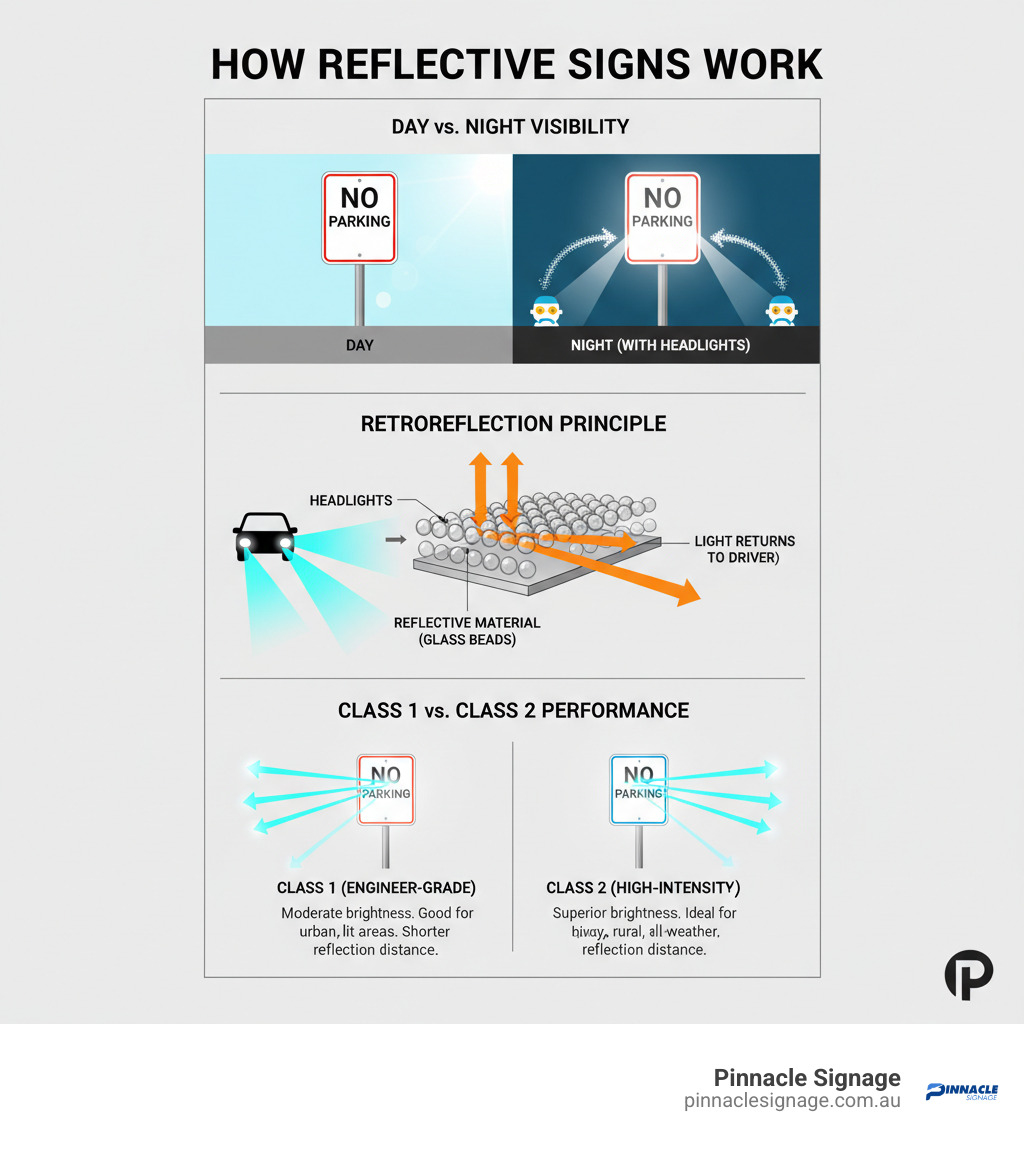
Reflective no parking signs use specialised retroreflective material that bounces light from vehicle headlights back to the driver, ensuring parking restrictions remain clearly visible in darkness, rain, fog, and other low-light conditions when standard signs become invisible.
- What they are: Signs made with retroreflective sheeting that return light to its source, creating high visibility in darkness
- Key materials: Durable, weather-resistant substrate (typically aluminium or poly) with Class 1 or Class 2 reflective coating
- Where to use: Car parks, loading zones, fire routes, construction sites, school zones, and any area requiring 24/7 parking enforcement
- Expected lifespan: 7-10+ years outdoors with quality materials and protective overlaminate
- Main benefit: Clear communication of parking rules day and night, reducing confusion and liability
When a driver pulls into your car park at 2am or steers through heavy rain at dusk, a non-reflective sign simply disappears. The result? Unauthorised parking, blocked access, safety hazards, and frustrated property managers dealing with preventable issues. Reflective signage solves this problem by maintaining consistent visibility regardless of lighting conditions.
For facilities managers, construction supervisors, and property owners across Australia, this means fewer parking disputes, better traffic flow, and reduced liability. Whether you're managing a shopping centre, hospital, construction site, or residential complex, reflective no parking signs ensure your rules are communicated clearly when it matters most.
At Pinnacle Signage, we understand that proper reflective no parking signage is crucial for preventing access issues and reducing liability for businesses and property managers. Our focus is on delivering quality Australian-made signs with the fast turnaround and reliable service that busy facilities teams need to maintain safety and order.
Why Reflectivity is Essential for Effective Parking Management
Picture this: it's 9pm on a rainy Tuesday, and a delivery driver is navigating your dimly lit car park. Without proper visibility, even the most clearly worded parking restrictions become completely invisible. That's precisely when reflective no parking signs prove their worth, not as a nice-to-have accessory, but as a fundamental tool for effective parking management and safety.
The science behind these signs is surprisingly neat. When vehicle headlights hit the reflective surface, light bounces directly back to the driver, making the sign appear illuminated against the darkness. This immediate recognition helps drivers quickly understand and respect parking restrictions, preventing dangerous situations like blocked fire routes, frustrating access issues, and costly towing incidents.
Night-time safety is where reflective signs truly earn their place. In busy commercial properties, hospital car parks, or industrial sites operating after hours, these signs maintain crystal-clear communication regardless of lighting conditions. Drivers don't need to squint or slow to a crawl to read the rules, they see them instantly from a safe distance.
Poor weather conditions add another layer of complexity. During heavy rain, fog, or dust storms, reflective signs maintain their clarity far better than standard alternatives. This consistent visibility improves driver awareness across all conditions, allowing people to react appropriately and preventing accidental parking violations that frustrate everyone involved.
For property managers and facilities teams, this translates directly into smoother operations. Reflective signage plays a vital role in preventing unauthorised parking, maintaining clear access routes for emergency vehicles, and ensuring the property functions as intended, 24 hours a day, 7 days a week.
If you're interested in how different types of signs communicate restrictions effectively, our guide on Understanding Prohibition Signs in the Workplace and Public Spaces provides helpful context.
Understanding the Components of a High-Quality Reflective No Parking Sign
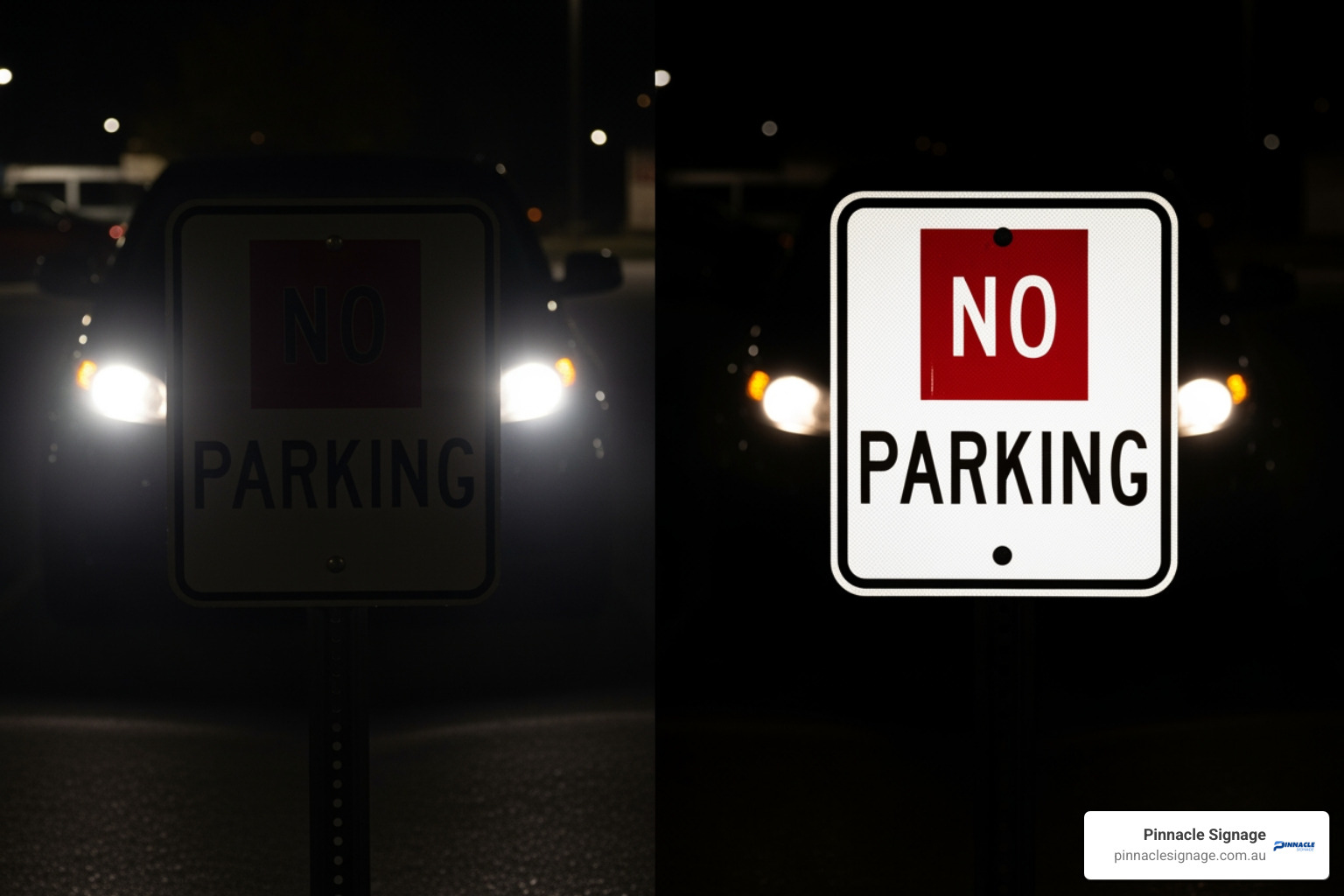
When you invest in a reflective no parking sign, you're getting much more than a simple piece of metal with words printed on it. You're purchasing a carefully engineered product built from the ground up to deliver maximum visibility, withstand years of harsh Australian weather, and provide genuine long-term value for your property or business.
The difference between a basic sign and a quality one comes down to material science and thoughtful construction. A well-made sign means fewer replacements, consistent visibility in all conditions, and ultimately a safer, more efficiently managed parking environment. For more insights on protecting your investment, take a look at our guide on Weatherproof Your Message: Top Solutions for Durable Signage.
Core Materials and Their Impact on Durability
The foundation of any durable reflective no parking sign starts with the right core material. At Pinnacle Signage, we craft our signs from high-grade aluminium, a choice that delivers on multiple fronts.
Rust-proof performance is the first major advantage. Unlike steel, aluminium naturally resists rust and corrosion, even when constantly exposed to moisture, salt spray, and harsh weather. This means your sign maintains both its structural integrity and professional appearance year after year, without the unsightly rust stains that plague cheaper alternatives.
The strength and longevity of our signs come from using substantial aluminium thickness, typically around 0.080-inch (approximately 2mm). This added thickness makes a real difference when signs face impacts, strong winds, or attempted vandalism. The result is a sign that can easily deliver a product life of 10 years or more under normal outdoor use.
Despite this robust construction, aluminium remains lightweight yet sturdy, which simplifies installation considerably. For facilities managers ordering in bulk, this also translates to reduced shipping costs across Australia, making it easier to outfit multiple properties or sites efficiently.
Reflectivity Grades Explained
The reflective quality of your sign determines how well it performs when visibility matters most. Retroreflectivity is categorised into different grades, each offering distinct levels of brightness and visibility distance. Understanding these grades helps you match the right sign to your specific environment and traffic conditions.
Class 1 High-Intensity Prismatic material represents our premium grade, offering superior brightness and the widest viewing angles. Signs with Class 1 reflectivity provide improved visibility up to 300 metres, making them ideal for high-traffic areas, critical safety zones, and locations where maximum visibility is absolutely essential. This grade typically comes with a 10-year warranty, reflecting its exceptional durability and consistent performance over time.
Class 2 Engineer Grade Prismatic material offers a highly effective and economical option for general applications. These signs deliver excellent visibility up to 150 metres, making them well-suited for private car parks, residential complexes, and areas with good ambient lighting or lower traffic speeds. Class 2 reflective sheeting usually carries a 7-year warranty and represents outstanding value for most everyday parking management needs.
Both grades are engineered to return light directly to its source, the fundamental principle that ensures your reflective no parking message reaches drivers clearly, whether it's midday or midnight. For more background on the basics of road signs, explore our Beginner's Guide to Road and Safety Signs.
The Role of Protective Features in a Reflective No Parking Sign
Beyond the core material and reflective sheeting, additional protective features play a crucial role in extending your sign's lifespan and maintaining its visual clarity. These elements work together to ensure your reflective no parking signs remain effective in the challenging Australian climate.
UV-resistant inks are essential for any sign facing prolonged sun exposure. We use high-quality UV-resistant inks for all our printing, preventing the colour fade that can render signs illegible within just a few years. This means your signs maintain their vibrant, professional appearance and clear messaging throughout their entire service life.
A clear protective overlaminate acts as a transparent shield over the printed surface, defending against multiple environmental threats at once. This layer resists UV degradation, chemicals, minor abrasion, and moisture. Some advanced laminates even provide graffiti resistance, allowing for easy cleaning without damaging the sign face, particularly valuable for signs like our "No Parking Garage in Constant Use Sign" available at Bunnings Warehouse.
Temperature tolerance is another critical factor. Our reflective sheeting and materials are designed to withstand extreme temperature fluctuations, from freezing cold to scorching heat up to 75°C. This resilience prevents cracking, peeling, or delamination, ensuring the sign maintains its integrity whether it's enduring a Central Queensland summer or a Tasmanian winter.
These protective layers represent a genuine investment in the longevity and performance of your reflective no parking signs, ensuring they continue serving their purpose without premature wear, fading, or replacement costs.
Types and Applications of Reflective No Parking Signs
Parking management isn't one-size-fits-all. A hospital car park has different needs than a construction site. A shopping centre faces different challenges than a quiet residential complex. That's why reflective no parking signs come in a wide range of designs and applications, each crafted to address specific situations and regulatory requirements. Whether you need a standard design for immediate deployment or a custom solution tailored to your property's unique rules, we've got you covered. Explore our general range of Parking & No Parking Signs available at Bunnings for convenient access.
Common Messages and Designs
The most effective parking signs use clear, universally recognised messages that drivers can understand instantly, even in poor visibility. The standard "No Parking" design features a red circle with a diagonal line through a black 'P' symbol, a format recognised across Australia. This fundamental prohibition sign works well for general applications, but specific situations often call for more targeted messaging.
For areas requiring constant access, "No Parking Any Time" removes any ambiguity about when the restriction applies. Commercial properties rely heavily on "Loading Zone Only" signs to keep delivery bays clear for trucks and service vehicles. These prevent general parking that could disrupt business operations and block essential access.
Safety-critical areas demand their own signage. "Fire Route" signs mark emergency vehicle access paths, where even a single parked car could delay fire services with potentially devastating consequences. For privately owned land, "Private Property" signs assert ownership rights and provide a legal foundation for enforcing parking rules in customer car parks, apartment complexes, or business premises.
Understanding the specific rules and regulations for parking signage in Australia helps ensure your signs are both effective and compliant. Our A-Z Guide to Australian Parking Signs Rules offers valuable insights into the requirements across different states and territories.
Where to Use a Reflective No Parking Sign for Maximum Impact
Quality signage is only half the equation. Strategic placement determines whether your reflective no parking signs actually prevent violations or simply get ignored. The key is positioning signs where visibility matters most and where parking violations create the biggest problems.
Commercial properties and shopping centres need clear parking management to handle customer flow, designate delivery zones, and prevent vehicles from blocking entrances or fire exits. During busy evening trading hours, reflective signs ensure customers can still see parking rules clearly as they arrive.
Construction sites present unique challenges, with constantly changing layouts and heavy machinery moving through tight spaces. Reflective signage maintains clear access for equipment and emergency vehicles while defining safe zones that protect workers and visitors alike.
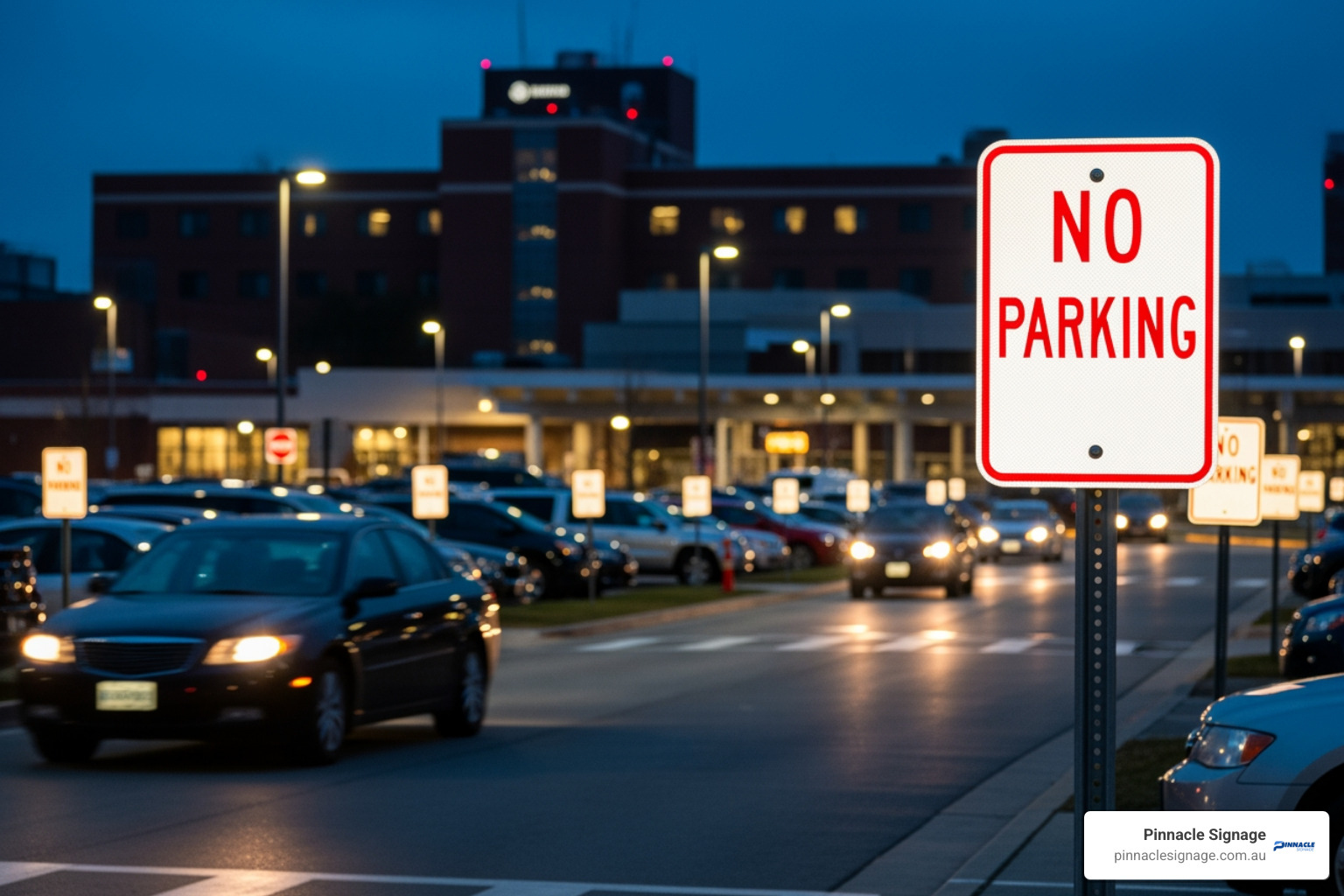
At hospitals and healthcare facilities, every second counts. Reflective signs keep ambulance bays clear, maintain emergency access routes, and ensure patient drop-off and pick-up areas remain available. When someone's rushing to the hospital at night, clear signage prevents confusion and keeps critical access open.
School zones require special attention to child safety. Reflective parking signs enforce drop-off and pick-up regulations around school entrances, particularly during those early winter mornings when parents are arriving in darkness.
Strata and residential complexes face ongoing parking disputes that can sour community relations. Reflective signs help enforce allocated parking, clarify visitor parking rules, and prevent blockages in shared driveways, reducing conflicts between residents and body corporate headaches.
Airports and transport hubs manage high volumes of traffic around the clock. Reflective signage designates short-term waiting areas, maintains security perimeters, and guides drivers through complex layouts, even during late-night arrivals and early-morning departures.
If you're managing a project that requires temporary parking restrictions, our article on Temporary Road and Parking Signs for Projects covers the options available.
Customisation for Specific Needs
Standard reflective no parking signs handle most situations beautifully, but many businesses and organisations have rules that don't fit neatly into off-the-shelf designs. That's where customisation becomes invaluable. A sign that speaks directly to your specific situation creates better compliance and presents a more professional image.
Adding your company logo transforms a generic prohibition into a branded communication that reinforces your professional standards. It's particularly effective for corporate car parks, retail centres, and business parks where brand consistency matters.
Custom wording lets you spell out unique parking regulations with precision. Instead of a generic "No Parking," you might need "No Parking: Staff Vehicles Only" or "No Parking: After 6 PM" to match your operational requirements. This clarity reduces confusion and gives you a stronger position when enforcing rules.
For complex car parks or multi-level facilities, directional arrows guide drivers more effectively than text alone. They minimise congestion by showing drivers exactly where they should, or shouldn't, be heading.
Time-based restrictions need clear communication. Custom signs can specify exact hours or days when parking is prohibited, crucial for areas with varied access needs throughout the week. A loading bay might be restricted during business hours but available for general parking after 6pm.
We can also incorporate colour matching for private property applications, helping your signage align with your brand guidelines while still maintaining the visibility and impact needed for effective parking management.
Custom signs ensure your message isn't just clear, but perfectly suited to your environment and requirements. For more on how customisation improves safety signage, see The Ultimate Guide to Custom Danger Signs.
Installation and Sourcing Information
Proper installation and sourcing are key to the effectiveness and longevity of reflective no parking signs. Correct mounting ensures visibility and durability, while sourcing from a local manufacturer provides products suited to Australian conditions.
For detailed guidance on mounting techniques and best practices, our Mounting Mastery: Your Guide to Installing Signs article covers everything you need to know about positioning, hardware selection, and ensuring your signs stay securely in place for years to come.
Sourcing Australian-Made Signage
When sourcing reflective no parking signs, particularly for large-scale projects, working with an Australian manufacturer offers distinct advantages. Products made in Australia, such as those from our facility in East Wagga Wagga, NSW, are specifically designed for local conditions and relevant standards.
Signs manufactured in Australia are built to handle the harsh sun, coastal air, and variable weather found across the country. Local manufacturing also allows for faster availability, which is crucial for time-sensitive projects or maintaining a consistent supply of signs across multiple locations. For large-scale rollouts, such as outfitting a shopping centre or managing several construction sites, sourcing signs in volume from a local manufacturer can streamline logistics and ensure product consistency.
Frequently Asked Questions about Reflective No Parking Signs
We often get asked a few key questions about reflective no parking signs. Here are our answers to help you make informed decisions that work for your property.
What is the difference between Class 1 and Class 2 reflective material?
The main difference comes down to how brightly they reflect light and where they're best used. Class 1 (High-Intensity Prismatic) is our premium option, offering superior brightness with wider viewing angles. These signs remain visible from up to 300 metres away, making them ideal for high-traffic roads, critical access routes, and anywhere maximum visibility is non-negotiable, even in challenging weather. They typically come with a 10-year warranty, reflecting their exceptional durability.
Class 2 (Engineer Grade Prismatic) provides excellent visibility up to 150 metres, which is more than adequate for private car parks, residential complexes, and areas with lower speed limits or decent ambient lighting. These signs usually carry a 7-year warranty and offer great value for less critical applications.
Choosing between them depends on your specific needs. If you're managing a busy commercial property, construction site, or anywhere with high traffic volumes, Class 1 is worth the investment. For quieter residential areas or well-lit private car parks, Class 2 delivers reliable performance at a more economical price point.
Do I need a reflective no parking sign for my private property?
While reflective signs aren't always legally required for private property in the same way they are for public roads, they're absolutely a best practice, and here's why: a reflective no parking sign ensures your parking rules are visible around the clock, not just during daylight hours. This matters because if a sign isn't visible, it's difficult to enforce the restriction or justify any action you might take.
Clear, reflective signage also helps reduce your liability. This is especially important in areas accessible to the public, like customer car parks, shopping centres, or privately owned facilities where visitors come and go. When your rules are clearly communicated and easily visible, you're protecting yourself from potential disputes or claims.
Beyond the legal side, reflective signs simply prevent confusion and frustration. Drivers know exactly what's expected, which means fewer vehicles blocking critical access points, less time spent dealing with parking disputes, and a smoother operation overall. It's an investment in clear communication and hassle-free property management.
How long do reflective signs last outdoors?
When you invest in a quality reflective no parking sign from Pinnacle Signage, you're looking at a typical product life of 7 to 10 years or more. Our signs are built from durable materials like 0.080-inch thick aluminium, and they feature protective overlaminates that shield against the elements.
The actual lifespan depends on a few factors. Class 1 High-Intensity reflective sheeting often comes with a 10-year warranty, while Class 2 Engineer Grade typically offers a 7-year warranty. The quality of the UV-resistant inks and overlaminates plays a crucial role too, preventing fading and degradation from Australia's harsh sun exposure.
Environmental conditions also matter. Signs in extremely harsh environments, like coastal areas with high salt exposure or locations prone to vandalism, might experience slightly shorter lifespans compared to those in more sheltered spots. But overall, when you choose quality materials and protective features, you're getting a sign that will reliably serve its purpose for many years, making it a smart long-term investment for your property.
Conclusion
Investing in quality reflective no parking signage is a critical step toward effective property management, improved safety, and the prevention of issues caused by unclear or invisible restrictions. The right signage ensures that parking rules are communicated clearly around the clock and in all weather conditions.
Different properties have unique requirements, from ensuring emergency access at hospitals to managing drop-off times in school zones. Whether using standard designs for universal recognition or custom signs for specific rules, the goal is clear communication. By selecting durable, high-visibility signs appropriate for the specific environment—be it a busy commercial centre, a construction site, or a residential complex—property managers can maintain order, ensure safety, and reduce parking-related conflicts.