

Detailed Guide to Road Traffic Safety Signs
Why Road Traffic Safety Signs Matter on Every Australian Road

Road traffic safety signs are a standardised system of symbols, colours, and shapes designed to communicate critical information to drivers, cyclists, and pedestrians, helping prevent accidents and keep traffic moving safely.
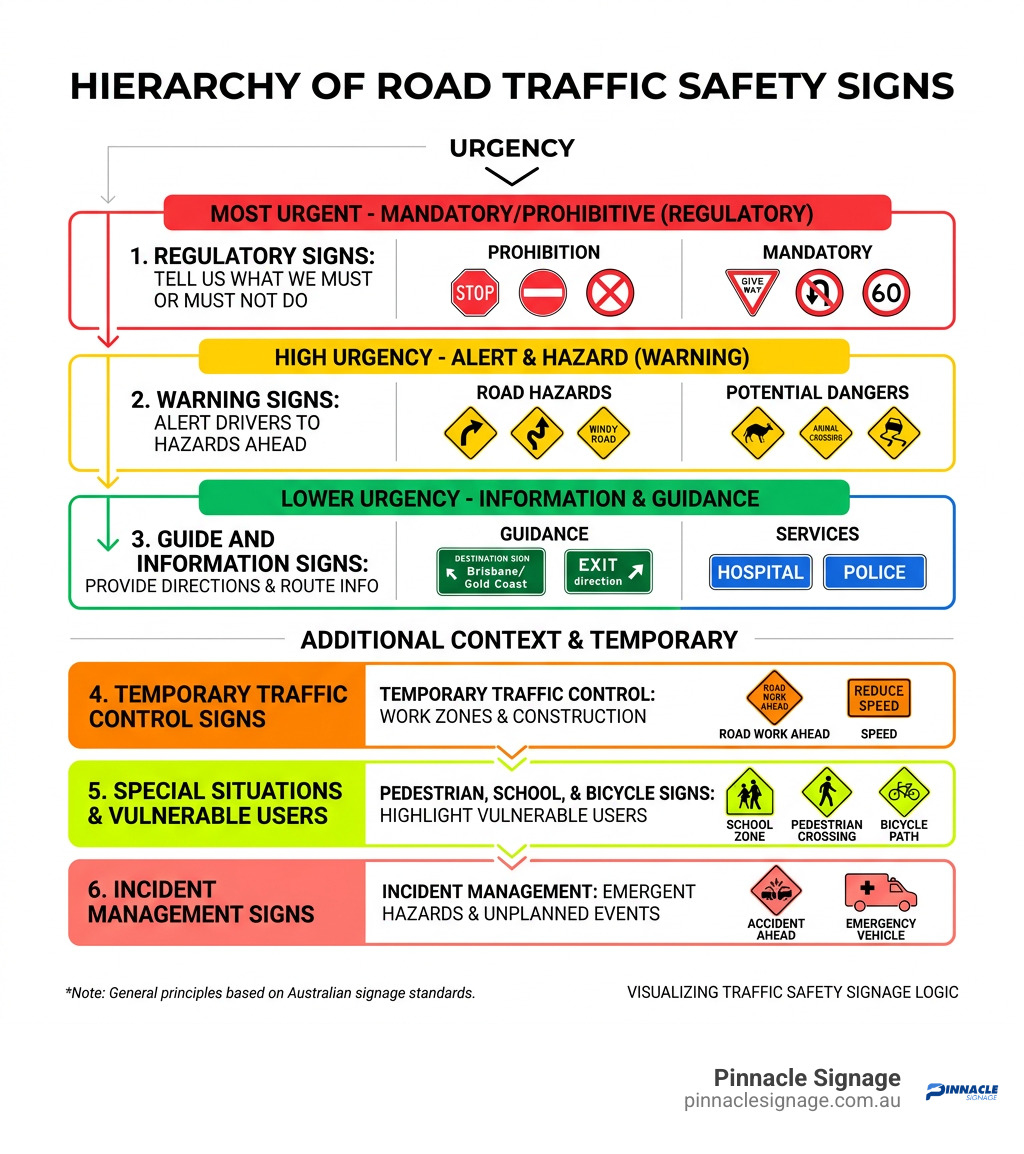
Here is a quick overview of the main types of road traffic safety signs and what they mean:
- Regulatory signs (white or red background): Tell road users what they must or must not do, such as Stop, Give Way, or speed limits
- Warning signs (yellow, diamond-shaped): Alert drivers to hazards ahead, like sharp curves, animal crossings, or slippery surfaces
- Guide and information signs (green, blue, or brown background): Provide directions, distances, and route information
- Temporary traffic control signs (orange background): Used in construction and work zones to manage traffic safely
- Pedestrian, school, and bicycle signs (fluorescent yellow-green): Highlight areas where vulnerable road users are present
- Incident management signs (pink or coral background): Deployed during emergencies to warn drivers of unplanned hazards ahead
Every sign you see on an Australian road follows a deliberate logic. The colour tells you the type of message. The shape tells you how urgent it is. And the symbol or text tells you exactly what to do, often in a fraction of a second.
That combination matters more than most people realise. Whether you are managing a construction site, overseeing a school campus, or coordinating traffic around a commercial facility, the right signs in the right places can be the difference between a safe environment and a serious incident.
For a broader look at how safety and road signage work together, the Pinnacle Signage guide to road and safety signs is a useful starting point.
At Pinnacle Signage, the team's background in the safety and industrial supply space provides a front-row view of how road traffic safety signs are used across construction, agriculture, commercial facilities, and public infrastructure. This guide walks through everything needed to understand, select, and deploy the right signage for any environment.
Road traffic safety signs terms you need:
Core Categories of Road Traffic Safety Signs
To navigate our roads safely, we rely on a structured hierarchy of signage. While many drivers recognise these signs instinctively, understanding the formal categories helps business owners and site managers ensure they are using the correct tools for traffic management. According to the standards for road signs in Australia, these devices are essential for maintaining order and preventing collisions between vehicles and pedestrians.
Regulatory Road Traffic Safety Signs and Compliance
Regulatory signs are the "law" of the road. They tell you what is mandatory. If you ignore a regulatory sign, you are likely breaking a traffic rule. Common examples include the iconic octagon Stop sign and the triangular Give Way sign.
In Australia, speed limit signs are a primary regulatory tool, featuring black numbers inside a red circle on a white background. For those managing private property or commercial sites, understanding prohibitive road signs is vital. These signs often use red circles with a slash to indicate actions that are strictly forbidden, such as "No Entry" or "No U-Turn," ensuring that traffic flows in the intended direction without conflict.
Warning: Road traffic safety signs for Hazard Awareness
While regulatory signs tell you what to do, warning signs tell you what to look out for. These are almost always diamond-shaped with a yellow background and black symbols or text. Their purpose is to alert the driver to a change in the road environment that might not be immediately obvious.
According to the Warning road signs, NSW Government guidelines, these signs are used for sharp curves, crests, and intersections. In regional areas like Wagga Wagga, animal crossing signs (such as kangaroos or livestock) are frequent sights, reminding drivers to reduce speed and remain vigilant. Using these signs effectively helps prevent "surprise" hazards from turning into accidents.
Guide and Information Signage
Guide signs are the navigators of the road system. They don't usually require a specific action like stopping, but they provide the context needed to reach a destination.
- Green backgrounds: Typically used for primary routes and highway directions.
- Blue backgrounds: Often seen on motorways or to indicate service facilities like hospitals and rest areas.
- Brown backgrounds: Reserved for tourist attractions, national parks, and historic sites.
- White backgrounds: Generally used for local street names and basic informational markers.
Decoding Colours and Shapes in Traffic Signage
The design of Road traffic safety signs is not accidental. It is based on human psychology and the need for instant recognition at high speeds. Before you can even read the words on a sign, your brain processes its shape and colour.
The Psychology of Sign Colours
- Red: Associated with danger and prohibition. It demands immediate attention and usually indicates a stop or a prohibited action.
- Yellow: The colour of caution. It stands out against natural backgrounds to warn of permanent hazards.
- Orange: Specifically used for temporary conditions, such as roadworks or construction zones, to signal that the normal road rules may have changed.
- Green: Provides a sense of security and guidance, used for directions and "safe" information.
- Blue: Used for motorist services and mandatory instructions in certain workplace safety contexts.
- Fluorescent Yellow-Green: This high-visibility shade is reserved for the most vulnerable road users, specifically in school zones and pedestrian crossings.
Universal Shapes for Instant Recognition
- Octagon: Exclusively used for Stop signs so they can be identified even if the sign is covered in snow or dirt.
- Inverted Triangle: The universal shape for Give Way, signalling that you must yield to other traffic.
- Diamond: The standard for hazard warnings.
- Vertical Rectangle: Used for most regulatory and directional instructions.
- Pentagon: Specifically used to identify school zones, alerting drivers to the presence of children.
Specialised Safety Signs for Work Zones and Pedestrians
In dynamic environments like construction sites, standard road signs are often supplemented by specialised markers. Understanding road construction signs is essential for anyone entering a work zone, as these areas present unique risks to both workers and drivers.
Construction and Temporary Traffic Control
Temporary traffic control relies heavily on orange backgrounds to signal a change in the usual road environment. Common signs include "Road Work Ahead," lane closure symbols, and flagger ahead signs. At Pinnacle Signage, we provide a variety of tools for these settings, including boxed edge signs and swing stands that can be deployed quickly. For those needing immediate solutions, the Pinnacle Danger Construction Site Sign at Bunnings is a convenient, durable option for marking off-limits areas.
Pedestrian, School, and Bicycle Safety
Protecting vulnerable road users requires specific signage that stands out in busy urban or school environments. Fluorescent green is the standard for children crossing and school zone signs. We also produce a wide range of bicycle lane markers and shared path signs to ensure cyclists and pedestrians can coexist safely. When paths are blocked, pedestrian detour signs are used to guide foot traffic away from hazards.
Incident Management and Emergency Scenes
You may occasionally see pink or coral-coloured signs on the road. These are incident management signs. They are used for unplanned events, such as traffic accidents, floods, or emergency road closures. Because they are a unique colour, they immediately signal to drivers that they are approaching an emergency scene and must be prepared to stop or divert.
Durability and Visibility Standards for Australian Roads
A sign is only effective if it can be seen. In Australia, our harsh sun and vast distances mean that Road traffic safety signs must be built to last. We focus on high-quality materials and reflective signage for parking and roads to ensure 24/7 visibility.
Material Selection for Longevity
We manufacture signs using durable, weather-resistant materials designed to withstand the Australian climate.
- Heavy-duty Aluminium: The standard for permanent road signs due to its rust-resistance and strength.
- Poly and Corflute: Ideal for temporary or lightweight applications.
- UV Resistance: Our signs are treated to prevent fading, often providing a lifespan of up to ten years in outdoor conditions.
Reflectivity and Night-Time Visibility
Night safety is critical. Most road signs in Australia use Class 1 reflective film, which bounces light from vehicle headlights back to the driver.
- Diamond Grade: The highest level of reflectivity, used for critical safety signs.
- High Intensity Prismatic: Offers excellent visibility at wide angles.
- Engineer Grade: Suitable for less critical informational signs. We adhere to AS 1319 standards to ensure that pictograms and text are sized correctly for the intended viewing distance, keeping everyone safe regardless of the time of day.
Securing Your Site with Professional Signage
Whether you are managing a local council project in Wagga Wagga or setting up a new commercial warehouse in Sydney, having the right Road traffic safety signs is non-negotiable. At Pinnacle Signage, we pride ourselves on being a reliable Australian-made partner for businesses, offering customisable options and fast turnaround times.
For your convenience, our premium range of products is available at Pinnacle Signage at Bunnings, making it easier than ever to pick up the safety gear you need. If your project requires something unique, you can also request a custom signage quote directly from our team. We are here to help you solve your traffic management challenges with professional, durable solutions.
Frequently Asked Questions about Road Traffic Safety Signs
What is the purpose of different road sign colours? Sign colours act as a code for drivers. Red indicates prohibition or stop, yellow warns of hazards, orange is for temporary roadworks, and green or blue provides guidance and service information. This allows road users to understand the "type" of message before they are close enough to read it.
Why are warning signs typically diamond-shaped? The diamond shape (a square rotated 45 degrees) is used globally for warnings because it is distinct from the rectangular shapes used for information and the circular or octagonal shapes used for regulations. This unique silhouette helps it stand out against the horizon.
How do I ensure my site signage meets Australian standards? The best way is to partner with a professional manufacturer like Pinnacle Signage. We ensure our products are designed with the correct colours, shapes, and reflectivity levels (such as Class 1 reflective) to align with Australian expectations for road and workplace safety.
Shipping & Pickup Information
We understand that when you need safety signs, you usually need them fast. We dispatch most items within 48 hours of order confirmation.
- 1 to 2 days: Sydney, ACT, Melbourne, Brisbane, Gold Coast
- 2 to 4 days: Rest of NSW and VIC
- 3 to 9 days: SA, WA, NT, and TAS
Free shipping is available for orders over $100 Australia-wide (excluding some bulky items to remote areas). If you are local to the Riverina, warehouse pickup is available at Unit 4/28 Nagle Street, East Wagga Wagga NSW, between 8 am and 5 pm, Monday to Friday.