

ADA Braille Signs: What You Need to Know for Accessibility
Understanding Tactile and Braille Signage in Australia

Tactile and Braille signs are essential wayfinding tools that combine raised characters and Unified English Braille (UEB) to help people with visual impairments navigate buildings independently. In Australia, requirements commonly reference the National Construction Code (NCC), AS 1428.1, and the Disability Discrimination Act 1992, which together set expectations for accessible public spaces. Effective tactile signs rely on consistent raised lettering, accurate Braille translation, strong colour contrast, and a non-glare finish.
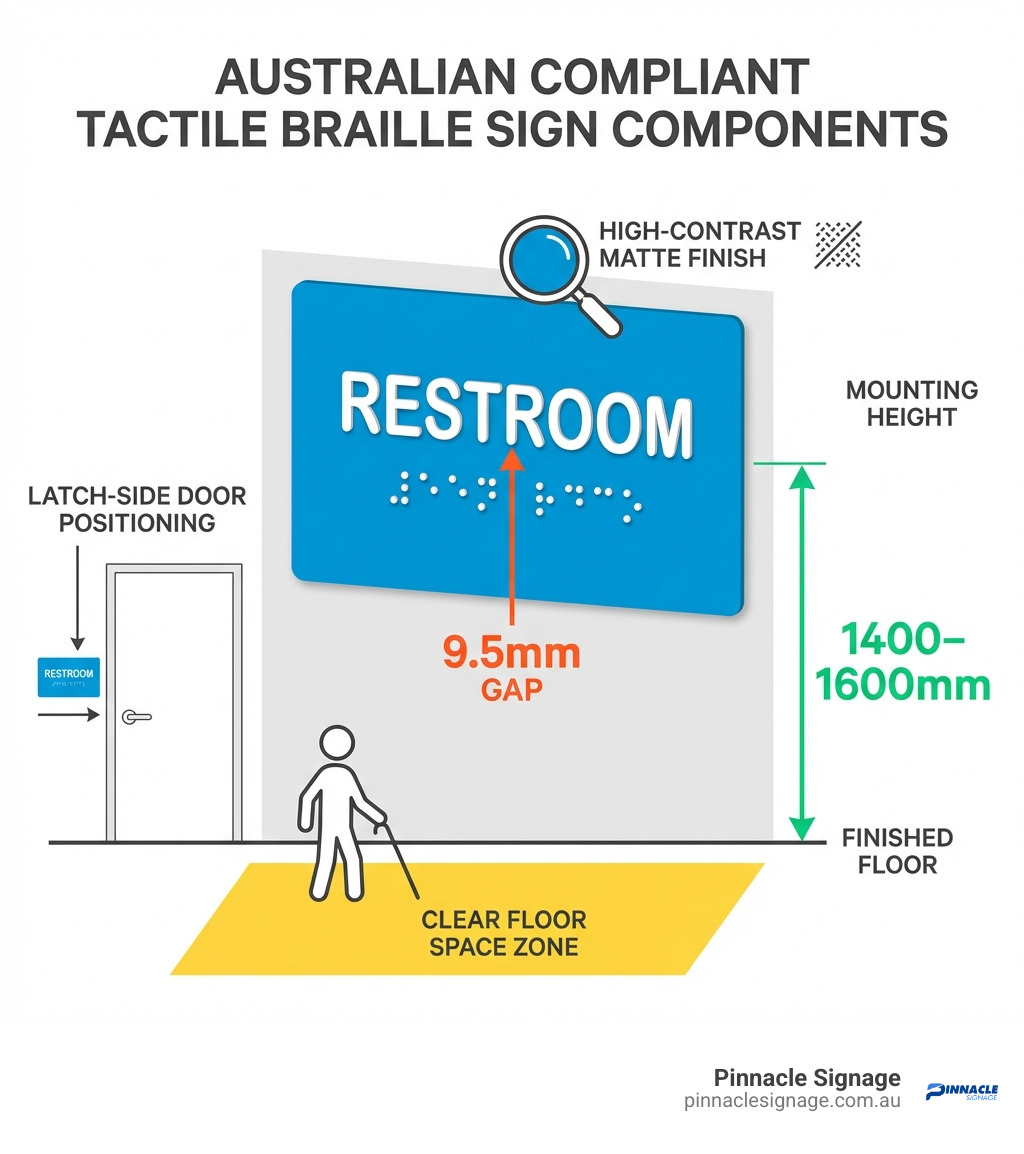
Here is a quick summary of what makes a tactile Braille sign compliant in Australia:
- Raised characters: Minimum 1 mm projection from the sign surface, uppercase, sans serif or simple serif font
- Braille: Grade 2 contracted Braille placed below the corresponding raised text, with a minimum 9.5 mm separation
- Colour contrast: High contrast between characters and background, light-on-dark or dark-on-light
- Non-glare finish: Matte or eggshell surface to prevent reflections
- Mounting height: Bottom of sign positioned between 1,400 mm and 1,600 mm above finished floor level
- Positioning: On the latch side of the door, or on the nearest adjacent wall, where space does not permit
- Clear floor space: Unobstructed approach to allow a person to stand and read the sign comfortably
In practical terms, these requirements typically apply to permanent rooms and key shared spaces in buildings that are open to staff, customers, patients, residents, and visitors. Common examples include restrooms, lifts, stairwells, exit doors, and office areas.
For site managers and project teams handling multi-floor fit-outs or multi-site rollouts, the main challenge is consistency: keeping terminology, layout, contrast, and placement uniform so users know what to expect. If you are standardising a site or rolling out upgrades across multiple locations, you can source many common options through Pinnacle Signage products at Bunnings for convenient in-store or online supply.
Relevant articles related to accessible signage:
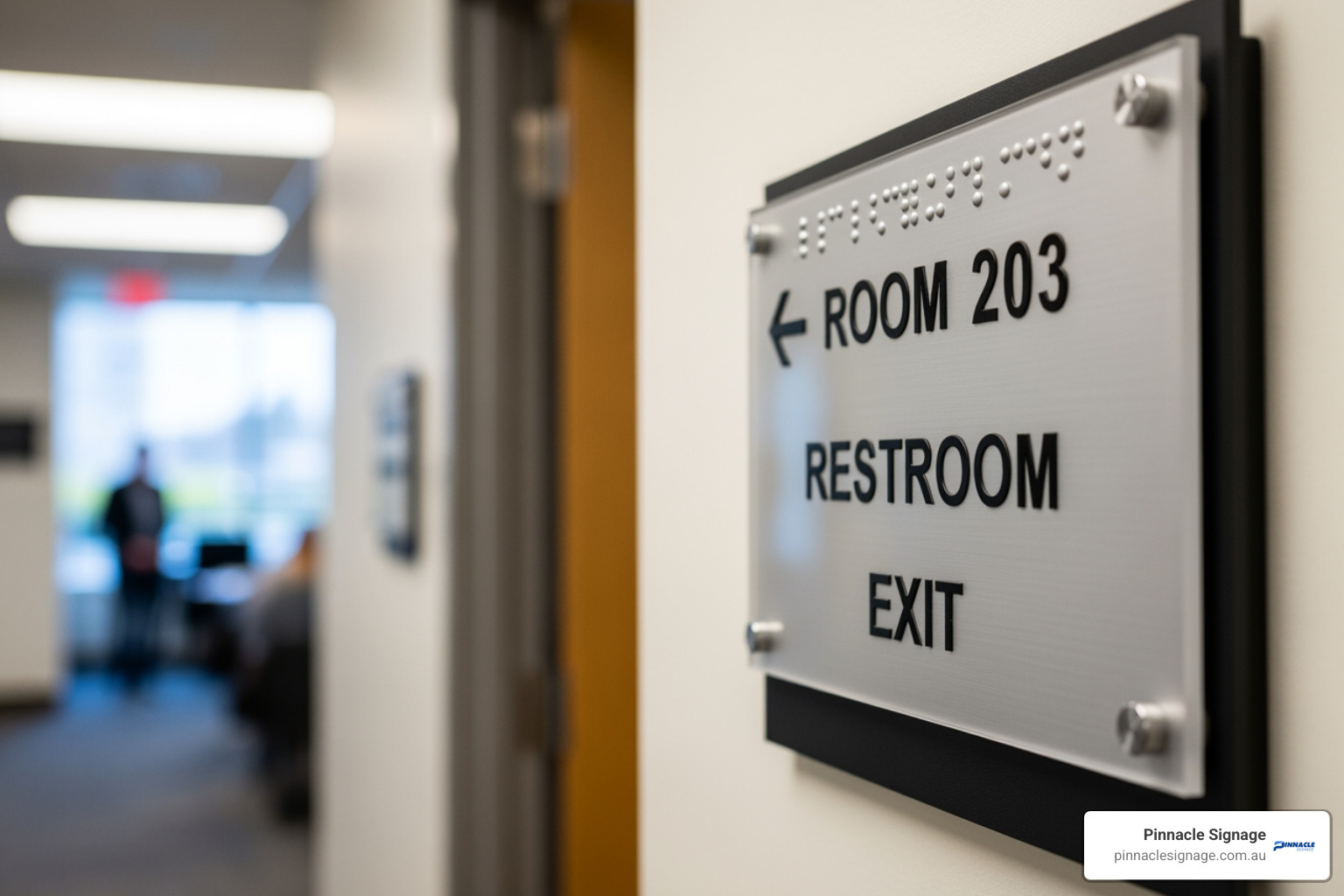
When we talk about accessibility, we often think of ramps and wide doorways. However, for the millions of people living with vision impairment, the ability to navigate a physical space also depends heavily on tactile communication. Tactile signs are designed to be read through touch, using a combination of raised print and Braille dots. In Australia, local expectations are commonly governed by the NCC and Australian Standard AS 1428.1.
For a deeper look at the basics, check out our guide to what braille tactile signs are.
The Role of Braille in Public Spaces
Braille acts as a sensory map at the point of need. Think about entering a large hospital, hotel, or multi-storey office and needing to confirm you have found the right room, toilet, lift, or exit. Tactile and Braille signage helps people who are blind or have low vision move more independently and with more confidence.
Using consistent universal braille signs across a facility gives users a predictable system to follow. That consistency matters just as much as the sign itself.
Legal Expectations for Australian Businesses
In Australia, equitable access is a legal expectation under the Disability Discrimination Act 1992 (DDA). If your facility is open to the public or provides services to staff and visitors, permanent rooms and key functional spaces must be identified in a way that supports accessible navigation. For official guidance, refer to Australian Government information on disability discrimination and access to premises via https://www.business.gov.au/.
If you are planning a new build, refurb, or a bulk refresh across multiple sites, it can help to standardise your sign schedule early, then source common items through Pinnacle Signage products at Bunnings while arranging any customisable options for room names, numbering, or site-specific wording.
Technical Requirements for Accessible Braille Signs
The tactile part of these signs refers to elements that physically protrude from the sign face. To be effective, these elements must be manufactured with precision. If the dots are too flat or the letters too crowded, the sign becomes unreadable to the touch. A compliant sign must have a tactile depth of at least 1 mm for characters. The dots themselves must have a domed or rounded profile, avoiding sharp edges that could be uncomfortable or confusing to read.
Formatting Grade 2 Braille
In Australia, the standard is Unified English Braille (UEB), specifically Grade 2. Grade 2 Braille is contracted Braille, which uses abbreviations and contractions to save space and speed up reading. For example, instead of spelling out every single letter in the word Exit, Grade 2 uses specific cell combinations that represent the whole word or parts of it.
There are also very specific capitalisation rules. In Braille, a special capital indicator dot is used before a letter to show it is uppercase. On tactile signs, we typically only capitalise the first letter of sentences, proper nouns, or initials to keep the tactile field clean and easy to decipher. You can learn more in our Braille Signage 101 guide.
Visual Standards for Accessible Braille Signs
While the tactile elements are vital for those with no sight, the visual properties are equally important for people with low vision.
- Colour Contrast: There must be a significant contrast between the characters and the background. This is usually measured by Light Reflectance Value (LRV). Think white text on a dark blue background or black text on a white background.
- Non-Glare Finish: Reflections from overhead lights can make signs impossible to read for someone with a visual impairment. All our tactile braille signs at Pinnacle Signage feature a matte or eggshell finish to eliminate glare.
- Font Choice: Sans-serif fonts like Arial or Helvetica are preferred because they have consistent stroke widths and no decorative elements that can confuse the fingers or the eyes.
For businesses requiring specific branding or unique messaging, customisable options are available to ensure your signage matches your facility while remaining functional.
Installation and Mounting Standards for Tactile Signs
Even a perfectly manufactured sign is useless if it is mounted in the wrong place. Consistency is the key to successful installation, ensuring that users know exactly where to find information.
Horizontal and Vertical Positioning
In Australia, the general rule for mounting height is to place the sign so the bottom edge is between 1,400 mm and 1,600 mm above the floor. This puts the tactile information at a natural height for most people to reach out and read with their hands.
For doors, the sign should almost always be on the latch side, which is the side where the handle is located. This allows a person reading the sign to know which way the door swings so they can avoid being hit as someone exits. If there is no room on the latch side, the sign can be placed on the nearest adjacent wall. For more details on getting this right, see our article on mastering accessible signage height.
Accessibility in Diverse Environments
Different spaces require different strategies:
- Lifts: Buttons inside the lift and call buttons in the lobby must have tactile and Braille identifiers.
- Stairwells: Handrails often require small tactile slugs or signs to indicate which floor a person has reached.
- Corridors: In long hallways, signs should be placed consistently, such as always on the left or always at the same height, so users know where to expect them.
Common Applications and Facility Requirements
Accessible signage is required anywhere there is a permanent room or a critical safety feature. For large-scale projects, ordering in bulk is the most efficient way to ensure every room is correctly identified.
Common locations include:
- Restrooms: Identifying male, female, unisex, and accessible toilets.
- Exits: Marking fire exits and paths of egress.
- Lifts: Floor numbering and emergency communication points.
- Permanent Rooms: Kitchens, boardrooms, plant rooms, and offices.
A great way to source these essential items quickly is through our partnership with Bunnings. You can find a wide range of Pinnacle Signage products at Bunnings, both in-store and online.
Signage for Health and Hospitality Sectors
In hospitals and aged care facilities, clear signage is a safety priority. Identifying wards, treatment rooms, and nurse stations with tactile elements ensures that all patients and visitors can find their way. In the hospitality sector, hotel room numbers are a prime candidate for Braille. We often handle bulk signage orders for hotels that need hundreds of identical, high-quality room plates that match their interior decor while remaining fully compliant.
Industrial and Commercial Use Cases
For commercial office buildings, buying tactile signs online is often the most efficient way to manage a fit-out. From directory boards to conference room labels, having a unified look across the facility improves the professional feel of the space. In warehouses, while many signs are for safety, permanent office spaces and first aid rooms within the facility still require tactile identification.
Frequently Asked Questions about Tactile Signage
Do all signs in a facility need to be tactile?
No. Tactile and Braille requirements generally apply only to signs that identify permanent rooms and spaces. Temporary signs, such as Out of Order or Cleaning in Progress, building addresses, and signs in non-public areas, like a private mechanical closet, usually do not require Braille. However, it is always best practice to be as inclusive as possible.
What is the difference between Grade 1 and Grade 2 Braille?
Grade 1 Braille is a direct letter-for-letter translation of the alphabet. It is quite long and takes up a lot of space. Grade 2 Braille uses contractions, like a form of shorthand, to make the text shorter and easier to read for experienced users. Grade 2 is the mandatory standard for public signage in Australia.
How can I ensure my custom signs are compliant?
The best way is to work with an experienced manufacturer. At Pinnacle Signage, we understand the nuances of AS 1428.1. We offer a range of customisable options where you can add your own text or logos while we ensure the Braille translation and tactile heights meet the necessary standards.
Shipping & Pickup Information
At Pinnacle Signage, we manufacture durable signage in Australia and support everything from one-off replacements to bulk orders for commercial fit-outs and multi-site rollouts. Many standard Pinnacle Signage items are also available via Bunnings, which can be a convenient option for teams needing to purchase in-store or online. To browse the range, visit the Pinnacle Signage brand page on the Bunnings website.
Production & Shipping Times
Pinnacle Signage dispatches most items within 48 hours of receiving your order and payment confirmation. Delivery times are estimated as follows:
- 1 to 2 days: Sydney, ACT, Melbourne, Brisbane, Gold Coast
- 2 to 4 days: Rest of NSW, Rest of VIC
- 3 to 6 days: SA, North QLD, Perth
- 5 to 9 days: TAS, NT, WA
Delivery Details
For most deliveries within Australia, we use courier services such as FEDEX. Please note that couriers cannot deliver to PO Boxes, so provide a valid daytime delivery address. To ensure safe delivery, a signature is required upon receipt. You must be available to accept courier deliveries, re-delivery charges will apply if you are not present. Include a daytime phone number with your shipping details if we need to contact you about your delivery. For items weighing over 50kg, a tailgate delivery is usually required for residential addresses. This service is included in our standard shipping. Alternatively, you can choose to pick up the item from a nearby depot.
Free Shipping
Free shipping is available for orders over $100 AU Wide. This applies to most items on the site. However, for some bulky items, additional shipping costs will apply for deliveries to WA, North QLD, NT, TAS, and island areas. Our staff will reach out to you after your order if these charges apply.
Warehouse Pickup
Pickup is available at our warehouse, located at Unit 4/28 Nagle Street, East Wagga Wagga NSW. The warehouse is open from 8am to 5pm, Monday through Friday, and is closed on weekends and public holidays. If you have any questions or need further information, please get in touch via our contact page.