

Your Comprehensive Guide to Site Safety Signs
Why Clear Signage is Non-Negotiable on Australian Worksites
Site safety signage is the first line of defence against incidents on Australian construction sites, mines, and industrial facilities. These visual communications protect workers and visitors by clearly identifying hazards, mandatory actions, and emergency procedures.
The five main categories of site safety signage are:
- Prohibition signs (red) - indicate what you must NOT do
- Mandatory signs (blue) - specify what you MUST do
- Warning signs (yellow) - alert you to potential dangers
- Safe condition signs (green) - guide you to safety or first aid
- Fire equipment signs (red) - locate firefighting equipment
Construction sites are among Australia's most hazardous work environments. Proper signage is crucial for preventing common incidents like falls, electrocutions, and being struck by objects by ensuring everyone on site understands the risks and safety measures.
Failing to understand a safety sign can have severe consequences. Clear, compliant, and strategically placed signage is not just about meeting regulations; it's about fostering a culture where safety is paramount and everyone returns home safely.
At Pinnacle Signage, we see how effective site safety signage prevents incidents and saves lives. We specialise in manufacturing durable safety signs that meet the demanding requirements of Australian worksites, delivering quality that facility managers and construction supervisors can rely on.
Simple guide to Site safety signage:
A Practical Guide to Effective Site Safety Signage
An effective site safety signage system communicates critical safety information instantly and clearly. When done right, your signage becomes a silent guardian that protects workers and visitors 24/7.
The Key Categories of Safety Signs Explained
Each category of safety sign has a distinct colour, shape, and purpose that makes it instantly recognisable, even in high-stress situations.
Prohibition signs use a red circle with a diagonal line to show what is not permitted. Signs like "No unauthorised access" or "No smoking" prevent dangerous behaviours before they happen.
Mandatory signs are blue circular signs with white pictograms that specify a required action, such as "Safety helmets must be worn." They are crucial at entry points to set clear PPE requirements.
Warning signs feature a yellow triangular design with black borders and pictograms. These signs provide a heads-up about potential dangers like "High Voltage" or "Falling Objects."
Safe condition signs are green squares or rectangles with white pictograms. They point the way to safety equipment, emergency exits, and first aid facilities, helping to ensure organised evacuations.
Fire equipment signs use a red rectangular format to mark the location of fire extinguishers, hose reels, and alarm points, enabling a fast response in an emergency.
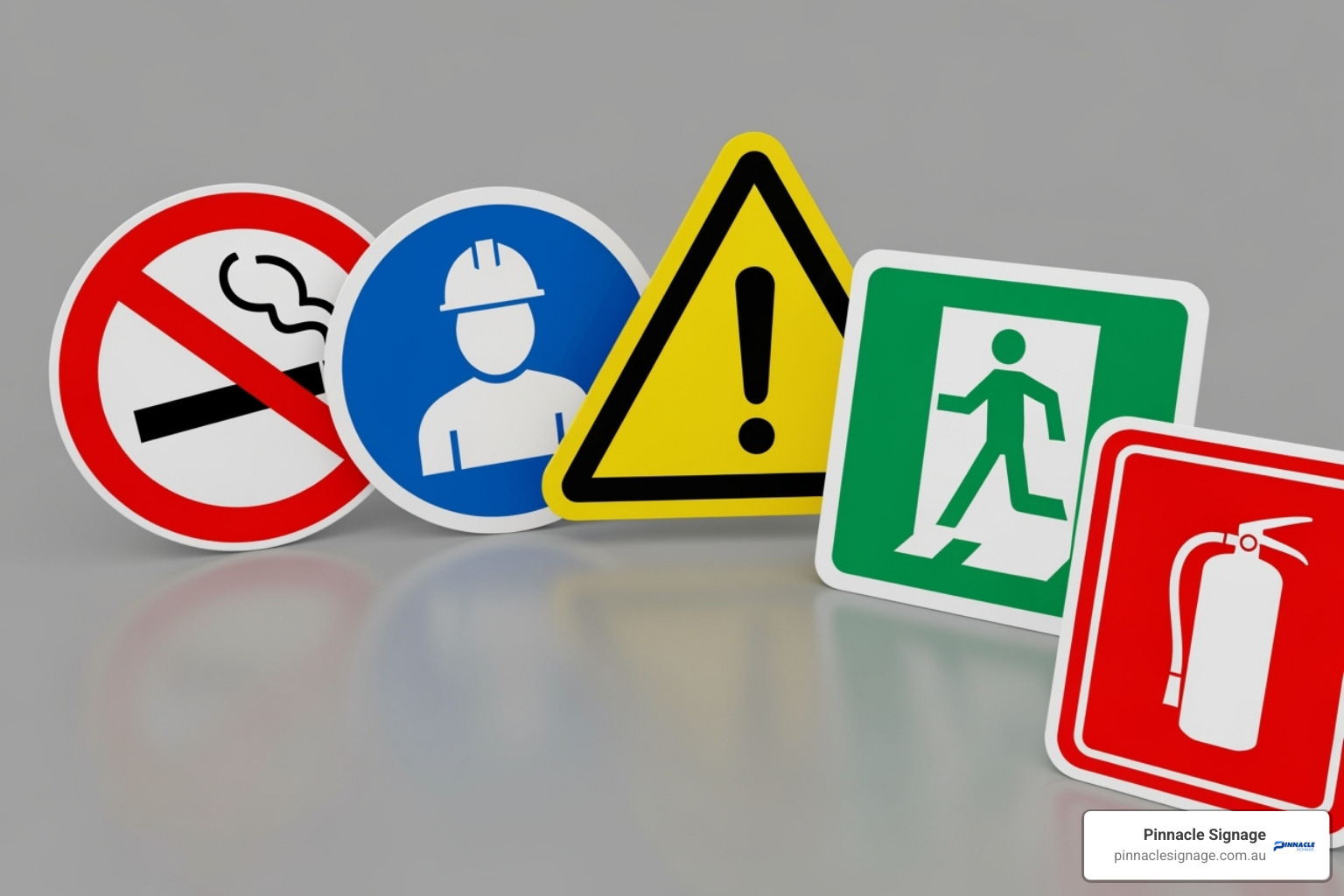
Understanding these categories is fundamental to effective site safety signage. For a deeper dive, our guide on The Definitive Guide to Safety Sign Hazard Identification offers more insights.
Common Site Safety Signage and Their Applications
Specific types of site safety signage address the unique challenges of Australian worksites.
PPE Required signs list mandatory personal protective equipment for specific areas, such as hard hats, safety glasses, and high-vis vests. They are common at site entrances and in specialised work zones.
Restricted Access signs like "Authorised Personnel Only" control entry to dangerous areas, such as excavation sites, active construction zones, or around heavy machinery.
Hazard Warning signs provide specific warnings like "Falling Objects," "High Voltage," or "Open Trench." They must be placed directly at the point of hazard for immediate relevance.
Open Trench and Excavation signs are vital for preventing falls and alerting workers to potential ground collapse risks, a common danger on Australian construction sites.
Overhead Works signs such as "Men Working Above" protect those below from falling debris or tools on multi-level construction projects.
Traffic Control signs manage the movement of vehicles, equipment, and pedestrians on busy sites to keep workers and the public safe.
Muster Point signs guide personnel to designated assembly areas during emergencies, ensuring an organised evacuation. Our article on Workplace Safety Made Simple: Muster Point Signs and Symbols explains how to implement these effectively.
Essential Elements for Effective Site Safety Signage
For signage to be effective, it must be designed and deployed correctly.
Clear language: Text must be concise and immediately understandable, avoiding jargon.
Universal symbols: Standardised pictograms are vital for immediate recognition, transcending language and literacy barriers.
Appropriate sizing: Signs must be large enough to be read from a safe distance.
High-contrast colours: The red, yellow, blue, and green colour schemes are chosen for maximum visibility in various lighting conditions.
Strategic placement: Signs must be positioned where they are visible and relevant—near hazards, at entry points, and along walkways, never obscured by obstacles.
Bilingual signs: For diverse workforces, bilingual signs ensure all workers understand critical safety information.
These elements create site safety signage that protects people effectively. For more guidance, see the Display placards and signs - SafeWork NSW resource.
Choosing Durable Materials for Australian Conditions
Australian worksites demand tough materials that can withstand harsh conditions while remaining visible.
Aluminium Composite Panel (ACP) is a premium choice for permanent outdoor signage. It's lightweight, strong, rust-proof, and UV-resistant, keeping colours vibrant under the intense sun.
Polypropylene offers flexibility and chemical resistance, making it ideal for temporary signs or application on uneven surfaces.
Colorbond Steel provides industrial-strength durability. This pre-finished steel resists chipping, peeling, and corrosion, making it perfect for harsh physical and environmental conditions.
Self-adhesive Vinyl is used for decals and labels applied directly to surfaces. High-quality vinyl is UV-stable and weather-resistant for indoor and outdoor use.
Key characteristics for materials in Australia are weather resistance, UV stability, and impact resistance to withstand active worksite conditions.
Investing in quality materials is an investment in long-term safety. Our article on Making Your Workplace Safe and Secure with High-Quality Safety Signage explores this further.
Best Practices for Signage Maintenance and Management
Proper maintenance ensures your site safety signage remains effective.
Regular inspections: Check signs frequently for damage, fading, or obstruction.
Cleaning: Regularly clean signs of dust and grime to maintain visibility.
Prompt replacement: Immediately replace any damaged, faded, or illegible signs.
Updating for changing site conditions: Update signage as site conditions, hazards, and access points change. Remove outdated signs to prevent confusion.
Promoting a safety culture: Well-maintained signage reinforces that management prioritises safety.
Reinforcing training: Signs serve as constant reminders of safety training but do not replace it.
Custom signs: Use custom signs for unique site risks that generic signs cannot cover.
Common Mistakes to Avoid: Avoid poor placement, inadequate maintenance, using outdated signs, and relying on signage alone without proper training and supervision.
Following these practices ensures your signage remains a powerful safety tool. For more tips, read our article on How to Use Health and Safety Signs in the Workplace Effectively.
Find the Right Signs for Your Site
Throughout this guide, we've seen how site safety signage is the backbone of workplace safety on Australian worksites. It's not just about compliance; high-quality, clear, and durable signage is a critical tool that protects your team and prevents incidents. A well-signed site is a safe site.
At Pinnacle Signage, we understand the demands of Australian worksites. Manufactured in Wagga Wagga, our signs are built using durable materials like Aluminium Composite Panel, Colorbond Steel, and weather-resistant polypropylene to withstand harsh local conditions.
We specialise in customisable solutions to meet your specific needs, from bilingual signs to unique hazard warnings. With fast, Australia-wide shipping, you can get the critical safety signage you need, when you need it.
Investing in quality site safety signage protects your most valuable asset—your people. Don't compromise on safety with substandard signage.
Ready to upgrade your site's safety signage? Start with the warning signs that form a crucial part of any comprehensive safety system.