

What Does a 3-Hour Parking Sign Really Mean
Understanding the 3 Hour Parking Sign
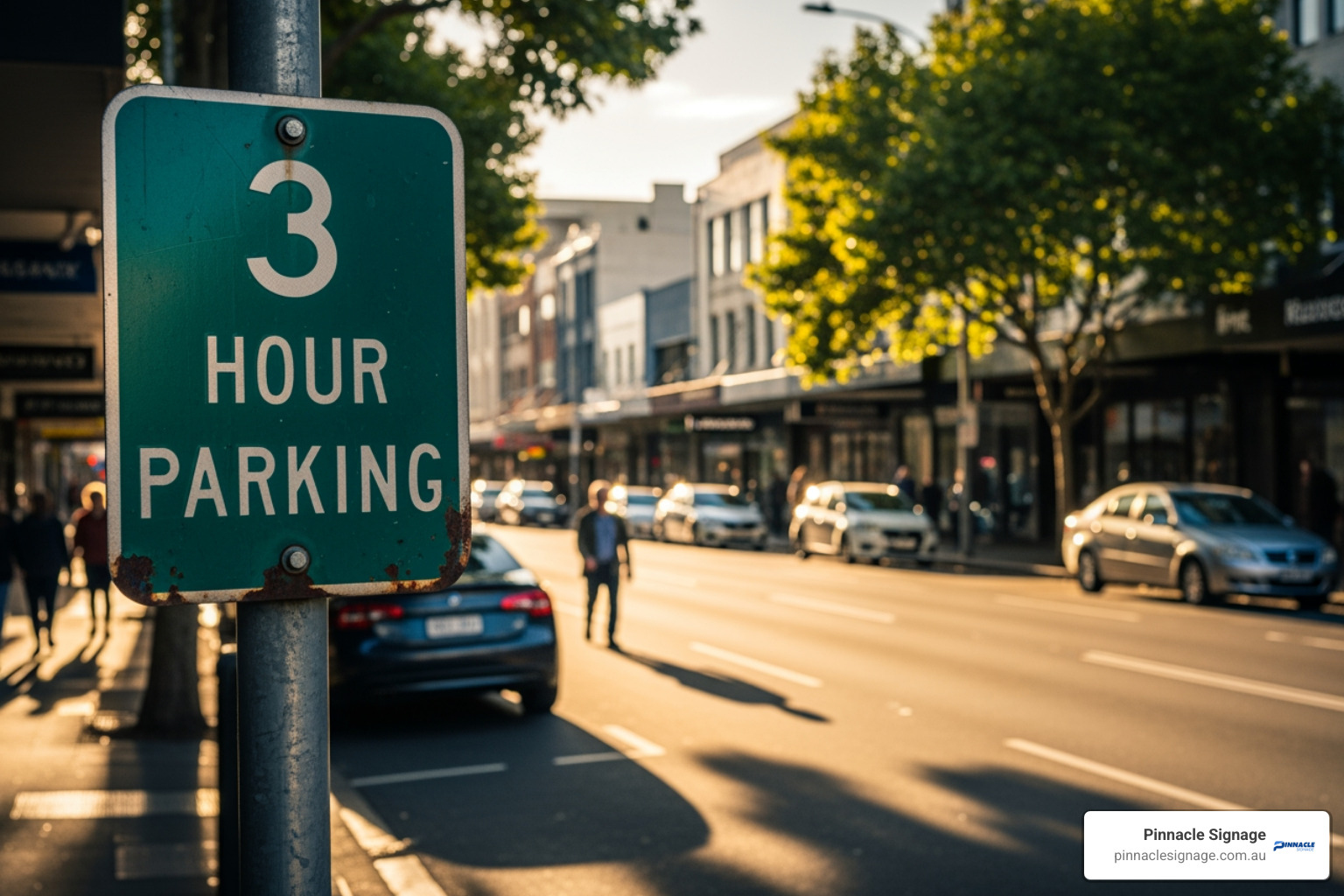
A 3 hour parking sign (displayed as '3P') tells you the maximum amount of time you can park your vehicle in that specific location during the hours and days shown on the sign. Here's what you need to know at a glance:
- Maximum parking duration: You may park for up to 3 hours, not a minute longer
- The time applies to the block or zone, not just one parking space
- Moving your car down the street doesn't reset the timer
- Check the sign for enforcement times, for example, Monday to Friday, 8am to 6pm
- Outside those hours, the restriction usually doesn't apply unless another sign says otherwise
- Payment may be required if the sign includes meter information or payment zone details
- Overstaying can result in fines, towing, or both
Whether you're running errands in a busy shopping district, visiting a medical centre, or parking near your workplace, understanding how to read and follow a 3-hour parking sign is essential. These signs are part of Australia's traffic management system, designed to encourage vehicle turnover and ensure fair access to parking in high-demand areas. Misinterpreting the rules can lead to costly fines or the inconvenience of having your vehicle towed.
Australian parking signs follow a standardised format, but they can still be confusing when combined with other restrictions, directional arrows, or payment requirements. The key is knowing what to look for and how each element on the sign affects where and when you can park.
As a provider of high-quality signage, Pinnacle Signage helps councils, businesses, and property managers implement clear, effective parking signage, including 3 hour parking signs, across commercial properties, construction sites, and public areas. Understanding how these signs work isn't just about avoiding fines, it's about creating safer, more accessible spaces for everyone.
3 hour parking sign terms you need:
Decoding the Basics of a 3-Hour Parking Sign
Understanding the basics of a 3 hour parking sign is the first step to becoming a parking pro. These signs are a common sight in commercial and residential areas across New South Wales, and they serve a vital purpose in managing vehicle flow.
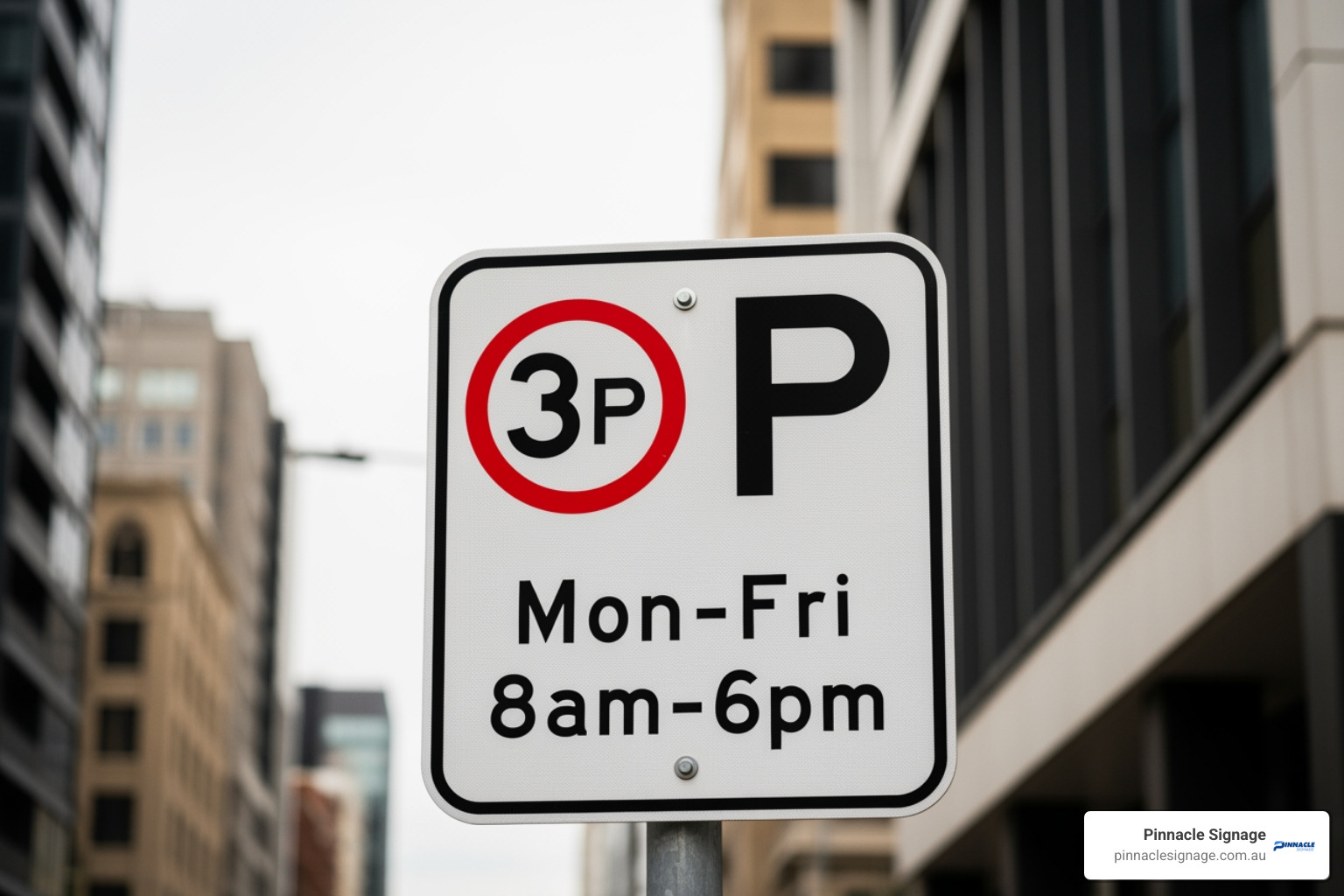
What '3P' Actually Means
When you see a sign displaying '3P', it means "3-hour parking". This is the maximum amount of time a vehicle is permitted to stay in that particular parking zone. It's not an invitation to park for exactly three hours, but rather a limit that you must not exceed. The primary goal of a 3P limit is to encourage vehicle turnover. In busy areas, this ensures that different drivers have the opportunity to access parking spaces throughout the day, supporting local businesses and reducing congestion. It's designed for short-to-medium term parking needs, allowing people enough time to conduct their business without hogging a spot all day.
Enforcement Times and Days
Reading a 3 hour parking sign isn't just about spotting the '3P'. You also need to pay close attention to any accompanying text that specifies when the limit applies.
- Specified Hours: Many 3P signs will include specific hours, such as "8 AM to 6 PM". This means the 3-hour limit is only enforced during these times. Outside of these hours, the parking might be unrestricted, or different rules might apply. Always check for additional signage.
- Days of the Week: The restriction often applies only on certain days, typically "Monday to Friday". Some signs might include "Saturday" or "Sunday", or even "Public Holidays" if the rules differ.
- Weekends: If a sign says "Monday to Friday", the 3-hour limit does not apply on Saturday or Sunday. However, this doesn't mean you can park indefinitely; other general parking rules or time limits might still be in effect.
- Public Holiday Exceptions: In most Australian states and territories, time-limited parking restrictions, including 3P, generally do not apply on public holidays unless explicitly stated otherwise. However, local council rules can vary, so it's always safest to double-check if you're unsure.
Paid vs. Free Parking
A 3 hour parking sign can indicate either free or paid parking, or sometimes a combination.
- Metered Parking: If the sign includes the word "Meter", "Ticket", or refers to a "Payment Zone", then payment is required. You'll typically find nearby parking meters or ticket machines where you can pay for your desired parking duration, up to the 3-hour limit. Many areas in NSW now use pay-by-phone apps, making payment more convenient.
- Free Parking Zones: If the sign simply states "3P" without any mention of payment, then it's a free parking zone. You can park for up to three hours without needing to pay, but you must still adhere to the time limit.
It's crucial to differentiate between these, as parking in a metered zone without paying can result in a fine, even if you stay within the time limit.
The Purpose and Placement of Timed Parking
Timed parking, like the 3-hour limit, isn't just about making things complicated for drivers. It's a strategic tool used by local councils and businesses to manage urban spaces effectively.

Why Councils and Businesses Use 3-Hour Limits
The implementation of 3-hour parking limits serves several key objectives:
- Encouraging Vehicle Turnover: This is perhaps the most significant reason. In popular areas, a constant rotation of vehicles ensures that more people can access shops, services, and amenities. Without limits, a few cars could occupy prime spots all day, making it difficult for others to find parking.
- Supporting Local Businesses: By ensuring a steady flow of potential customers, 3P parking directly benefits local businesses. Customers can find a spot, do their shopping or run their errands, and then move on, making way for the next shopper.
- Maximising Space Availability: Parking spaces are a finite resource in urban areas. Time limits help to distribute this resource more equitably among a larger number of users throughout the day.
- Preventing Commuter Parking: Many 3P zones are located near public transport hubs or business districts. The time limit discourages commuters from parking their cars all day to save on parking fees or public transport costs, freeing up spaces for shorter-term visitors.
Common Locations for 3-Hour Parking
You'll most commonly encounter 3 hour parking signs in areas where there's high demand for accessible, short-to-medium term parking.
- Shopping Districts and Main Streets: These are prime locations for 3P parking, as councils want to encourage shoppers to visit local businesses without long-term parkers monopolising spots.
- Near Public Transport Hubs: While discouraging all-day commuter parking, 3P can allow for short visits to pick up or drop off passengers, or for quick errands near stations.
- Hospitals and Medical Centres: These facilities often use 3P limits to ensure patients and visitors can find parking without too much difficulty, accommodating appointments and visits.
- Council Facilities and Libraries: Public services need accessible parking, and 3P limits help manage demand.
- Basement Parking and Commercial Car Parks: Many private car parks, especially those associated with commercial buildings or shopping centres, also implement 3P limits to manage their spaces. For managing such areas, effective basement parking signage is crucial.
How to Interpret a 3-Hour Parking Sign in Context
Parking signs in Australia can sometimes feel like a puzzle, especially when multiple rules are stacked on a single pole or when arrows dictate specific zones. Knowing how to decipher these combined messages is key to avoiding fines.
Reading Signs with Multiple Rules
When faced with a pole adorned with several signs, remember these rules:
- Top-to-Bottom Rule: Generally, signs are meant to be read from top to bottom. The top sign often indicates the most general rule, with subsequent signs adding more specific restrictions or exceptions. However, always consider the impact of arrows.
- Most Restrictive Sign: When different rules apply to the same area at different times, the most restrictive rule takes precedence. For example, a "No Stopping" rule will override a "3P" rule during its specified hours.
- Clearways and Loading Zones: Be aware of signs indicating clearways (where stopping is prohibited during peak hours) or loading zones. These often have very specific timeframes and can significantly impact where you can park, even if a 3P sign is present. Our A-Z Guide to Australian Parking Signs & Rules provides a comprehensive overview.
The Meaning of Arrows and Zones
Arrows on parking signs are critical for understanding which section of the road the rule applies to.
- Single Arrows: A single arrow pointing left or right indicates that the parking restriction applies to the kerb space in the direction of the arrow until the next parking sign or the end of the block.
- Double-Sided Arrows: A sign with arrows pointing both left and right means the restriction applies to the kerb space on either side of the sign pole. This regulation will continue until another sign or the end of the block.
- Area-Wide Restrictions: Sometimes, a sign might indicate a "Zone" or have no arrows, implying the rule applies to a broader area, often within a designated parking zone. Always look for entry and exit signs for these zones.
- End of Zone: A sign with a diagonal line through it, or an "End" sign, indicates the termination of a particular restriction.
It's vital to correctly interpret these directional cues to ensure you're parking legally within the designated zone.
Comparing a 3-Hour Parking Sign to Other Limits
The 3 hour parking sign (R5-3 in the Transport for NSW system) is just one of many time-limited parking signs you'll encounter. Others include:
- 1P (1-hour parking): Allows parking for a maximum of one hour. This is common in very high-turnover areas.
- 1/4P (15-minute parking): Extremely short-term parking, often used for quick drop-offs or pick-ups, or for accessing services like ATMs. Transport for NSW provides examples of these signs (e.g., R5-15 - Parking (1/4 hour)).
- No Parking: You can stop here briefly to pick up or drop off passengers or goods, but you cannot leave your vehicle unattended.
- No Stopping: This is the most restrictive sign. You cannot stop your vehicle here for any reason, even for a moment, except in traffic.
Each of these serves a different purpose in managing traffic flow and accessibility. Pinnacle Signage manufactures parking signs that conform to Australian standards, including the R5-3 design plan for 3 hour parking signs, ensuring clarity and compliance.
Consequences, Exemptions, and Special Cases
Understanding the rules is one thing, but it's equally important to know what happens if you don't follow them and if there are any situations where the rules don't apply to you.
What Happens if You Overstay?
Ignoring a 3 hour parking sign can lead to several unpleasant consequences:
- Parking Fines: The most common outcome is a parking infringement notice, or fine. The amount can vary significantly depending on the local council and the severity of the overstay. In NSW, these fines can be substantial.
- Demerit Points: While less common for simple parking overstays, some severe parking offences can, in certain circumstances, contribute to demerit points on your licence.
- Vehicle Towing: In some areas, particularly those with strict enforcement or where your vehicle poses an obstruction, your car might be towed. This incurs not only a fine but also significant towing and impoundment fees, plus the inconvenience of retrieving your vehicle.
- The 'Chalk and Move' Rule: Some councils use methods like marking tyres with chalk or using sensor technology to monitor parking times. The rule is that the time limit applies to the entire block or designated parking area. Simply moving your car a few spaces forward or across the street within the same block does not reset the 3-hour limit. You must move your vehicle completely out of the regulated area and then re-enter to start a new parking period.
Exemptions for Disability Parking Permits
The rules for 3 hour parking signs can be different for drivers displaying a valid Australian Disability Parking Scheme permit.
- Concessions for Permit Holders: Generally, a vehicle displaying a valid disability parking permit can park for longer than the stated time limit in a timed parking area. For example, in a 3P zone, a permit holder might be allowed to park for an unlimited period or for a significantly extended period (e.g., 6 hours).
- Always Check Local Rules: While there are general concessions, the exact rules can vary between local councils and states. Always check the specific conditions for disability parking in the area you are visiting, as some zones (like "No Stopping" or "Loading Zones") may still apply.
Rules for Commercial and Other Vehicles
Certain types of vehicles may also have specific regulations or exemptions:
- Loading Zones: Dedicated loading zones are typically for commercial vehicles or for the purpose of loading/unloading goods or passengers. These often have their own specific time limits (e.g., 15 minutes) and are usually separate from general 3P parking. Drivers of commercial vehicles should look for these specific signs.
- Commercial Vehicle Permits: Some councils offer permits for commercial vehicles that allow them different parking privileges in certain zones.
- Motorcycle Parking Rules: Motorcycles often have different parking rules than cars, and in some areas, may be exempt from certain time limits or allowed to park in specific motorcycle-only bays. It's always best for motorcycle riders to check local regulations.
- Reflective No Parking signs or other specific commercial vehicle signs (like those for truck loading) are vital for managing these unique situations, ensuring safety and compliance. Pinnacle Signage provides high-quality reflective no parking signs and custom solutions for various vehicle types.
Frequently Asked Questions about 3-Hour Parking
We understand that parking rules can sometimes be confusing. Here are answers to some common questions about 3 hour parking signs.
Can I move my car to another spot on the same street to reset the 3-hour limit?
No, the time limit applies to the entire parking area or block, and moving your car a few spots over will not reset the clock. The intention of timed parking is to encourage turnover of parking spaces within a defined zone. To legally restart your parking time, you must move your vehicle completely out of the regulated zone or block and then re-enter.
What happens if I park outside the hours shown on the 3-hour parking sign?
If a 3 hour parking sign specifies enforcement hours, for example, "Monday to Friday, 8 AM to 6 PM", then outside these times, the 3-hour limit usually doesn't apply. This often means parking is unrestricted, and you can park for longer periods. However, it's crucial to check for any additional signs that might indicate different restrictions for those 'off-peak' hours (e.g., "Resident Permit Holders Only 6 PM to 8 AM") or general "No Parking" rules that apply 24/7. Always read all signs on the pole carefully.
Does a 3-hour parking limit apply on public holidays?
In most Australian states and territories, time-limited parking restrictions, including those indicated by a 3 hour parking sign, do not apply on public holidays. This means you can often park for an unlimited duration on a public holiday in a 3P zone. However, this is a general rule, and local council regulations can sometimes vary. It is always best to check the specific information provided by the local council for the area you are parking in, especially if you are unsure. When in doubt, look for signage that explicitly states "Except Public Holidays" or consult the local council's website for clarity.
Need Clear Parking Rules for Your Property?
Managing parking on a commercial property, construction site, or private car park is made simple with clear, effective signage. A well-signed area ensures safety, compliance with Australian standards, and efficient traffic flow for staff and visitors.
Pinnacle Signage offers a complete range of parking and general signs designed to meet these standards. If you require a specific message or branding for your site, our team can help create custom signage solutions. For consultation on your specific requirements, contact our team today.