

Don't Get Lost: Master the Art of Reading Road Signs
Why Understanding Signs Is Essential for Safety and Navigation
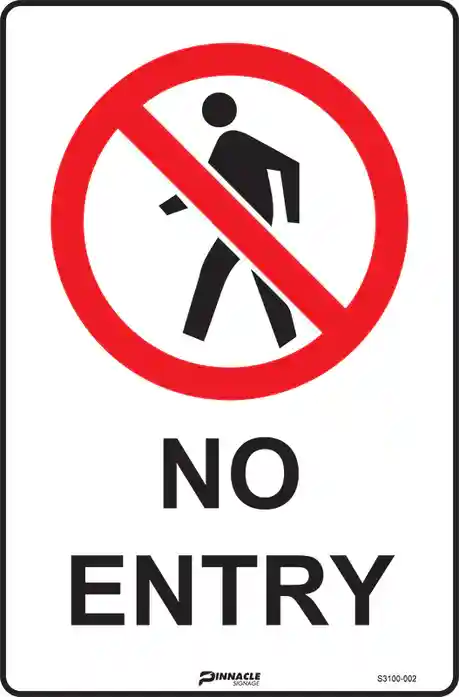
How to read signs correctly can mean the difference between a safe journey and a serious incident. Whether you're navigating busy highways, managing a construction site, or ensuring workplace compliance, recognising and interpreting signs quickly is a fundamental safety skill. Many of these essential safety and road signs are now available through our partnership with Bunnings, making it easier for businesses to maintain compliance.
Quick Guide to Reading Signs:
- Start with the shape, octagons mean stop, inverted triangles mean yield, and diamonds warn of hazards
- Check the colour: red for prohibitions, yellow for warnings, green for directions, and blue for services
- Read the symbol or text, icons and words provide specific instructions or information
- Respond appropriately, slow down, change lanes, prepare to stop, or follow the indicated direction
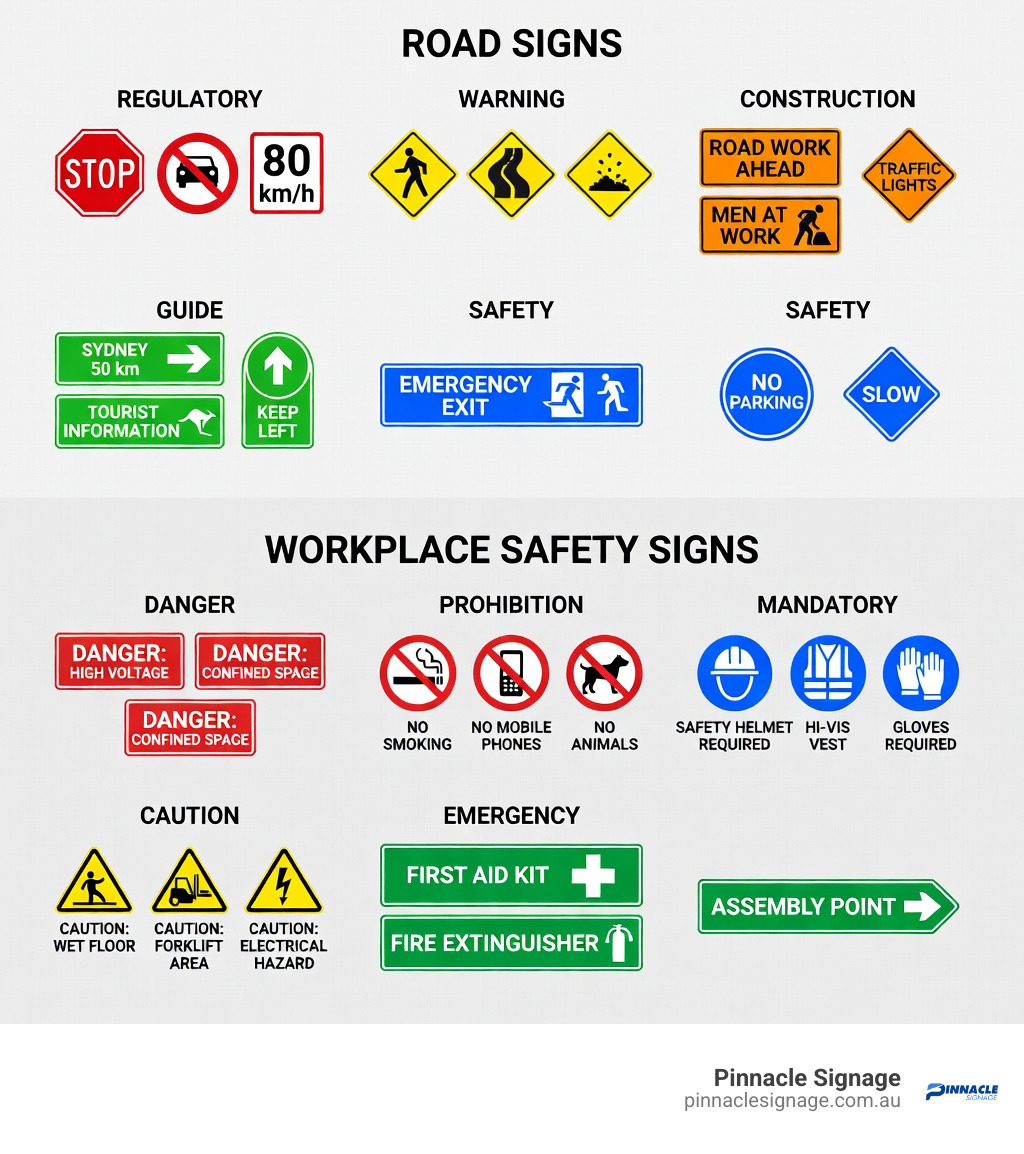
Road signs in Australia follow a standardised system where shape and colour communicate meaning instantly, often before you can read the text. Regulatory signs with white backgrounds and red circles are legally enforceable. Warning signs use yellow diamonds to alert you to hazards ahead. Orange backgrounds signal construction zones where fines are often doubled. Green signs guide you to destinations, while blue signs point to services like fuel and food.
In workplace settings, how to read signs extends beyond roads to include safety signage that protects workers from hazards. Danger signs with red panels warn of life threatening risks, while caution signs with yellow backgrounds indicate moderate hazards. Mandatory signs use blue backgrounds to show required actions, and prohibition signs feature red circles with diagonal lines.
Pinnacle Signage provides high quality, durable signage solutions that help Australian businesses communicate critical information clearly and compliantly. Our expertise in the safety and industrial supply space ensures that every sign we produce meets the necessary standards for workplace and public safety.
Relevant articles related to How to read signs:
The Visual Language of Australian Road Signs
When we talk about how to read signs, we are really talking about learning a second language, one that uses visual cues instead of spoken words. On Australian roads, this system is designed to be intuitive. You should be able to tell what a sign is trying to say from a distance, even before the words become legible. This is achieved through a strict hierarchy of shapes and colours.
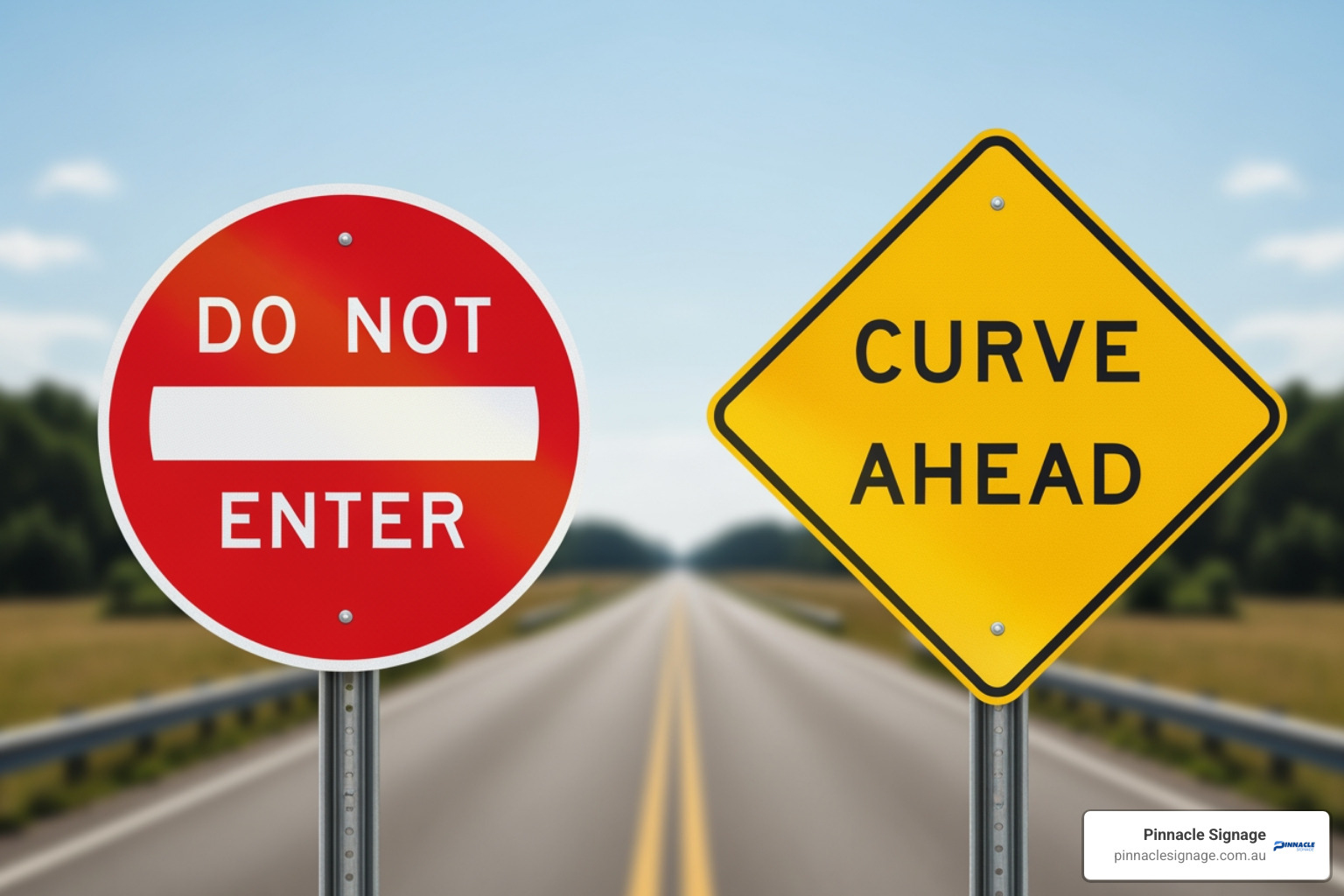
The primary goal of this visual language is to reduce the cognitive load on drivers. When you are travelling at 100 km/h on the Sturt Highway near Wagga Wagga, you do not have time to read a paragraph of text. You need to see a red circle and instinctively know it is a rule you must follow. We manufacture our signs to meet these exact standards, ensuring that every sign we produce is instantly recognisable to any road user.
Understanding Shapes for Quick Recognition
The shape of a sign is often the first thing you perceive. In Australia, specific shapes are reserved for specific types of information.
- Octagon: This shape is used exclusively for Stop signs. Because it is the only eight sided sign on the road, you can recognise it even from the back or if it is covered in dust. It requires a complete stop at the line.
- Inverted Triangle: This is the Yield or "Give Way" sign. It tells you that you must give way to traffic on the intersecting road, but you may not need to come to a full stop if the way is clear.
- Diamond: Most warning signs in Australia are diamond shaped. These alert you to permanent hazards like curves, intersections, or areas where animals might cross.
- Pentagon: Often used for school zones, this shape alerts drivers to the presence of children and the need for increased vigilance and reduced speed.
- Crossbuck: The X shape is used for railway crossings. It is a critical indicator that you are approaching a point where a train has the right of way.
If you have a unique facility or a private road that requires specific messaging, more info about custom signage options can help you design signs that follow these familiar shapes while conveying your specific rules.
Decoding Background Colours
Colour coding is the second pillar of how to read signs. The background colour tells you the intent of the message.
- White Backgrounds: These are regulatory signs. They state the law. If you ignore a sign with a white background, you are likely committing a ticketable offence.
- Yellow Backgrounds: These are warning signs. They are not necessarily laws in the same way a speed limit is, but they warn you of conditions that require your attention to stay safe.
- Orange Backgrounds: You will see these in work zones. They indicate temporary conditions due to construction or maintenance. In many parts of Australia, traffic fines double in areas marked with orange signs to protect workers.
- Green Backgrounds: These are your primary informational and guide signs. They tell you where you are, where you are going, and how far it is to the next town.
- Blue Backgrounds: These indicate motorist services. If you need fuel, a place to sleep, or a hospital, look for the blue signs.
- Brown Backgrounds: These are reserved for tourist attractions and recreational areas. If you are looking for a national park or a historic site near East Wagga Wagga, follow the brown signs.
How to Read Signs for Regulatory and Warning Purposes
Understanding the difference between a rule and a warning is vital for legal compliance and physical safety. Regulatory signs are the must do signs, while warning signs are the watch out signs.
Identifying Regulatory Rules
Regulatory signs tell you what you can and cannot do. In Australia, these are almost always rectangular with a white background and black text or symbols. The most famous regulatory sign is the speed limit sign. Unlike some other countries, Australian speed limit signs feature black numbers on a white background, encased in a bold red circle.
Ignoring these signs is not just dangerous, it's illegal. Whether it is a No Entry sign, a No U-Turn sign, or parking restrictions, these signs are there to manage traffic flow and prevent accidents. We take great care in our manufacturing process to ensure the red on these signs is vibrant and UV resistant, as a faded regulatory sign can lead to confusion and safety breaches. For a deeper look at prohibitive messaging, check out our guide on Stop Look Listen Understanding Prohibitive Road Signs.
Anticipating Hazards with Warning Signs
Warning signs are your best friend when driving on unfamiliar roads. They give you the heads up about what is around the corner. A yellow diamond with a black symbol of a winding road tells you to ease off the accelerator before you even see the turn.
In rural areas around New South Wales, animal crossing signs are particularly important. Seeing a kangaroo or cattle symbol on a yellow diamond should prompt you to scan the road edges, especially at dawn and dusk. These signs are placed based on data where collisions are frequent, so they are not just suggestions; they are based on real world risks. You can learn more about these in our article Road Hazard Signs Explained Know Before You Go.
Navigating Construction and Guide Signage
Roadworks are a constant part of Australian life as we maintain our vast infrastructure. Knowing how to read signs in these zones is about more than just finding your way, it is about protecting the lives of the men and women working on the road.
How to Read Signs for Directions and Services
Guide signs are designed to keep you moving in the right direction. On major highways, large green signs with white lettering provide clear information about upcoming exits and the distance to major regional hubs.
- Green Signs: These are the backbone of navigation. They often include route numbers, which help you stay on the correct highway without needing to constantly check a map.
- Blue Signs: These are incredibly helpful for long haul drivers. They indicate service centres, rest areas, and essential facilities. If you see a blue sign with a bed icon, you know lodging is available at the next exit.
- Brown Signs: These highlight the beauty of our region. From lookout points to local museums, these signs encourage tourism and help you find the "hidden gems" of the NSW countryside.
For businesses looking to implement their own wayfinding systems, we offer several directional signage systems that can be customised to suit your facility layout.
Managing Safety in Work Zones
Construction signs use high visibility orange because it stands out against almost any background. These signs are temporary, but their instructions are mandatory. When you see an orange sign that says "Roadwork Ahead" or "Prepare to Stop," you must reduce your speed immediately.
Work zones often feature "Multi-Message" signs, which are frames that hold several smaller signs at once. These might include a speed limit, a warning about workers, and a lane closure notice all in one place. It is important to remember that in many Australian jurisdictions, fines for speeding are significantly higher in these zones. You can find out more in our Construction Traffic Signs 101 What Every Driver Should Know guide.
If you are a contractor or site manager, you can find the Pinnacle 600 x 400mm Metal Danger Construction Site Sign at Bunnings for a quick and reliable solution for your site.
Workplace Safety and Accessibility
The skill of how to read signs is just as important once you step out of your car and into a workplace. Workplace safety signs follow their own set of Australian Standards to ensure that hazards are communicated effectively to employees and visitors alike.
How to Read Signs for Workplace Safety
In an industrial or commercial setting, signs are categorised to help you react correctly to different levels of risk.
- Danger Signs: These are for life threatening hazards. They feature a red oval on a black background with the word "DANGER" in white. Examples include high voltage areas or confined spaces. You should never enter an area marked with a danger sign without proper authorisation and equipment.
- Caution Signs: These warn of hazards that could lead to minor or moderate injury, like a slippery floor or a low ceiling. They feature a yellow background and a black triangle.
- Mandatory Signs: These tell you what you must do, such as "Eye Protection Must Be Worn." They are blue circles with white symbols.
- Prohibition Signs: These tell you what you must not do, like "No Smoking." They feature a red circle with a diagonal slash over a black icon.
For businesses handling chemicals, understanding Hazchem Signage is a legal requirement. These signs use specific codes to tell emergency services how to handle a spill or fire involving dangerous goods. You can also find Safe Work Australia guidance on safety signs for more detailed regulatory information.
Understanding Accessibility and Braille
Accessibility is about ensuring everyone can read the environment, regardless of their physical abilities. In Australia, AS 1428.1 sets out the requirements for tactile and Braille signage. This ensures that people with vision impairments can steer public buildings safely.
Tactile signs use raised characters and Grade 2 Braille. Grade 2 is a contracted version of Braille that is faster to read by touch. These signs must be mounted at specific heights, usually between 1200mm and 1600mm, and in consistent locations, typically on the latch side of a door. We specialise in high quality Braille Signage 101 Understanding Tactile Signs for Accessibility to help businesses meet these essential standards.
Interpreting Signs in Life and Health
Beyond the physical signs on our roads and walls, many people find value in learning how to read signs in a more metaphorical or intuitive sense. This involves paying attention to the world around you and your own internal state to find guidance or meaning.
Recognising Life Clues and Synchronicity
Synchronicity is the experience of meaningful coincidences. Perhaps you are thinking about a specific problem and then see a quote on a billboard or hear a song on the radio that seems to provide the answer. While not "signs" in a regulatory sense, these occurrences can act as prompts for self reflection.
- Repeated Encounters: Noticing the same number sequence, animal, or phrase multiple times in a short period.
- Intuitive Pulls: Feeling a strong "hunch" to take a different route home or call a friend you haven't spoken to in years.
- Surrendering Control: Sometimes, the best way to "read" these signs is to stop trying to force an outcome and instead remain open to whatever information the day presents.
Listening to Bodily Signals
Our bodies are often the most honest signposts we have. Physical ailments can sometimes be "signs" of underlying stress or emotional states that we haven't consciously addressed.
- Headaches: Often a sign of overthinking or mental tension.
- Tight Shoulders: A common physical manifestation of carrying too much "weight" or responsibility.
- Gut Feelings: The enteric nervous system in our gut often reacts to situations before our conscious mind does. Learning to trust that "sinking feeling" or "butterflies" can be a vital part of personal safety and decision making.
By practising mindfulness, we can become more adept at recognising these internal signs before they turn into more significant health issues.
Frequently Asked Questions about Reading Signs
What is the difference between a danger sign and a caution sign?
The primary difference is the severity of the hazard. A Danger Sign is used for conditions that are likely to be life threatening or result in serious injury if ignored. These have the distinctive red and black "DANGER" header. A Caution Sign is for hazards that might result in minor or moderate injury, like a trip hazard. These are yellow and black.
Why are some road signs different colours like blue or brown?
These colours categorise the type of information. Blue signs are for motorist services like food, fuel, and accommodation. Brown signs are specifically for tourist attractions, cultural sites, and historic landmarks. This allows drivers to quickly filter out information they don't currently need.
How do I know if a sign is legally enforceable in Australia?
Generally, regulatory signs (white background, red circle or black border) are legally enforceable under Australian Road Rules. This includes speed limits, "No Entry," and "Keep Left" signs. Failing to obey these signs can result in fines and demerit points. Warning signs (yellow diamonds) are advisory, but ignoring them can still lead to accidents for which you may be held liable.
Partnering for Clear Communication
Mastering how to read signs is a lifelong skill that improves safety for everyone. At Pinnacle Signage, we take our role in this system seriously. By manufacturing durable, high quality signage that adheres to Australian Standards, we help ensure that the "visual language" of our roads and workplaces remains clear and effective.
Whether you are a site manager in Sydney needing bulk safety signs or a small business owner in Wagga Wagga looking for custom wayfinding, we are here to help. Our partnership with Bunnings means that many of our most popular signs are available for immediate pickup or delivery across the country. You can explore our range on the Pinnacle Signage Brand Page at Bunnings.
Order Your Professional Signage Today
We pride ourselves on fast turnaround times, with most orders dispatched within 48 hours. We offer free shipping for orders over $100 across most of Australia, making it easy and cost effective to get your site compliant.
- Fast Dispatch: Most items sent within 48 hours of payment.
- Reliable Delivery: We use trusted couriers like FEDEX for Australia wide shipping.
- Warehouse Pickup: Available at Unit 4/28 Nagle Street, East Wagga Wagga NSW, from 8 am to 5 pm, Monday to Friday.
- Custom Solutions: If you need something specific, you can contact our team for custom solutions or call us on 1300 40 45 50.
For our industry partners and resellers, please ask about our special distributor pricing and competitive margins. We are committed to being your reliable Australian made supply partner. Clear communication starts with the right sign. Let's make sure your message is seen and understood.