

The Ultimate Guide to Basement Parking Signage Design
Why Effective Car Park Wayfinding Matters
Basement parking signage is the critical communication system that guides drivers safely through underground car parks, preventing accidents, reducing confusion, and ensuring smooth traffic flow.
In a typical basement car park, effective signage supports:
- Safety: Clear warnings about hazards, speed limits, pedestrian zones, and clearance heights
- Wayfinding: Directional arrows, level indicators, and exit signs that guide drivers seamlessly
- Compliance: Meeting Australian Standards for accessibility, safety, and regulatory requirements
- Efficiency: Reducing driver stress, search time, and congestion through logical navigation
- Liability Protection: Demonstrating duty of care and reducing legal risk for property managers
When a driver enters a basement car park, they are immediately relying on your signage to make quick decisions in a confined, often dimly lit environment. Poor signage creates frustration, traffic jams, and safety risks, as confusing layouts can contribute to driver distraction. Inadequate signage can also expose property managers to legal risk under Work Health and Safety obligations, as outlined by regulators such as Safe Work Australia.
Effective basement parking signage goes beyond simply marking exits and entrances. It creates a coordinated system that addresses driver behaviour, pedestrian safety, accessibility requirements, and emergency procedures. From the moment a vehicle enters the facility to when it exits, every sign plays a role in managing traffic flow, preventing accidents, and enhancing the user experience.
At Pinnacle Signage, we support businesses across Australia with basement parking signage solutions that integrate into broader safety and wayfinding systems. Many of our general safety and traffic signs are now conveniently available through Pinnacle Signage at Bunnings, in-store and online, which is particularly useful for facilities managers and contractors needing consistent signage across multiple sites.
Basement parking signage helpful reading:
The Core Functions of Basement Parking Signage
The primary purpose of signage in basement parking areas is multifaceted, but it boils down to two critical elements: ensuring safety and facilitating smooth traffic flow. As owners or managers of a parking facility, keeping people safe on your property should always be your number one goal. This involves preventing both vehicle-to-vehicle and vehicle-to-pedestrian accidents, which are unfortunately common in busy, confined spaces. The role of signage here is undeniable, acting as a silent, ever-present guide and protector.
Effective basement parking signage plays a crucial role in managing traffic flow within the garage. It guides drivers seamlessly from entry to their parking spot, and then efficiently to the exit. This coordination of the circulation system is vital to prevent congestion, especially during peak hours. When drivers know exactly where to go, it significantly reduces their stress and confusion, leading to a much better user experience. Imagine trying to steer a multi-level basement without clear directions, it's a recipe for frustration and potential accidents.
Moreover, clear and concise signage helps to mitigate the risks associated with distracted driving. In environments where drivers are already navigating tight turns and low lighting, unambiguous signs help them make quick, informed decisions, reducing the likelihood of them looking away from the road. The importance of identifying and addressing hazards effectively cannot be overstated, and proper signage is the first line of defence. For more insights into identifying potential risks, you might find our article on From Blind Spots to Bright Ideas: How to Identify Hazards Effectively beneficial.
Well-planned signage improves the overall user experience, making your basement parking facility efficient, safe, and user-friendly. It's about providing only the necessary information at each decision point, preventing information overload and ensuring drivers can focus on the immediate task of driving and parking.
Essential Signage Types for Every Basement Car Park
A comprehensive basement parking signage system is built upon three core categories: directional, safety, and informational signs. Each plays a distinct yet interconnected role in creating a functional and safe parking environment.
Directional & Wayfinding Signs
These are the guides of your basement car park, leading users through the labyrinth of levels and bays. They are crucial for preventing drivers from getting lost, reducing unnecessary circling, and ensuring a smooth flow of traffic.
- Entry and Exit Signs: Clearly mark the points of entry and exit, often with arrows to indicate direction. These are the first and last signs drivers interact with. We have more information available on Entry and Exit Signs 101 and offer a range of Exit & Entry Signage.
- Level Indicators: Large, prominent signs indicating the current parking level (e.g., P1, P2, B1, B2).
- Directional Arrows: Guiding traffic flow towards parking bays, ramps, exits, and key facilities like elevators or stairwells.
- Elevator and Stairwell Identification: Clear signs pointing to and identifying vertical transportation.
- Pedestrian Route Marking: Separating pedestrian walkways from vehicle traffic paths, enhancing safety for those on foot.
Safety & Warning Signs
Safety signs are non-negotiable in any basement car park. They alert drivers and pedestrians to potential hazards, mandated rules, and critical information that helps prevent accidents.
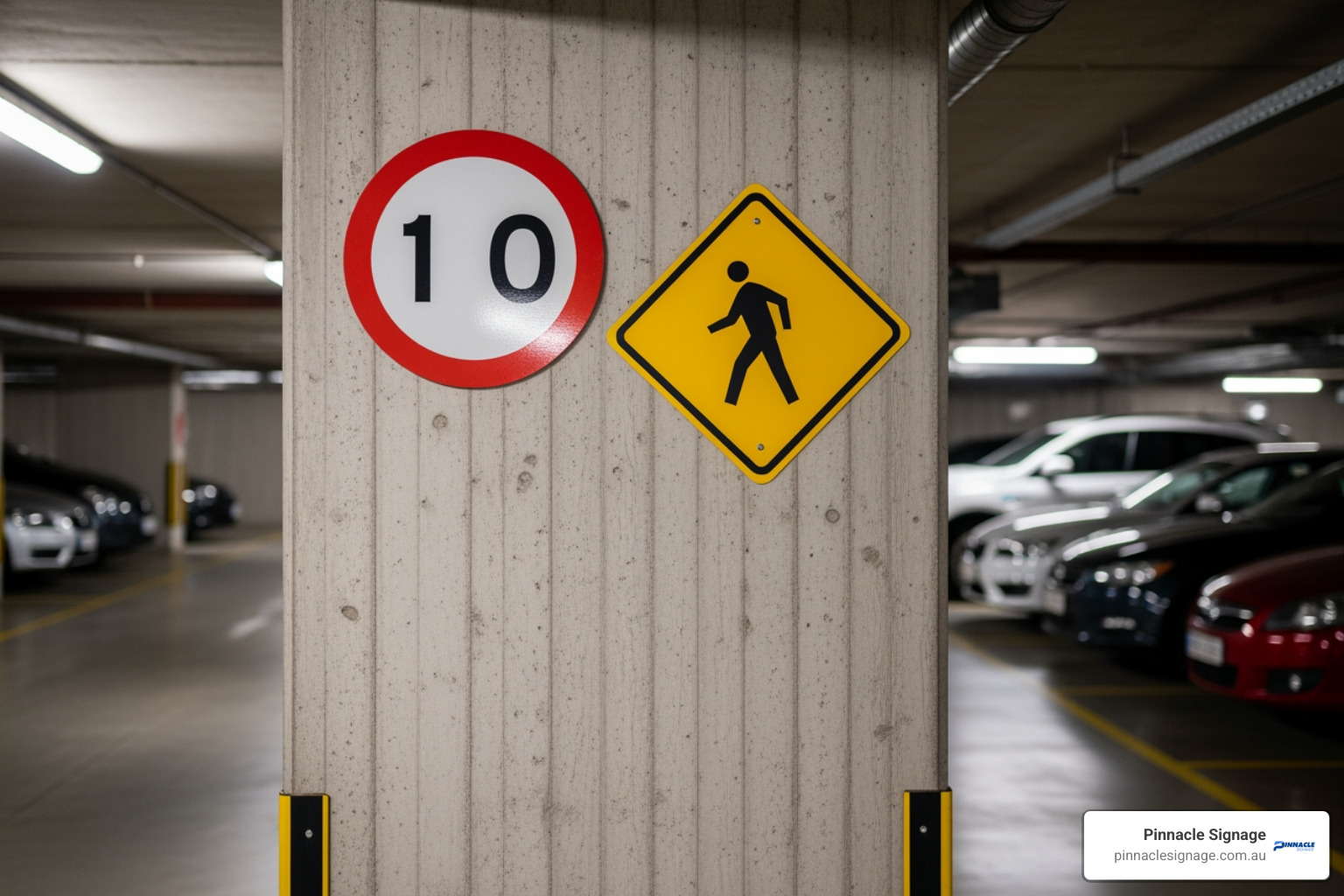
- Speed Limit Signs: Essential for controlling vehicle speed in confined spaces, typically low (e.g., 10 km/h).
- Stop and Give Way Signs: Manage intersections and potential conflict points within the car park.
- Clearance Height Bars: Located at entries and on ramps, these physical and visual warnings prevent oversized vehicles from entering or damaging the structure.
- Pedestrian Crossing Warnings: Alert drivers to designated pedestrian zones.
- Wet Floor Signs: Temporary signs used to warn of slippery surfaces, crucial for preventing slips and falls.
- General Safety Signs: Includes signs like "Watch for Pedestrians," "Tight Corner," or "Low Clearance." We offer a comprehensive range of Danger signage and Caution signage, and you can learn more about the distinctions in our guide, Caution vs Danger vs Warning: What's the Difference.
Informational & Regulatory Signs
These signs provide specific instructions, designate areas, and ensure compliance with parking rules and accessibility requirements.
- Parking Bay Identification: Numbering or lettering individual parking bays for easy recall and navigation.
- Reserved Parking: Clearly marking spaces for specific users (e.g., "Staff Parking," "Visitor Parking," "Management").
- Accessible Parking Spaces: Designated parking for individuals with disabilities, located on the shortest accessible route to an accessible entrance. If multiple accessible entrances exist, these spaces should be dispersed and located closest to those entrances.
- EV Charging Stations: Identifying spaces equipped for electric vehicle charging.
- No Parking Zones: Ensuring fire lanes, emergency exits, and critical access points remain clear.
- Time Limit Restrictions: Informing drivers of maximum parking durations.
- Payment Instructions: Detailing how to pay, rates, and any associated terms.
- Tow-Away Warnings: Alerting drivers to the consequences of violating parking rules.
For a deeper dive into the specific rules governing parking in Australia, our A-Z Guide to Australian Parking Signs Rules is an excellent resource. We also provide various Prohibition Signage options to clearly communicate restricted actions.
Designing for Clarity: Key Considerations for Effective Basement Parking Signage
Designing effective basement parking signage requires careful consideration of visibility, legibility, and consistency. The unique environment of a basement car park, with its often lower light levels and confined spaces, presents distinct challenges that demand a thoughtful approach to signage design.
Visibility, Lighting, and Colour
Visibility is paramount. Signs must be unobstructed, reflective where appropriate, and visible during all hours of operation. High-contrast colours are essential, such as bright text on a dark background or the other way around, to support legibility in varying light conditions. For areas with particularly low light or for critical directional information, illuminated signs can significantly improve visibility.
One effective strategy to improve visibility and aid navigation in multi-level basement car parks is colour-coding the floor levels. Using distinctly different colours for each level, sometimes combined with unique imagery or themes, helps drivers quickly orient themselves. For example, Floor 1 could be blue, Floor 2 orange, and Floor 3 green. This visual cue can be applied consistently across all signs and graphics on a given floor, from column markers to directional arrows. Avoiding visual clutter is also important, as too much information can overwhelm and confuse drivers.
Font, Size, and Placement for your basement parking signage
The choice of font, size, and placement directly impacts how easily and quickly a sign can be read by a driver in motion. Sans-serif fonts are generally preferred for their clean lines and readability.
- Letter Height vs. Viewing Distance: For signs intended to be read from a moving vehicle, a capital letter height of no less than 75 mm (approximately 3 inches) is a useful benchmark. For text intended for pedestrians, a minimum of 40 mm (approximately 1.5 inches) capital letter height is advisable.
- Placement for Driver Line-of-Sight: Signs should be positioned with a clear line of sight, perpendicular to the intended viewer. Consider a driver's eye-level and typical approach angles. Evaluate sign locations both during the day and at night to check visibility under all operating conditions.
- Mounting Height Guidelines: Signs should be mounted at a height that is easily visible but does not obstruct pedestrian or vehicle movement. As a simple rule, they should not be placed any closer than 300 mm (approximately 12 inches) from a walkway where people might walk into them.
- Logical Sign Sequencing: Information should be presented in a logical order, anticipating a driver's decision points. Avoid placing signs that require a decision too far in advance or too late.
Even the best signs can be ineffective if poorly implemented, as common errors in placement or design can hinder clarity.
Simplicity and Consistency
The goal of signage is to convey information quickly and unambiguously.
- Using Universal Symbols: Incorporating widely recognised pictograms and symbols can bridge language barriers and improve immediate comprehension, especially for common instructions like "No Entry", "Parking", or "Exit".
- Keeping Text Brief and Direct: Sign messages should be concise, ideally no more than seven to ten words. Only provide the information necessary for a decision at that particular location. Avoid unnecessary detail that can confuse viewers.
- Maintaining a Consistent Design Language: Use the same fonts, colours, symbols, and messaging style throughout the entire car park. This consistency builds familiarity and trust, making the system intuitive to follow.
- Creating a Logical Information Hierarchy: Organise information on signs from most important to least important. For free-standing directional signs, place the most critical message at the top. For ceiling-mounted signs, it is often more effective at the bottom.
Local council requirements and relevant Australian Standards for traffic control devices also support consistency in how information is presented. For general workplace health and safety expectations that relate to traffic management and signage, you can refer to trusted resources such as business.gov.au or Safe Work Australia.
Overcoming Common Challenges in Basement Environments
Basement parking environments present unique challenges for signage, from varying light conditions to potential moisture and vehicle impacts. Addressing these proactively helps your signage remain effective and readable for years to come.
Durability in Damp and Demanding Conditions
Basements can be damp, exposed to vehicle emissions, and susceptible to accidental impacts. The choice of materials for your basement parking signage is, therefore important.
- Moisture Resistance: Signs must withstand humidity and occasional moisture without degrading. Durable, weather-resistant materials that do not rust or warp are a practical choice in these environments.
- Preventing Corrosion from Emissions: Vehicle exhaust can be corrosive over time. Signage materials and fixings should be selected for their resistance to these environmental factors. We ensure our materials are designed for long-lasting performance in typical Australian conditions. You can read more about selecting suitable materials in our article on durable signage solutions for weatherproof messaging.
- Choosing Impact-Resistant Options: Accidental bumps from vehicles are a reality in tight basement spaces. We often recommend robust materials that are less likely to shatter or deform severely upon impact, so they maintain their legibility and structural integrity. All hardware used for mounting should also be corrosion-resistant to support longevity.
For many general safety and traffic messages in car parks, off-the-shelf signs made from durable materials are available through Pinnacle Signage at Bunnings, which is handy if you need a quick replacement after damage.
Maintenance and Upkeep of your basement parking signage
Even the most durable signs need ongoing maintenance to remain effective.
- Creating a Cleaning Schedule: Regularly clean signs to remove dust, grime, and exhaust residue, which can diminish visibility and legibility.
- Regular Inspections for Damage: Conduct routine checks for any signs that are faded, cracked, bent, or otherwise damaged. Promptly replace any compromised signs to maintain safety and clarity.
- Replacing Faded or Broken Signs: Faded signs are harder to read and can lead to confusion. Broken signs can pose a physical hazard. Swift replacement is important.
- Checking Illuminated Sign Functionality: For illuminated signs, regularly test that the lighting is operational. A non-illuminated sign in a dark basement will not perform its role effectively.
Proper installation also plays a vital role in the longevity and effectiveness of your signs. Our article on best practices for installing signs provides practical insights into secure and lasting installation, whether you are working on a small private car park or a large commercial basement.
Ensuring an Effective and Compliant Signage System
Designing and implementing an effective basement parking signage system is a crucial investment in safety, efficiency, and user experience. A well-planned system, using high-quality and durable materials, ensures reliability and longevity even in demanding basement conditions.
As an Australian manufacturer, Pinnacle Signage produces signage that meets stringent Australian Standards. This commitment to compliance helps facility managers ensure their car parks are safe, accessible, and easy to navigate. Whether using standard sign formats or custom designs that incorporate specific branding, the ultimate goal is a clear, consistent, and intuitive wayfinding system. By focusing on clarity, durability, and compliance, property managers can significantly enhance the safety and functionality of their basement parking facilities.