

A Comprehensive Guide to Forklift Warning Signs
Why Your Workplace Needs Forklift Warning Signs
Forklift warning signs are essential safety tools that alert workers and visitors to potential hazards in areas where forklifts operate. These visual safety devices help prevent accidents by communicating critical information about forklift traffic zones, operational procedures, and restricted areas.
Common Messages on Forklift Warning Signs
- Stop: Tells operators and pedestrians to halt and check for traffic.
- Watch for Traffic: Alerts everyone to active forklift movement in the area.
- Sound Horn: Reminds operators to use their horn to signal presence.
- No Riders: Prohibits unauthorized personnel from riding on forklifts.
- Pedestrian Crossing: Marks designated safe zones for foot traffic to cross forklift paths.
- Speed Limit: Sets the maximum safe operating speed for forklifts in a specific zone.
- No Entry: Restricts access to areas where only forklifts are permitted.
- Keep Clear: Instructs people to maintain a safe distance from forklift operations.
- Shared Forklift and Pedestrian Area: Indicates zones where both forklifts and people operate, requiring extra caution.
The statistics around forklift accidents paint a sobering picture. Each year, forklift accidents result in numerous fatalities and thousands of serious injuries. The most concerning aspect is that safety authorities estimate a significant percentage of these incidents could be prevented through proper training and safety measures, including clear warning signage.
The leading cause of forklift accidents is operator error, often stemming from lack of awareness of surroundings. This is precisely where forklift warning signs prove their worth, they serve as constant visual reminders that can significantly reduce accident rates. Research shows that workplace safety signs, including forklift warning signs, can reduce accidents by up to 25%.
Whether you're managing a busy warehouse, construction site, or manufacturing facility, the right signage creates a safer work environment for everyone. These signs don't just protect people - they also help maintain smooth operational flow by clearly defining traffic patterns and operational zones.
The Critical Role of Visual Safety Communication
In any busy industrial environment, especially those with heavy machinery like forklifts, effective communication is paramount. Our workplaces are dynamic, and hazards can emerge quickly. This is where visual safety communication, particularly through forklift warning signs, plays a critical role. They act as silent, ever-present safety officers, constantly reminding everyone of potential dangers and necessary precautions.
These signs are more than just pieces of plastic or metal; they are vital tools for hazard communication, reducing injuries, and improving traffic flow. They speak louder than words because they are always visible, even when direct supervision isn't possible. By clearly delineating forklift operating areas, pedestrian walkways, and restricted zones, we can significantly minimise the risk of collisions and other incidents. As we've seen, workplace safety signs can cut accident rates by up to a quarter, a statistic that speaks volumes about their effectiveness. For a deeper dive into how signs communicate without words, explore our guide on Workplace Safety Signs That Speak Louder Than Words.
Understanding Sign Categories: Danger, Warning, and Caution
When it comes to safety signage, understanding the different levels of risk is crucial. Australian safety regulations use a clear, colour-coded system to show the severity of a hazard at a glance. At Pinnacle Signage, we ensure our signs follow these national classifications to provide clear and unambiguous messages.
- Danger Signs: These signs signal the most extreme hazards. They indicate a situation that, if not avoided, will result in death or serious injury, such as in high-voltage areas or near radioactive materials.
- Warning Signs: These are used for hazards that could cause serious injury or illness but are not likely to be immediately life-threatening. A "Warning: Forklift Traffic" sign is a common example.
- Caution Signs: These signs alert people to potential hazards or unsafe practices that might result in minor or moderate injury if ignored. An example is "Caution: Watch Your Step."
- Notice Signs: These signs provide important instructions or information related to company policy or operational efficiency, rather than immediate physical hazards. For instance, "Notice: Forklift Parking Only."
The specific colours and symbols used are part of a nationally recognised system designed for instant recognition and understanding, ensuring everyone gets the message quickly. You can learn more about these distinctions in our articles: Caution vs. Danger vs. Warning: What's the Difference? and The Definitive Guide to Safety Sign Hazard Identification.
Key Types and Best Practices for Forklift Warning Signs
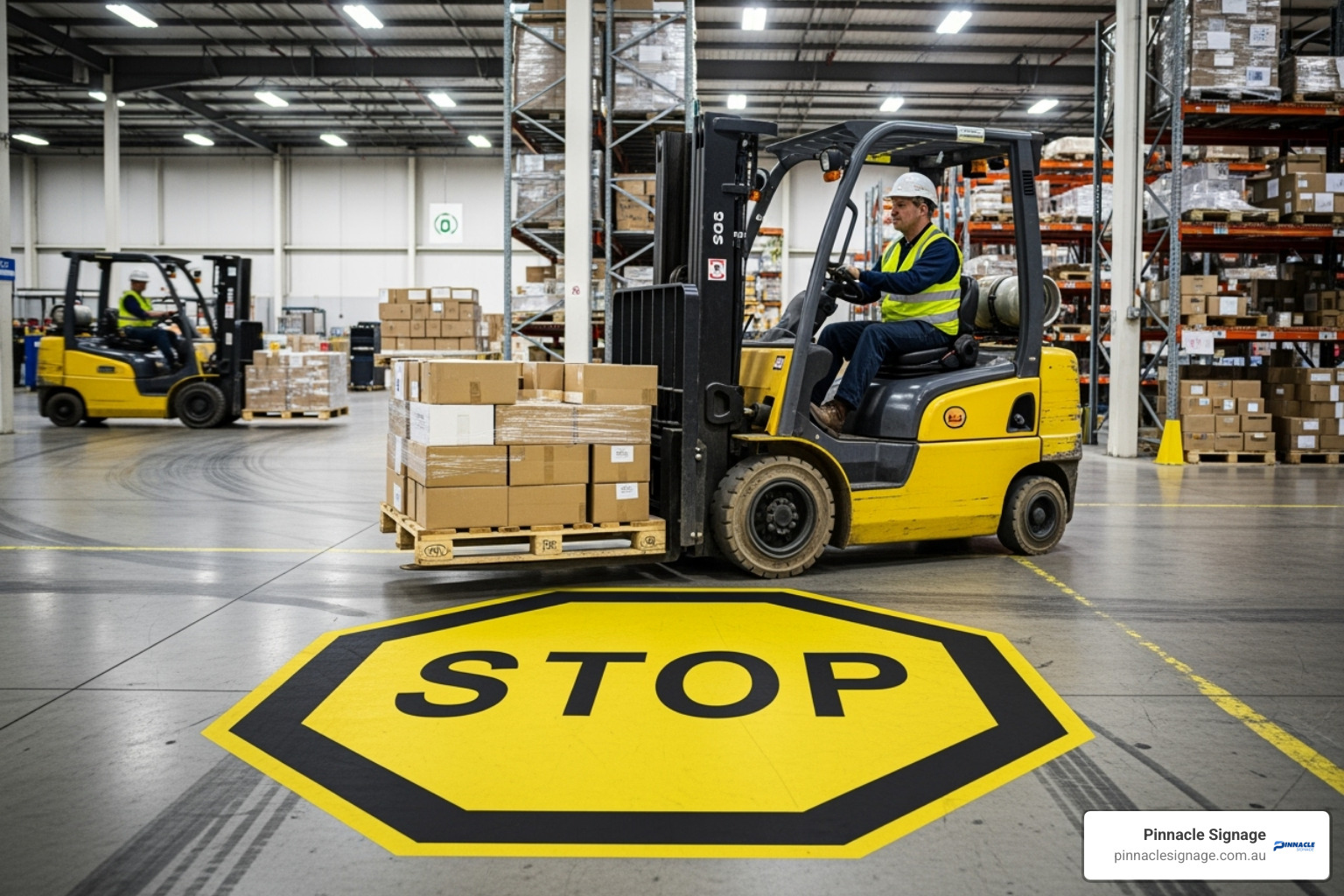
When it comes to implementing effective forklift warning signs, understanding the different types and their optimal placement can make all the difference in creating a safer workplace. The key lies in choosing the right sign for the right situation and ensuring they're positioned where they'll have maximum impact.
Common Messages on Forklift Warning Signs
The most effective forklift warning signs deliver their message in just a few words, but those words can prevent serious accidents. "Watch for Traffic" and "Watch for Forklifts" are among the most versatile messages, perfect for high-traffic areas where pedestrians and operators need to maintain constant vigilance. These signs work particularly well near warehouse entrances, loading bays, and busy intersections.
"Stop" signs, often combined with messages like "Look Out For Forklift Traffic," create crucial pause points in your facility. They're essential at blind corners, doorways, and pedestrian crossings where a moment's hesitation can prevent a collision. Similarly, "Sound Horn" signs remind operators to announce their presence, especially valuable at corners where visibility is limited.
One of the most important safety messages is "No Riders", a simple directive that addresses a common cause of serious injuries. Unauthorised passengers on forklifts account for numerous workplace accidents, making this message particularly critical in facilities where visitors or untrained staff might be tempted to hitch a ride.
"Pedestrian Crossing" signs help establish safe zones for foot traffic, while "No Entry" or "Fork Trucks Only" signs keep unauthorised personnel out of dangerous areas. "Keep Clear" messages ensure pathways and parking areas remain unobstructed, preventing both accidents and operational delays. For areas with height restrictions, "Low Overhead Clearance" signs protect both equipment and operators from costly damage and potential injury.
These messages work best when they align with your existing safety training programs. For comprehensive forklift safety guidelines, resources like Forklift Safety 101 – Forklift Safety Rules provide valuable context for your signage strategy.
Floor Signs vs. Wall Signs: What's the Best Choice?
The debate between floor signs and wall signs isn't really about choosing one over the other, it's about understanding when each option works best. Floor signs excel in dynamic environments where immediate attention is crucial. They sit directly in the line of sight of both forklift operators and pedestrians, making them impossible to ignore.
The durability of modern floor signs has revolutionised warehouse safety. Made from industrial-grade, ultra-tough vinyl materials, these signs withstand constant forklift traffic while maintaining their vibrant colours and clear messaging. Many feature anti-slip surfaces that have been rigorously tested for slip resistance in both dry and wet conditions, ensuring they improve safety rather than create new hazards.
Floor signs truly shine in high-traffic intersections, loading docks, and pedestrian walkways. A "Stop - Look for Forklifts" floor sign at a busy intersection commands attention in a way that wall-mounted signage simply cannot match. Their unique placement often makes them more noticeable, particularly for people who naturally look down while walking or operating machinery.
Wall signs, however, offer their own distinct advantages. They're protected from direct wear and tear, making them ideal for displaying comprehensive safety information or general warnings that need to remain visible from a distance. Wall signs work exceptionally well for regulatory information, speed limits, or general area warnings where the message needs to be seen before entering a specific zone.
The most effective safety strategies combine both approaches. Floor signs handle immediate, action-oriented messages while wall signs provide broader context and regulatory information. For detailed insights into maximising floor sign effectiveness, check out our guides on Forklift Floor Signs: Keeping Your Warehouse Safe and Sound and Prevent Accidents Before They Happen: Explore Floor Safety Signage with Pinnacle.
The Role of Custom and Bilingual Forklift Warning Signs
Every workplace has its unique challenges, and sometimes standard forklift warning signs don't quite address your specific needs. This is where customisable signs become invaluable tools for comprehensive safety management.
Custom signs allow you to address unique hazards that might not be covered by standard messaging. Perhaps your facility has specific intersection protocols or unusual traffic patterns that require custom warnings. Custom signage can also incorporate company branding while maintaining safety focus, creating a cohesive visual environment that reinforces your commitment to safety.
The ability to specify exact instructions means you can create signs that speak directly to your operational procedures. Instead of generic warnings, you might have signs that say "All Forklifts STOP - Sound Horn Before Entering Production Area", messaging that aligns perfectly with your specific safety protocols.
Bilingual signage addresses the reality of Australia's diverse workforce. When safety messages are presented in multiple languages, you ensure that clear communication reaches all staff members, regardless of their primary language. A "Warning: Forklift Traffic" sign that includes equivalent messaging in other relevant languages demonstrates your commitment to inclusive safety practices.
This approach isn't just about compliance, it's about reducing misunderstandings that can lead to dangerous situations. Language barriers can create serious safety risks, particularly in high-stakes environments where quick comprehension of warnings is essential.
If you have specific requirements that standard signage doesn't address, our team can help develop custom solutions. For more info about custom signage, we're here to discuss how custom signs can improve your workplace safety strategy.
Find the Right Forklift Signage for Your Business
At Pinnacle Signage, we understand that every workplace has unique safety challenges, and forklift warning signs are often a critical piece of the puzzle. Whether you're managing a busy warehouse in Sydney or a smaller operation in regional Australia, we're here to help you create a safer workplace with signage that actually works.
We're not just another signage supplier. We're your partners in workplace safety. Our team has worked with businesses across Australia, from small family operations needing a handful of signs to large corporations requiring comprehensive safety signage rollouts. We specialise in helping organisations, groups, and businesses looking to order in bulk, offering scalable solutions and competitive margins for resellers and distributors who want to provide their clients with premium products.
What sets us apart is our focus on durability and practicality. Our forklift warning signs are built to handle whatever your workplace throws at them, heavy traffic, harsh chemicals, extreme weather, and the daily grind of industrial operations. We combine this toughness with expert advice, helping you choose the right signs for your specific environment and ensuring they're placed where they'll have maximum impact.
Take a moment to explore our full range of forklift signs and see how our solutions can benefit your operations. You'll find everything from ultra-tough floor decals that can handle constant forklift traffic to robust wall-mounted warnings that catch attention from across the warehouse. Need something specific to your workplace? Our team can work with you to create custom solutions with your text, logos, colours, and dimensions - we focus on customising these elements to perfectly match your needs.
For your convenience, we offer warehouse pickup at our facility located at Unit 4/28 Nagle Street, East Wagga Wagga NSW. Our warehouse is open from 8am to 5pm, Monday through Friday, and is closed on weekends and public holidays. It's a great option if you're in the area and want to see the quality of our products firsthand.
Shipping & Delivery Information
We know that when you need safety signage, you usually need it quickly. That's why Pinnacle Signage dispatches most items within 48 hours of receiving your order and payment confirmation. We've built our processes around getting your signs to you fast, because workplace safety shouldn't have to wait.
Our estimated delivery times are designed to get your signage where it needs to be, when it needs to be there:
- 1-2 days: Sydney, ACT, Melbourne, Brisbane, Gold Coast
- 2-4 days: Rest of NSW, Rest of VIC
- 3-6 days: SA, North QLD, Perth
- 5-9 days: TAS, NT, WA
For most deliveries within Australia, we use reliable courier services such as FEDEX. Here's what you need to know to ensure smooth delivery: provide a valid daytime delivery address - couriers cannot deliver to PO Boxes. A signature is required upon receipt to ensure your signs arrive safely, so please be available to accept courier deliveries. If you're not present, re-delivery charges will apply. Including a daytime phone number with your shipping details helps us contact you if needed.
For items weighing over 50kg, a tailgate delivery is usually required for residential addresses, and this service is included in our standard shipping. Alternatively, you can choose to pick up the item from a nearby depot if that works better for your schedule.
Free shipping is available for orders over $100 Australia-wide, which applies to most items on our site. However, for some bulky items, additional shipping costs will apply for deliveries to WA, North QLD, NT, TAS, and island areas. Don't worry though - our staff will reach out to you after your order if these charges apply, so there are never any surprises.
Let Pinnacle Signage be your partner in creating a safer, more efficient workplace - because when it comes to safety, you deserve signage that works as hard as you do.