

Prevent Accidents Before They Happen – Explore Floor Safety Signage with Pinnacle
The Unseen Danger: Why Every Workplace Needs to Address Slippery Floors
Slippery floor warning signs are essential safety tools for preventing workplace accidents and protecting businesses from costly liability claims. These signs alert staff and visitors to wet or hazardous floor conditions, giving them the crucial warning they need to take extra care.
Research highlights the severe risks of slips, trips, and falls (STFs). According to a study by the University of Rochester, STFs account for 15% of accidental deaths, 25% of reported injury claims, and a staggering 65% of lost work days. Even a minor spill can lead to a serious incident.
When floors become wet from leaking equipment, mopping, spills, or weather, the risk to everyone on your premises increases dramatically. For Australian businesses, the financial impact extends beyond immediate medical costs to include workers' compensation claims, potential legal action, lost productivity, and damage to your safety reputation. Fortunately, these accidents are highly preventable with the right signage and safety protocols.
Your Complete Guide to Slippery Floor Warning Signs
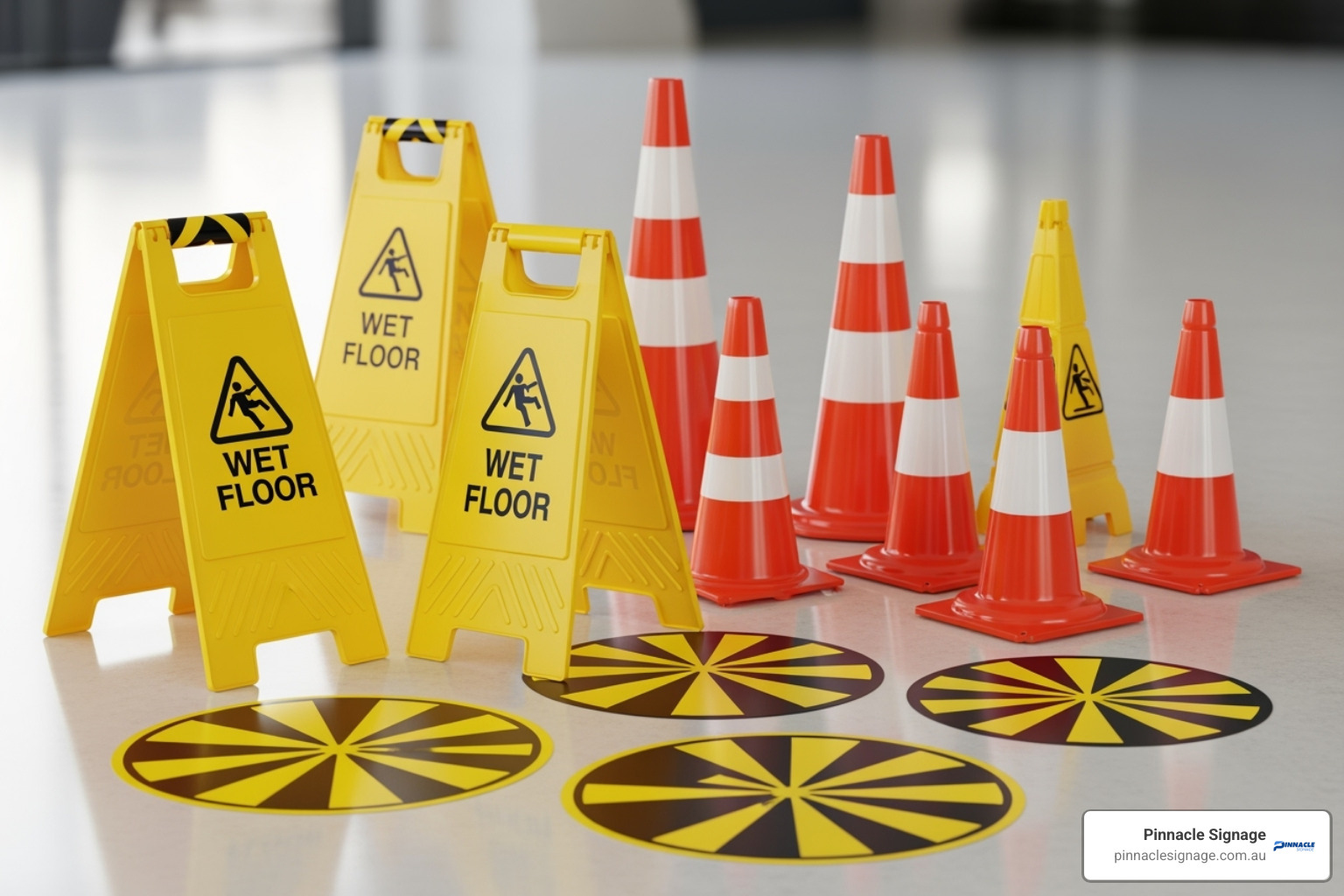
When it comes to preventing workplace accidents, not all slippery floor warning signs are created equal. The right sign in the right place can be the difference between a safe workplace and a costly compensation claim. This guide covers everything you need to know to make the smart choice for your business, from sign types and materials to placement and communication.
Choosing the Right Type of Sign for Your Space
Modern safety signage offers options that work for your specific situation, moving beyond one-size-fits-all solutions.
- A-frame signs: The workhorse of floor safety. Their bright, two-sided design catches attention, and their collapsible nature allows for instant deployment.
- Safety cones: Unbeatable for marking off larger areas. They are lightweight, stackable, and create clear boundaries around wet zones.
- Standing signs: Offer a professional, permanent look for areas with recurring hazards, like an entrance that gets wet every time it rains.
- Floor decals: Solve the problem of signs that get moved or create obstacles. These slip-resistant markers become part of your floor, providing constant warnings in high-risk areas like commercial kitchens.
- Wall-mounted signs: Brilliant space-savers for narrow corridors or near fixed hazards like water fountains and hand-washing stations.
- Bilingual signs: Essential for Australia's diverse workplaces, ensuring the safety message reaches everyone.
For more detailed guidance on selecting the perfect caution signage, check out our comprehensive guide: More info about caution signage options.
Key Features to Look for in a Durable Warning Sign
Quality slippery floor warning signs are an investment that pays for itself by lasting for years and preventing accidents.
- Material Selection: Plastic is great for temporary warnings, while polyester with overlaminate offers superior durability for long-term use, handling temperatures up to 110°C. Vinyl excels for floor decals, and aluminium provides a robust, professional appearance for permanent signs.
- Size and Readability: Signs must be spotted from a reasonable distance. The classic black-on-yellow colour scheme is effective because this high-contrast combination is easy to notice. Clear pictograms alongside text ensure the message is understood instantly.
- Durability Features: Look for weather resistance to handle Australian conditions, slip-resistant laminate on floor decals, abrasion resistance for high-traffic areas, and temperature resistance for extreme environments.
Best Practices for Placing and Maintaining slippery floor warning signs
Even the best sign is useless if it's in the wrong spot. Proper placement is about understanding how people move through your space.
- Strategic Positioning: Place signs where people can see them before they reach the danger zone. For long corridors, use signs at both ends.
- Focus on High-Traffic Areas: Entryways during wet weather are critical slip zones that may need permanent warning systems.
- Ensure Visibility: Use A-frame signs for multi-directional approaches and ensure signs are not hidden behind furniture or other obstacles.
- Regular Maintenance: Clean signs regularly to maintain their visual impact. Inspect them for wear, fading, or damage.
- Proper Storage: Keep collapsible and stackable signs in clean, dry areas to extend their life.
- Timely Removal: Leaving signs out on dry floors creates "sign fatigue," causing people to ignore future warnings. Remove signs as soon as the hazard is gone.
For comprehensive guidance on maximising safety signage effectiveness, explore our resource: More info about using safety signs effectively.
The Advantage of High-Visibility and Specialised Signs
Standard signs work well in ideal conditions, but some workplaces require specialised solutions.
- Reflective materials are vital in low-light conditions like car parks, warehouses, or during early morning cleaning.
- Glow-in-the-dark (photoluminescent) signs absorb ambient light and emit a glow in darkness, making them invaluable during power outages or emergencies.
- LED signs provide active, illuminated warnings that are highly effective in busy, high-distraction environments.
- Custom messaging allows for specific warnings beyond "Wet Floor," such as "Caution: Icy Surface" for cold storage or "Grease Spill Area" for kitchens.
The key advantage of these signs is 24/7 visibility, ensuring safety during shift changes, emergencies, and in unusual lighting. Learn more about comprehensive workplace safety solutions: More info about making your workplace safe.
Critical Industries for slippery floor warning signs
While every workplace needs floor safety signage, these industries face higher risks where slippery floor warning signs are absolutely essential.
- Hospitality: Restaurants, hotels, and pubs constantly deal with food, drink, and grease spills.
- Retail: Supermarkets and shopping centres have high foot traffic and frequent cleaning schedules, creating regular hazards.
- Healthcare: Hospitals and aged care facilities require constant disinfection, leading to wet surfaces where staff move urgently and patients may have mobility issues.
- Construction: Site offices, break areas, and newly completed spaces present slip hazards from spills and tracked-in mud or water.
- Food Processing: Frequent wash-downs and food spillage create inherently slippery and hazardous conditions.
- Commercial Properties: Office buildings and warehouses require strategic signage for everything from leaking machinery to break room spills.
- Public Venues: Airports, train stations, and stadiums see thousands of visitors daily, where weather can quickly create dangerous surfaces.
For these industries, comprehensive safety signage is a fundamental part of risk management. Find out how different industries approach safety signage: More info about industries that rely on safety signage.
How to Effectively Communicate Safety Warnings
Installing signs is just the first step. A strong safety culture ensures the message leads to safer behaviour.
- Staff Training: Train your team on why, when, and where to place signs. When people understand the genuine risks, they take warnings more seriously.
- Visual Reminders: Use safety posters in break rooms and floor markings to reinforce the message that safety matters.
- Create a Safety Culture: Empower all staff to address spills and deploy signs immediately, without waiting for permission.
- Lead by Example: When management respects and adheres to safety signage, it sends a clear message that safety is a priority.
- Visitor Awareness: Use universally understood symbols and consider bilingual signs to ensure warnings are clear to everyone.
Effective communication transforms simple signs into a comprehensive safety system. For deeper insights, explore our guide: More info about understanding safety signage.
Find the Right Signs to Protect Your Site
Effective slippery floor warning signs are not just accessories; they are essential tools for proactive safety and risk mitigation. They protect your staff and visitors while safeguarding your business from the significant costs associated with workplace accidents.
At Pinnacle Signage, we help businesses move from reactive problem-solving to proactive prevention. Our signs are manufactured in Australia, built to withstand local conditions, and designed for maximum visibility and durability. With Australia-wide delivery, we make it easy to get the high-quality signage you need, whether you're in a busy city or a remote location.
Investing in the right signage is investing in peace of mind. It creates a safer environment where everyone can move with confidence. Don't wait for an accident to highlight the risks. The statistics are clear, but the solution is simple.
Explore our range of caution signs and take the crucial step from hoping accidents won't happen to ensuring they don't.