

A Practical Guide to First Aid Safety Sign Requirements
Why First Aid Safety Signs Are Critical in Every Australian Workplace
First aid safety sign requirements in Australian workplaces are straightforward yet essential. Here's what you need to know:
- Colour Standard: Green background with white symbols or text (AS 1319-1994)
- Primary Purpose: Identify locations of first aid kits, equipment, and facilities
- Legal Requirement: Employers must ensure first aid resources are clearly marked and accessible
- Key Types: First aid kit signs, AED location signs, eyewash station signs, first aid room signs
- Material Options: Polypropylene, metal, self-adhesive vinyl, photoluminescent for low-light areas
- Common Sizes: Range from 100mm x 100mm for small kits to 600mm x 450mm for rooms and stations
When an emergency strikes, every second counts. Your employees need to locate first aid equipment immediately, whether it's a basic kit for a minor cut or an AED for a cardiac event. A clearly visible first aid safety sign can mean the difference between a quick response and a delayed one that puts someone's health at risk.
Many facilities managers and site supervisors struggle with signage that fades, falls off, or simply doesn't meet Australian standards. Dealing with suppliers who miss deadlines or deliver products that aren't fit for harsh Australian conditions is not just a frustration, it's a compliance risk. At Pinnacle Signage, we understand these challenges and provide Australian-made signage designed for local conditions, ensuring your workplace emergency preparedness is never compromised.
This guide breaks down everything you need to know about first aid safety signs, from regulatory requirements to material selection, helping you make informed decisions that protect your people and meet your compliance obligations.
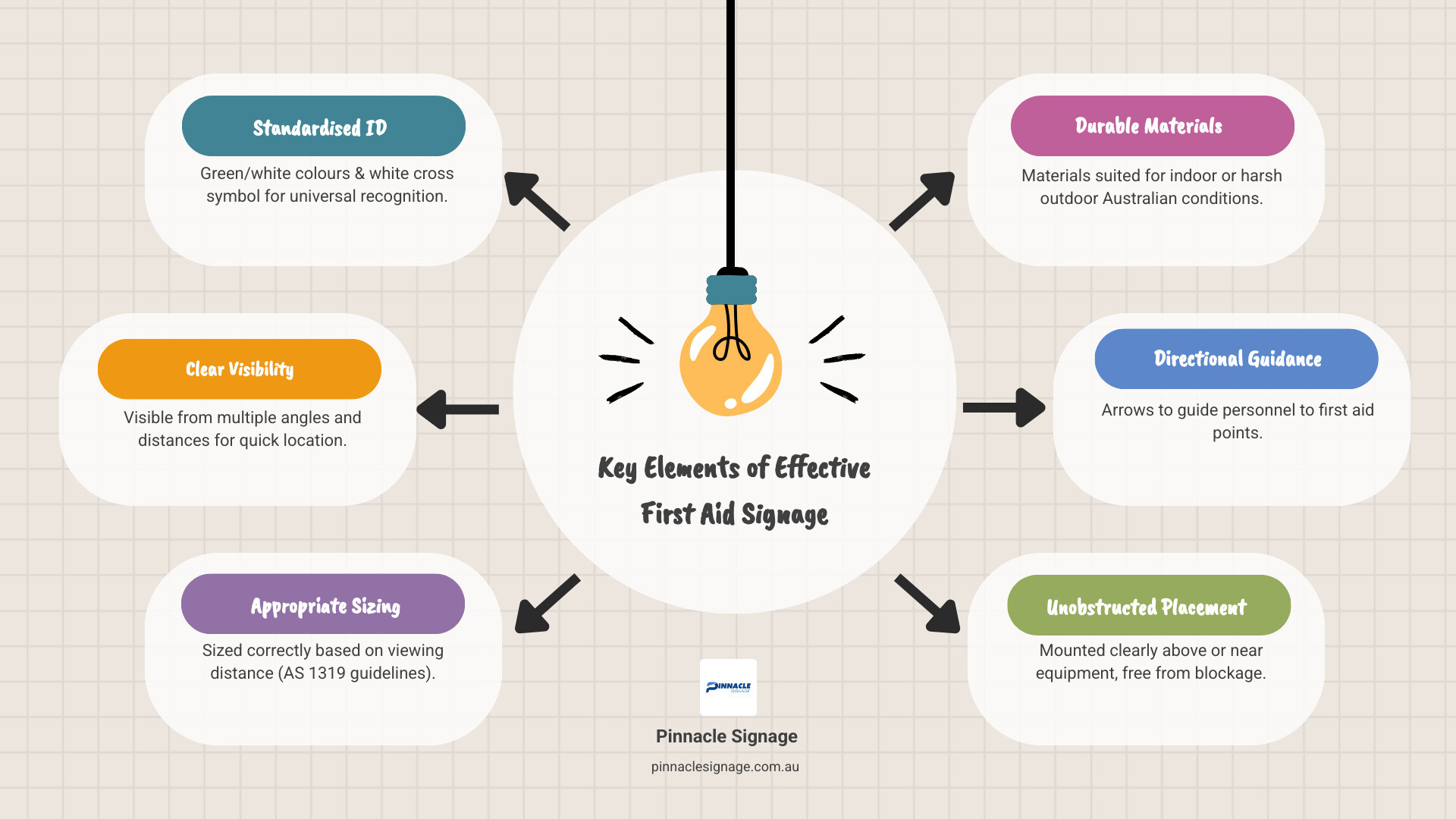
Key terms for first aid safety sign:
The Role of First Aid Signage in Workplace Safety
When an accident happens at work, the clock starts ticking immediately. The difference between a minor incident and a serious injury often comes down to how quickly someone can access the right equipment. This is where first aid safety signs become genuinely lifesaving tools rather than just compliance checkboxes.
At its core, a first aid safety sign does one essential job: it guides people to lifesaving equipment when every second matters. Whether someone needs a basic plaster for a cut finger or urgent access to an AED for a cardiac event, clear signage eliminates the panic of searching. These signs mark everything from simple first aid kits to fully equipped first aid rooms, emergency eye wash stations, safety showers, and defibrillators.
Reducing emergency response times is where these signs prove their worth. Picture a worker who's just had a chemical splash to the eye. If they can immediately spot the eyewash station sign and reach it within seconds, you might prevent permanent vision damage. Without clear signage, those precious moments get wasted in confusion and searching, potentially turning a manageable incident into a catastrophic injury.
Beyond the immediate crisis response, first aid safety signs empower your team. When employees know exactly where to find help, they feel more confident and secure. This confidence matters enormously in high-stress situations, when someone needs to act quickly rather than steer uncertainty. It sends a clear message that their safety genuinely matters to you as an employer.
There's also the broader cultural benefit. Visible first aid signage helps foster a robust safety culture throughout your workplace. These signs serve as constant, quiet reminders that safety is a priority, not an afterthought. They demonstrate management's commitment to protecting staff and visitors, which in turn encourages everyone to take safety seriously.
First aid safety signs fall under the category of "Safe Condition Signs" in Australian standards. You'll recognise them instantly by their distinctive green and white colour scheme, a combination that's universally understood to indicate safety equipment and emergency facilities. The white cross symbol is recognised globally as the pictogram for first aid, making these signs effective even in workplaces with diverse, multilingual teams.
It's worth understanding how first aid safety signs differ from the other safety signs around your workplace. While danger, warning, and caution signs alert you to hazards using red, yellow, and black colour schemes, first aid signs do the opposite. They're not warning you about a problem, they're directing you to a solution. Prohibition signs tell you what not to do with their red circles and diagonal lines. Mandatory signs instruct you what you must do with their blue backgrounds. But first aid safety signs, with their calming green and white format, simply say "help is here when you need it."
The green background with white symbol isn't just pleasant to look at, it's strategically chosen. This colour combination stands out effectively in most environments without being alarming. It's reassuring rather than frightening, which matters when someone's already stressed or injured. The standardisation means that whether you're in a warehouse in Wagga Wagga or an office in Perth, you'll instantly recognise where to find first aid equipment.
You can find quality first aid safety signs at Bunnings stores across Australia or order them directly for your workplace. Either way, investing in clear, compliant signage is one of the simplest yet most effective safety measures you can implement.
Common Types of First Aid Safety Signs
Setting up a solid workplace safety system? Knowing the various types of first aid safety signs is key. It helps you cover every emergency scenario. At Pinnacle Signage, we craft a full range of signs. These are built for diverse Australian workplaces, from small offices to large industrial sites.
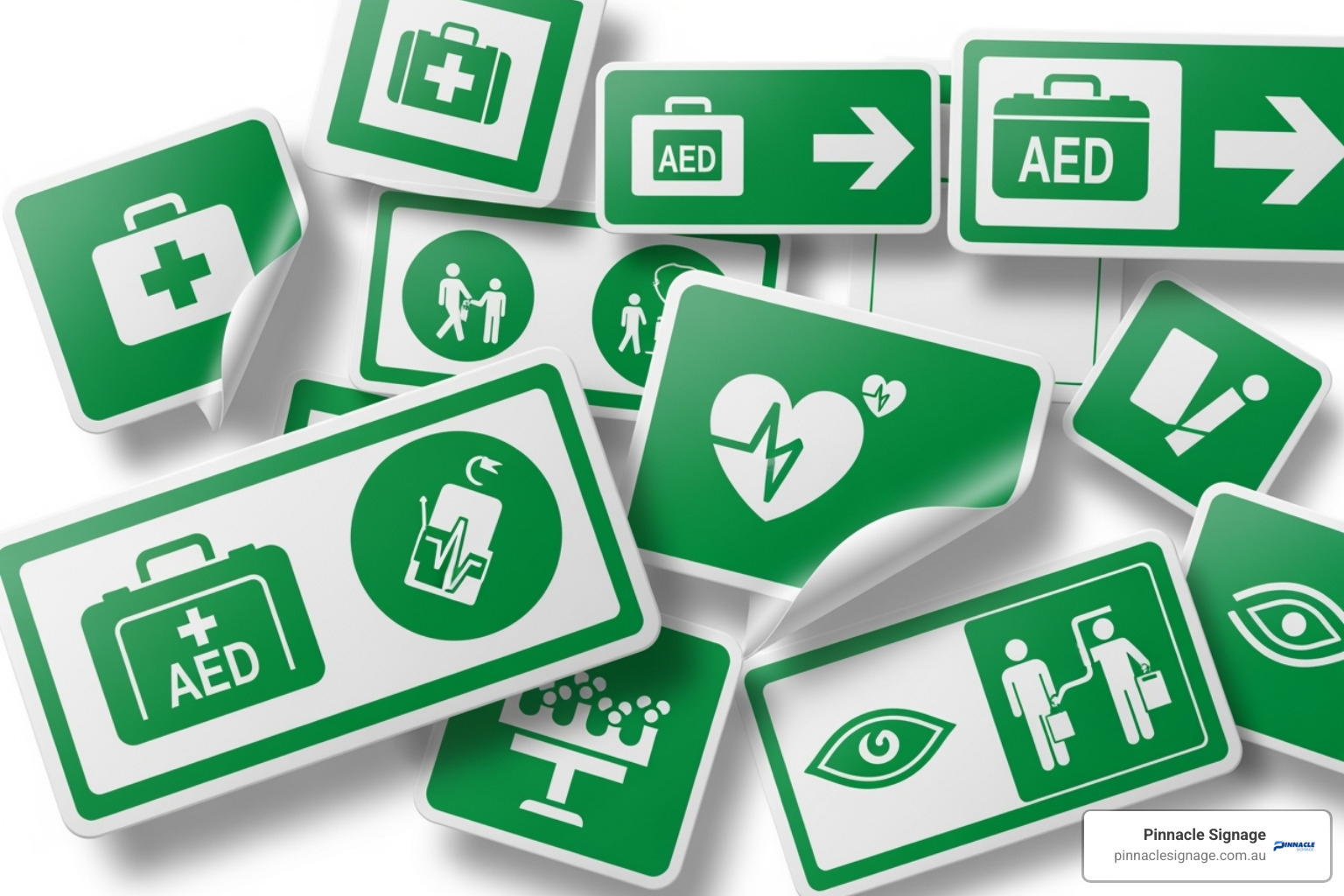
These signs generally fall into three main categories: those marking first aid kits and stations, signs identifying emergency equipment, and informational or directional signs that guide people to help.
Signs for First Aid Kits and Stations
The most common first aid safety signs you'll see in any workplace are those marking where first aid supplies are kept and where medical assistance can be provided. These are your frontline signs, the ones that matter most when someone needs immediate help for a cut, burn, or other injury.
A clear sign positioned directly above or next to every first aid kit location ensures nobody wastes precious seconds searching for supplies. In larger workplaces or those with higher risk levels, you'll also need signs marking your first aid room, which is a dedicated facility where more extensive medical care can be provided. Similar to this is a first aid post, a designated station within a larger area where trained first aiders or supplies are available. For more detailed information about these specific signs, check out our guide on first aid post signs.
When your facility has a complex layout, directional arrows become crucial. These signs lead the way through corridors, around corners, and across open-plan areas, guiding people quickly to the nearest first aid resources. We manufacture durable and compliant signs for all these purposes, and many of our products are now available at Bunnings for your convenience. For example, you can find the Pinnacle 300 x 225mm Poly First Aid Sign at Bunnings, making it easy to pick up quality signage alongside your other supplies.
Emergency Equipment Identification Signs
Beyond general first aid kits, many Australian workplaces house specialised emergency equipment that requires its own clear signage. These aren't just nice to have, they're often the difference between a good outcome and a tragedy.
AED defibrillator location signs are vital for cardiac emergencies. When someone's heart stops, every second counts, and a prominent sign with the AED symbol ensures this life-saving device can be found and deployed immediately. Similarly, workplaces handling chemicals or dust-producing materials must have emergency eye wash stations clearly marked. These signs typically feature a symbol depicting a person using an eyewash, making them instantly recognisable even in a moment of panic.
For more extensive chemical exposure, safety showers need equally prominent signage to prevent severe burns or chemical injuries. Spill kits, while not strictly first aid equipment, often contain personal protective equipment and neutralising agents that prevent injury during hazardous material incidents, making their location signs an important part of your emergency preparedness. Depending on your industry, you might also have other specialised equipment like oxygen tanks or decontamination showers, each requiring clear, standardised signage that meets Australian requirements.
Informational and Directional First Aid Safety Signs
Sometimes a sign needs to do more than point to a piece of equipment. It needs to provide information, guide people from a distance, or help them steer complex spaces when they're stressed and time-sensitive decisions matter.
First Aiders on Duty signs indicate who the designated first aiders are and how to contact them, which can be invaluable in a large facility. These might be notice boards or signs with specific names and contact numbers. Alongside these, emergency contact details signs often accompany first aid points, providing crucial phone numbers for internal and external emergency services.
In large facilities or those with complex layouts, guiding personnel from a distance becomes essential. Think about a multi-storey building, a sprawling warehouse, or an industrial site where someone unfamiliar with the layout needs to find help quickly. Large, easy-to-spot directional signs, often mounted overhead or projecting from walls, ensure that no one gets lost when searching for assistance. A clear hierarchy of these directional signs throughout your facility means everyone can find help, whether they're a long-term employee or a first-day contractor.
How to Choose the Right First Aid Safety Sign
Selecting the correct first aid safety sign involves more than just picking a design. It requires careful consideration of the environment, visibility requirements, and the specific needs of your workplace.

At Pinnacle Signage, we guide our customers through these choices to ensure they get durable, effective, and compliant solutions.
Selecting the Best Material for Your Environment
The longevity and effectiveness of your first aid safety signs depend heavily on the material they are made from. Choosing the right one ensures your signs can withstand their environment, from a climate-controlled office to a harsh industrial site.
- Indoor Use: For internal areas, materials like rigid plastics or self-adhesive vinyl are often suitable. They are cost-effective, easy to install on smooth surfaces, and ideal for offices, retail spaces, and other controlled environments.
- Outdoor and Harsh Environments: For external use, or areas exposed to moisture, chemicals, or extreme temperatures, more robust options are needed. Durable metals and high-performance plastics resist fading, cracking, and corrosion, ensuring your signs remain legible for years in industrial settings or under the Australian sun.
- Low-Light and Power Outages: For areas where power outages are a concern or visibility is naturally low, high-visibility photoluminescent signs are an excellent choice. These "glow-in-the-dark" signs absorb ambient light and then emit it in darkness, ensuring that first aid locations remain visible even during power failures. This can be a critical advantage when every second counts.
Determining the Correct Sign Size
A sign is only effective if it can be easily read and understood from the required distance. Australian Standard AS 1319-1994 provides guidelines for minimum sign sizes based on viewing distance to ensure legibility.
- Legibility: The text and symbols on the sign must be clear and large enough to be understood quickly.
- Viewing Distance: Consider how far away a person might need to read the sign. A sign in a large warehouse will need to be much larger than one in a small office. For example, a sign that needs to be read from 20 metres away will require a larger format than one read from 5 metres.
- AS 1319 Guidelines: We adhere to these standards to ensure our signs are appropriately sized for various applications, from small labels on kits to large wall-mounted signs for entire facilities.
- Warehouse Signage: Typically requires larger signs with bolder graphics to be visible across expansive spaces.
- Office Signage: Can often be smaller, but still needs to be clear and mounted at an appropriate height.
For a comprehensive understanding of how to select the right dimensions and placement, refer to An essential guide to choosing the right signage.
The Benefits of Custom-Designed Signs
While standard first aid safety signs cover most needs, there are situations where a custom-designed sign can be particularly beneficial, offering custom solutions for unique workplace requirements.
- Site-Specific Instructions: Your workplace might have unique hazards or specific first aid procedures. Custom signs allow you to include precise instructions relevant to your site.
- Unique Workplace Hazards: If your facility deals with specific chemicals or machinery, a custom sign can highlight the associated first aid responses.
- Including Emergency Contact Numbers: Adding internal emergency numbers or specific first aider contact details directly onto a sign can streamline emergency response.
- Company Branding: While maintaining compliance with safety standards, custom signs can also subtly incorporate your company's branding, contributing to a professional and cohesive look.
If you can't find the exact sign you need, we can design custom signs that meet your exact specifications. For more information on creating signs custom to your business, you can explore custom sign options and discuss your needs with our team.
Placement and Compliance with Australian Standards
Proper placement of first aid safety signs is just as critical as their quality and design. A compliant sign that's hidden or obscured is as good as no sign at all. At Pinnacle Signage, we're committed to ensuring our signs help you achieve both regulatory compliance and maximum visibility.
Key Regulatory Guidelines in Australia
In Australia, workplace health and safety regulations make it clear that employers have a duty of care to provide adequate first aid equipment and facilities. More importantly, these resources must be clearly marked and easily accessible. It's not enough to have a first aid kit tucked away somewhere, it needs to be found in seconds, not minutes.
The Safe Work Australia's Code of Practice provides comprehensive guidance on managing risks to health and safety in the workplace, including specific requirements for first aid provisions and signage. This national framework helps employers understand their obligations and ensures consistency across different industries.
First aid safety signs fall under Australian Standard AS 1319-1994, which specifies the design and use of safety signs in occupational environments. Under this standard, first aid signs are classified as Emergency Information Signs, which means they must feature a white symbol or text on a green rectangular or square background. This consistent green and white design ensures immediate recognition, even for visitors or new employees who might be unfamiliar with your facility. Understanding Australian Standards for Safety Signs is crucial for maintaining compliance and, more importantly, keeping people safe.
The whole point of this standardised approach is simple: in an emergency, people shouldn't have to think about what a sign means. The green background with white cross is universally understood, allowing anyone to quickly locate the help they need.
Critical Locations for Sign Placement
Strategic placement is what transforms a good first aid safety sign into an effective one. They need to be where they can be seen quickly and easily by anyone who might need them, whether that's a long-term employee or someone visiting your site for the first time.
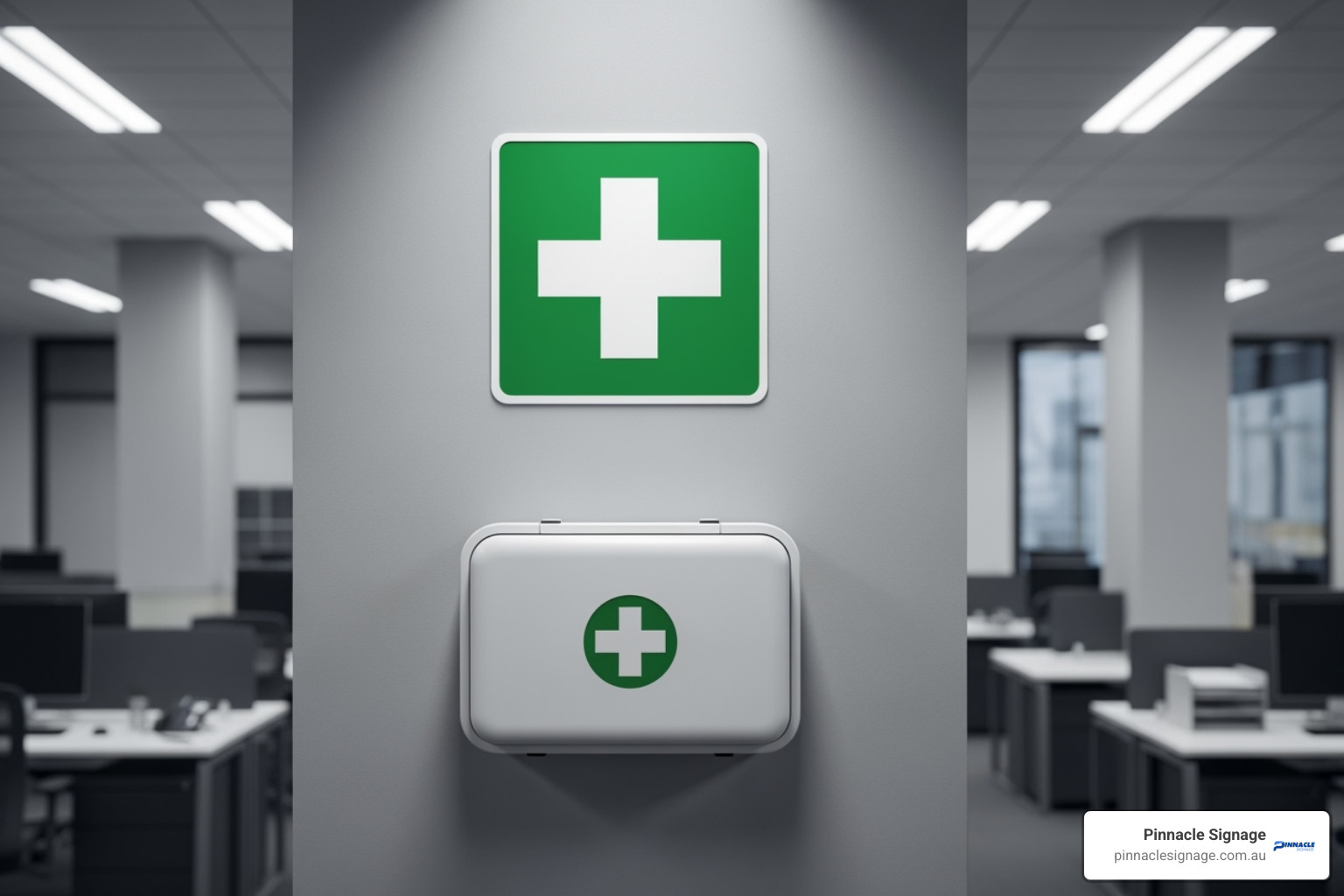
The most direct placement is immediately above first aid kits or next to them, leaving no doubt about their location. This is your baseline, but effective signage goes beyond just marking the kit itself. Consider placing signs at facility entrances or reception areas to inform visitors and new employees of first aid locations from the moment they arrive.
Common areas like break rooms, lunchrooms, and meeting points are excellent spots for general first aid location signs or directional indicators. These are places where people naturally gather, making them ideal for reinforcing safety information. In high-risk zones, such as workshops, kitchens, manufacturing floors, or chemical storage areas, prominent first aid and emergency equipment signs become even more critical.
The key is ensuring unobstructed sightlines. No obstacles, whether machinery, shelving, or doors when they're open, should block the view of the sign. They should be mounted at an appropriate height for clear visibility, typically at eye level or above, depending on the environment. In large warehouses or facilities with complex layouts, directional signs with arrows become invaluable, guiding people through corridors and around corners towards the nearest first aid station.
If you're looking to make your signage truly effective, our article on workplace safety signs that speak louder than words offers practical insights on maximising visibility and impact.
For those looking to purchase quality first aid safety signs, Pinnacle Signage products are now available at Bunnings stores and online across Australia, making compliance and safety more accessible than ever.
Frequently Asked Questions about First Aid Safety Signs
We regularly hear from businesses across Australia who want to get their first aid safety sign requirements right. Here are the questions that come up most often, answered clearly and practically.
Are first aid signs legally required in Australia?
Yes, they are. Under Work Health and Safety (WHS) regulations across all Australian states and territories, employers have a legal duty of care to provide adequate first aid equipment, facilities, and personnel. But here's the crucial part: these resources must be clearly marked and easily located. If your employees can't find the first aid kit when they need it, you haven't truly met your obligation.
The principle is consistent nationwide, based on Safe Work Australia's Model Code of Practice for First Aid in the Workplace. While specific wording might vary slightly between states, the core requirement remains the same. First aid equipment must be clearly identified and accessible, which means appropriate first aid safety signs aren't just good practice, they're essential for compliance.
What colour should a first aid sign be?
This one's straightforward. According to Australian Standard AS 1319-1994, which governs safety signs in Australian workplaces, first aid safety signs are classified as "Emergency Information Signs." These must feature a white symbol or text on a green rectangular or square background.
The green colour signals safety and emergency assistance, while the white provides clear contrast for maximum visibility. The most common symbol you'll see is a simple white cross. This colour scheme is universally recognised, meaning even visitors to your workplace will immediately understand what these signs indicate.
How can I ensure my signs are understood by everyone?
Making sure your first aid safety signs are universally understood is critical, especially in today's diverse Australian workplaces. The white cross on a green background is your strongest tool here, it's a globally recognised symbol that transcends language barriers completely.
Supplementing symbols with simple, clear text like "First Aid Kit" or "Eyewash Station" eliminates any remaining ambiguity. Keep the language straightforward and avoid technical jargon. For workplaces with multilingual teams, consider adding translations of key text.
Consistent placement also matters. When signs are always in predictable, visible locations, people learn where to look instinctively. Combine this with regular first aid training and emergency drills, and your team will know exactly what the signs mean and how to respond when it counts.
If you're looking for compliant first aid signs, browse our complete range of First Aid Signage or check out the selection of Pinnacle Signage first aid signs at Bunnings for convenient in-store or online purchasing.
Find the Right First Aid Signage for Your Business
Making your workplace safer and staying compliant with Australian regulations doesn't need to be a headache. The right first aid safety sign can make all the difference when seconds count, and we're here to help you get exactly what you need.
At Pinnacle Signage, we manufacture every sign right here in Australia, using materials that can handle our unique climate and conditions. Whether you're dealing with scorching summers, coastal salt spray, or dusty industrial environments, our signs are built to last and meet all relevant Australian Standards.
We work with everyone from small businesses setting up their first aid stations to large organisations ordering in bulk for multiple sites. If you're a reseller, we offer special distributor pricing with competitive margins that make it worthwhile for your business too.
Here's something that makes getting our signs even easier: Pinnacle Signage products are now available at Bunnings, both in-store and online across Australia. This partnership means you can grab what you need when you're already picking up other supplies, or order online for delivery or click-and-collect. You can explore our range by visiting the Pinnacle Signage brand page on the Bunnings website. For specific first aid signs, check out options like our 300 x 225mm Poly First Aid Sign and other first aid safety sign products available through their network.
Of course, you can still order directly from us, especially if you need custom designs with your emergency contact numbers, site-specific instructions, or company branding. We offer fast turnaround times and can handle everything from a single custom sign to bulk orders for multiple facilities.
Need help choosing the right size, material, or placement for your signs? Our team knows the ins and outs of Australian workplace safety requirements and we're always happy to talk through your specific situation.
Browse our complete range of First Aid Signage to see what's available, or contact our expert team today if you need bulk pricing, custom designs, or just want to chat about what would work best for your workplace. We're here to help you make safety visible.