

An Essential Guide to Informational Signs
What Are Informational Signs and Why Are They Essential?
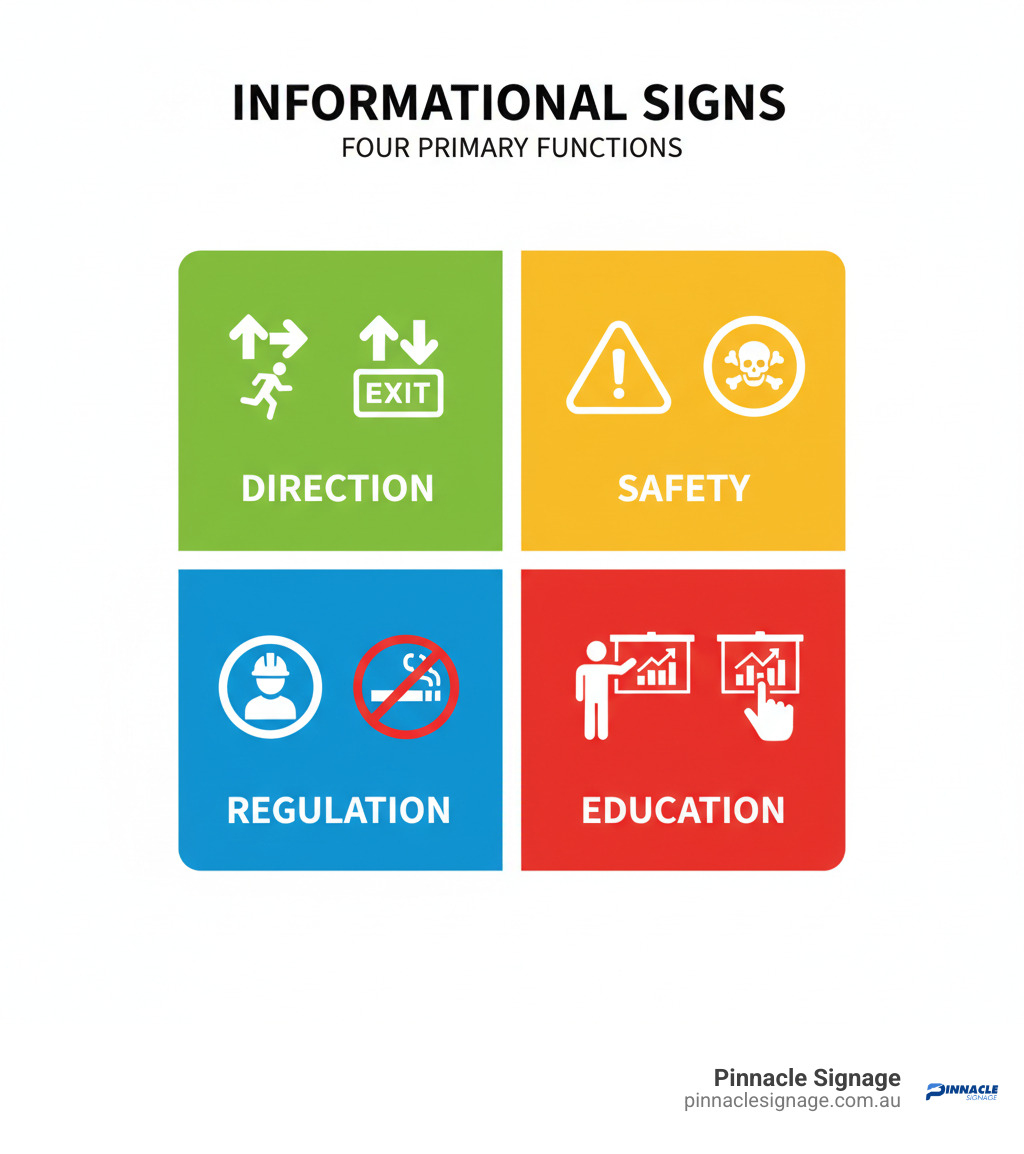
Informational signs are visual tools that convey important messages to help people steer spaces safely and efficiently. They serve four primary functions:
- Direction: Guiding people through unfamiliar environments like hospitals, shopping centres, and workplaces.
- Safety: Warning of hazards and communicating required protective measures.
- Regulation: Communicating legal requirements, restrictions, and mandatory actions.
- Education: Providing contextual information, instructions, and general knowledge.
Whether you manage a construction site, retail facility, or healthcare environment, informational signs are essential for clear communication. They protect people, ensure compliance, and improve operational efficiency. From simple arrows to complex safety warnings, these signs bridge the gap between what people need to know and what they can immediately understand.
In Australian workplaces, informational signage is often a legal requirement. It helps prevent accidents, guides people through unfamiliar spaces, and communicates rules like no-smoking areas or parking restrictions. The most effective signs use standardised symbols, colours, and shapes for easy identification and consistent understanding.
A Breakdown of Common Informational Signs and Their Features
Understanding the different types of informational signs helps us appreciate how much these silent communicators shape our daily experiences. They work behind the scenes to keep us safe, informed, and moving in the right direction.
Navigational and Directional Signs for Wayfinding
Navigational signs are silent guides in complex environments like hospitals, airports, and shopping centres. They answer the crucial question, "Where am I going?" before it even needs to be asked.
Effective wayfinding relies on simplicity. Directional arrows are universally understood, and when combined with clear text, they create a logical path. Maps and diagrams with a "You Are Here" marker help people understand their location within a larger space, reducing confusion and freeing up staff from giving directions.
Australian road signs use a colour-coding system that drivers instinctively understand. Green signs guide us to towns and cities, blue signs point to services, and brown signs highlight attractions. These signs often include details like exit numbers to help with travel planning.
For businesses, well-placed entry and exit signs are crucial for safety and efficiency. Our guide on Entry and Exit Signs 101 explores these navigation tools in more detail.
Safety, Regulatory, and Prohibition Signs
In Australian workplaces, safety signs are the first line of defence against accidents. They follow Australian Standards like AS 1319:1994 for consistency and immediate recognition.
- Danger signs use bold red and white to warn of life-threatening hazards like high voltage. They are reserved for the most serious risks.
- Caution signs use yellow and black to alert people to everyday hazards that could cause minor injuries, such as wet floors or low doorways.
- Mandatory signs use blue and white to indicate required actions, like wearing a hard hat or safety boots.
- Prohibition signs use a red circle with a diagonal line to communicate "do not" messages, such as 'No Smoking' or 'Restricted Access'.
- Fire safety signs (red) and first aid signs (green) guide people to life-saving resources during emergencies.
This clear system ensures safety messages are understood quickly, protecting everyone in the workplace.
Educational and General Informational Signs
Informational signs also educate and provide context, answering the "what," "how," and "why" of a space.
- Contextual signs turn ordinary places into learning opportunities, like a museum placard or a park sign about local wildlife.
- Instructional signs guide actions, such as explaining waste sorting, listing opening hours, or providing event details. Our Notice Signage range covers these general communication needs.
- Property and park rules communicate guidelines for biosecurity, food storage, or trail etiquette, protecting shared environments.
- Biosecurity signage is vital in Australia's agricultural sector. These signs communicate protocols to prevent the spread of pests and diseases, safeguarding our industries and natural environments. Our Stock and Farm Signage is designed for these unique challenges.
Key Characteristics of Effective Signage
Effective informational signs share several key characteristics that ensure they communicate clearly when it matters most.
- Clarity and Simplicity: The message must be instant and easy to understand, using direct language and essential information.
- Legibility: High-contrast colours, sans-serif fonts, and appropriate text size ensure the sign is readable from a distance.
- Visibility: Strategic placement, free from obstructions, and adequate lighting make the sign easy to see.
- Consistency: Using standardised symbols, colours, and layouts across a facility helps users quickly recognise and understand messages.
- Durability: Weather-resistant materials and robust construction ensure signs remain effective over time without becoming a hazard themselves.
- Accessibility: Signs should be usable by everyone. This includes using features like Braille and tactile elements, large print, and appropriate placement to meet Australian accessibility standards.
How to Implement an Effective Signage Strategy
Creating an effective signage strategy is about thoughtful planning that considers your specific environment, users, and objectives to create a cohesive and functional system.
Best Practices for Designing and Placing Informational Signs

Applying a few fundamental principles can transform how people interact with your space.
- Keep it simple: Use concise language and universally recognised symbols. A clear arrow or "i" symbol communicates faster than words.
- Ensure legibility: Use high-contrast colours and sans-serif fonts. Letter height should be appropriate for the viewing distance.
- Place signs strategically: A sign is useless if it's not seen. Place safety warnings at the point of hazard and directional signs before decision points.
- Maintain consistency: A unified design language (colours, fonts, symbols) builds familiarity and speeds up comprehension.
- Choose durable materials: For outdoor or harsh environments, weather-resistant materials are critical to prevent fading and damage.
- Consider accessibility: Ensure signs are usable by everyone by adhering to Australian standards for accessible signage, which govern placement and features for all users, including those with disabilities.
- Perform regular maintenance: Inspect and replace signs that are faded, damaged, or outdated. An obsolete sign can be more dangerous than no sign at all.
Avoiding common pitfalls is key to a successful signage strategy. For more tips, read our guide on 6 Bad Signage Mistakes and How to Prevent Them.
Partner with a Trusted Australian Signage Provider
Choosing the right signage partner is crucial for creating a system that works. At Pinnacle Signage, we understand that informational signs must be reliable and meet the specific needs of your operation.
- Australian-Made Quality: Our signs are manufactured in Australia with materials designed for local conditions, ensuring durability and faster turnaround times.
- Customisation: We offer custom solutions for any project, from specialised biosecurity signs to directional signs that match your corporate branding.
- Bulk Ordering: We support large-scale orders for councils, construction companies, and facility managers, with distributor pricing available for resellers and volume purchasers.
- Expert Guidance: Our team helps you steer the selection process, ensuring you choose the right signs for your application and comply with relevant Australian standards.
- Reliable Australia-Wide Delivery: We dispatch most items within 48 hours, ensuring you get your signs when and where you need them.
Whether you need essential First Aid Signage or a complete Fire Signage collection, we have the products and expertise to help.
Ready to improve your facility's signage? Contact us to discuss custom solutions, request bulk pricing, or get expert advice.
Shipping & Pickup Information
Getting your informational signs delivered quickly and safely is a top priority. We've streamlined our shipping process to ensure your order reaches you efficiently, wherever you are in Australia.
Production & Shipping Times
Pinnacle Signage dispatches most items within 48 hours of receiving your order and payment confirmation. Estimated delivery times are:
- 1-2 days: Sydney, ACT, Melbourne, Brisbane, Gold Coast
- 2-4 days: Rest of NSW, Rest of VIC
- 3-6 days: SA, North QLD, Perth
- 5-9 days: TAS, NT, WA
Delivery Details
We partner with reliable couriers like FEDEX for most deliveries. Please note:
- Provide a valid daytime delivery address, as couriers cannot deliver to PO Boxes.
- A signature is required upon receipt, so someone must be available to accept the package. Re-delivery charges will apply if you are not present.
- For items over 50kg, a tailgate delivery may be required for residential addresses, which is included in our standard shipping at no extra cost. You can also opt to collect heavy items from a nearby depot.
Free Shipping
We offer free shipping Australia-wide for orders over $100 on most items. For some bulky items, additional shipping costs may apply to WA, North QLD, NT, TAS, and island areas. Our staff will contact you if these charges apply to your order.
Warehouse Pickup
If you prefer to collect your order, pickup is available at our warehouse at Unit 4/28 Nagle Street, East Wagga Wagga NSW. We are open from 8am to 5pm, Monday to Friday (closed on weekends and public holidays).