

Biohazard Basics What You Need to Know About Warning Signs
Why Evacuation Route Signs Are Essential for Workplace Safety
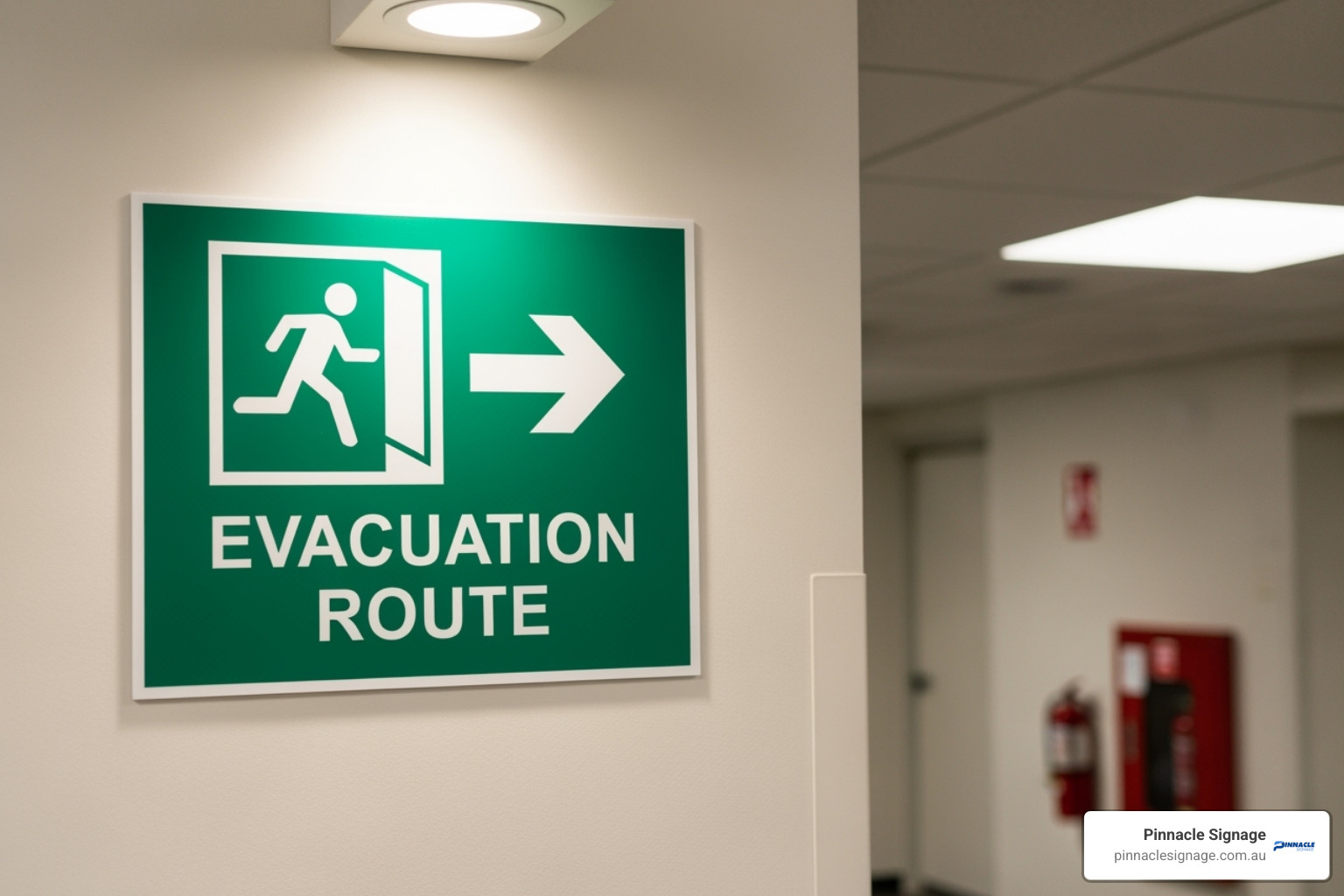
Evacuation route signs are critical safety devices that guide people to safety during emergencies, helping to prevent panic and save lives when every second counts. These signs provide clear directional guidance, reduce confusion during high-stress situations, and ensure both employees and visitors can quickly locate the nearest exit.
Key benefits of evacuation route signs:
- Reduce panic and confusion during emergencies
- Guide unfamiliar visitors safely to exits
- Assist emergency responders in understanding building layout
- Minimise evacuation time through clear direction
- Provide visibility even in low-light conditions with photoluminescent options
- Support business continuity by protecting people and property
According to research from York County's evacuation planning, clear signage is "one of the most – if not the most – important part of an evacuation." When people can quickly identify escape routes, it dramatically improves their chances of reaching safety without injury.
Well-placed evacuation signage does more than meet compliance; it builds confidence among staff and visitors, supports faster emergency response times, and demonstrates a commitment to workplace safety. For any busy office, retail space, or industrial facility, these signs are the backbone of an effective emergency response plan.
Why Clear Evacuation Route Signs are a Non-Negotiable Safety Benefit
When an emergency strikes, there is no room for confusion. Evacuation route signs become silent guides, directing everyone to safety when panic threatens to take over. For regular staff, new contractors, or first-time visitors, clear signage transforms potential chaos into an orderly evacuation, ensuring everyone can find their way out.
These signs are more than a compliance measure; they are a fundamental part of protecting lives and demonstrating your moral responsibility as a business owner. Investing in quality evacuation signage shows employees, visitors, and emergency responders that their safety is a priority.
The benefits are extensive. Well-placed evacuation route signs boost employee confidence, help guide first responders, and support business continuity by minimising injury and confusion. For a deeper understanding of how different safety signs work together, check out our comprehensive guide: An Essential Guide To Fire And Safety Signs: Types & Meanings.
The Crucial Role in High-Stress Situations
During an emergency, adrenaline and stress can make familiar places feel foreign, especially for those in unfamiliar environments like visitors or contractors. Evacuation route signs cut through this confusion with instinctive guidance. They provide clear direction when people need it most, enabling critical split-second decisions that lead to safety. In large or complex facilities, these signs are essential for minimising chaos.
Well-designed evacuation signage is simple. When a person's focus is on getting out, they don't need to think—they just need to follow the arrows. This panic reduction is invaluable, as it prevents poor decisions and keeps pathways clear.
Beyond Compliance: The Practical Benefits for Your Business
While meeting safety requirements is essential, quality evacuation route signs deliver practical benefits that impact your daily operations. Faster evacuation times mean less risk for everyone. Efficiently clearing a building reduces the risk of injury from slips, falls, or collisions common in panicked situations.
A proactive approach to safety also boosts your business reputation, creating employee peace of mind and improving morale. Operationally, clear signage makes emergency drills smoother and more effective, reinforcing procedures so everyone knows what to do.
Crucially, quality signage assists emergency services on arrival. First responders can quickly understand your facility's layout, track evacuation flow, and locate anyone who might still be inside. This coordination can be the difference between a manageable incident and a tragedy.
Ready to improve your workplace safety with professional evacuation signage? Explore our complete range of safety and evacuation signage to find the perfect solution for your facility.
Decoding the Different Types of Evacuation Signage
Not all evacuation signs are the same. A complete system of evacuation route signs works as a coordinated team, with each type serving a specific purpose to guide people from the first sign of danger to a safe assembly point.
A well-designed system creates a clear visual path for anyone, regardless of their familiarity with the building. Directional arrow signs lead people along the safest route, exit signs mark the final doorway to safety, and assembly point signs show where to gather outside. For severe weather, shelter signs are also critical. Understanding how these signs work together is key to creating a comprehensive safety network.
For a deeper dive into the fundamentals of emergency signage, check out our comprehensive resource: The Ultimate Guide To Exit Fire Signs.
Guiding the Way: Directional and Exit Signs
Directional signs eliminate guesswork during an emergency. A left arrow sign pointing to a stairwell or a straight-ahead sign in a corridor provides vital reassurance and clarity. Exit signs are the final checkpoint, positioned above or beside doors that lead directly outside. They must use high-contrast colours and clear lettering for visibility.
For power outages, you have two main options. Illuminated signs are connected to your building's electrical system with battery backup. Photoluminescent signs are a clever, zero-energy alternative. They absorb ambient light and then glow in the dark when needed, with no wiring or batteries required. These glow-in-the-dark signs are highly practical for Australian businesses, providing reliable visibility for hours during blackouts.
For more insights on choosing the right directional signage for your facility, explore our guide: Exit Strategy: Top Picks For Fire Exit Directional Signs.
Designating Safety: Assembly, Muster, and Shelter Signs
Evacuation is not complete until everyone is accounted for. Assembly area signs create designated gathering spots, preventing people from wandering off or re-entering the building. These signs should be bright and easy to spot in a chaotic situation.
Muster point signs serve a similar function, often used in larger facilities to organise different departments or groups for a more efficient roll call. For many Australian businesses, shelter signs are also vital. Severe weather shelter and storm shelter signs guide people to reinforced areas during cyclones or other natural disasters.
These signs transform a chaotic evacuation into an organised process, reducing panic and helping emergency services respond more effectively.
To learn more about implementing effective assembly areas, visit our detailed guide: Understanding Assembly Area Signs Made Easy.
Ready to improve your workplace safety with professional evacuation route signs? Explore our complete range of evacuation and safety signage to find the perfect solution for your facility.
Strategic Placement and Materials for Effective Evacuation Route Signs
Effective evacuation route signs depend on two things: strategic placement and durable materials. A sign is useless if it can't be seen or doesn't withstand the Australian climate.
Visibility and durability are essential for safety. The right placement and quality materials can make all the difference when seconds count. For a comprehensive look at implementing fire safety signs effectively, check out our guide: Workplace Safety Made Easy: How To Implement Fire Safety Signs.
Where to Install Your Signs for Maximum Effectiveness
To determine placement, think about how people move through your building, especially under stress. Key locations for evacuation route signs include:
- Building entrances: To orient new visitors and contractors immediately.
- Hallway intersections: At every junction, turn, or corridor split to prevent confusion.
- Stairwells: Clearly marking the primary escape route in multi-level buildings.
- Changes in direction: To guide people along the entire evacuation path.
- Regular intervals: Along long corridors to provide constant reassurance.
- Before final exits: To clearly guide people to the actual exit doors.
Most importantly, all signs must have unobstructed views and be mounted at a height that ensures they are easily seen. The size of the sign should also be appropriate for the viewing distance.
Choosing the Right Material for Durability and Visibility
Your sign's material determines its longevity and performance, especially in Australia's diverse climate. Common options include:
- Aluminium: Rust-proof and robust, ideal for harsh industrial or outdoor environments.
- Polypropylene: A versatile and durable lightweight option for indoor or outdoor use.
- Self-adhesive vinyl: Flexible and easy to apply on smooth indoor surfaces like drywall or glass.
- Pre-coated steel: Offers heavy-duty strength for the most demanding applications.
- Fluted plastic: A cost-effective choice for temporary signage.
- Magnetic: Perfect for steel surfaces where signs may need to be repositioned.
For low-light conditions, consider reflective materials that are visible at night when hit by light, or photoluminescent materials that absorb light and glow in the dark during a power outage. To protect your investment, ask about protective coatings that defend against fading, graffiti, and chemicals, ensuring your signs remain effective for years.
Integrating Signage into Your Complete Emergency Plan
Evacuation route signs are most effective as part of a complete emergency plan that also includes evacuation diagrams, staff training, and regular drills. When these elements work together, they create a robust safety system.
An integrated approach provides multiple layers of guidance that work for everyone. For official guidance on developing comprehensive emergency plans, Safe Work Australia offers excellent resources: Official guidance on emergency plans.
How Signs and Evacuation Diagrams Work Together
Evacuation diagrams and evacuation route signs are a powerful combination. Diagrams provide the big picture—the "You Are Here" maps showing the floor layout, all available exits, and paths to safety. They offer visual reinforcement for the physical signs people will follow.
This combination supports route planning, allowing staff to familiarise themselves with multiple escape routes in case one is blocked. Diagrams also help in locating safety equipment like fire extinguishers and first aid stations. Together, signs and diagrams ensure there is no confusion about where to go or where to gather at clarifying assembly points. For more insights on effective muster point signage, check out our guide: Clear And Safe: The Importance Of Muster Point Signage.
Planning, Implementation, and Maintenance Considerations
Effective signage requires ongoing attention. This is not a set-and-forget task.
Start with a thorough site assessment to map out hazards and primary and secondary exit routes. From there, route planning defines the safest paths, ideally with input from safety officers. Create a signage inventory to document what signs are needed and where they will go.
Once installed, a regular maintenance schedule is crucial:
- Inspect signs for damage, fading, or obstructions.
- Clean signs regularly to ensure they remain visible.
- Replace damaged signs promptly to maintain your safety standards.
- Update plans and signage whenever your building layout or emergency procedures change.
Treating your evacuation signage as a living part of your safety system ensures it remains reliable. For more information on our complete range of muster point and assembly area signage, visit: Muster Points Explained: Keeping Your Team Safe In Emergencies.
Frequently Asked Questions about Evacuation Route Signs
Here are answers to some of the most common questions we receive about evacuation route signs from Australian businesses.
How many evacuation signs do I need for my workplace?
There is no single answer, as the number depends on your facility's layout. The best approach is a site assessment. Walk the evacuation routes from a visitor's perspective. You need a sign at every key decision point, such as hallway intersections, stairwells, and any change in direction. The path to an exit must always be clear and visible. If you can't see the next sign, you need another one. Ensure pathways and signs remain unobstructed. It's always better to have too many signs than too few.
What's the difference between photoluminescent and standard signs?
The key difference is performance in a power outage. Standard signs are made from materials like aluminium or vinyl and rely on existing light to be seen. They work well in well-lit areas but become hard to see in the dark or in smoke. Photoluminescent signs are designed for low-light conditions. These glow-in-the-dark signs absorb energy from ambient light and then glow brightly during power outages, providing clear guidance without electricity or batteries. They are a cost-effective and reliable solution, especially for businesses in areas prone to power disruptions.
Can I get custom evacuation route signs for my facility?
Yes, absolutely. We understand that unique facility layouts require custom solutions. We can create signs with specific wording, unique directional arrows, or company branding to suit your building's architecture and evacuation strategy. Whether you have a heritage building with an unusual layout or a modern, complex facility, we can work with you to design signs that are clear, effective, and perfectly suited to your needs. You can customise one of our existing designs or provide your own concept.
Ready to explore what's possible for your workplace? Explore our complete range of safety and evacuation signage to see how we can help create a safer environment for everyone who walks through your doors.
Conclusion
In any workplace, evacuation route signs are a non-negotiable part of your safety system. They are the clear, calm voice of direction during a crisis, guiding people to safety when it matters most.
Effective signage does more than point to an exit. It reduces panic, protects visitors, and assists emergency responders. Investing in high-quality signs demonstrates a commitment to a strong safety culture, giving employees and visitors peace of mind and protecting your business.
From durable outdoor assembly point markers to photoluminescent signs for power outages and custom directional signs for unique layouts, having the right system in place is crucial. At Pinnacle Signage, we help Australian businesses create comprehensive signage solutions that keep people safe.
Don't wait for an emergency to test your preparedness. Ensure your evacuation route signs are clear, visible, and effective. Your people's safety depends on it.
Ready to improve your workplace safety? Explore our complete range of safety and evacuation signage and find how we can help you create a safer environment for everyone.