

The Ultimate Guide to Industrial Machine Safety Signage
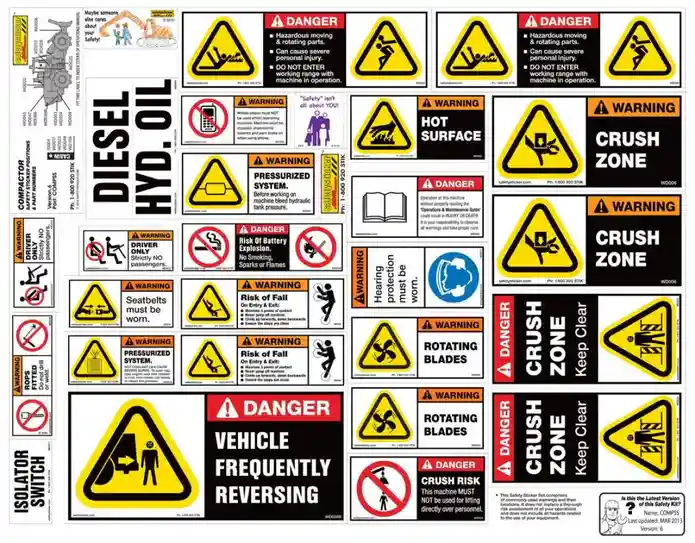
In industrial safety, machine hazard signs serve as the first line of visual defence. While engineering controls like physical guards and interlocks are the primary way to prevent contact with dangerous parts, signs provide the critical information needed to interact with that equipment safely. According to SafeWork Australia, employers have a legal obligation to manage risks, and providing clear, legible signage is a key part of fulfilling that duty.
Effective risk communication ensures that everyone on the floor, from the veteran operator to the new apprentice, understands the nature of the danger before they reach for a lever or open a panel. Without these visual cues, even the most well-maintained workshop can become a maze of hidden risks. For a deeper look at how to spot these dangers, you can read The Definitive Guide To Safety Sign Hazard Identification.

At Pinnacle Signage, we focus on producing signs that cut through the noise of a busy factory. Whether it is a high-voltage warning or a notice about automatic start-up, our signs are designed to meet the rigorous demands of Australian workplaces. You can explore our range of high-impact options in the Pinnacle Signage Danger Collection.
Identifying Machine Hazard Signs for Moving Parts
Moving parts are the most common cause of mechanical injuries. When we talk about machine hazard signs for moving parts, we are usually addressing four main categories of risk:
- Pinch Points: These occur where two parts move together, and at least one of them moves in a circle (like gears, rollers, or belt drives).
- Rotating Shafts: Even a smooth-looking shaft can catch loose clothing, hair, or jewellery, leading to horrific entanglement accidents.
- Crush Hazards: Common in hydraulic presses or heavy sliding components where a limb can be caught between a moving part and a fixed object.
- Entanglement: This is a major risk with drills, lathes, and milling machines where the machine can "grab" an operator.
Signs like "DANGER Moving Parts" or "CAUTION Keep Hands Clear" are essential here. They remind workers that the machine doesn't have a brain, it won't stop just because a finger is in the way. It is also vital to warn about the danger of loose clothing or long hair near these areas. For more on how to categorise these specific risks, check out our article on Danger Signage.
Mandatory and Prohibition Machine Hazard Signs
Not all machine hazard signs are there to tell you "don't touch." Some are there to tell you what you must do to stay safe. These are known as Mandatory and Prohibition signs.
Mandatory Signs usually feature a blue circle with a white symbol. They indicate that a specific action is required. For machinery, this often involves Personal Protective Equipment (PPE). Examples include:
- Eye protection must be worn (to protect against flying debris).
- Ear protection required (for machines exceeding 85-90 dB(A)).
- Guards must be in position before operating.
Prohibition Signs are the "no-go" signs, featuring a red circle with a slash. These are critical for lockout-tagout procedures. A "Do Not Operate" sign on a machine undergoing maintenance can literally be a lifesaver. It prevents unauthorised personnel from starting a machine while someone else is working on its internals. You can learn more about these specific types in our guide: Mandatory Signs What They Are Why They Matter And How To Spot Them.
Decoding Safety Sign Colours and Symbols
To ensure machine hazard signs are understood instantly - even by those who might speak English as a second language - Australia uses a standardised system of colours and symbols. This visual shorthand allows an operator to gauge the severity of a hazard from across the room.
- Danger (Red/Black/White): Used for life-threatening hazards. If you see a "DANGER" header, it means there is a high probability of death or serious injury if the message is ignored.
- Warning (Black/Yellow): Used for hazards that could result in death or serious injury but are generally considered a lower risk level than "Danger."
- Caution (Black/Yellow): Often used for "Warning" or to alert people to potential minor or moderate injuries, such as "Caution: Hot Surface."
- Mandatory (Blue/White): Instructions that must be followed (e.g., "Wear Safety Glasses").
- Emergency (Green/White): Indicates the location of safety equipment like emergency stops, first aid kits, or eye-wash stations.
Understanding these differences is key to proper site set-up. Using a "Danger" sign for a minor trip hazard devalues the impact of your truly critical signs. For a breakdown of which header to use when, see Caution Vs Danger Vs Warning What's The Difference and Beyond The Icon Understanding Safety Symbols.
Strategic Placement and Maintenance of Industrial Signage
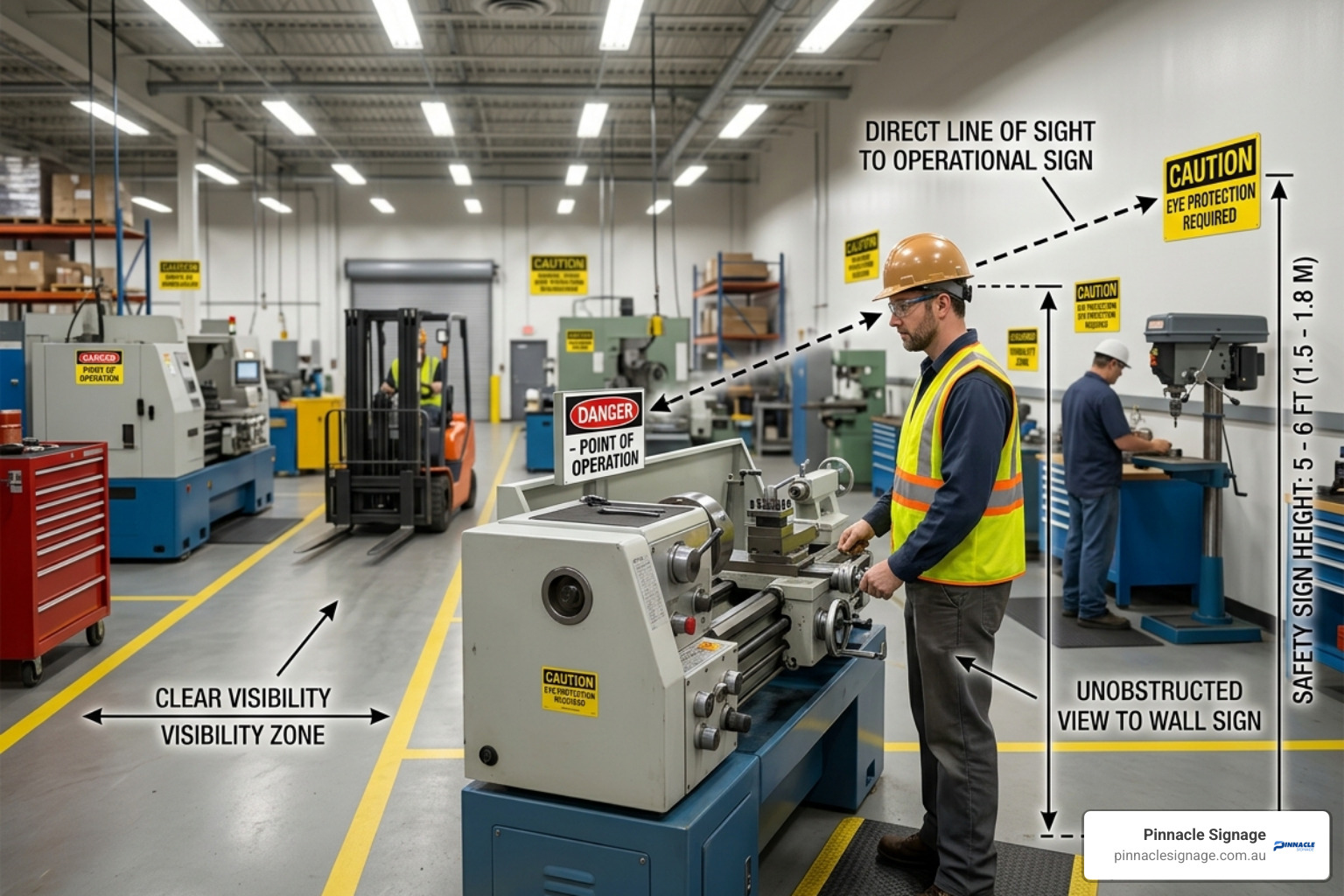
A sign is only effective if it can be seen. We often see workshops where machine hazard signs are obscured by stacked pallets, covered in grease, or mounted so high that they are outside the operator's natural line of sight.
Best Practices for Placement:
- Line of Sight: Place the sign where the operator's eyes naturally fall during machine set-up or operation.
- Proximity: The sign should be as close to the actual hazard as possible without becoming a hazard itself (e.g., don't mount a sign where it might be hit by a moving part).
- Mounting Height: For general area warnings, signs should be slightly above eye level. For specific machine hazards, they should be at the point of operation.
- Lighting: Ensure the area is well-lit so the sign is legible 24/7.
Durability is another major factor. In an industrial setting, signs are exposed to UV light, chemical splashes, and physical abrasion. At Pinnacle Signage, we use UV-resistant inks and durable substrates like metal or poly to ensure your message doesn't fade over time. For more tips on maintaining a compliant site, visit Safety Signage Australia Your Guide To Clear And Compliant Signs or browse our Pinnacle Signage Caution Collection.
Integrating Signage with Operational Safety Procedures
Machine hazard signs shouldn't exist in a vacuum; they should be the visual component of your Safe Operating Procedures (SOPs).
- Lockout-Tagout (LOTO): Signs are essential for identifying energy isolation points. A "Danger: Do Not Start" tag is the final step in ensuring a machine stays de-energised during repairs.
- Emergency Shutoffs: All emergency stop buttons should be clearly labelled with high-visibility green and white or red and white signage so they can be found in a split second during a crisis.
- Authorised Personnel: Use signs to restrict machine use to those who are trained and certified. This prevents "have-a-go" accidents from untrained staff.
- Custom Solutions: Sometimes a standard sign doesn't quite cover a unique piece of equipment. In these cases, custom signs with specific wording (e.g., "Do Not Stand In Front Of Machine While Operating") are necessary. You can find out how to design these in The Ultimate Guide To Custom Danger Signs.
Frequently Asked Questions about Machine Safety
What are the legal requirements for machine hazard signage in Australia?
Under the Work Health and Safety (WHS) Act, employers must provide any information, training, and instruction necessary to protect people from risks. SafeWork Australia points to Australian Standard AS 1319-1994 as the benchmark for safety signs. This standard dictates everything from the size of the lettering to the specific colours used. Failing to provide adequate signage can lead to significant fines and increased liability in the event of an accident.
Material Selection for Industrial Environments
The choice of material depends on the specific operational environment:
- Metal (Aluminium/Steel): Ideal for high-impact areas or where the sign needs to be mounted on a fence or wall. These are extremely durable and rust-resistant.
- Poly (Plastic): Offers excellent chemical resistance for indoor use. It is flexible and resistant to denting.
- Vinyl Stickers: Suitable for application directly onto the curved surfaces of machines or control panels.
How often should machine safety signs be inspected?
We recommend a formal visibility check at least once every six months. You should look for:
- Fading: If the red is turning pink or the yellow is turning white, the sign is losing its "hazard" impact.
- Damage: Cracks, dents, or peeling adhesive.
- Cleanliness: Dust and grease can quickly make a sign unreadable. A simple wipe-down with a damp cloth is often all that's needed. For critical items like first aid, regular checks are even more important.
Safer Machines, Smarter Signage: Final Takeaways
At the end of the day, machine hazard signs are about more than just ticking a compliance box. They are about ensuring that every worker who walks into your facility in the morning walks out again at the end of their shift, safe and sound.
Pinnacle Signage is proud to be a premier Australian manufacturer based right here in East Wagga Wagga, NSW. We understand the local landscape and the specific safety requirements of Australian industry. We make high-quality, compliant signage accessible to businesses across the country.
When you order from us, you get the benefit of local expertise and a commitment to quality. We offer:
- Fast Turnaround: Most orders are dispatched within 48 hours.
- Free Shipping: On orders over $100 AU Wide (exceptions apply).
- Local Pickup: Visit our warehouse in East Wagga Wagga, NSW, Monday to Friday, 8am-5pm.
- Custom Options: If you can't find the exact sign you need, we can make it for you.
Keep your workplace safe and your team informed. For expert advice or to place a bulk order, visit us online today.