

Beyond the Barrier: Understanding Radiation Restricted Zones
What Is a Radiation Restricted Area (And Why It Matters for Safety Compliance)

A radiation restricted area is any area where access is controlled to protect people from exposure to radiation or radioactive materials. In simple terms, if radiation levels are elevated enough to pose a risk, entry must be managed, monitored, and clearly communicated through signage.
Here is a quick breakdown of the key zone types, from lowest to highest risk:
- Unrestricted area - dose rate at or below 2 mrem/hr; no special access controls required
- Restricted area - access is controlled by the licensee or employer; triggered when dose rates exceed 2 mrem/hr or radioactive material quantities exceed regulatory thresholds
- Radiation area - dose equivalent exceeds 5 mrem (0.05 mSv) in 1 hour at 30 cm from the source; must be posted with a caution sign
- High radiation area - dose equivalent exceeds 100 mrem (1 mSv) in 1 hour at 30 cm; requires physical barriers and access controls
- Very high radiation area - absorbed dose exceeds 500 rads (5 Gy) in 1 hour at 1 metre from the source; requires the strictest access controls, including locked entrances and direct supervision
These zones are not just regulatory formalities. They exist to prevent accidental overexposure, protect workers and the public, and ensure that anyone entering a hazardous area has the right training, equipment, and authorisation.
Radiation hazards appear across a wide range of Australian workplaces, from hospitals and research laboratories to mining operations and industrial radiography sites. Getting the zone classifications right and posting them correctly is a legal and moral obligation.
I'm Doug Lindqvist, General Manager of Pinnacle Signage, and throughout my years in the safety and industrial supply space, I've seen how unclear or non-compliant signage around a radiation restricted area can create serious risks for workers and liability headaches for site managers. In this article, we'll walk through everything you need to know, from dose thresholds and zone classifications to signage requirements and access control protocols.
Relevant articles related to Radiation restricted area:
Defining the Radiation Restricted Area and Zone Hierarchy
In safety management, "restricted" isn't a one size fits all term. When we talk about a radiation restricted area, we are referring to a space where an employer or licensee limits access specifically to protect individuals from undue risks. This differs from a "controlled area," which acts as a buffer zone where exposure is possible but usually lower, and an "unrestricted area," where anyone can walk through without needing a dosimeter or a safety briefing.
Establishing these zones is a standard procedure that ensures we aren't just putting up signs for the sake of it, but placing them where they actually save lives. The hierarchy moves from general access to highly secured, locked-down environments as the potential dose increases.

Identifying a Radiation Restricted Area by Exposure Levels
How do we know when a room moves from being a regular lab to a radiation restricted area? It all comes down to the numbers. Generally, an area must be designated as restricted if:
- Radiation levels could result in an individual receiving more than 2 mrem (0.02 mSv) in any one hour.
- Radioactive material is present in quantities exceeding ten times the regulatory limits.
The goal is to keep the public dose from licensed operations below 100 mrem (1 mSv) per year. If a zone exceeds 2 mrem/hr, it is no longer considered safe for the general public to wander through.
Sub-Classifications within Restricted Zones
Once you are inside the "Restricted" umbrella, there are several sub-categories you need to be aware of. Each has its own rules for PPE, monitoring, and signage:
- Radiation Area: Where levels exceed 5 mrem/hr at 30 cm.
- High Radiation Area (HRA): Where levels exceed 100 mrem/hr at 30 cm.
- Very High Radiation Area (VHRA): Where levels exceed 500 rads/hr at 1 metre. This is a lethal environment if not strictly managed.
- Airborne Radioactivity Area: Where concentrations of radioactive material in the air exceed specific derived air concentration (DAC) values.
Dose Rate Thresholds and Classification Levels
Precision is everything when measuring radiation. We use terms like "deep-dose equivalent" to describe the external radiation dose to the whole body at a tissue depth of 1 centimetre.
The thresholds are strictly enforced. For example, a "Radiation Area" is triggered at 5 mrem per hour, while a "High Radiation Area" jumps to 100 mrem per hour. These measurements are taken at a distance of 30 centimetres from the source or any surface the radiation penetrates. If you're managing a site in NSW, staying on top of these thresholds is the difference between a safe workplace and a massive regulatory fine.
Occupational Dose Limits for Workers
For those of us working in these zones, there are clear "speed limits" for how much radiation our bodies can absorb in a year. The Radiation | EPA - NSW Environment Protection Authority guidelines align with international standards:
- Adult Workers: 50 mSv (5 rem) per year.
- Minors: 10% of the adult limit (5 mSv/year).
- Pregnant Workers: 5 mSv (500 mrem) for the duration of the pregnancy once declared.
We always follow the ALARA principle: As Low As Reasonably Achievable. Just because the limit is 50 mSv doesn't mean we want to hit it. We use time, distance, and shielding to keep those numbers as close to zero as possible.
Contamination Limits and Surface Monitoring
It isn't just about the "rays" coming off a source; it's also about the "dust" or liquid that might get on surfaces. We measure this in disintegrations per minute (dpm) over a 100 cm² area using "smears" or wipes.
- Beta-Gamma Contamination: Typically restricted if over 1,000 dpm/100 cm².
- Alpha Contamination: Much stricter, often restricted if over 20 dpm/100 cm².
If levels hit 100,000 dpm/100 cm² for beta-gamma, you are looking at a "High Contamination Area," which requires full protective suits and intensive decontamination protocols.
Essential Signage for a Radiation Restricted Area
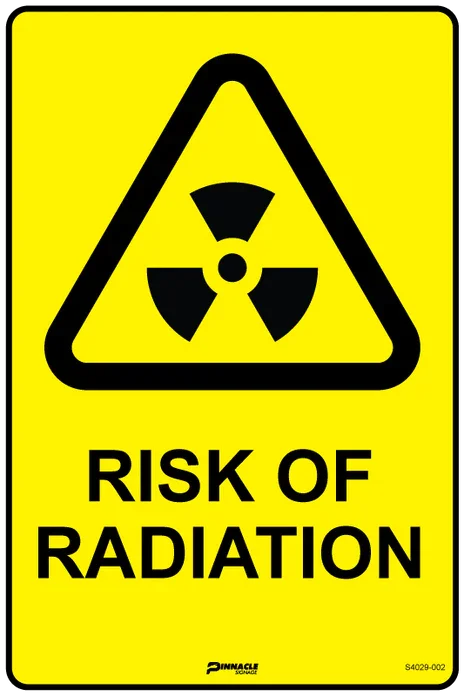
Signage is your first and most important line of defence. In Australia, we follow AS 1319 for safety signs, which dictates exactly how these warnings should look. A Radiation Restricted Area Sign must be conspicuous - you shouldn't have to go looking for it.
The standard "trefoil" symbol (the three bladed fan shape) must be used. The colour scheme is non-negotiable: magenta (or purple) on a yellow background. This high contrast combination is internationally recognised and ensures the sign is visible even in low light or dusty industrial environments.
Sizing and Visibility Requirements for Safety Signs
A sign is useless if you can't read it until you're already standing in the "Hot Zone." According to Understanding Australian Standards for Safety Signs, the size of the sign must correspond to the viewing distance.
For a danger sign to be effective at 12 metres, it needs to be at least 300x225mm. If the viewing distance is 18 metres, you need to step up to 450x300mm. We also have to consider font height, generally 5mm of letter height for every metre of viewing distance for upper case text. At Pinnacle Signage, we manufacture these to exact Australian Standards right here in East Wagga Wagga, ensuring they stand up to the harsh NSW climate.
Mandatory Wording and Contact Information
While the trefoil symbol does a lot of the heavy lifting, the text provides the context. Common wording includes:
- CAUTION: RADIATION AREA
- DANGER: HIGH RADIATION AREA - KEEP OUT
- CAUTION: RADIOACTIVE MATERIAL
Beyond the hazard, signs should include the name of the Authorised User or Radiation Safety Officer (RSO) and an emergency contact number. This is vital for first responders who might encounter the area during an incident. For more on the specific types of warnings, check out The Atoms Warning: A Deep Dive into the Radioactive I, II, and III Signs.
Access Control and Safety Protocols
You can't just hang a sign and hope for the best. A radiation restricted area requires active management. This starts with the Radiation Safety Officer (RSO), who is responsible for the overall safety program.
For High Radiation Areas, physical barriers are a must. We’re talking about locked doors, gates, or even "cocooning" (enclosing a source in a substantial cage). These barriers must be designed so that someone can always exit the area (no locking people in!), but unauthorised people cannot get in. Our Restricted Area Authorised Personnel Sign Guide explains how to pair these physical barriers with the right entry requirements.
Managing Access within a Radiation Restricted Area
Entry into these zones usually requires a Radiation Work Permit (RWP). This document outlines exactly what the job is, what the radiation levels are, and what PPE is required (like lead aprons, gloves, or respirators).
Personnel monitoring is also a staple. Anyone entering a restricted area likely needs a personal dosimeter (like a TLD or film badge) to track their cumulative dose. If you are bringing visitors into a zone, they must be escorted and briefed on the risks. As we highlight in our resource, Keep Out: Why Restricted Access Signs Are Your First Line of Defence, the sign is the gatekeeper, but the protocol is the key.
Emergency Procedures and Zone Establishment
In the event of a spill or a source becoming unshielded, we use the "Hot Zone" concept.
- The Hot Zone (Inner Cordon): Established where dose rates exceed 100 mSv/hr. Access is for life saving actions only, with strictly limited stay times (usually under 30 minutes).
- The Buffer Zone: A transition area for decontamination.
- The Cold Zone: Where the command post is set up and radiation levels are at background levels.
Establishing these perimeters quickly is essential. Using high visibility Restricted Area Signs helps cordoning off the area before the public can wander in.
Frequently Asked Questions about Radiation Zones
What defines a High Radiation Area in Australia?
In line with Australian regulatory standards, a High Radiation Area is any area accessible to personnel where radiation levels could result in an individual receiving a dose equivalent exceeding 1 mSv (100 mrem) in 1 hour at 30 cm from the radiation source.
Are there exceptions to posting requirements for restricted areas?
Yes. You generally don't need to post "Caution" signs for:
- Containers being transported (which follow separate ADG Code labelling).
- Areas where radioactive materials are present for less than 8 hours, provided they are constantly attended by a qualified individual who takes precautions to prevent exposure.
- Rooms where the source is a sealed unit (like a diagnostic X-ray machine) and the room is only a radiation area when the machine is on.
What colours must be used for radioactive warning signs?
Standard safety signs for radiation must use a magenta or purple trefoil symbol on a yellow background. This is specified in AS 1319 and is consistent globally to ensure there is no confusion about the hazard.
Past the Trefoil: Making Sense of Radiation Restricted Zones
Managing a radiation restricted area is a serious responsibility that requires a mix of technical knowledge, strict protocols, and clear communication. From understanding the 5 mrem/hr threshold for a Radiation Area to ensuring your High Radiation Area is physically locked and correctly labelled, every step is vital for keeping your team safe and your site compliant.
At Pinnacle Signage, we take pride in being the premier safety signage manufacturer in East Wagga Wagga, NSW. We understand the local regulatory landscape and the importance of durability in Australian industrial environments. Whether you need a single custom warning sign or a bulk order for a new facility, we offer fast turnaround with dispatch within 48 hours.
You can find our range of premium safety products through Pinnacle Signage, or visit us in East Wagga Wagga for warehouse pickup between 8am and 5pm, Monday to Friday. Our team is available to help you customise your Danger Signage to meet specific site requirements and ensure you go beyond the barrier safely.
Need help choosing compliant radiation restricted area signs or custom wording? Contact us.