

The Low Down of Construction Vehicle Signs
Why Clear Signage is Non-Negotiable
A construction vehicle sign is a critical safety tool mounted on or displayed near heavy vehicles operating in work zones and on public roads. These signs warn other motorists, pedestrians, and site workers of potential hazards such as slow-moving vehicles, wide turns, sudden stops, oversize loads, and frequent lane changes.
Common types of construction vehicle signs include:
- Construction Vehicle Do Not Follow
- Oversize Load Ahead
- Pilot Vehicle / Escort Vehicle
- Trucks Turning
- Construction Vehicles Excepted
- Trucks Use Next Entrance
These signs improve visibility, communicate vehicle movements, and help prevent accidents by alerting road users to the unique behaviours and hazards associated with construction vehicles. They are often made from durable, reflective materials like aluminium or self-adhesive vinyl to ensure visibility in all lighting and weather conditions.
Every year, work zone incidents involving construction vehicles result in serious injuries, property damage, and costly delays. A single misunderstanding between a motorist and a dump truck, grader, or pilot vehicle can escalate into a dangerous situation. Clear, compliant signage isn't just about ticking regulatory boxes, it's about protecting lives, reducing liability, and keeping operations running smoothly. Whether you're managing a fleet of heavy vehicles or coordinating traffic on a busy construction site, the right signage ensures everyone knows what to expect and how to respond.
Experience across countless Australian projects, from large-scale civil works to regional road maintenance, shows how the right construction vehicle sign can make all the difference. Investing in clear, compliant signage is a critical step in preventing incidents, protecting workers, and maintaining overall site safety.
The Critical Role of Construction Vehicle Signs in Work Zone Safety
Construction sites and roadwork zones are inherently high-risk environments. Heavy vehicles operating in these areas don't behave like regular traffic, and that's where a construction vehicle sign becomes absolutely essential. These signs act as a visual language that everyone can understand instantly, whether they're a passing motorist, a pedestrian, or a worker on site.
The impact on overall safety is significant. When construction vehicles are properly marked, driver awareness increases dramatically, especially for people unfamiliar with how these operations work. Workers on site get an extra layer of protection because external traffic receives a clear warning about their presence and activities. And from a business perspective, comprehensive signage demonstrates a proactive commitment to safety, which helps reduce liability exposure for construction companies.
These aren't just nice-to-have accessories. They're fundamental tools for effective work zone management and accident prevention. For a deeper dive into various warning signs and their applications, check out our guide on Everything You Need to Know About Construction Warning Signs. We also explore the broader topic of hazard identification in The Definitive Guide to Safety Sign Hazard Identification.
Communicating Vehicle Movements
Here's the thing about construction vehicles: they don't follow normal traffic patterns. A dump truck might be crawling along at 20km/h, then suddenly veer off the road into a work zone. A grader making a wide turn can swing into adjacent lanes without warning. These vehicles stop abruptly, change lanes unexpectedly, and make frequent turns that would surprise any driver not familiar with construction operations.
A construction vehicle sign gives other road users a warning they need to react safely. Take the "Construction Vehicle Do Not Follow" sign, for instance. This sign explicitly tells motorists to keep their distance and expect unpredictable movements. It's particularly critical for preventing rear-end collisions when a truck suddenly exits the roadway to enter an active work zone.
These movement warnings aren't about slowing down traffic for the sake of it. They're about creating a buffer zone where everyone has time to process what's happening and respond appropriately. If you want to understand more about how these traffic signs work together, our article Road Construction Traffic Signs Explained (Without Driving You Crazy) breaks it down in plain language.
Enhancing Visibility Day and Night
Construction doesn't stop when the sun goes down. Many operations run through the night, at dusk and dawn, or continue regardless of weather conditions. In these scenarios, a sign's effectiveness depends entirely on whether drivers can actually see it.
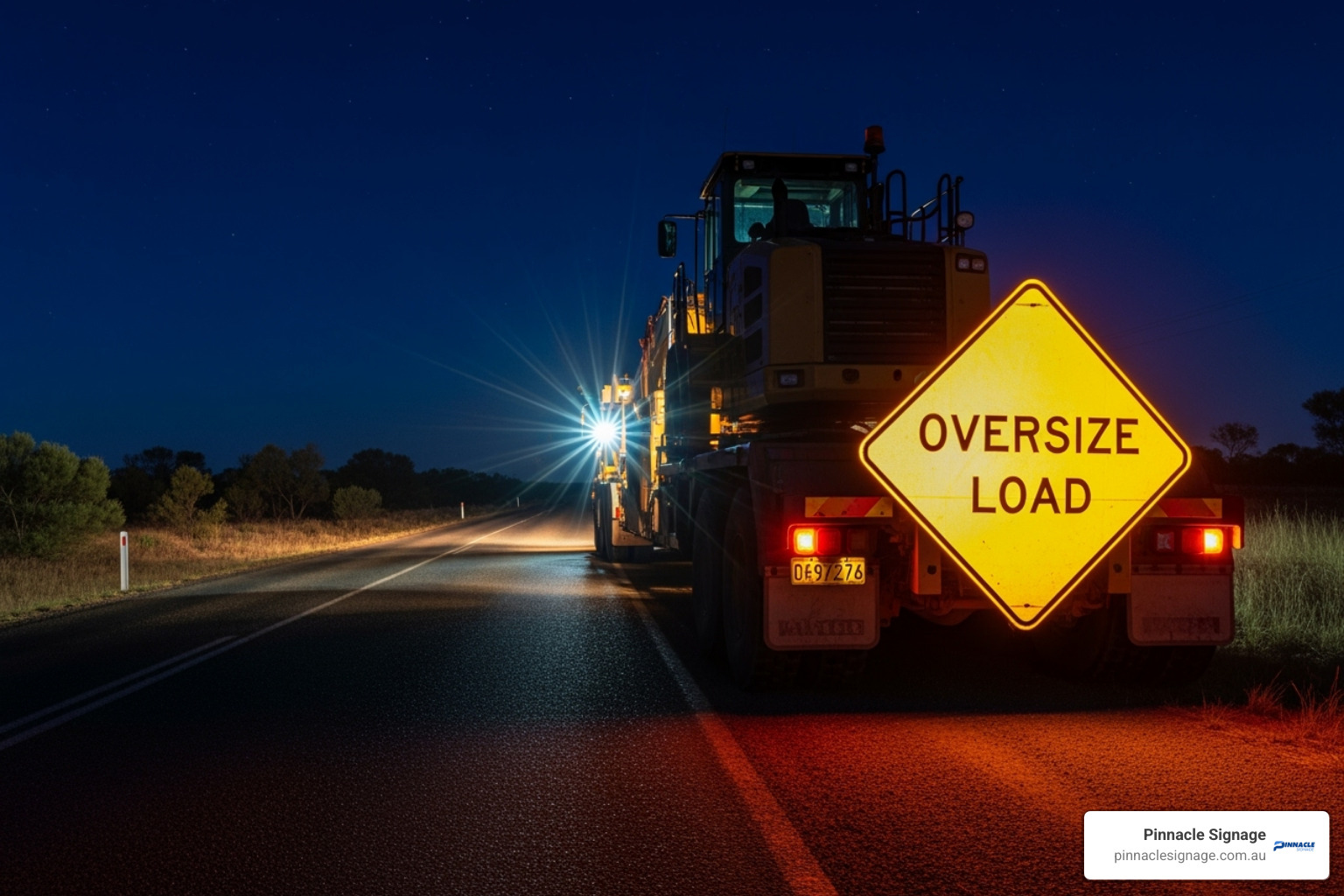
This is where reflective materials become non-negotiable. Signs using Engineer Grade reflective sheeting can be clearly visible from up to 150 metres away at night. For high-speed roads or situations where you need even more warning distance, High-Intensity Prismatic sheeting extends that visibility range to an impressive 300 metres. That extra distance translates directly into extra reaction time for drivers, which can make all the difference between a close call and a safe pass.
The reflectivity levels you choose matter. They need to match your operating conditions, the speed of surrounding traffic, and the specific hazards your vehicles present.
Common Types of Construction Vehicle Signs Explained
Understanding which construction vehicle sign to use in different situations isn't complicated, but it does matter. The right sign ensures everyone on and around your work site knows what to expect, whether that's a slow-moving grader, an oversize load taking up extra road space, or a pilot vehicle leading an escort convoy. Our Road Construction Signage Requirements 101 provides a comprehensive overview to help you steer these needs.
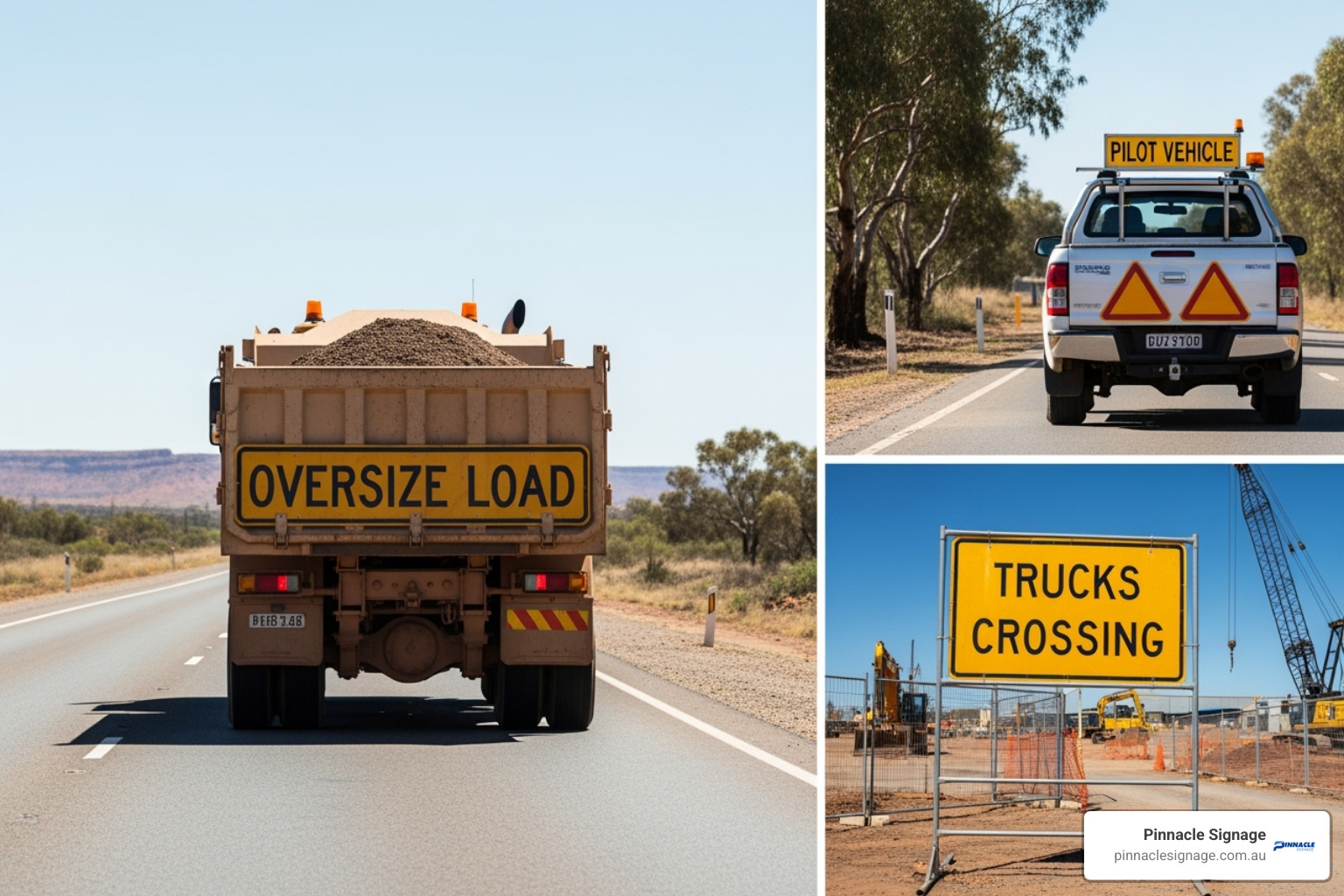
Construction vehicle signage generally falls into three main groups. Warning signs alert drivers to potential hazards ahead or around your vehicles. Regulatory signs indicate specific rules or permissions that apply to construction vehicles. Informational signs provide guidance or operational details that help manage traffic flow and site access.
Warning Signs for Other Motorists
These signs exist to grab attention and communicate the unique behaviours of construction vehicles that might catch other road users off guard.
A Construction Vehicle Do Not Follow sign is perhaps the most critical warning sign for dump trucks and heavy machinery. When a vehicle might stop suddenly, turn unexpectedly, or dump material without warning, this sign tells trailing vehicles to keep their distance. It's a simple message that prevents countless potential collisions.
Trucks Turning signs warn that the vehicle needs extra space to manoeuvre, especially for wide turns. Motorists who see this sign know not to squeeze past on the inside of a turn, a mistake that can end badly for everyone involved.
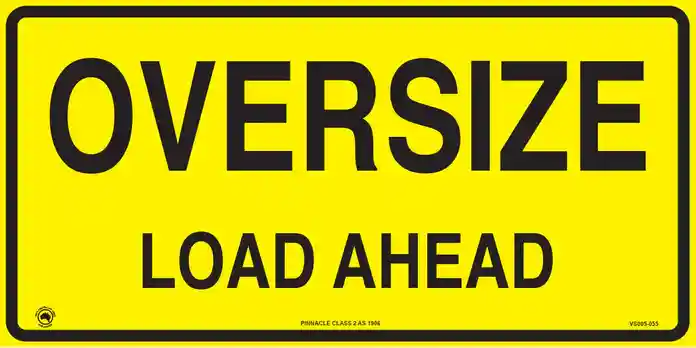
When you're moving something that exceeds standard dimensions, Oversize Load Ahead and Oversize Load signs become essential. These signs give other drivers time to adjust their position and speed. We cover these requirements in detail in Stay Safe, Stay Compliant: Get Information About Oversized Vehicle Signs.
Pilot Vehicle and Escort Vehicle signs are displayed on the vehicles that accompany oversize loads, making it clear to other traffic that they're part of a managed convoy and should be given appropriate space and respect. Our Escort Vehicle Pilot Sign Kits: Essential for Managing Oversize Loads in Australia explains how these systems work together to keep everyone safe.
Regulatory and Informational Signs
Beyond warnings, some construction vehicle signs communicate specific permissions or provide practical guidance for managing traffic and access.
Construction Vehicles Excepted signs are particularly useful in areas with general traffic restrictions. When certain vehicles are prohibited, but construction vehicles need special permission to operate, this sign makes that exception clear. Transport for NSW provides more information on the 'Construction Vehicles Excepted' sign and its specific applications.
Trucks Use Next Entrance signs direct construction vehicles to designated entry points, keeping them separate from general traffic and reducing congestion at main site entrances. This simple direction can significantly improve traffic flow and safety around active work sites.
Authorised Personnel Only signs, while not exclusively for vehicles, are often displayed at restricted site entrances or on specific vehicles to control access and reinforce safety protocols. Learn more about managing restricted access with Authorised Personnel Only Signs: Upgrade Your VIP Access Zones Today.
Understanding Regulatory Standards for a Construction Vehicle Sign in Australia
If you're putting signs on construction vehicles in Australia, you're operating in a well-regulated environment, and for good reason. The standards exist to ensure that every construction vehicle sign does its job properly, communicating clearly and consistently across different projects, states, and conditions.
The primary guiding document is Australian Standard AS 1742.3, which covers traffic control devices for works on roads. This standard sets out the specifications for everything from sign dimensions and colours to reflectivity levels and placement. For heavy vehicles, especially those carrying oversize loads or operating as pilot vehicles, the National Heavy Vehicle Regulator (NHVR) provides additional requirements that must be followed.
These aren't just bureaucratic hoops to jump through. Adhering to these regulations delivers real benefits. You get improved safety outcomes, legal compliance that protects your business, and consistent messaging that drivers recognise instantly, no matter where they encounter your vehicles. Australian projects must always follow local and national guidelines. For a deeper understanding of site safety compliance, see Building Site Signs: Essential Requirements for Construction Safety.
Key Features: Materials and Durability
The material your construction vehicle sign is made from determines how long it will last and how well it performs in Australia's harsh conditions. We're talking scorching sun, torrential rain, dust storms, and everything in between. Choosing the right material isn't about cutting corners, it's about ensuring your signs remain legible and effective for years.
Aluminium is the workhorse of rigid signage. It resists rust, withstands extreme weather, and provides a robust, long-lasting solution for permanent or semi-permanent installations on vehicles. It's particularly popular for signs that need to stay in place for extended periods.
Self-adhesive vinyl offers flexibility and is ideal for vehicle wraps or temporary applications. It can be applied directly to vehicle surfaces and, when properly laminated, provides excellent UV protection and abrasion resistance. This makes it suitable for contractors who need signage that can be updated or changed periodically.
Magnetic signs bring versatility to the table. They can be easily applied and removed without damaging your vehicle's paintwork, making them perfect for contractors who use their vehicles for both work and personal purposes. One moment it's a work vehicle, the next it's your daily driver.
The investment in quality materials pays for itself by reducing replacement frequency and ensuring your signs remain readable when it matters most.
Key Features: Reflectivity and Size of a Construction Vehicle Sign
Once you've got the right material, the next critical consideration is how well your construction vehicle sign can be seen, and from how far away. This comes down to reflectivity and size, both of which directly impact safety.
Reflectivity is measured in classes. Class 1 Reflective sheeting, which includes Diamond Grade or High-Intensity Prismatic materials, offers the highest level of reflectivity. These signs can be seen from up to 300 metres (1,000 ft) at night, making them essential for high-speed roads, highways, or complex work zones where early warning is critical. Class 2 Reflective sheeting, often Engineer Grade, provides good reflectivity for most urban and slower-speed environments, with nighttime visibility up to 150 metres (500 ft). For construction vehicles that operate at dawn, dusk, or through the night, high reflectivity isn't optional, it's essential.
Sign size matters because larger signs are easier to see from further away. Australian standards often specify minimum sizes based on the speed limit of the road where the vehicle operates. The faster the traffic, the larger and more visible the sign needs to be.
Legibility is the final piece of the puzzle. Even the largest, most reflective sign is useless if drivers can't read it quickly. Font size, colour contrast, and message simplicity all play a role. In Australia, fluorescent orange backgrounds with bold black text are common for warning signs, offering maximum contrast and visual impact that grabs attention instantly.
When selecting or specifying signs, always consider the environment, the speed of approaching traffic, and the distance from which the sign needs to be read. These factors will guide your choices in reflectivity class and sign dimensions. For more information on crucial warning signs, explore Caution Signs You Can't Miss on a Construction Site: Full Guide.
Best Practices for Sign Placement and Maintenance
Even the most expensive, perfectly compliant construction vehicle sign becomes useless if it's positioned poorly or left to deteriorate. I've seen too many sites where signs are technically present but might as well be invisible, either obscured by equipment, covered in dust, or mounted at angles that make them impossible to read from approaching vehicles.
Proper placement starts with understanding sight lines. Your sign needs to be at a height and angle that allows drivers to see it clearly from a distance, without obstruction from other vehicles, site equipment, or vegetation. This sounds obvious, but it's remarkable how often signs end up blocked by something that wasn't there when they were first installed.
Secure mounting is critical, especially on moving vehicles. Signs that vibrate loose, flip around, or fall off completely aren't just ineffective, they're potential hazards themselves. Use quality fixings appropriate for the surface and conditions. For vehicles operating on rough terrain or at highway speeds, this becomes even more important.
Regular cleaning might seem like a minor detail, but dirt, dust, and grime can dramatically reduce both the legibility and reflectivity of signs. A reflective construction vehicle sign covered in road dust isn't going to reflect much of anything. Schedule regular cleaning as part of your vehicle maintenance routine, especially during dusty conditions or after wet weather.
Damage inspection should be routine. Check for fading, scratches, dents, or torn edges. A damaged sign can confuse rather than inform, and a faded sign might not be visible at all in low light. Replace signs that show significant wear before they become a liability.
Placement on Different Vehicle Types
The right placement for a construction vehicle sign varies significantly depending on what type of vehicle you're working with. What works on a dump truck won't necessarily work on a pilot car or excavator.
For dump trucks, the "Construction Vehicle Do Not Follow" sign is typically mounted on the rear, positioned where it's clearly visible to trailing traffic. This placement is crucial because these trucks frequently make sudden stops, turn unexpectedly to enter work zones, or engage in dumping operations that can create hazards for following vehicles.
Pilot cars and escort vehicles require a different approach. These vehicles need "Pilot Vehicle" or "Escort Vehicle" signs that are visible from both front and rear, often roof-mounted to ensure they're seen from a distance. Combined with flashing lights, these signs clearly identify the vehicle's special role in accompanying oversize loads.
Excavators and graders present unique challenges. While they don't typically travel long distances on public roads, when they do move between work zones or operate near traffic, they need appropriate warning signs. These might be displayed on temporary stands nearby or, where possible, mounted directly on the machine where they won't interfere with operation.
For oversize load vehicles, comprehensive signage is non-negotiable. This includes "Oversize Load" banners on both front and rear, plus additional reflective markings along the vehicle's length to help other drivers judge its full size, especially at night. The placement needs to account for the load itself, ensuring signs remain visible and aren't obscured by the cargo.
The Importance of Quality and Compliance
Ensuring your fleet is equipped with the right construction vehicle sign is a fundamental aspect of site safety and public responsibility. It's not just about compliance; it's about proactively protecting your team, the public, and your business. Durable, compliant signage is built to withstand Australia's harsh conditions, from the scorching sun in North Queensland to the wet, muddy sites of a Melbourne winter. Whether you require standard signs or custom solutions with specific text, logos, or dimensions to match operational needs, sourcing high-quality products is a critical investment in safety.
Talk to an Expert or Shop Now
- Contact our team for custom orders, bulk pricing, and compliance advice
- Prefer to buy in-store or online? View the Pinnacle Signage range at Bunnings