

How to Properly Label Hazardous Areas with Flammable Materials Signs
Why Flammable Materials Signs Matter in Australian Workplaces

Flammable materials signs are standardised safety signs used to identify and communicate the presence of substances that can ignite and cause fires or explosions in the workplace. If you need a quick answer on what these signs require in Australia, here is a summary:
- What they are: Visual warnings identifying flammable liquids, gases, and solids in storage, transport, or work areas
- Who needs them: Any business storing, handling, or transporting flammable or combustible substances
- Key standards: GHS 7 (from January 2023), the Australian Dangerous Goods (ADG) Code, and AS 1319
- Common types: Danger signs, Hazchem diamonds, GHS pictogram labels, and No Smoking signs
- Where they go: At every entrance to a hazardous area, on storage containers, and near the specific hazard
- Materials: Rust-free aluminium, UV-stabilised polyethylene, and self-adhesive vinyl for durability in Australian conditions
Workplaces that handle petrol, LPG, acetylene, solvents, or even certain dusts are legally required to display appropriate flammable hazard signage under Australian WHS regulations. Getting this wrong is not just a compliance issue - it can cost lives.
I'm Doug Lindqvist, General Manager of Pinnacle Signage, and my background in safety and industrial supply has given me first-hand experience with the challenges businesses face when sourcing compliant flammable materials signs that hold up in tough Australian conditions. In the sections below, I'll walk you through exactly what you need to know - from classifications and compliance to installation and maintenance.
Key terms for Flammable materials signs:
The Primary Purpose of Flammable Materials Signs in the Workplace
In any Australian industrial or commercial setting, the primary goal of safety signage is to prevent accidents before they happen. When it comes to flammable materials signs, the stakes are incredibly high. These signs serve as the first line of defence in a multi-layered safety strategy.
Their first and most obvious job is ignition prevention. By clearly marking an area as containing flammable substances, we are telling workers and visitors that normal activities - like smoking, using a grinder, or even operating certain electronics - could trigger a catastrophic event. It’s about creating an immediate "stop and think" moment.
Risk mitigation also extends to emergency services. If a fire does break out, Fire and Rescue NSW crews need to know exactly what they are walking into. A Danger Flammable Materials sign tells first responders whether they should be using water, foam, or dry chemicals to suppress the flames. Using the wrong suppressant on certain flammable chemicals can actually make the situation worse.
Furthermore, these signs provide essential worker awareness. In a busy warehouse in East Wagga Wagga, it’s easy to become "blind" to the hazards we work around every day. High-visibility signage acts as a constant, silent reminder of the hidden dangers within a drum or behind a cabinet door.

Australian Classifications for Flammable Hazards
Australia uses a rigorous system to categorise dangerous goods, ensuring that the signage used is consistent across the country. This system is largely governed by the Australian Dangerous Goods (ADG) Code and is reflected in the Hazchem signs we see on our roads and in our factories.
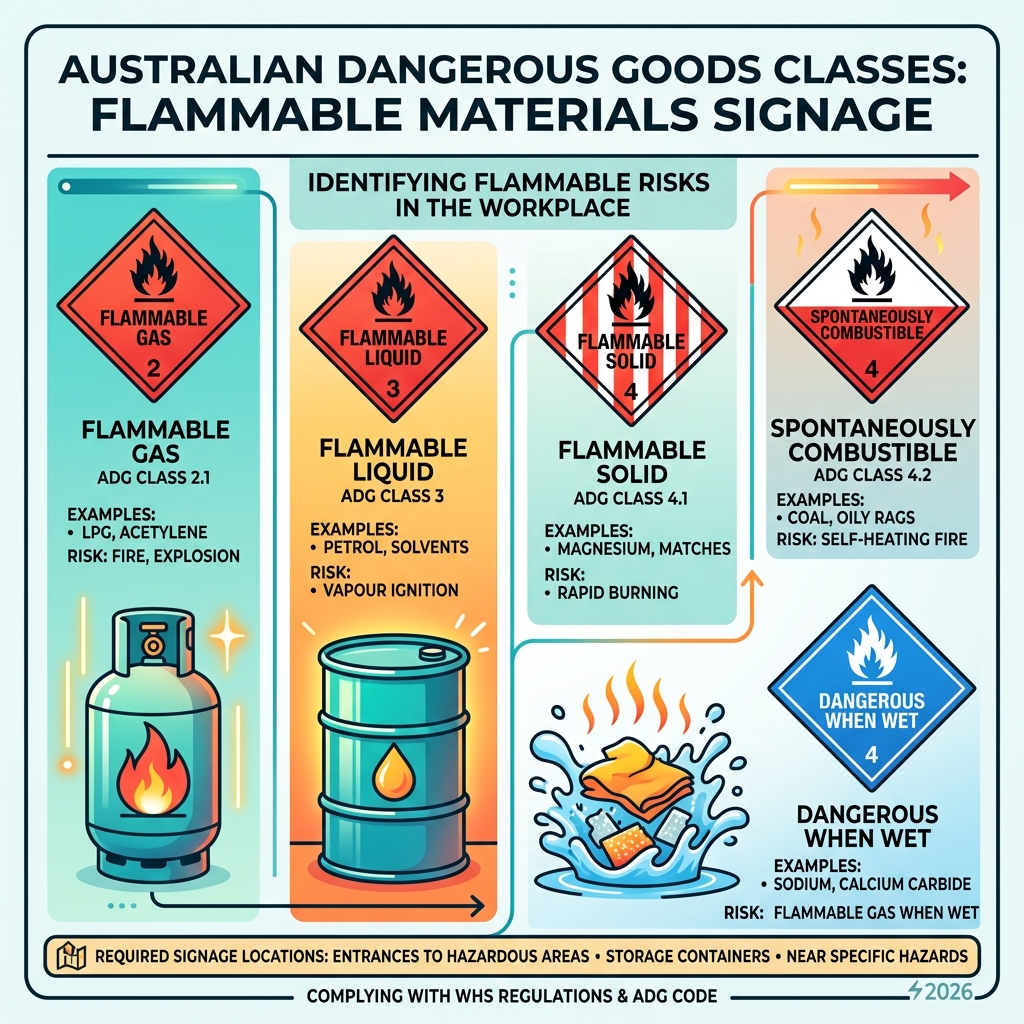
The most common classifications you will encounter include:
- Class 3: Flammable Liquids. This is the big one. It covers substances like petrol, diesel, kerosene, and many paints or solvents. Given that over 80% of Australian cars run on petrol, this is a hazard most of us face daily.
- Class 2.1: Flammable Gases. This includes LPG (common in forklifts and BBQ bottles), acetylene (used in welding), and hydrogen. These are often stored under high pressure, adding a physical explosion risk to the fire hazard.
- Class 4: Flammable Solids. These are materials that can ignite through friction or retained heat.
For bulk storage, Safe Work Australia requires the use of placards (large Hazchem diamonds) to ensure that the specific class of hazard is identifiable from a distance.
Identifying Flammable Materials Signs for Liquids and Gases
When you are looking for signs to mark petrol storage or LPG cylinders, you are looking for the iconic red diamond. Under the GHS signage system, these signs feature a black flame pictogram on a white or red background.
For Class 2.1 Flammable Gases, the sign will typically show a flame icon and the number '2' at the bottom. For Class 3 Flammable Liquids, it will show a flame and the number '3'. These visual cues are designed to be understood even if the text is obscured or if the viewer speaks a different language.
Understanding Flammable Solids and Reactive Substances
Flammable solids are a bit more complex because they behave differently. We categorise them into three subclasses:
- Class 4.1 (Flammable Solids): These are identified by red and white vertical stripes. They include things like matches or nitrocellulose.
- Class 4.2 (Spontaneously Combustible): These signs are white on the top half and red on the bottom. They mark substances that can ignite simply by coming into contact with air.
- Class 4.3 (Dangerous When Wet): These are blue diamonds. This is a critical distinction because using water to put out a fire involving these materials (like sodium or magnesium) can cause a violent reaction.
Understanding these distinctions is vital for identifying explosive or reactive material signs correctly on your site.
Compliance with Australian Standards and GHS 7
Compliance isn't just about avoiding a fine from SafeWork NSW; it’s about following a proven framework for safety. In Australia, the "Bible" for safety signs is AS 1319 (Safety signs for the occupational environment) and AS 1216 (Class labels for dangerous goods).
From January 1, 2023, Australia fully transitioned to GHS 7 (the Globally Harmonised System of Classification and Labelling of Chemicals, Revision 7). This means that any hazardous chemical manufactured or imported must be labelled according to these standards.
One of the trickier parts of hazardous chemicals sign requirements involves pictogram overlap rules. For example, if a label has a transport "diamond," the GHS pictogram for the same hazard is often omitted to avoid confusion. However, for workplace storage, both are often used to provide maximum clarity.
Material Selection for Durability in Australian Conditions
At Pinnacle Signage, we know that a safety sign is useless if it fades, cracks, or peels off within six months. The Australian sun is brutal, especially in regional areas like the Riverina. When choosing flammable materials signs, material selection is paramount.
- Rust-Free Aluminium: This is our premium choice for outdoor areas. It’s incredibly durable, won't rust, and handles extreme temperature fluctuations (from frosty Wagga mornings to 40-degree summer days) without warping.
- UV-Stabilised Polyethylene (Poly): A great, cost-effective alternative to metal. It’s flexible, impact-resistant, and treated to resist fading from UV exposure.
- Self-Adhesive Vinyl: Perfect for smooth surfaces like cabinets, doors, or individual containers. We use high-tack adhesives to ensure they stay put even in greasy industrial environments.
Customising Flammable Materials Signs for Specific Site Needs
While we stock a massive range of standard signs, we understand that every site is unique. Perhaps you have a specific storage tank that requires a unique combination of a "Danger" header, a Hazchem diamond, and emergency contact details.
We specialise in customised hazchem signage produced right here in our East Wagga Wagga facility. Because we manufacture locally, we can offer fast turnarounds on bulk orders and include site-specific text or bilingual options to support a diverse workforce. Whether you need a one-off custom placard or a thousand small labels, we have the regional expertise to get it done right.
Installation and Maintenance for Maximum Effectiveness
The most expensive sign in the world won't save anyone if it’s hidden behind a pallet or mounted too high to read. Proper fire hazard sign placement is a science in itself.
Installation Best Practices:
- Eye Level: Signs should generally be mounted at eye level (approx. 1.5m from the ground) for maximum visibility.
- Entrances: A placard must be placed at every vehicle entrance to the site and every entrance to the specific storage room.
- Viewing Distance: Ensure the sign is large enough to be read before the person enters the danger zone. A 300x225mm sign is usually sufficient for small rooms, but large warehouses may require 600x450mm or larger.
- Surface Prep: Before applying adhesive signs, the surface must be clean, dry, and free of oil.
Maintenance Protocols: Safety signs are not "set and forget." You should include them in your monthly safety walks. Check for:
- Fading: If the red is looking pink, it’s time to replace it.
- Damage: Cracks or peeling can make the text unreadable.
- Obstructions: Ensure new equipment or stock hasn't blocked the line of sight.
- Cleanliness: Dust and grime can quickly obscure a sign. A simple wipe-down with a damp cloth is often all that's needed.
Complementary Safety Signage and Equipment
Flammable materials signs rarely work alone. To create a truly safe environment, you need a cohesive system of signage.
In areas where flammables are stored, "No Smoking" and "No Ignition Sources" signs are mandatory. You should also have clear Fire Signage identifying the location of extinguishers and fire blankets.
Floor marking is another excellent tool. Using yellow and black hazard tape to mark the "clear zone" around a flammable storage cabinet helps prevent the accidental accumulation of combustible rubbish (like cardboard boxes) near the hazard.
Frequently Asked Questions about Flammable Signage
Where should flammable materials signs be placed?
Signs must be positioned at every entrance to the storage area and near the specific hazard, ensuring they are clearly visible and not obstructed by doors or equipment. For bulk storage, placards must be visible to emergency services from the property boundary.
What is the difference between flammable and combustible signs?
The difference lies in the "flashpoint" - the lowest temperature at which a liquid gives off enough vapour to ignite. Flammable liquids (like petrol) have a flashpoint below 60°C and ignite easily at room temperature. Combustible liquids (like certain oils) have a flashpoint above 60°C and usually require heating before they will catch fire.
Do I need GHS pictograms or Hazchem diamonds?
Generally, you need both, but for different purposes. GHS pictograms are required on individual bottles, drums, and containers to inform workers how to handle the substance safely. Hazchem diamonds (placards) are required for bulk storage and transport to assist emergency services in identifying the hazard class from a distance.
Label It Right, Prevent the Spark
Labelling your hazardous areas correctly is one of the simplest yet most effective ways to protect your business, your people, and your community. By understanding the Australian standards, choosing the right materials, and maintaining your signage, you create a culture of safety that goes "beyond the sign."
At Pinnacle Signage, we take pride in being the premier safety signage manufacturer in East Wagga Wagga, NSW. We don't just sell signs; we provide regional expertise and high-quality, local production that you can rely on.
Whether you are a local farmer needing a few "Danger: Diesel" signs or a major industrial site requiring a complete GHS-compliant overhaul, we are here to help. We offer 48-hour dispatch on stocked items and free shipping on orders over $100 Australia-wide (exceptions apply).
Ready to secure your site? Contact Pinnacle Signage directly for custom quotes and bulk orders. Stay safe out there!