

Signs of the Times and How to Master GHS Compliance
What Is GHS Signage and Why Does It Matter for Australian Workplaces?
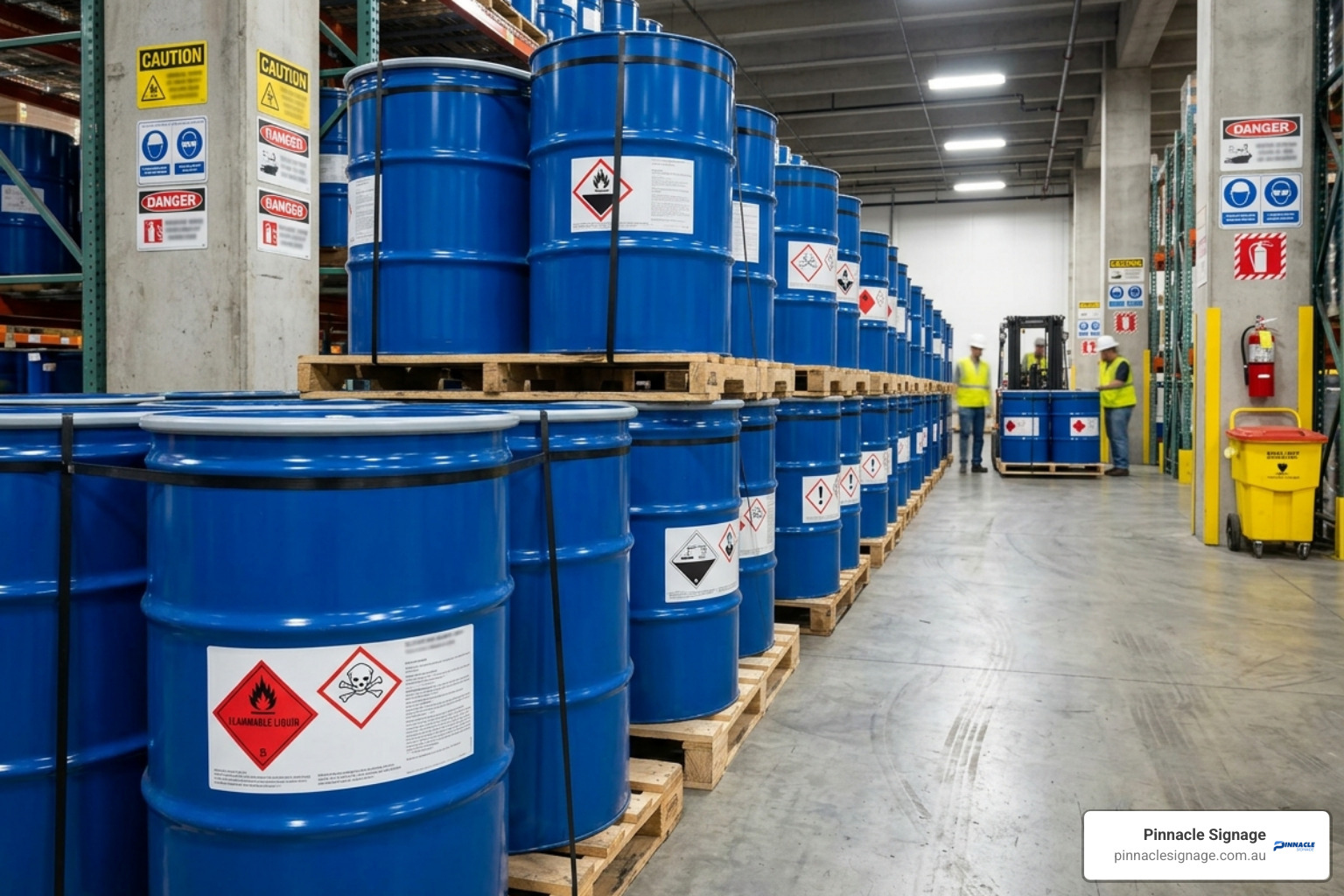
GHS signage refers to the standardised system of hazard labels, pictograms, and signs used to communicate chemical dangers in workplaces - based on the United Nations' Globally Harmonised System of Classification and Labelling of Chemicals (GHS).
Here is a quick overview of what GHS signage involves:
- 9 core pictograms - standardised symbols inside a red-bordered diamond, each representing a specific hazard class
- Signal words - either "Danger" or "Warning" to indicate severity
- Hazard statements (H-codes) - describing the nature of the hazard
- Precautionary statements (P-codes) - explaining safe handling, storage, and disposal
- Product identifier - the chemical name or other identifier
- Supplier information - name and contact details of the manufacturer or importer
In Australia, GHS requirements are enforced under workplace health and safety laws. As of 1 January 2023, manufacturers, importers, and suppliers must classify and label hazardous chemicals using the GHS 7 standard - and with GHS Rev.11 now current internationally, further updates are on the horizon for Australian workplaces.
Getting your GHS signage right is not just about avoiding fines. It is about making sure workers can immediately understand the risks around them - and respond appropriately in an emergency.
I'm Doug Lindqvist, General Manager of Pinnacle Signage, and before founding the business, I spent years in the safety and industrial supply space, where I saw how poor-quality or non-compliant GHS signage created real headaches for facilities managers and site supervisors alike. This overview covers the essential requirements for Australian workplaces.
Understanding the Globally Harmonised System and GHS Signage
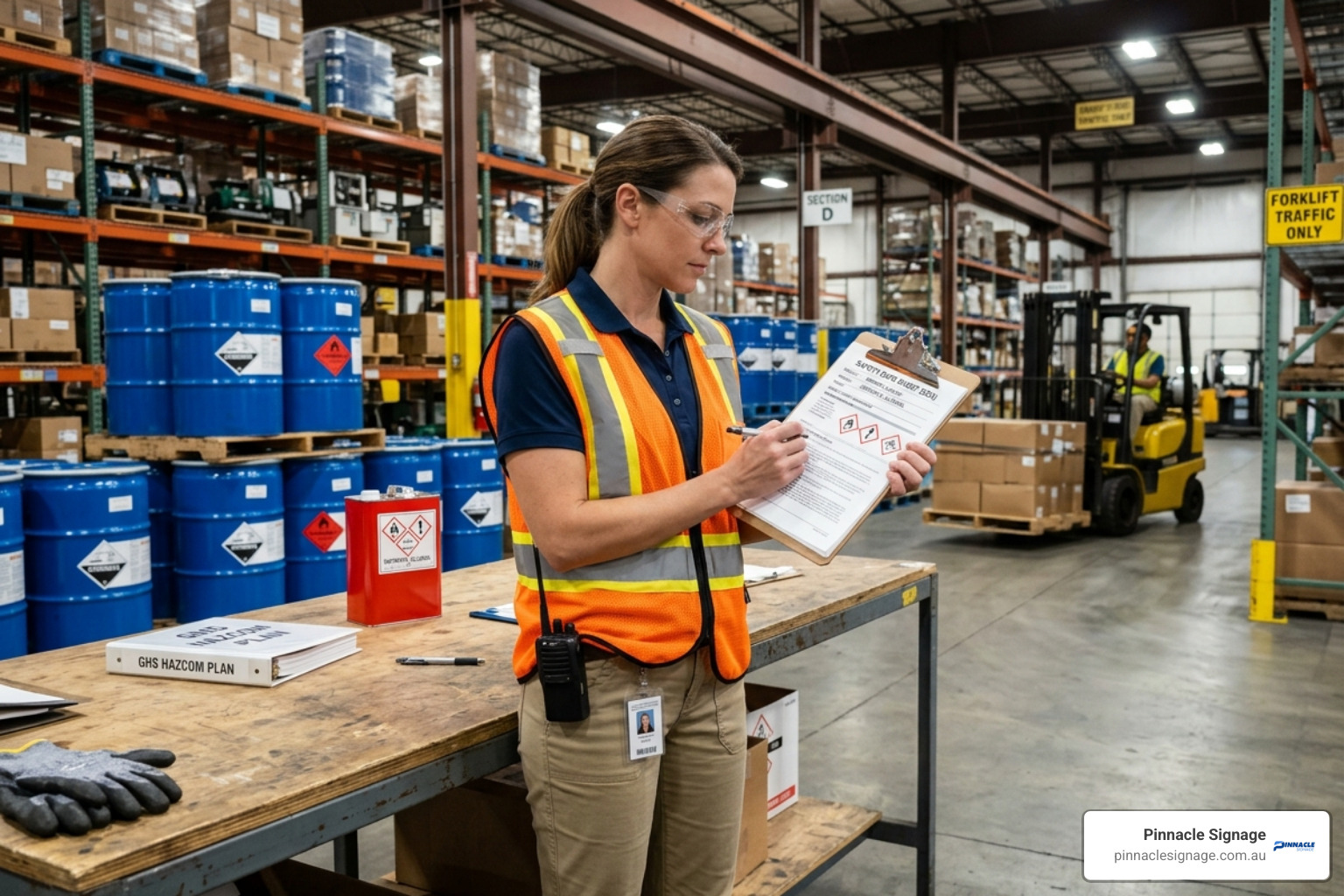
The Globally Harmonised System (GHS) was created by the United Nations to solve a very practical problem: different countries used different symbols and terms to describe the same chemical hazards. This lack of consistency was dangerous for workers and a nightmare for international trade. By creating a "universal language" for chemical safety, the GHS ensures that a drum of solvent in East Wagga Wagga carries the same hazard warnings as any other compliant container.
In Australia, Safe Work Australia provides practical guidance on how GHS is applied in workplaces through Using the GHS - Safe Work Australia. For Pinnacle Signage, that means producing signs that do more than look compliant. They need to match the technical requirements Australian workplaces rely on.
The Evolution of GHS 7 to Rev.11 in 2026
As we move through April 2026, the landscape of GHS signage is shifting. While Australia moved to GHS 7 in early 2023, the international community has continued to refine the system. GHS Rev.11 (2025) is now the current global benchmark. These updates often involve refining hazard categories - such as new classifications for desensitised explosives or updated aerosols definitions - to ensure the most accurate risk communication possible.
Staying ahead of these revisions is vital for any business handling hazardous materials. If you are still using outdated symbols from a decade ago, you might be missing critical hazard information. You can learn more about identifying these symbols in our guide: Know Your Hazard Symbols A Guide To Chemical Signage.
Why Standardisation Matters for Australian Workplaces
Standardisation is the backbone of worker protection. When an emergency occurs, every second counts. If a worker spills a corrosive liquid, they shouldn't have to guess what the symbol on the wall means. The diamond-shaped GHS signage with its distinct red border provides an instant, non-verbal cue that transcends language barriers.
Compliance with SafeWork NSW and SafeWork Australia isn't just a legal hoop to jump through; it's a commitment to your team's safety. Whether you're running a farm, a manufacturing plant, or a hospital, having clear Chemical Signs 101 in place ensures that everyone from the site manager to the newest apprentice knows exactly what they are dealing with.
The Nine Core GHS Pictograms and Their Meanings
At the heart of the system are the nine pictograms. Each one consists of a black symbol on a white background, framed by a red diamond border. It is important to note that for Australian compliance, each pictogram should only appear once on a label, even if multiple hazards require the same symbol. For a deeper look at these icons, check out Hazard Label Symbols Demystified And Where To Get Them.
Physical Hazard Symbols
Physical hazards refer to the immediate dangers a substance poses to its surroundings, such as explosions or fires.
- Exploding Bomb (GHS01): Used for explosives, self-reactive substances, and organic peroxides that can cause a mass explosion.
- Flame (GHS02): The go-to for flammables, pyrophorics, and self-heating substances. If it can catch fire easily, this is the sign you need.
- Flame Over Circle (GHS03): This represents oxidisers. These chemicals don't necessarily burn themselves, but they provide oxygen that can make other fires much more intense.
- Gas Cylinder (GHS04): For gases under pressure. These can explode if heated or become "missiles" if the valve is damaged.
- Corrosion (GHS05): This symbol is unique because it bridges physical and health hazards. It indicates a substance can eat through metal and cause severe skin burns or eye damage. More info about corrosive GHS signs.
Health and Environmental Hazard Symbols
These pictograms warn of the "silent" dangers - hazards that affect the human body or the ecosystem over time.
- Skull and Crossbones (GHS06): This signifies acute toxicity. In simple terms, exposure to even a small amount can be fatal or cause immediate, severe illness. More info about acute toxicity GHS signs.
- Exclamation Mark (GHS07): A general warning for less severe hazards like skin irritation, respiratory tract irritation, or narcotic effects.
- Health Hazard (GHS08): Often called the "exploding chest" symbol, this is for serious, long-term health risks like carcinogens, mutagens, or respiratory sensitisers.
- Environment (GHS09): This is for aquatic toxicity. While often non-mandatory for workplace labels in some jurisdictions, it is highly recommended for any chemicals that could harm our local NSW waterways.
Compliance Requirements for Workplace Chemical Labelling
A compliant GHS label is more than just a sticker with a picture. It is a comprehensive data set designed to keep you safe. According to Chemicals and the GHS | SafeWork NSW, there are six key elements that must be present for a label to be considered compliant in an Australian workplace.
Key Elements of Compliant GHS Signage
- Product Identifier: The name of the chemical.
- Signal Word: "Danger" for more severe hazards, or "Warning" for less severe ones.
- Hazard Pictograms: The diamond symbols we discussed above.
- Hazard Statements (H-codes): Standard phrases like "Highly flammable liquid and vapour."
- Precautionary Statements (P-codes): Instructions divided into Prevention (e.g., "Keep away from heat"), Response (e.g., "If on skin: Wash with plenty of water"), Storage, and Disposal.
- Supplier Information: The name and contact details of the Australian manufacturer or importer.
Navigating these requirements can be tricky, which is why we've focused on making Ghs Signage Made Simple Browse Our Products And Shop Online a reality for our customers.
Where to Install GHS Signage for Maximum Safety
Compliance doesn't end at the container label. Larger GHS signage must be placed throughout your facility to warn of bulk storage or specific hazardous areas.
- Storage Areas: Large placards should be visible at the entrance to any room where hazardous chemicals are stored.
- Decanting Stations: If you move chemicals from a large drum to a smaller spray bottle, the area must be clearly marked, and the new container must also be labelled.
- Eye-Level Placement: Signs should be mounted at eye level (roughly 1.5 metres from the floor) so they are easily seen during daily operations.
- Facility Entrances: For emergency responders, Hazardous chemicals signs (placards) at the main entry point of the site are a legal requirement under the ADG Code for manifest quantities.
Comparing GHS Labels and Transport Dangerous Goods Signs
One of the most common points of confusion is the difference between GHS workplace labels and Dangerous Goods (DG) transport signs (often called Hazchem signs). While they both use diamond shapes, they serve different purposes and follow different rules.
The ADG Code (Australian Code for the Transport of Dangerous Goods) governs how chemicals are moved on our roads and rails. These signs often include a class number (like Class 3 for flammables) and may have different colours than the white-and-red GHS diamonds. For a quick breakdown, see our guide: Hazchem Signs Explained Your Quick Guide To Safety Symbols.
When to Use GHS vs Hazchem Placards
- Workplace Use: GHS is the standard for containers used within your facility. It focuses on the chronic and acute health risks to workers.
- Bulk Storage & Transport: Hazchem placards are required for bulk storage tanks and vehicles. They are designed for emergency services (firefighters and police) to quickly identify the substance and the required response from a distance.
If you're managing a site in Wagga Wagga that stores large quantities of fuel or chemicals, you likely need both. Our Step By Step Guide To Hazchem Signage Compliance can help you determine your specific needs.
Avoiding Pictogram Overlap and Redundancy
To prevent "signage fatigue" and confusion, there are specific hierarchy rules. For example, if a chemical requires the "Skull and Crossbones" (GHS06), you generally do not need to also include the "Exclamation Mark" (GHS07) for skin or eye irritation, as the more severe hazard takes precedence. Similarly, if you have a DG transport placard on a tank, it can sometimes replace the need for certain GHS pictograms in that specific location. We've detailed these nuances in Hazardous Chemicals Sign Requirements 101.
Selecting Durable Materials for Industrial Environments
In an industrial setting, a sign is only useful if it remains legible. A faded or peeling GHS signage is a safety hazard. Because we manufacture our signs right here in East Wagga Wagga, we understand the harsh Australian sun and the chemical-heavy environments our products face.
- Self-Adhesive Vinyl: Best for curved surfaces like drums or small containers. We use high-grade vinyl with aggressive adhesives that resist peeling.
- Rigid Plastic (Poly): A great all-rounder for indoor and outdoor wall mounting. It's flexible enough to handle minor impacts but tough enough to last.
- Metal (Aluminium): The gold standard for outdoor durability. It won't rust and can withstand extreme temperatures for up to 10 years.
For more tips on choosing the right material for your specific chemical risks, check out Chemical Handling Signage Made Simple No Chemistry Degree Required.
Customisation and Bulk Ordering for the Australian Industry
Every facility is different. While standard pictograms are essential, you often need custom signs that include your specific chemical names, CAS numbers, and site-specific PPE requirements. At Pinnacle Signage, we specialise in customisable options with a fast 48-hour dispatch. Whether you need a single sticker or a bulk order for a new warehouse, we have the regional expertise to get it done.
Training Resources and Employee Awareness
Signs are only effective if your team knows how to read them. We recommend incorporating GHS training into your regular safety drills. Simple tools like wallet cards or reference posters can make a huge difference. Another essential resource is a compatibility chart, which helps workers understand which chemicals can be stored together safely. Learn more here: Why You Need A Chemical Compatibility Chart For Safe Chemical Storage.
Frequently Asked Questions about GHS Signage
What are the penalties for GHS non-compliance in Australia?
Non-compliance can lead to significant fines from SafeWork NSW. Beyond the financial cost, a lack of compliant signage can lead to workplace injuries, which may result in workers' compensation claims, legal action, and a stop-work order on your facility. In short, the cost of a few signs is nothing compared to the cost of an accident.
How often should GHS signs be inspected or replaced?
We recommend a formal inspection every six months. Look for fading, cracking, or peeling. If a sign is no longer legible from its intended viewing distance (for example, a 300x450mm sign should be readable from at least 10-15 metres in good light), it must be replaced immediately.
Can I create custom GHS signs for specific chemical blends?
Yes! In fact, for unique chemical blends created on-site, custom signage is often a requirement. You must use the classification data from the blend's Safety Data Sheet (SDS) to determine the correct pictograms and statements. We can help you design these custom layouts to ensure all six mandatory elements are included.
Read the Signs, Get GHS Right
Mastering GHS signage doesn't have to be a daunting task. By understanding the core pictograms, staying updated with GHS Rev.11, and choosing durable materials, you can create a safety culture that protects your most valuable asset - your people.
At Pinnacle Signage, we take pride in being more than just a manufacturer. We are your local partners in safety. From our facility in East Wagga Wagga, we combine premium Australian-made quality with 48-hour dispatch.
If you're ready to audit your site or need custom solutions for your chemical storage, don't hesitate to reach out. Contact the Pinnacle Signage team in East Wagga Wagga today. We're here to help you get compliant and stay safe.