

The Shocking Truth Behind Danger High Voltage
Understanding High Voltage: A Critical Workplace Safety Priority
Danger high voltage warnings mark some of the most serious hazards in Australian workplaces. Understanding what constitutes high voltage and why proper signage is essential can mean the difference between life and death for workers and the public.
Quick Answer: What You Need to Know About Danger High Voltage Signs
- High voltage is generally defined in Australia as exceeding 1000V AC or 1500V DC
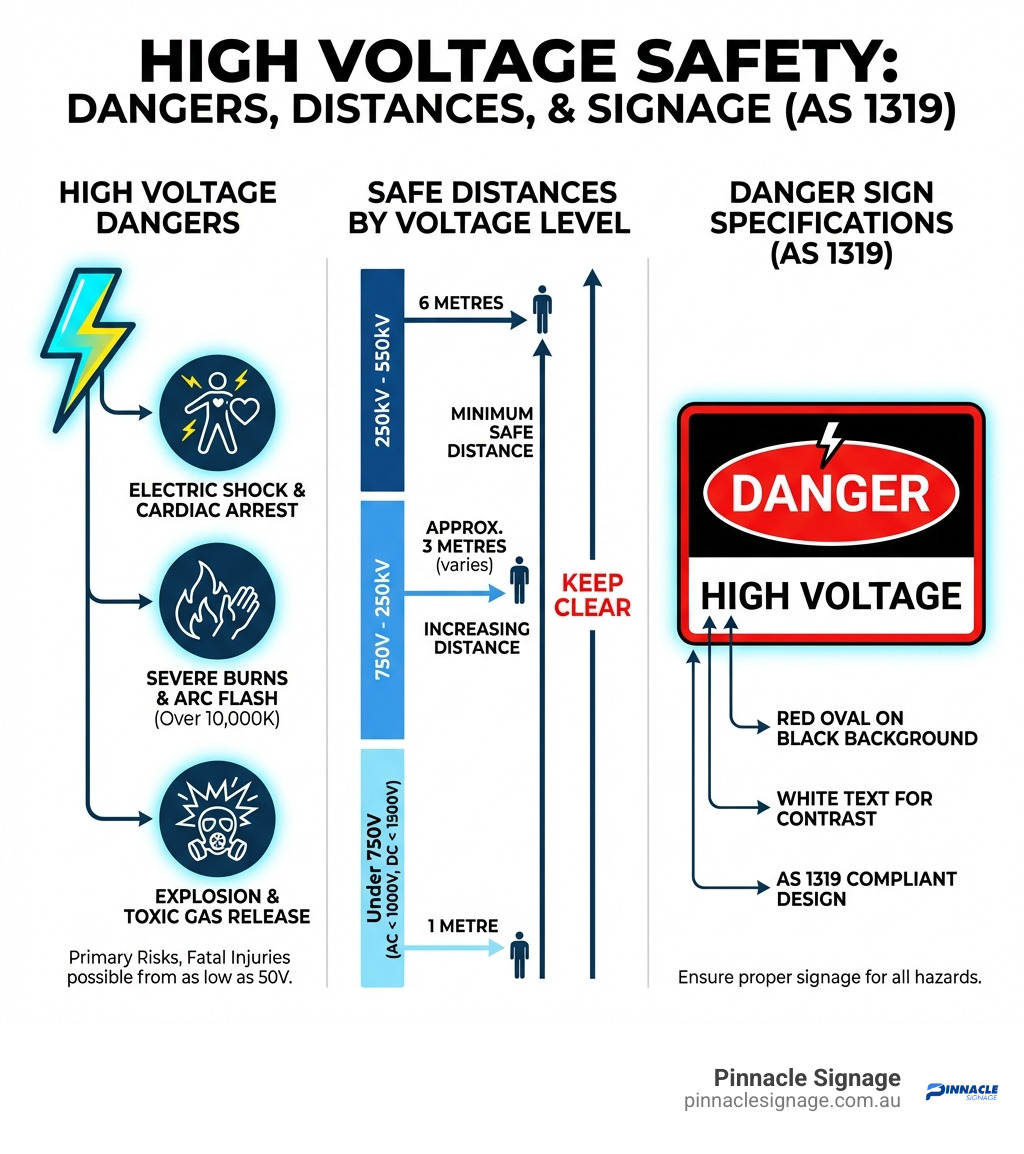
- Primary risks include electric shock, severe burns, arc flash, explosions, and toxic gas release
- Critical distances range from 1 metre (under 750V) to 6 metres (250-550kV)
- Danger signs must comply with AS 1319: red oval on a black background with white text
- Fatal injuries can occur from voltages as low as 50V under certain conditions
From substations and power distribution networks to industrial machinery and overhead lines, high voltage equipment is present across construction sites, manufacturing facilities, agricultural properties, and public infrastructure throughout Australia. The consequences of inadequate warnings or improper safety protocols are severe: electric shock leading to cardiac arrest, third-degree burns from arc flash events, violent muscle contractions causing falls, and explosions that can ignite flammable atmospheres.
For businesses across Australia, from regional farms to major construction sites, effective electrical safety communication is non-negotiable. It starts with clear, compliant, and highly visible warning signs, positioned to protect workers and meet safety obligations.
What Constitutes "High Voltage" and What Are the Risks?
In Australia, high voltage is generally defined as electrical potential large enough to cause damage or injury, typically referring to alternating current (AC) exceeding 1000 volts (V) or direct current (DC) exceeding 1500 V. This definition highlights that it's not just the voltage, but also the potential current and stored energy, that dictates the danger.
While these are general benchmarks, some industries have their own specific thresholds. For instance, in automotive engineering, high voltage is defined as voltage in the range of 30 to 1000 VAC or 60 to 1500 VDC. These varying definitions underscore the need for a clear understanding and appropriate safety measures custom to each specific environment.
The Primary Dangers of High Voltage Exposure
The consequences of an incident involving danger high voltage electricity are usually far more significant than those for lower voltage systems. When someone comes into contact with high voltage, the primary risks are severe and often life-threatening:
- Electric Shock: This is perhaps the most immediate danger. When an electric current passes through the body, it can disrupt normal physiological functions, particularly the heart. This can lead to cardiac arrest, nerve damage, muscle contractions, and even death. Voltages over approximately 50 volts can cause dangerous amounts of current to flow through a human being.
- Severe Third-Degree Burns: Electrical energy converts into heat when it encounters resistance in the body. This can cause deep, severe burns not only at the point of contact but also internally as the current travels through tissues and organs. Arc flash incidents, which can reach temperatures exceeding 10,000 degrees Celsius, can cause devastating burns to skin and internal organs.
- Arc Flash Events: An arc flash is an electrical explosion that occurs when current travels through the air between conductors or to ground. This event releases immense energy in the form of light, heat, pressure, and sound. Beyond the intense burns, the blast can cause physical injuries from flying shrapnel, hearing damage, and eye injuries.
- Explosions from Electrical Faults: High voltage faults can generate enough heat and pressure to cause equipment to explode. This is particularly dangerous in environments where flammable gases, vapours, or dust are present, as electrical sparks can easily ignite these atmospheres.
- Release of Toxic Gases: Electrical discharges and arcs can decompose surrounding materials and air, releasing toxic gases. For example, ozone and nitrogen oxides can be produced, which are harmful if inhaled and can cause respiratory issues or other illnesses.
- Violent Involuntary Muscle Contractions Leading to Falls and Other Injuries: An electric shock can cause muscles to contract violently and involuntarily. This can lead to a person being thrown from a height, losing their balance and falling, or making contact with other hazardous objects, resulting in fractures, head injuries, or other trauma.
Understanding the Physics of the Threat
To truly appreciate the danger high voltage poses, we need to understand the basic physics behind it. It's not just the voltage that kills, but the current, and the total energy delivered.
- Voltages Over 50V Can Be Dangerous: While high voltage is typically defined in thousands of volts, it's crucial to understand that even voltages above 50 volts can be lethal under certain conditions. Factors like wet skin, wounds, or the path the current takes through the body can significantly lower the threshold for danger.
- Dielectric Breakdown of Air: Air is normally an electrical insulator, but if the voltage is high enough, it can break down and become conductive. This allows electricity to 'jump' or arc across a gap. It means that at very high voltages, direct contact isn't necessary to cause harm; simply being too close to high voltage equipment is extremely hazardous.
- The Role of Current and Energy in Lethality: While voltage is the "push," current is the "flow." It's the current passing through the body that causes damage. The total energy stored in a high voltage system, especially in capacitors, can be substantial. Devices like electronic flash units, strobe lights, and pulsed lasers contain large energy storage capacitors that can deliver a lethal charge long after the power has been removed. Similarly, microwave ovens are particularly dangerous to service due to their high voltage (up to 5,000 V) at high current, an instantly lethal combination. This stored energy reinforces the need for extreme caution and proper discharge procedures.
For comprehensive safety guidelines, consult official resources such as the model Code of Practice for managing electrical risks from Safe Work Australia. Furthermore, ensuring that all high voltage equipment is clearly labelled with appropriate signage is a fundamental step in preventing accidents. We offer a wide range of compliant labels; learn more about them in An Essential Guide to High Voltage Labels.
Identifying and Managing High Voltage Hazards in Australian Workplaces
Across Australia, from the busy construction sites of Sydney to the vast agricultural lands of New South Wales, danger high voltage hazards are a constant presence. Identifying these hazards and implementing robust management strategies are paramount to workplace safety.
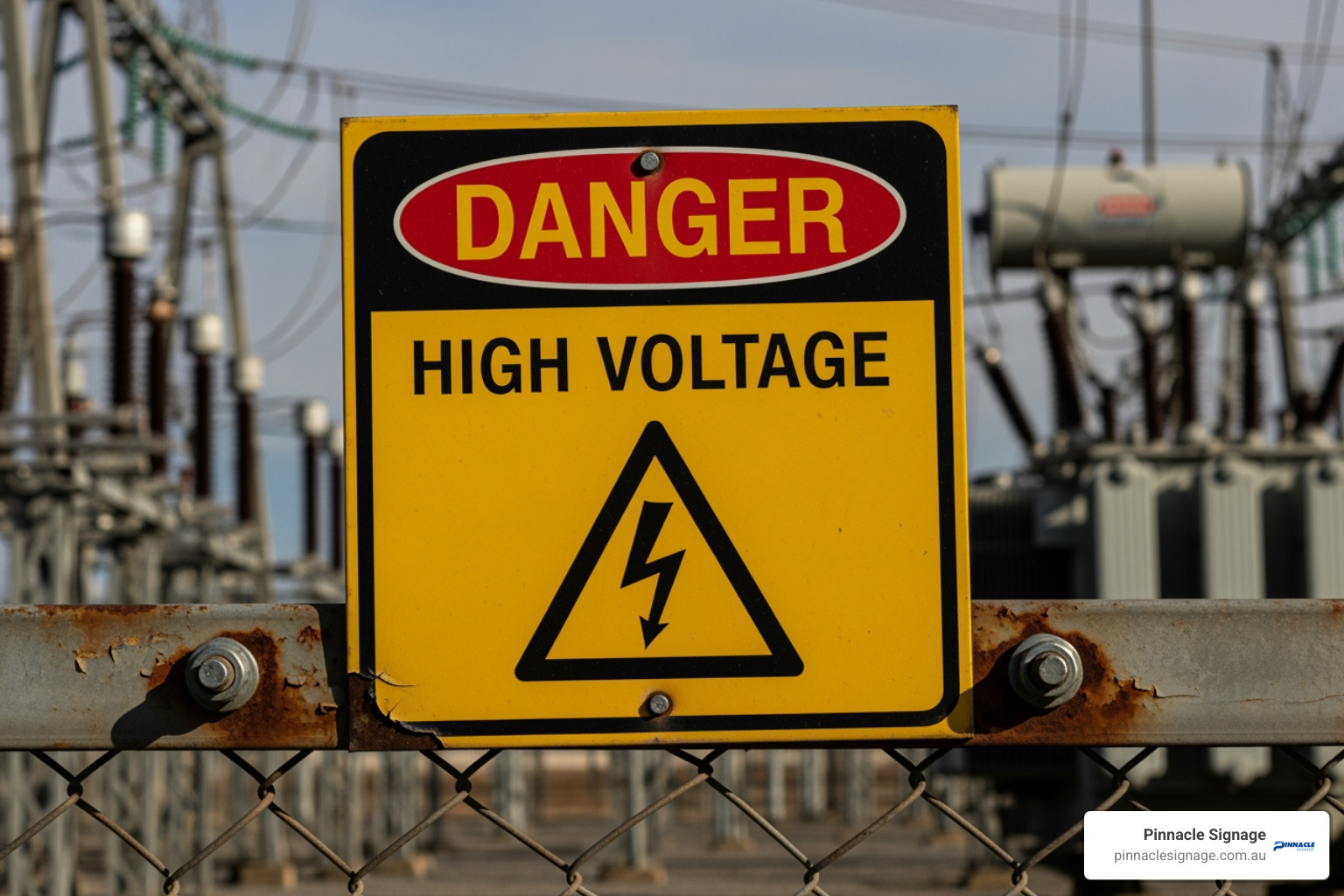
Common sources of high voltage in Australian workplaces include:
- Power Distribution Networks: This encompasses substations, overhead power lines, and underground cables that deliver electricity across communities and industrial areas.
- Industrial Machinery: Many large-scale industrial machines, particularly in manufacturing, mining, and heavy industry, operate with high voltage motors and control systems.
- Scientific Research Equipment: Laboratories and research facilities often utilise specialised equipment that generates or uses high voltages for experiments, such as X-ray machines or particle accelerators.
- Large-Scale Commercial Appliances: While not always obvious, some commercial appliances, particularly in catering or large-scale HVAC systems, can involve significant voltages.
Effectively managing these risks relies on clear, durable, and compliant signage that communicates hazards to everyone on site.
A Systematic Approach to Risk Management
Managing the risks associated with danger high voltage requires a systematic approach, as guided by Australian Work Health and Safety (WHS) principles. This process begins with hazard identification—a thorough examination of the workplace to pinpoint all equipment, installations, and areas where high voltage is present or could be induced. This also includes considering less obvious sources like static charge build-up or feedback from secondary systems. Safe Work Australia provides a national framework and valuable resources to help identify and control hazards.
Once hazards are identified, the next phase is to assess the specific risks. This involves evaluating who might be harmed and how, considering the likelihood and potential consequences of an incident. For high voltage, this assessment must consider the voltage level, current capability, proximity to workers, and potential for arc flash or explosion.
Following the assessment, control measures are put into place based on the hierarchy of controls. The most effective control for high voltage is de-energisation and isolation of the power source using proper lock-out and tag-out procedures. Where de-energisation isn't feasible, other controls must be used, such as maintaining safe approach limits, using physical barriers and insulation, ensuring only competent personnel perform the work, providing appropriate Personal Protective Equipment (PPE), and implementing a robust permit-to-work system for high-risk tasks.
Finally, risk management is an ongoing process. Control measures must be regularly reviewed to ensure they remain effective, especially after an incident, when work procedures change, or at scheduled intervals.
Contributing Factors to Electrical Incidents
Even with robust systems in place, several factors can contribute to electrical incidents involving danger high voltage:
- Environmental Conditions: External factors such as unfavourable weather, moisture, dust, or extreme temperatures can compromise insulation, increase the risk of arcing, or affect equipment performance. For example, working near power lines in wet conditions significantly increases the risk of electric shock.
- Poor Equipment Maintenance: Equipment in poor condition is a major hazard. Worn insulation, faulty wiring, damaged components, or inadequate grounding can lead to unexpected failures and expose workers to high voltage. Regular inspection and maintenance are crucial.
- Human Error and Complacency: Despite training and procedures, human error remains a significant factor. This can include failing to follow safety protocols, making incorrect assumptions, taking shortcuts, or becoming complacent due to routine. Fatigue, lack of attention, or inadequate training can all increase the likelihood of mistakes.
- The Importance of Robust Safety Procedures and Training: To mitigate these contributing factors, workplaces must invest in comprehensive safety procedures and ongoing training. Workers need to understand the risks, know how to use safety equipment correctly, and be empowered to stop work if conditions are unsafe. Clear and visible signage plays a vital role in reinforcing these procedures and serving as a constant reminder of the hazards present. We believe that proper signage is non-negotiable for safety; read more in The Shocking Truth: Why Electrical Warning Signs Are Non-Negotiable.
The Critical Role of Danger High Voltage Signage
In Australian workplaces, safety signage is not merely a suggestion; it's a legal and ethical imperative, especially when dealing with danger high voltage. Under the model Work Health and Safety (WHS) laws adopted across Australia, employers have a clear duty of care. This means taking all reasonably practicable steps to ensure the health and safety of workers and visitors.
High-quality signage acts as a primary control measure, serving as a visual warning system that informs, educates, and protects. It's the first line of defence, alerting individuals to hazards before they can cause harm. For areas with danger high voltage signage, the potential for severe injury or death, prompting immediate caution and adherence to safety protocols.
Understanding the Requirements for Danger High Voltage Signs
To be effective and compliant in Australia, danger high voltage signs must adhere to specific standards. Australian Standard AS 1319, "Safety signs for the occupational environment," outlines the design and application of safety signs. For 'Danger' signs, the requirements are stringent because they warn of life-threatening hazards.
- Specific Format for 'Danger' Signs: According to AS 1319, a 'Danger' sign must incorporate the word 'DANGER' in white text on a red oval, all enclosed within a black rectangular header. The main message, such as "HIGH VOLTAGE" or "ELECTRICAL HAZARD," is then presented in black text on a white background below this header. This distinctive design ensures immediate recognition of a critical hazard.
- Clear and Legible Text: The text on the sign must be concise, easy to understand, and large enough to be read from a safe distance. Symbols, where used, must be universally recognised.
- Strategic Placement for Maximum Visibility: Signs must be positioned in key locations where they are clearly visible and can warn individuals before they encounter the hazard. For high voltage, this often means at the entrance to electrical rooms, on substation fences, or directly on high voltage equipment. Our detailed guide, Danger High Voltage Sign Requirements 101, provides further insights into these crucial specifications.
Why a Generic Warning is Not Enough for Danger High Voltage
When it comes to danger high voltage, a generic "Warning" sign simply isn't sufficient. The hierarchy of safety signs exists for a reason: to communicate the severity of a hazard accurately.
- Communicating Lethal Potential: 'Danger' signs are reserved for situations where there is a very real and immediate risk of death or severe injury. Using a 'Danger' sign for high voltage explicitly communicates this lethal potential, compelling a higher level of caution and adherence to strict safety procedures.
- Differentiating from Lower-Level Hazards: If all hazards were marked with the same type of sign, workers and the public would become desensitised. By reserving 'Danger' for the gravest risks, it ensures that when people see such a sign, they understand the extreme severity and act accordingly.
- Legal Implications of Inadequate Warnings: Failing to use the correct type of sign for a danger high voltage hazard could have serious legal repercussions for businesses. It might be argued that the duty of care was not met, as the severity of the risk was not adequately communicated.
- The Importance of Using the Correct Sign Hierarchy: Understanding the difference between 'Caution', 'Warning', and 'Danger' signs is vital for effective risk communication. 'Caution' signs indicate potential hazards that could cause minor or moderate injury, while 'Warning' signs point to hazards that could cause death or serious injury, but the risk might be less immediate or avoidable with basic precautions. 'Danger' signs, however, unequivocally state that a life-threatening hazard is present. For a comprehensive breakdown, refer to Caution vs. Danger vs. Warning: What’s the Difference?.
Public Safety Around High Voltage Infrastructure
Beyond workplaces, danger high voltage infrastructure is ubiquitous in our public spaces across Australia, from city streets to rural landscapes. Overhead power lines, substations, and pad-mounted transformers are essential for our daily lives but pose significant risks to the public if not respected.
These elements of our community infrastructure are often accessible, making public awareness and adherence to safety guidelines critical. Accidental contact, whether direct or indirect, can have devastating consequences.
Maintaining Safe Distances
One of the most crucial aspects of public safety around danger high voltage is maintaining safe distances. Electricity can "arc" or jump from an energised line, even without direct contact, especially at higher voltages. This phenomenon means that simply being near a power line can be perilous.
The safe distance you need to maintain depends directly on the voltage of the power line. This applies not only to individuals but also to tools, equipment, ladders, and even trees. Activities such as flying drones or kites, tree trimming, or operating large farm machinery near overhead lines all require strict adherence to these distance rules. For guidance on staying safe around overhead lines, consult resources like BC Hydro's safety information, while always following Australian standards and your local regulations first.
LIST of Safe Approach Distances
To provide a clear understanding of the distances required for safety, here are general guidelines for safe approach limits around power lines. Always remember that these are minimums, and local electricity network operators or specific job requirements may mandate greater distances.
- Under 750 V: Safe distance is 1 metre.
- Over 750 V to 75 kV: Safe distance is 3 metres.
- Over 75 kV to 250 kV: Safe distance is 4.5 metres.
- Over 250 kV to 550 kV: Safe distance is 6 metres.
It's vital for everyone, particularly those working in construction, agriculture, or any outdoor profession, to be aware of these limits. Ignorance is not an excuse when lives are at stake. Our range of electrical hazard warning signs can help reinforce these critical safety messages; explore them in Stay Current with the Best Electrical Hazard Warning Signs.
Frequently Asked Questions about High Voltage Safety
We often receive questions about electrical safety and the correct use of signage. Here are some of the most common inquiries regarding danger high voltage.
What is the main difference between a 'Danger' and a 'Warning' sign for electrical hazards?
The primary difference lies in the severity and immediacy of the hazard. A 'Danger' sign, with its distinctive red oval and black header, is reserved for situations where there is an immediate and life-threatening hazard that will cause death or serious injury if not avoided. For electrical hazards, this means direct contact with danger high voltage where the risk of electrocution or severe burns is imminent.
A 'Warning' sign, typically a black triangle on a yellow background, indicates a hazard that could result in death or serious injury, but the risk might be less immediate or the consequences might be mitigated by certain precautions. For example, a 'Warning' sign might be used for areas with exposed electrical cables that are not high voltage, but still pose a significant shock risk. The choice depends on a thorough risk assessment of the specific hazard. For more on distinguishing between hazard labels, visit Hazard Label Symbols Demystified and Where to Get Them.
How close can my workers get to overhead power lines?
The safe approach limits for workers around overhead power lines are mandated by Australian regulations and depend on several factors: the voltage of the line, the type of work being performed, and the qualifications and training of the workers. These limits are typically more stringent for untrained personnel or general public access.
It is crucial to:
- Consult relevant state-based regulations: Specific distances are outlined in WHS regulations and electrical safety acts applicable to New South Wales.
- Contact the electricity network operator: Always communicate with the local electricity network operator (e.g., Essential Energy in regional NSW) before planning any work near power lines. They can provide specific advice and may need to de-energise or cover lines.
- Never assume a line's voltage: Treat every power line as live and dangerous, regardless of whether it appears insulated or not.
Are there specific design requirements for danger high voltage signs in Australia?
Yes, absolutely. To ensure consistency and immediate recognition of severe hazards, safety signs in Australia, including those for danger high voltage, should comply with Australian Standard AS 1319.
For 'Danger' signs, the standard dictates a very specific design:
- A red oval on a black rectangular header, with the word 'DANGER' in white capital letters.
- The main hazard message (e.g., "HIGH VOLTAGE," "ELECTRICAL HAZARD," "KEEP CLEAR") is displayed below this header in black text on a white background.
- The sign must be clear, concise, and placed in a highly visible location to warn people before they are exposed to the hazard. This ensures that the message is understood quickly and effectively, allowing individuals to take appropriate precautions.
Ensure Your Site is Safe and Compliant
A proactive safety culture relies on clear, effective communication, and high-quality signage is a primary line of defence against electrical hazards. Protecting your team, your site, and the public starts with a simple, unmissable warning. Ensuring that all electrical safety signage meets relevant Australian Standards, such as AS 1319, is a critical step in maintaining a safe and compliant workplace. Durable, correctly designed signs ensure the clear communication of danger high voltage and other critical safety messages, helping to protect everyone from harm.
Keep your team, your site, and your community safe by making high voltage hazards impossible to miss.
If you need help choosing the right "Danger High Voltage" sign or working out what your site requires, contact us today for personalised advice.
Prefer to shop in person? You can also find Pinnacle Signage electrical safety signs at your local Bunnings warehouse, ready for immediate installation.