

Beyond the Vest: Why High Visibility Signage is Crucial
Introduction: More Than Just a Bright Colour

High visibility signage is more than just a bright colour, it's a critical tool designed to stand out and convey vital information instantly, significantly impacting safety and efficiency in any workplace. For any business, ensuring these essential messages are seen, understood, and acted upon is paramount.
Here's a quick look at why high visibility signage is indispensable:
- What it is: Signs specifically designed to be easily noticed and legible, often utilising bright, contrasting colours, reflective materials, or illumination to ensure maximum attention-grabbing potential.
-
Why it matters:
- Improved Safety: Warns of immediate and potential hazards, preventing accidents and protecting lives.
- Clear Communication: Delivers essential instructions, warnings, and safety messages quickly and effectively to drivers and personnel.
- Improved Operational Efficiency: Guides traffic flow, directs personnel to facilities, and streamlines operations by providing clear navigation.
- Meeting Standards: Helps workplaces meet Australian safety standards and regulations, reducing risks and ensuring a safer environment.
For essential workplace communications, visibility is everything. If a critical warning or directional message isn't instantly visible and easy to read, its purpose is defeated, potentially leading to confusion, delays, or, more severely, accidents. It delivers crucial information such as traffic directions, warnings, hazards, and safety messages to vehicle drivers and personnel, while also improving operational efficiency by defining pedestrian and traffic routes and directing personnel to essential facilities.
Pinnacle Signage was founded to address the challenges businesses faced in acquiring reliable, quality, high visibility signage. Our mission is to provide effective solutions that ensure your messages cut through the noise, keeping your operations safe and running smoothly.
High visibility signage vocabulary:
Decoding the Message: Types of High Visibility Signs and Their Uses
Understanding the various types of high visibility signage and their specific applications is fundamental to creating a safe and efficient workplace. Each sign serves a unique purpose, from alerting us to danger to guiding us to safety. By categorising signs by their function, we can better understand how they contribute to overall safety and operational flow. These include safety signs, directional signs, prohibition signs, mandatory signs, and temporary signs, all working together to form a cohesive communication system. To dig deeper into the visual language of safety, explore More Than Just Symbols: A Deep Dive into the World of Safety Signage.
Hazard and Warning Signs
Hazard and warning signs are arguably the most critical category of high visibility signage. They are designed to alert individuals to potential dangers that could cause injury or harm.
- Danger Signs: These signs are reserved for immediate hazards that could result in death or serious injury. They typically feature a red top panel, white lower panel, and black border, with the word "DANGER" prominently displayed. For example, a "Danger: High Voltage" sign immediately communicates a life-threatening electrical risk. To understand the nuances, read our guide on Caution vs. Danger vs. Warning: What's the Difference?.

- Caution Signs: These signs warn about potential hazards or unsafe practices that might lead to minor or moderate injuries. They typically feature a yellow background with a black triangle and symbol, accompanied by black text. Think of a "Wet Floor" sign or a "Low Headroom" warning. Our range of Caution Signage provides clear visual cues for these situations.
- Warning Signs: These signs are used for potentially hazardous situations that could result in death or serious injury, but where the hazard is not immediate. They often feature an orange background with black lettering.
Specific applications of these signs are crucial across industries. For instance, in electrical environments, clear High Voltage Safety Signs are non-negotiable. Workplaces handling chemicals rely heavily on high visibility signage for safety. Hazchem Signage is essential for identifying hazardous chemicals and materials, ensuring proper handling, storage, and emergency response. All our dangerous goods diamond signs are designed and manufactured in accordance with the Australian Dangerous Goods (ADG) Code 7.6 2018. Similarly, GHS Signage is crucial for identifying hazardous chemicals and ensuring compliance with the Globally Harmonised System (GHS) of Classification and Labelling of Chemicals, featuring standardised symbols and text to communicate hazard information clearly and effectively.
Directional and Informational Signs
Beyond warning of dangers, high visibility signage plays a vital role in guiding people and vehicles safely and efficiently through a workplace. These signs ensure smooth operations and direct individuals to critical locations.
- Guiding Traffic: Directional signs are essential for managing vehicle and pedestrian flow, reducing congestion, and preventing accidents. They help individuals steer complex environments, whether it's a large warehouse or an agricultural property.
- Wayfinding: In an emergency, clear wayfinding can be life-saving. Exit & Entry Signage is essential for guiding individuals to designated exit points or entryways, ensuring safe evacuation and efficient navigation.
- Locating Essential Facilities: When seconds count, knowing the location of first aid or fire safety equipment is paramount. First Aid Signage is crucial for identifying the location of first aid facilities and equipment. These are typically green with white text and pictograms. Similarly, Fire Signage is crucial for identifying fire safety equipment, emergency exits, and evacuation routes, facilitating quick and safe responses during emergencies.
- General Information: Notice Signage communicates general information such as housekeeping rules, company policies, or instructions, ensuring everyone is aware of important guidelines.
Prohibition and Mandatory Signs
These types of high visibility signage are critical for enforcing rules and preventing unsafe behaviours, directly contributing to a safer working environment.
- Prohibition Signs: These signs explicitly warn against actions that might risk health or safety. They generally contain eye-catching colours like red, and in many cases have a red circle and slash pictogram for instant visual recognition. Our Prohibition Signage helps to prevent unwanted actions, such as "No Entry" or "No Smoking".
- Restricting Access: To maintain security and safety, Restricted Area Signage clearly marks areas where access is limited or requires specific authorisation. This is vital for protecting sensitive equipment, hazardous zones, or private property.
- Mandatory Signs: These signs state actions or behaviours that are required in a certain area, acting as the 'must-do' of safety signs. They generally have a white background with a blue and white pictogram or symbol and black text. For example, "Eye Protection Must Be Worn" or "Hard Hats Required". Our comprehensive range of Mandatory Signage ensures compliance with safety protocols.
Temporary and Road Work Signage
Temporary and road work signage is a dynamic and essential category of high visibility signage, designed to manage traffic and inform the public in constantly changing environments.
- Construction Sites: These sites are inherently hazardous and require extensive temporary signage to warn of dangers, direct traffic, and ensure worker and public safety.
- Traffic Management: Whether it's a short-term road closure or a long-term construction project, effective traffic management relies heavily on high visibility signage. This includes directing vehicles, indicating detours, and warning drivers of changed conditions. For a detailed explanation, see our guide on Road construction traffic signs explained.
- Road Works: From minor repairs to major infrastructure projects, road work signage alerts drivers to hazards like uneven surfaces, reduced speed limits, and workers present.
- Events: Temporary signage is also crucial for managing crowds and vehicle flow at large events, ensuring safety and efficiency for participants and attendees.
Our Multi Message Signage is specifically used for traffic management in temporary roadwork situations. These signs often accommodate two 600mm x 600mm signs at the top and one 1200mm x 300mm sign at the bottom, or a single 1200mm x 600mm sign at the top with a 1200mm x 300mm sign below. Many of our designs are based on guidelines issued by state road authorities throughout Australia. Similarly, Boxed Edge Signage and Swing Stands offer versatile solutions for temporary traffic management, built with durable materials and rugged frames to withstand various conditions. Adbase Signage provides another sturdy and reliable option for temporary traffic management, designed to slot securely into Adbase rubber stands.
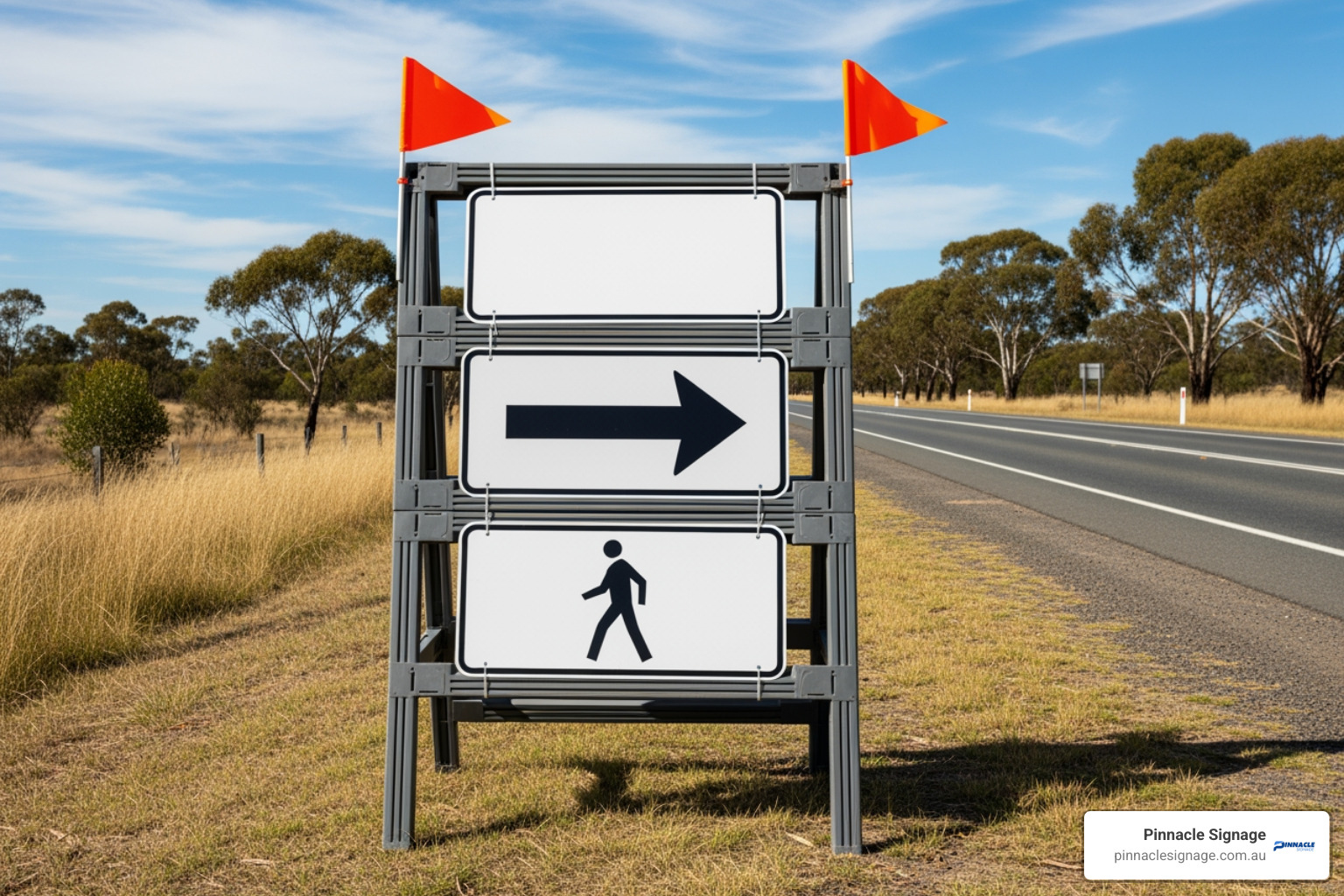
Effective work zone signing must conform to relevant Australian standards. Signs should be mounted at a height that ensures visibility, typically at least 1.5 metres above the ground, or higher where pedestrians or parked cars are present. For night work, retro-reflective signs are essential. All signs should face incoming traffic at approximately right angles and be as vertical as possible to avoid sun glare. Orange flags are often mounted on warning signs to improve their visibility. Critically, signs must be maintained, kept clean, and their legends fully intact. Unneeded signs should be covered, removed, or turned away so they are not visible to traffic, as signs that do not reflect actual conditions can lead to driver disobedience.
Placement, Visibility, and Maintenance of High Visibility Signage
Installing high visibility signage isn't just about putting up a sign; it's about strategic planning to ensure maximum effectiveness. Our practical advice helps business owners steer the complexities of installation and placement, maximising the impact of their signage. For a broader perspective on selecting appropriate solutions, our article on Choosing the Right Signage for Your Australian Business offers further insights.
The Science of Sight: Factors Affecting Visibility
The effectiveness of high visibility signage hinges on its ability to be seen and understood under various conditions. Several factors influence this "science of sight":
- Lighting Conditions: A sign visible in broad daylight might disappear at night or in low-light conditions. This is where reflective materials and fluorescent colours become invaluable. Reflective signs bounce light back to the source, making them highly visible when illuminated by vehicle headlights or other light sources. Fluorescent colours, often used in daylight, appear brighter by converting ultraviolet light into visible light.
- Viewing Distance and Text Size: The further away a viewer is, the larger the sign and its text need to be. Australian standards guide the relationship between viewing distance and the minimum size of text and symbols. If a sign is too small for the distance, it becomes a "vague, coloured blob," losing its effectiveness.
- Environmental Factors: Dust, rain, fog, and even glare can significantly reduce a sign's visibility. Choosing durable, weather-resistant materials is crucial to ensure signs remain legible in harsh Australian conditions.
- Sightlines and Obstructions: A sign is useless if it's blocked from view. We often advise businesses to think about "sightlines" from all relevant vantage points, including workstations, machinery, and pedestrian paths. Obstructions, whether temporary (like stacked pallets) or permanent (like new shelving), must be addressed. If an obstruction cannot be removed, the sign itself should be moved, or a second sign added to cover blind spots. Some innovative designs, like V and L-shaped signs, are specifically engineered to offer visibility from multiple angles, reducing the chance of obstruction.
Strategic Placement for Maximum Impact
Location is everything for high visibility signage. Strategic placement ensures your messages are seen and understood when it matters most.
- Eye-Level Placement: Whenever possible, signs should be placed at eye level, typically around average head height. This ensures they are seen without strain, allowing messages to sink in over time. However, this might need adjustment based on whether the viewer is typically seated or standing, or if the sign is in a vehicle area.
- Proximity to Hazards: Signs must be placed close enough to the hazard they describe to provide timely warning, but far enough away to allow for a safe reaction. For example, warning signs for a road work zone need to be placed at a distance that allows drivers ample time to slow down or change lanes, considering prevailing speeds and road conditions. The core principle of adequate advance notice is universal for Australian worksites.
- Avoiding Sign Clutter: While it might seem logical to place all safety messages in one spot, too many signs in one location can lead to information overload, making it harder for people to process critical messages. This "sign clutter" can reduce overall effectiveness.
- Grouping Related Signs: Instead of cluttering, group complementary signs together. For instance, all chemical warnings (Hazchem, GHS, Emergency Information Panels) can be placed in a designated area. Conversely, unrelated signs should be separated to avoid confusion. For more guidance on effective placement, refer to How to Use Health and Safety Signs in the Workplace Effectively.
Ensuring Longevity: Maintenance and Care
Even the most strategically placed and visible sign will lose its effectiveness if not properly maintained. High visibility signage requires ongoing care to ensure it remains functional and legible.
- Regular Cleaning Schedules: Dirt, dust, grime, and even bird droppings can obscure a sign's message and reduce its visibility. Implementing a regular cleaning schedule, especially for outdoor or industrial environments, is essential.
- Inspection for Damage or Fading: Signs can suffer wear and tear from weather, accidental impacts, or vandalism. Fading colours, peeling graphics, or physical damage compromise a sign's ability to convey its message. Regular inspections are necessary to identify any issues.
- Prompt Replacement of Worn Signs: Once a sign is deemed damaged, faded, or no longer clearly legible, it must be replaced promptly. A compromised sign is a liability and can lead to confusion or accidents.
- Choosing Durable Materials: The longevity of a sign starts with its construction. We use durable, weather-resistant materials designed to withstand harsh Australian conditions, including UV exposure, extreme temperatures, and moisture. This ensures our signs remain effective over time. Learn more about weather-resistant materials for long-lasting signage solutions.
Meeting Standards and Specific Needs
For Australian businesses, ensuring high visibility signage meets both local standards and unique site needs is a delicate balance. It's about combining required guidelines with practical, site-specific communication.
Adhering to Australian Standards
Following Australian Standards is an ethical obligation that protects workers, visitors, and the business itself.
- AS 1319 for Safety Signs: This Australian Standard sets out the general principles for the design and use of safety signs in workplaces. It dictates everything from colours, symbols, and text to the general requirements for lighting, environment, and viewing distance. Adhering to AS 1319 ensures that your signs are universally understood within Australia. For a comprehensive overview, consult Understanding Australian Standards for Safety Signs.
- Safe Work Australia Guidelines: Safe Work Australia provides national policy and guidance on work health and safety. Their guidelines often complement Australian Standards, offering practical advice on implementing effective safety measures, including signage. The underlying principles of risk assessment and using signage to mitigate hazards are reflected in these Australian frameworks.
- Importance of Adherence: Beyond meeting obligations, following standards ensures your workplace is genuinely safe. Properly designed and placed signs, in line with Australian standards, effectively communicate hazards and instructions, significantly reducing the risk of accidents.
The Power of Customisation for your high visibility signage
While standards provide a framework, every workplace has unique hazards and communication requirements. This is where customisable high visibility signage truly shines.
- Addressing Unique Site-Specific Hazards: A standard "Danger" sign might not fully capture the nuance of a particular hazard on your property. Customisation allows you to add specific text or symbols that precisely articulate the danger, such as "Danger: Unstable Ground" or "Caution: Automated Machinery - Stand Clear". This precision in messaging improves safety significantly. For detailed insights, explore The Ultimate Guide to Custom Danger Signs.
- Incorporating Company Branding: Beyond safety, custom signs can integrate your company's logo or branding, reinforcing professionalism and a commitment to safety. This is particularly useful for general informational signs or visitor instructions.
- Communicating Specific Instructions: Whether it's a unique biosecurity protocol for an agricultural property or specific entry requirements for a manufacturing plant, custom signs allow you to communicate precise instructions that standard signs cannot. For instance, Customised Hazchem Signage allows you to tailor messages to specific chemical hazards, ensuring they align with the Australian Dangerous Goods (ADG) Code 7.6 2018.
We offer extensive customisation options, allowing you to choose custom text, logos, colours, and dimensions to suit your specific requirements. To explore the possibilities and create signage perfectly suited to your needs, you can create your own custom signs for any need.
The Bigger Picture: Integrating Signage into a Complete Safety System
Effective high visibility signage is a powerful component of workplace safety, but it's most impactful when integrated into a comprehensive safety system. It's about layering safety measures to create multiple lines of defence and fostering a strong culture of safety awareness.
A Cohesive Approach to Safety
Signs don't work in isolation; they work best when combined with other safety measures to form a cohesive strategy.
-
Combining Signs with Other Measures:
- Road Markings: In conjunction with high visibility signage, clear road markings define traffic lanes, indicate priority, mark pedestrian crossings, and designate no-parking areas. For instance, white road markings regulate traffic, while yellow markings regulate parking. Thermoplastic markings, made reflective by tiny glass beads, offer superior longevity and grip compared to paint.
- Traffic Signals: At busy junctions or in areas with controlled access, traffic signals, speed sensors, and flashing warning signs can control traffic flow and speed, complementing static signs.
- Reflective Tapes: Beyond static signs, Reflective Tapes provide high-visibility marking solutions for enhancing safety on vehicles, equipment, barriers, and other surfaces in low-light and night-time conditions.
- Barriers & Bunting: Barriers & Bunting provide effective solutions for crowd control, perimeter delineation, and hazard marking, physically separating hazards from personnel and the public.
- PPE Requirements: Signs indicating mandatory Personal Protective Equipment (PPE) are crucial, but they must be backed up by the availability and enforcement of that equipment.
Innovations in Signage Technology
The field of high visibility signage is constantly evolving, with new technologies and materials enhancing effectiveness and durability.
- LED Illuminated Signs: For areas requiring constant, undeniable visibility, LED illuminated signs offer superior brightness and energy efficiency compared to traditional lighting. These are especially valuable in low-light conditions or at night. Our Illuminated Stock Ahead Signs are designed to improve road safety by providing high-visibility warnings in rural and agricultural areas, featuring LED guides to improve visibility in challenging conditions.
- V-shaped and L-shaped Signs: Some innovative designs incorporate V or L shapes to improve visibility from multiple angles. This design ensures that even if a viewer approaches from an oblique angle, the sign remains clearly legible, reducing blind spots. Our Poly off-wall signs, for example, are designed to fold into a wall-mountable triangle shape, making them particularly useful in hallways where they need to be seen from a distance.
- Durable Materials and Advanced Printing Techniques: Advances in materials science mean signs are more weather-resistant, UV-stable, and impact-resistant than ever before. Advanced printing techniques ensure colours remain vibrant and text sharp for longer, even in harsh Australian climates.
- Digital and Variable Message Signs: While often used in public road networks, digital and variable message signs (VMS) are becoming more prevalent in large industrial settings. These allow for real-time updates to messages, adapting to changing conditions or hazards instantly.
Find Your Signage Solution
At Pinnacle Signage, we understand the critical role high visibility signage plays in keeping Australian workplaces safe and efficient. We are committed to providing high-quality, Australian-made signage solutions that meet stringent local standards and your specific operational needs.
Whether you are managing a busy construction site, an expansive agricultural property, or a busy industrial facility, we offer durable, effective signage designed to stand out and communicate clearly. We are specialists in bulk orders, offering scalable solutions and competitive pricing for organisations, groups, and businesses across Australia.
You can now conveniently explore our full range of compliant, high-quality signage. Explore the full Pinnacle Signage range at Bunnings, both in-store and online across Australia. For example, if you need a critical warning sign for a construction zone, you can find solutions like the Danger Construction Site sign at Bunnings.
For direct inquiries, custom solutions, or bulk orders, our team is ready to assist. Contact our team for a custom solution custom to your exact requirements.
Shipping & Pickup Information
We pride ourselves on efficient service. Pinnacle Signage dispatches most items within 48 hours of receiving your order and payment confirmation. Delivery times are estimated as follows:
- 1 - 2 days: Sydney, ACT, Melbourne, Brisbane, Gold Coast
- 2 - 4 days: Rest of NSW, Rest of VIC
- 3 - 6 days: SA, North QLD, Perth
- 5 - 9 days: TAS, NT, WA
For most deliveries within Australia, we use courier services such as FEDEX. Please note that couriers cannot deliver to PO Boxes, so provide a valid daytime delivery address. To ensure safe delivery, a signature is required upon receipt. You must be available to accept courier deliveries, re-delivery charges will apply if you are not present. Include a daytime phone number with your shipping details if we need to contact you about your delivery. For items weighing over 50kg, a tailgate delivery is usually required for residential addresses. This service is included in our standard shipping. Alternatively, you can choose to pick up the item from a nearby depot.
Free shipping is available for orders over $100 AU Wide. This applies to most items on the site. However, for some bulky items, additional shipping costs will apply for deliveries to WA, North QLD, NT, TAS, and island areas. Our staff will reach out to you after your order if these charges apply.
Pickup is available at our warehouse, located at Unit 4/28 Nagle Street, East Wagga Wagga NSW. The warehouse is open from 8am to 5pm, Monday through Friday, and is closed on weekends and public holidays.