

More Than Just Symbols: A Deep Dive into the World of Safety Signage
Why Safety Signs Are Essential in Every Australian Workplace
What are safety signs? Safety signs are visual communication tools that use a combination of colours, shapes, and symbols to warn of hazards, indicate mandatory actions, prohibit certain behaviours, or guide people to safety. They are designed to convey critical information quickly and clearly, often without the need for words.
Walk into any construction site, factory, or office building in Australia, and you'll see them everywhere. These brightly coloured signs with bold symbols tell you to watch your step, wear a hard hat, or find the nearest fire exit. While common, they play a critical role in keeping people safe every day. Whether preventing a trip hazard, alerting someone to chemical dangers, or directing people during an emergency, these signs communicate essential information in seconds. This is vital in noisy environments or for people who speak different languages. For facilities managers and business owners, getting signage right isn't just about compliance, it's about genuinely protecting workers, visitors, and contractors from harm.
Understanding what are safety signs and how they function is fundamental to creating safer workplaces across Australia. At Pinnacle Signage, we are passionate about helping businesses get this right with quality, reliable signage solutions.
The Language of Safety: How Signs Communicate Without Words
Think about the last time you saw a warning sign. You likely understood it instantly, without reading a single word. That's the power of safety signage, it speaks a universal language that transcends barriers of literacy and culture.
Safety signs work because they rely on a carefully designed visual language built from colours, shapes, and symbols (pictograms). This approach is crucial in Australian workplaces, where teams often include people from diverse backgrounds. A factory worker in East Wagga Wagga needs to recognise a hazard just as quickly as someone on a busy Sydney construction site, regardless of their first language.
The power of this system lies in its speed. In an emergency, you don't have time to read paragraphs of text, you need to grasp the message in a fraction of a second. A yellow triangle with a lightning bolt symbol communicates "electrical hazard" instantly, while a red circle with a diagonal line means "prohibited" without needing translation. These visual cues draw attention and convey critical information before an accident can occur.
This approach isn't arbitrary; it's part of a standardised system designed for consistency. The goal is to create clear safety communication by using as few words as possible, relying instead on powerful visual elements that anyone can understand at a glance. At Pinnacle Signage, we're committed to ensuring these messages are crystal clear because effective communication can be the difference between a safe day at work and a preventable accident.
Visual communication also extends to those with visual impairments. More info about Braille & Tactile Signage ensures no one is left out of vital safety information.
The result is a system that works beautifully across Australia's diverse workplaces. When everyone can understand the safety message instantly, regardless of their background, we create safer environments for all.
Decoding the System: The Main Categories of Safety Signs
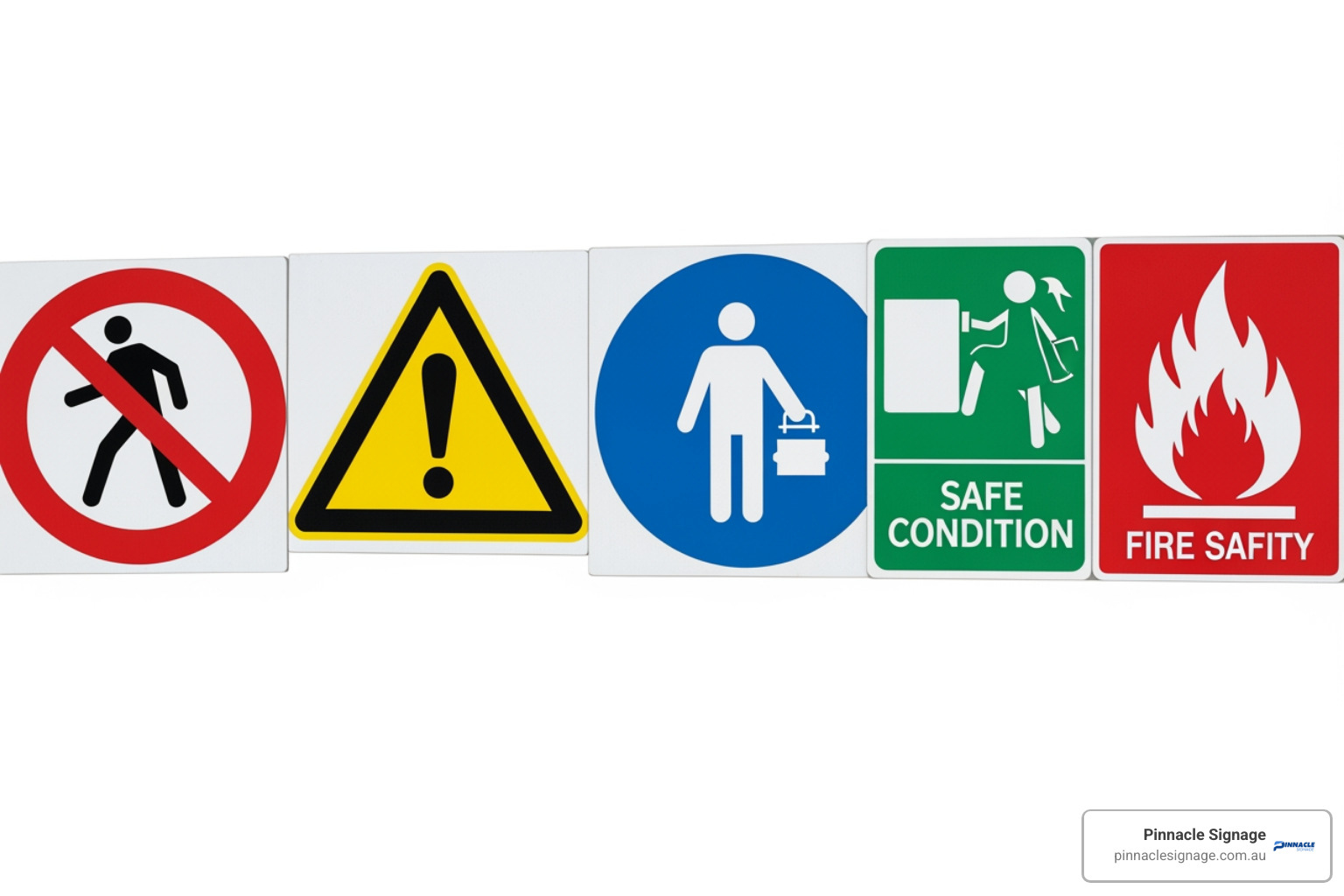
To keep everyone safe, we need a clear and simple system that anyone can understand at a glance. That's why safety signs are organised into five distinct categories, each with its own specific purpose, colour, and shape. Once you understand this system, reading safety signs becomes second nature, no matter where you are in Australia.
Prohibition Signs
A red circle with a diagonal line over a black pictogram on a white background means something is forbidden. Prohibition signs instantly tell you which actions are dangerous and must be avoided.
The bold red colour grabs your attention, even in busy environments. Common examples include "No Smoking" near flammable materials, "No Entry" to a restricted area, or "Do Not Touch" on dangerous equipment. These signs are essential for preventing risky behaviours before they happen.
If you need to enforce safety rules at your site, you can Explore Prohibition Signage to find the right solutions.
Warning Signs
Warning signs alert you to potential dangers that might not be immediately obvious, such as a freshly mopped floor or high voltage equipment.
These signs are instantly recognisable by their triangular shape with a black pictogram on a bright yellow background. The yellow makes them highly visible from a distance. Common warnings include "Slippery Surface", "High Voltage", and "Forklift Operating" on construction sites and in warehouses. Their goal is to promote vigilance and encourage people to take precautions.
For a deeper understanding of different alert levels, check out our guide on Caution vs Danger vs Warning: What's the Difference?. You can also view our Caution Signs to see what's available.
Mandatory Signs
Mandatory signs tell you what you must do to stay safe. These are the non-negotiable actions required in a specific area.
They feature a circular shape with a white pictogram on a blue background. You'll see them everywhere in Australian workplaces, indicating things like "Wear Eye Protection" in workshops, "Hard Hat Area" on construction sites, or "Foot Protection Must Be Worn" in warehouses. These signs ensure the proper use of personal protective equipment (PPE) and compliance with safety procedures.
For a comprehensive look at required safety actions, visit The A-Z of Mandatory Safety Signs.
Safe Condition & Emergency Signs
In an emergency, clear guidance is vital. Safe condition signs provide this by pointing people towards safety equipment, escape routes, and assembly points.
These signs use a green square or rectangular shape with a white pictogram. The colour green is universally associated with safety, making it perfect for signs like "First Aid Station", "Emergency Exit", or "Assembly Point". They help people find what they need quickly, even in stressful situations.
To ensure your facilities are properly equipped, you can shop for First Aid Signage for compliant, high-quality options.
Fire Safety Signs
In a fire, every second counts. Fire safety signs ensure that fire fighting equipment, alarms, and exits are clearly marked and easy to locate, even in smoke or darkness.
These signs are typically red, square or rectangular, with a white pictogram. Common examples include "Fire Extinguisher", "Fire Hose Reel", and "Fire Alarm Call Point". The bold red colour commands attention and signals urgency, making these signs a critical part of any fire safety plan.
To make sure your premises meet fire safety requirements, browse Fire Signage for a comprehensive range of compliant options.
What are safety signs? A Visual Guide to Colours and Shapes
Understanding what are safety signs really comes down to recognising two key visual elements: colours and shapes. These aren't random design choices. They're part of a carefully standardised system that ensures anyone, anywhere, can grasp the essential message of a sign in seconds, often without reading a single word. This visual shorthand is what makes safety signage so effective in busy workplaces across Australia, where quick recognition can genuinely save lives.
The Colour Code: What do safety sign colours mean?
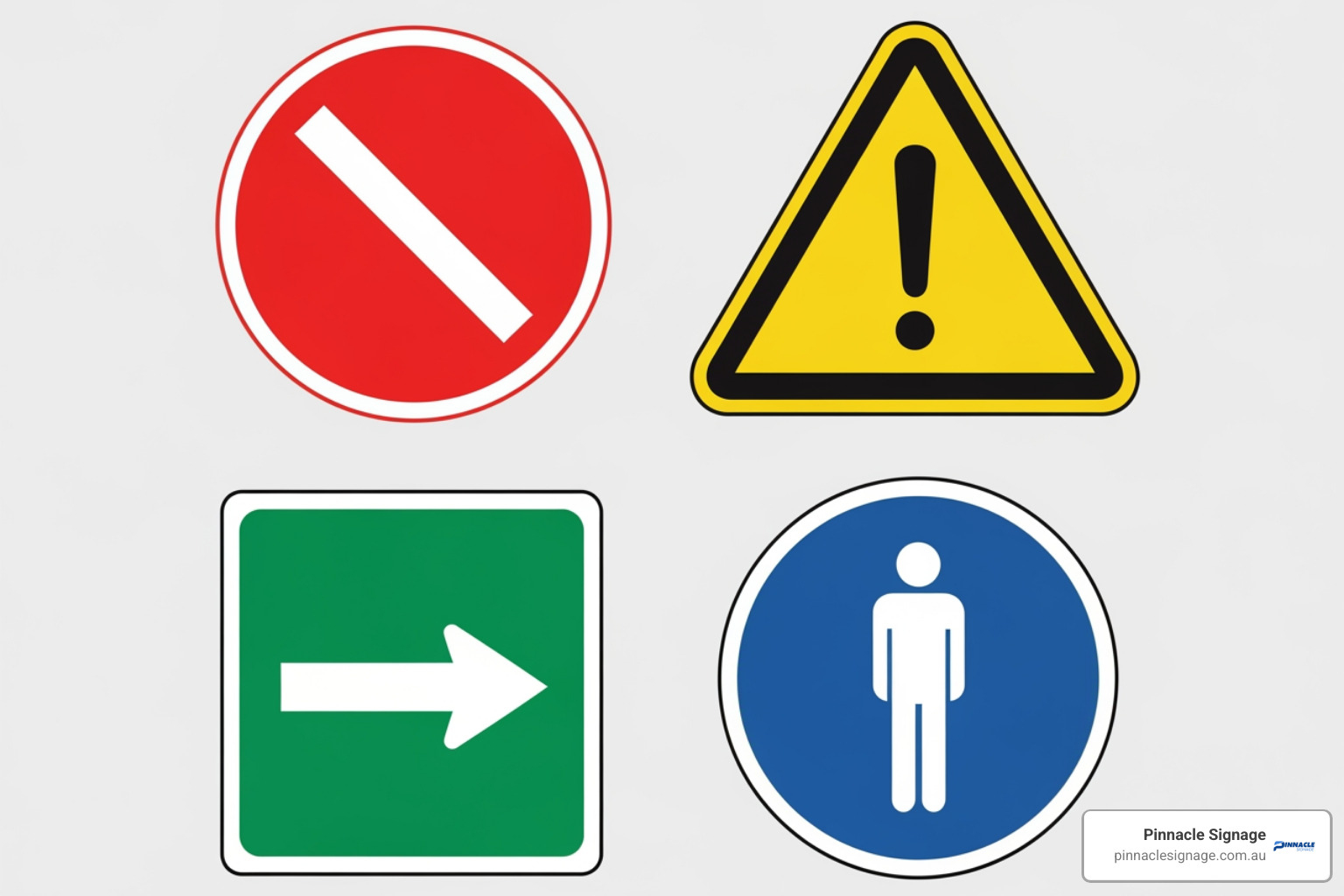
Every colour on a safety sign has a specific meaning, forming a code that communicates urgency and message type instantly.
- Red signals danger, prohibition, or fire safety. It marks immediate hazards that could cause serious injury or death, forbids dangerous actions, and shows the location of fire equipment.
- Yellow means caution. It warns of potential hazards that could cause minor to moderate injury if you are not careful, like slippery floors or moving equipment.
- Green is the colour of safety. It guides you to first aid kits, eyewash stations, and emergency escape routes. In an emergency, follow the green.
- Blue indicates a mandatory instruction. These signs tell you what you must do, such as wearing hearing protection or following a specific safety rule.
These colour associations are consistent across Australian workplaces. For more details on how these colours align with Australian Standards, have a look at our guide on Understanding Australian Standards for Safety Signs.
The Shape System: What do safety sign shapes represent?
The shape of a sign also reinforces its message, adding another layer of instant recognition.
- Circles give direct commands. A circle with a diagonal line means prohibition (something you must not do), while a solid blue circle indicates a mandatory action (something you must do).
- Triangles are universal warnings. Their pointed shape signals a potential hazard that requires your attention.
- Squares and rectangles provide information and guidance. These shapes are used for emergency information, safe conditions, and general directions, helping you locate important resources.
This combination of standardised colours and shapes creates a powerful visual language that works reliably across all Australian workplaces. For a deeper look at how these visual cues work for hazardous materials, explore our article on Hazard Label Symbols Demystified and Where to Get Them.
Specialised Hazard Communication: GHS and Beyond
While traditional safety signs cover a broad range of hazards and instructions, some dangers require a more specific and internationally harmonised approach. Chemical hazards, in particular, need clear, consistent communication that transcends borders and languages. This is where the Globally Harmonised System (GHS) becomes essential, alongside other specialised signage for unique workplace risks.
What are GHS Pictograms?
GHS pictograms are part of the Globally Harmonised System of Classification and Labelling of Chemicals. This international standard, adopted in Australia, ensures chemical hazards are communicated consistently, making these pictograms essential for any business handling hazardous substances.
Each GHS pictogram is a graphic image showing the type of hazard. They are recognisable by their distinctive red square border set on a point (like a diamond), with a black symbol on a white background. This design makes them stand out on labels and safety data sheets (SDSs).
These pictograms help workers quickly understand if a product is flammable, corrosive, or poses a health hazard, so they can take proper precautions.
At Pinnacle Signage, we offer a full range of Shop GHS Signage designed to meet these crucial standards, manufactured in Australia.
Common GHS Symbols and Their Meanings
Each GHS pictogram represents a specific hazard class. Understanding them helps you quickly assess chemical risks. Here are some common symbols:
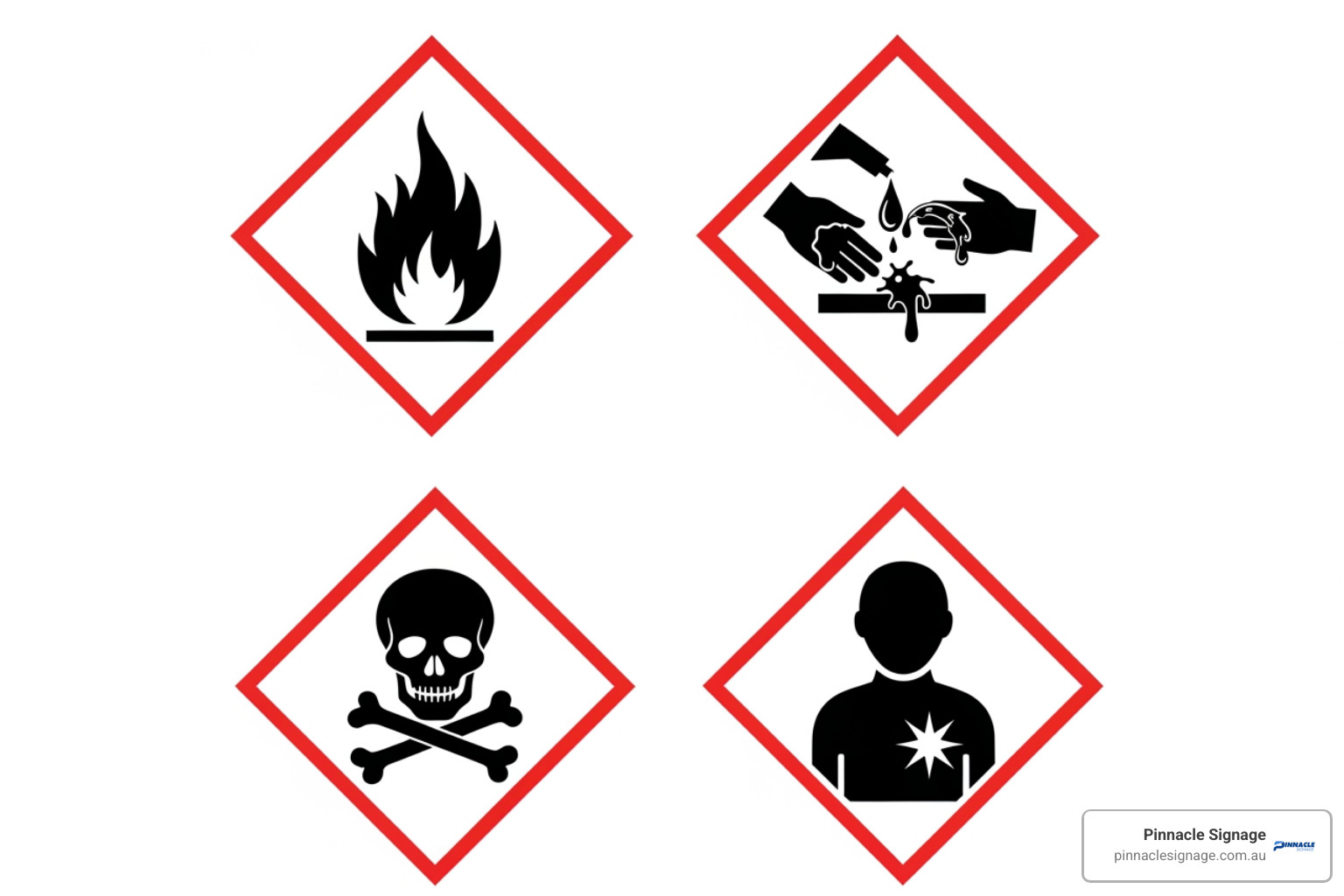
- The Flammable pictogram (flame) indicates substances that can ignite. It's a warning to keep them away from heat and open flames.
- The Corrosive symbol warns of substances that cause severe skin burns, eye damage, or corrode metals. It's a reminder to wear appropriate PPE.
- The Acute Toxicity pictogram (skull and crossbones) warns of substances that can cause severe health effects or death, even in small doses.
- The Health Hazard pictogram (person with a starburst) alerts to serious, long-term health risks like carcinogenicity or reproductive toxicity.
For specific signage related to corrosive substances, you can view our Corrosive GHS Signs to ensure your workplace is properly marked.
Other Specialised Signs
Beyond GHS, other signs address unique, high-risk hazards.
- Biosecurity hazards are critical in agricultural and research settings. These signs warn of biological risks like pathogens or pests that could harm ecosystems. Given Australia's unique environment, biosecurity signage is vital. Our article on Biohazard warning signs: what they mean and why they matter provides more detail. You can also explore Biosecurity Signs for Australian conditions.
- Radiation hazards, marked by the trefoil symbol, warn of ionising radiation. They are crucial in medical, research, and industrial sites using radioactive materials.
- Asbestos warnings are particularly important in Australia. These signs are vital in older buildings or demolition sites to alert people to the presence of asbestos, preventing serious health risks.
These specialised signs ensure that specific, often invisible, dangers are clearly communicated so appropriate safety measures can be taken.
Making Signs Work: Effective Placement and Compliance
Having the right safety signs is only half the battle. The other half is making sure they're actually seen, understood, and acted upon. This comes down to smart placement, maintaining visibility, and meeting Australian standards and regulations.
Key Considerations for Placement and Visibility
A sign is useless if it isn't noticed. Effective placement is a strategic decision that can prevent accidents.
Signs should be placed as close as safely possible to the hazard, ensuring the warning is timely. Position them where they are clearly visible and not obscured by equipment or doors. Consider the line of sight from all approaches.
Adequate lighting is crucial. Signs must be well-lit. For critical emergency signs, consider photoluminescent materials that glow in low light. Mount signs at a readable height for everyone.
A common challenge is 'sign blindness', where too many signs cause people to ignore them. Regularly review your signage to ensure it remains impactful.
For more guidance, our article on How to Use Health and Safety Signs in the Workplace Effectively provides practical tips.
Why Obeying Signs is Crucial for Accident Prevention
Safety signs are not suggestions, they are directives designed to protect lives. Many accidents happen because a warning sign was ignored.
When everyone respects safety signs, it fosters a strong safety culture where personal responsibility is key. Obeying signs is fundamental to protecting yourself and others. Ignoring them can also have serious legal implications for individuals and businesses, as employers have a duty of care that includes providing clear signage.
These signs are silent guardians, whether guiding someone to an exit or warning of a slippery floor. Our article Workplace Safety Signs That Speak Louder Than Words explores how effective signage creates safer environments.
Australian Standards and Regulations
In Australia, safety signage is governed by standards to ensure consistency and effectiveness. The primary standard is AS 1319, "Safety Signs for the Occupational Environment", which specifies the design, colours, and shapes for workplace safety signs. Adhering to AS 1319 ensures your signs are clear and easily understood.
Safe Work Australia also provides national guidance on work health and safety, including the use of signs.
Compliance with Australian standards ensures your signs are effective, reduces accident risks, and demonstrates a commitment to safety. For a comprehensive guide, see our article on Safety Signage Australia: Your Guide to Clear and Compliant Signs.
Find the Right Signage at Bunnings
When you need safety signage, you often need it quickly. That's why Pinnacle Signage products are now available at Bunnings stores and online across Australia. Whether you're a facilities manager in Sydney or a small business owner in Townsville, you can get the compliant, durable safety signs you need on your next Bunnings run.
This partnership makes getting signage easier. You can walk into your local Bunnings and take signs home the same day, or browse the full range on the Bunnings website for delivery to your site. When you're there, look for the Pinnacle Signage brand to get genuine Australian-made quality that meets local standards.
For example, the Pinnacle Danger Construction Site Sign is a durable metal option for harsh outdoor conditions. For indoor use, the Pinnacle First Aid Sign provides a clear, weather-resistant marker.
You can explore our complete range by visiting the Pinnacle Signage at Bunnings brand page. From mandatory PPE signs to fire safety markers, you'll find a comprehensive selection ready for immediate purchase, making safety more accessible for Australian businesses.
Your Partner for Compliant and Effective Signage
We've explored what are safety signs, from their core purpose to the colours, shapes, and symbols that make them universally understood. These signs are vital tools that transcend language barriers to prevent accidents and protect lives in Australian workplaces.
At Pinnacle Signage, we know that effective safety signage is about more than compliance, it's about genuinely protecting people. We provide high-quality, durable signage solutions that meet Australian Standards and withstand our harsh conditions. Our comprehensive range covers everything from standard mandatory signs to specialised GHS, biosecurity, and restricted area signage.
We proudly serve businesses across Australia, offering scalable solutions for small businesses and large organisations requiring bulk orders. Our products are Australian-made, with fast, Australia-wide shipping from our warehouse in East Wagga Wagga. We also specialise in custom solutions, creating signage with your specific text, logos, or dimensions.
For any questions about our range, custom designs, or bulk order pricing, our friendly team is here to help.
Contact us for custom or bulk orders
Shipping & Pickup Information
We aim to get your essential signage to you as quickly as possible.
Production & Shipping Times: Most items are dispatched within 48 hours. Estimated delivery times are:
- 1 - 2 days: Sydney, ACT, Melbourne, Brisbane, Gold Coast
- 2 - 4 days: Rest of NSW, Rest of VIC
- 3 - 6 days: SA, North QLD, Perth
- 5 - 9 days: TAS, NT, WA
Delivery Details: We use courier services for most deliveries. Please provide a valid daytime delivery address (no PO Boxes) and phone number. A signature is required upon receipt, and re-delivery charges may apply if you are not present to accept the delivery.
Free Shipping: Free shipping is available for orders over $100 Australia-wide on most items. For some bulky items, additional shipping costs may apply to certain regions (WA, North QLD, NT, TAS). Our staff will contact you if these charges apply.
Warehouse Pickup: Pickup is available at our warehouse at Unit 4/28 Nagle Street, East Wagga Wagga NSW, from 8am to 5pm, Monday to Friday. The warehouse is closed on weekends and public holidays.