

A Driver's Guide to Mandatory Cautionary and Informatory Signs
Understanding Mandatory Cautionary and Informatory Signs on Australian Roads

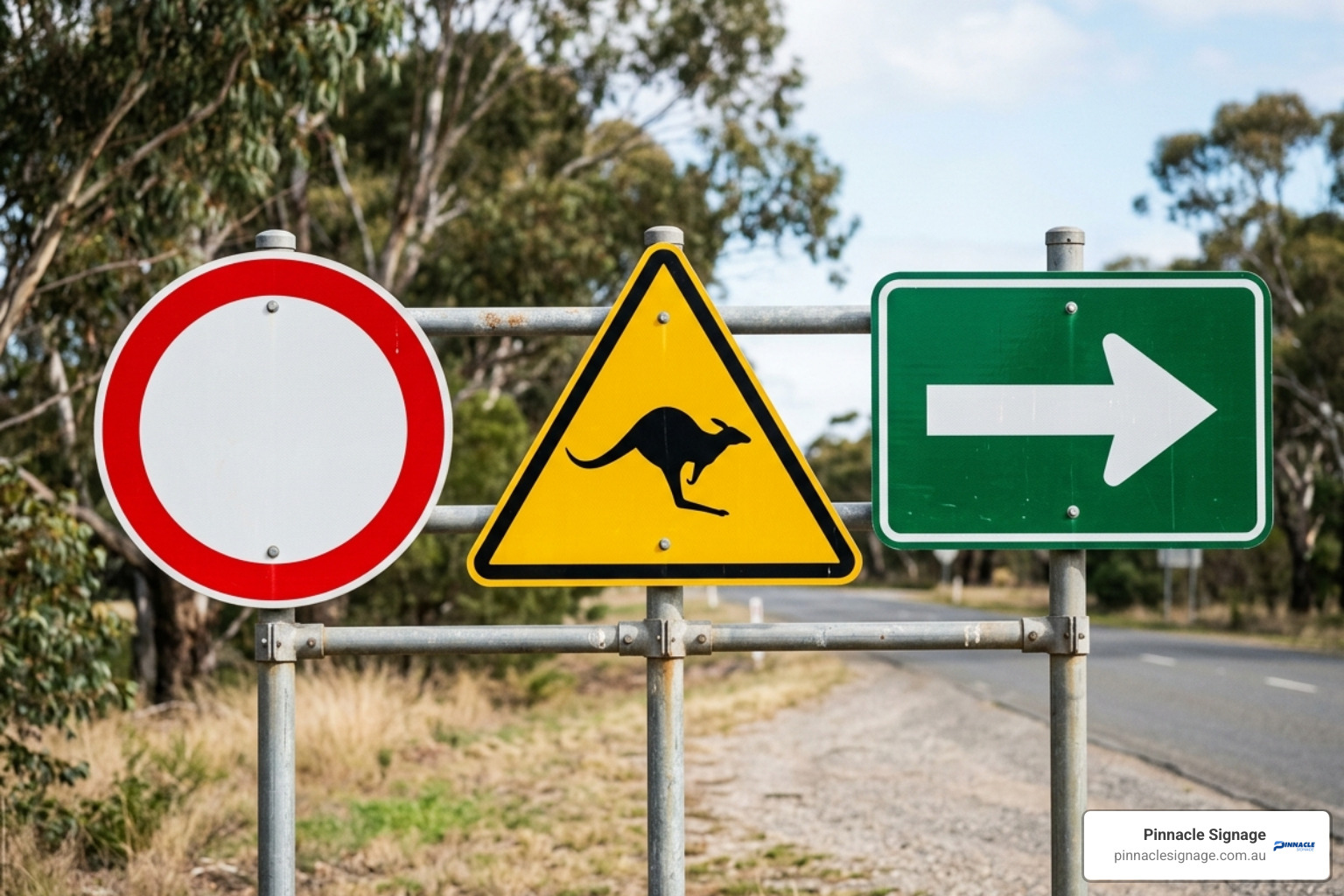
Mandatory cautionary and informatory signs are the three core categories of road signs used in Australia to regulate traffic, warn of hazards, and guide drivers to their destination. Here is a quick breakdown:
- Mandatory Signs: These provide legal orders that drivers must obey to ensure safety and order.
- Cautionary Signs: These warn of upcoming hazards, giving drivers time to react safely.
- Informatory Signs: These guide drivers to services, routes, and facilities.
Every sign you pass on an Australian road fits into one of these three categories. Mandatory signs carry legal weight, ignore one and you risk fines or demerit points. Cautionary signs give you advance notice of a hazard so you can react safely. Informatory signs point you toward the services, routes, and facilities you need.
Together, they form a visual language that keeps traffic moving safely and efficiently. Understanding how to read that language quickly, by shape, colour, and symbol, is one of the most practical skills any driver or site manager can have.
I'm Doug Lindqvist, General Manager of Pinnacle Signage, an Australian-owned manufacturer specialising in safety and compliance signage for businesses across the country. My years working in the safety and industrial supply space gave me a front-row seat to how critical it is to get mandatory cautionary and informatory signs right - both on public roads and across work sites. In this guide, I'll walk you through exactly what each sign category means, how to identify them, and why they matter.
Mandatory cautionary and informatory signs word list:
When we hit the road in East Wagga Wagga or head out on a long haul across New South Wales, we are constantly processing information. But have you ever stopped to think about how you process it? Research into traffic engineering shows that drivers notice colour first, then shape, and finally the text or symbol (the "legend") on a sign.
This hierarchy is why mandatory cautionary and informatory signs are so strictly standardised. In Australia, these standards are governed by AS 1742 (Manual of uniform traffic control devices). By keeping the "look" of a sign consistent, we ensure that a driver doing 100 km/h on the Sturt Highway can identify a hazard or a rule in a split second, even in heavy rain or at dusk.
Effective signage must fulfil a specific need, command attention, and convey a clear, simple meaning. If a sign is faded, confusing, or placed poorly, it loses its "command of respect." That’s why we focus on durability and clarity here at Pinnacle Signage. Whether it is a sign on a public road or a custom safety sign for a local warehouse, the Importance Of Safety Signs cannot be overstated. They are the silent language of the streets, keeping us all in line without a police officer needing to stand at every corner.
The Visual Language of Mandatory Cautionary and Informatory Signs
To navigate safely, you need to understand the "code." Think of it like a shorthand for the road.
- Mandatory (Regulatory) Signs: These are usually circular. In the Australian context, many of our regulatory signs are rectangular with a white background and black text, but the most critical ones, like "Stop" (octagon) and "Give Way" (inverted triangle), use unique shapes so they are recognisable even if they are covered in mud or snow.
- Cautionary (Warning) Signs: These are typically diamond-shaped (or triangular in some international contexts) with a bright yellow background. The yellow is a universal "heads up" to the human brain.
- Informatory (Guide) Signs: These are rectangular. They use green for directions, blue for services (like petrol or hospitals), and white for general information.
Following Australian standards for road signs, especially the AS 1742 series, helps make signs easy to recognise at a glance. Even if a driver has not seen that exact sign before, the colour and shape usually make its purpose clear.
Why Mandatory Cautionary and Informatory Signs Matter for Workplace Safety
While we often talk about these signs in the context of driving, they are just as vital for site management and industrial safety. If you run a farm or a construction site in NSW, you are legally obligated to manage risks. Signage is often the most efficient way to communicate those risks to staff and visitors.
According to Safety signs and signals. The Health and Safety (Safety Signs and Signals) Regulations 1996. Guidance on Regulations L64, signs should be used whenever a risk cannot be avoided or adequately controlled by other means. On a busy worksite, mandatory cautionary and informatory signs act as a constant safety briefing. A mandatory sign tells a forklift driver they must wear a high-vis vest; a cautionary sign warns of a slippery floor; and an informatory sign points the way to the first aid kit.
Mandatory Signs: Enforcing Road Rules and Legal Compliance
Mandatory signs, often called regulatory signs, are the "lawmakers" of the road. They don't give suggestions; they give orders. These signs are derived from local laws and regulations, and they are there primarily for the safety of other road users.
Common examples include:
- Stop Signs: Uniquely octagonal so you can identify them from the back.
- Speed Limits: Circular with a red border (in many standards) or a white rectangle with a red circle in Australia.
- No Entry: A clear prohibition to prevent head-on collisions.
We see these every day, but their importance is massive. For a deeper dive into these "must-obey" markers, check out our guide on Mandatory Signs What They Are Why They Matter And How To Spot Them. If you are looking to kit out a private road or facility, you can find many of these Pinnacle Signage at Bunnings.
Prohibition and Compulsion in Traffic Control
Mandatory signs generally fall into two sub-categories:
- Prohibition Signs: These tell you what you cannot do. They usually feature a red circle with a slash. Examples include "No Left Turn," "No U-Turn," or "No Parking." These are critical for maintaining the flow of traffic and preventing accidents in tight spots.
- Compulsory Signs: These tell you what you must do. A "Keep Left" sign or a "Compulsory Sound Horn" sign at a blind warehouse corner are perfect examples.
In public spaces, Understanding Prohibition Signs In The Workplace And Public Spaces is essential for avoiding accidents and ensuring that everyone, from pedestrians to heavy vehicle drivers, knows the boundaries.
Legal Consequences of Non-Compliance
Ignoring a mandatory sign isn't just a safety risk; it’s a legal one. In NSW, failing to obey a regulatory sign can result in heavy fines and demerit points. Traffic engineers and police use these signs to assign "right of way." When a driver ignores a "Give Way" sign, they aren't just breaking a rule; they are disrupting the psychological expectation of safety that other drivers have.
The legal weight of these signs is what separates them from the other two categories. While you won't get a ticket for ignoring a sign that says "Petrol 5km Ahead," you certainly will for doing 80 km/h in a 60 km/h zone.
Cautionary Signs: Warning Drivers of Potential Hazards
If mandatory signs are the "law," cautionary signs are the "advice." Their job is to warn you of a hazard that you might not see yet. In Australia, these are almost always yellow diamonds with black symbols. They are designed to give you enough reaction time to adjust your speed or position.
You’ll find these marking:
- Sharp curves or hairpins.
- School zones where children might dart out.
- Areas prone to slippery conditions or livestock crossings.
For business owners, All About Caution Signage Options And Tips provides great insight into how to use these effectively on your own property. If you’re managing a site, you might need something like the Pinnacle Danger Signs at Bunnings to keep unauthorised people away from high-risk areas.
Identifying Road Geometry and Environmental Risks
Nature doesn't always play fair, and roads aren't always straight. Cautionary signs help us navigate the physical world.
- Road Geometry: Signs for "Narrow Bridge," "Steep Descent," or "Winding Road" prepare the driver for a change in how the vehicle will handle.
- Environmental Risks: In regional NSW, signs for "Falling Rocks" or "Slippery When Wet" are lifesavers. They prompt us to slow down before the physics of the road take over.
Temporary Hazards and Work Zone Safety
We’ve all seen the bright orange signs near roadworks. These are a specific type of cautionary sign used for "Incident Management" or temporary work zones. They use orange or high-vis yellow-green backgrounds because these colours are highly visible and signal that the normal rules of the road have changed.
Whether it's "Men at Work" or "Lane Closed Ahead," these signs protect the people working on our infrastructure. Once the work is done, these signs must be removed immediately to maintain the "respect" drivers have for them. If a driver passes a "Roadwork" sign for three days and sees no workers, they start to ignore the next one they see.
Informatory Signs: Guiding Road Users to Their Destination
Informatory signs are the "navigators." They don't tell you what to do, and they don't warn you of danger - they simply help you get where you are going. These are usually rectangular and use a variety of colours depending on the information provided.
For a comprehensive look at how these work, read An Essential Guide To Informational Signs. They are essential for reducing driver stress, which in turn improves safety.
Facility and Service Markers for Efficient Travel
Ever been on a long drive and felt that relief when you see the blue sign for a "Rest Area" or "Petrol"? That’s the power of informative signs.
- Blue Signs: Indicate services like hospitals, tourist information, and fuel.
- Brown Signs: Point to recreational or cultural interests, like national parks or historic sites.
These signs are facilitators. They help drivers find what they need without having to take their eyes off the road to look at a GPS or a map.
Directional Guidance and Route Planning
Green signs are the backbone of our highway system. They tell us which lane leads to Sydney, how many kilometres are left until Wagga Wagga, and which exit to take for the airport.
- Route Markers: Help you stay on the right highway (e.g., the M31).
- Flood Gauges: A vital informative sign in rural Australia, telling drivers exactly how deep the water is over a road.
Understanding these is the key to efficient route planning. For more on the smaller, often overlooked signs, check out A Practical Guide To Understanding Notice Signs.
Frequently Asked Questions about Road Signage
What happens if I ignore a mandatory sign?
Ignoring a mandatory sign is a breach of the law. Beyond the immediate risk of a collision, you face fines and demerit points. In a workplace setting, ignoring mandatory PPE signs can lead to serious injury and potential legal action against the site operator. You can learn more about the implications in our article on Understanding Prohibition Signs In The Workplace And Public Spaces.
How do I recognise a cautionary sign in Australia?
In Australia, permanent cautionary signs are typically yellow diamonds with black symbols or text. They are designed to stand out against the natural green and brown of the Australian landscape. The goal is to give you enough time to react to a hazard, like a sharp turn or a pedestrian crossing. For more tips, see All About Caution Signage Options And Tips.
Are informative signs legally enforceable?
Generally, no. Informatory signs are there to help you, not to police you. You won't get a ticket for missing your exit or for not stopping at a rest area. However, some informative signs, like those indicating "Truck Routes," are important for heavy vehicle drivers to follow to avoid getting stuck or entering restricted residential areas. Read more in An Essential Guide To Informational Signs.
The Road Signs That Keep Australia Moving
Understanding mandatory cautionary and informatory signs is about more than just passing a driving test; it's about participating in a system that keeps our community safe. Whether you are driving through the Riverina or managing a busy industrial site in East Wagga Wagga, these signs are your most reliable tools for communication.
At Pinnacle Signage, we take pride in manufacturing high-quality, durable signage that meets Australian Standards and stands up to the harsh Australian sun. From our base in East Wagga Wagga, NSW, we offer a massive range of safety and compliance signs, many of which are available through our partnership with Bunnings.
If you need custom signage or a bulk order for your business, we offer:
- Fast Turnaround: Most orders are dispatched within 48 hours.
- Reliable Shipping: Free shipping on orders over $100 Australia-wide (exceptions apply).
- Local Pickup: If you're in the Wagga area, you can pick up your order directly from our warehouse (Mon-Fri, 8am-5pm).
Stay safe on the roads and keep your workplace compliant with the right signage. If you have questions about which signs are right for your needs, Contact Pinnacle Signage.