

Watch Out! Everything You Need to Know About Traffic Cautionary Signs
Why Traffic Cautionary Signs Could Save Your Life on Australian Roads

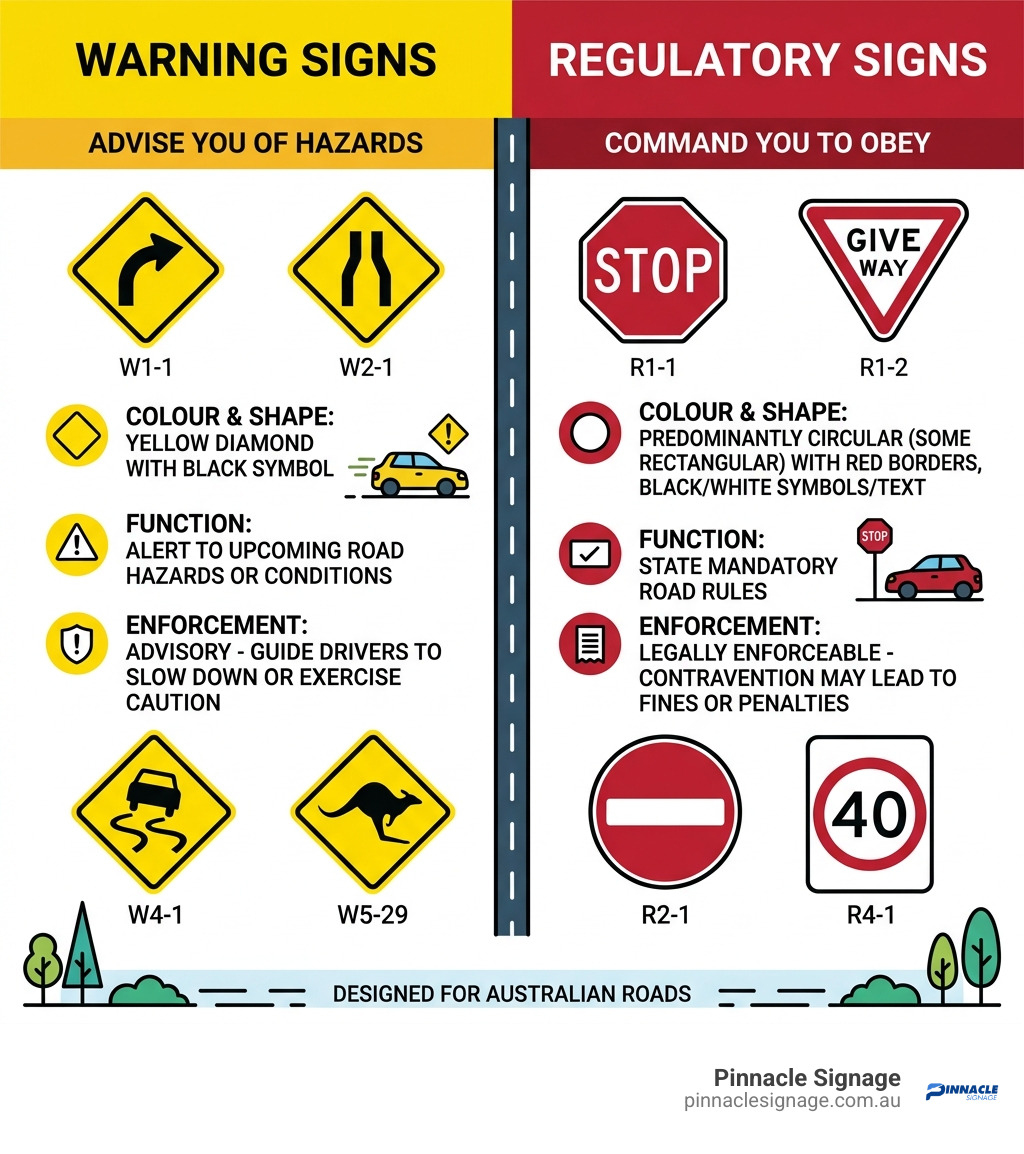
Traffic cautionary signs are yellow diamond-shaped signs that warn drivers of potential hazards, unexpected conditions, or situations requiring extra care ahead on the road.
Here is a quick overview of what you need to know:
- What they are: Warning signs that alert drivers to hazards like sharp curves, animal crossings, slippery surfaces, and narrow bridges
- Shape and colour: Diamond-shaped with a black symbol or legend on a yellow background (permanent); orange background for temporary roadwork zones
- Purpose: To prompt a reduction in speed or a change in driving behaviour before reaching the hazard
- How they differ from regulatory signs: Warning signs are advisory; regulatory signs like Stop and Give Way are legally enforceable
- Where you see them: On roads, highways, rural tracks, construction zones, and school areas across Australia
Traffic cautionary signs are one of the most important tools in road safety, giving drivers the time and information they need to respond safely before they reach a dangerous situation. Whether you are managing a construction site, overseeing a rural property, or maintaining signage for a facility, understanding how these signs work is essential for keeping people safe and staying compliant with Australian standards.
I'm Doug Lindqvist, General Manager of Pinnacle Signage, an Australian-owned manufacturer based in East Wagga Wagga, NSW, with hands-on experience supplying compliant traffic cautionary signs to businesses across industries, including construction, mining, and agriculture. This article provides a comprehensive overview of design standards, sign categories, placement guidelines, and advisory speeds.
Essential traffic cautionary signs terms:
Understanding the Role of Warning Indicators

When we talk about road safety in Australia, we often think about speed limits and traffic lights. However, the unsung heroes of our regional roads and busy construction sites are traffic cautionary signs. These signs serve as a visual shorthand, communicating vital information about what lies around the next corner or over the next crest.
In Australia, the design and application of these signs are governed by strict standards, primarily AS 1742 (Manual of uniform traffic control devices) and AS 1319 (Safety signs for the occupational environment). These standards ensure that whether you are driving through the Riverina or navigating a warehouse in Sydney, the signs you see are consistent and easy to understand.
Defining Traffic Cautionary Signs and Their Purpose
The primary function of a warning sign is to call attention to unexpected conditions on or adjacent to a road. They are designed to alert road users to situations that might not be readily apparent. For example, a sharp turn on a country road might be hidden by trees, or a dip in the road might be difficult to see in low light.
By providing this advance notice, traffic cautionary signs allow drivers to reduce their speed or adjust their driving position in the interest of safety. This situational awareness is critical for preventing accidents, especially in high-speed environments or areas with heavy machinery. You can find more detailed information on Warning road signs - NSW Government.
How Warning Signs Differ from Regulatory Signs
It is important to distinguish between warning signs and regulatory signs. Regulatory signs, such as Stop or Give Way signs, impose a legal obligation on the driver. They are usually red, white, and black, and failing to obey them can result in fines or demerit points.
In contrast, traffic cautionary signs are advisory. They inform you of a hazard, but they do not typically carry the same immediate legal penalty for "disobedience" unless your failure to respond leads to negligent driving. A yellow diamond sign tells you what is coming, while a red circle or octagon tells you what you must do right now. To dive deeper into the legal side of things, check out our guide on Stop Look Listen Understanding Prohibitive Road Signs.
Standard Designs, Shapes, and Colours in Australia
Consistency is the backbone of traffic safety. If every council used different colours for their warning signs, drivers would be constantly confused. In Australia, we follow a very specific colour and shape palette to ensure instant recognition.
Visual Standards for Permanent and Temporary Signs
For permanent road hazards, the standard is a diamond-shaped sign with a black legend (the symbol or text) on a yellow background. This high-contrast combination is chosen because yellow is the most visible colour to the human eye from a distance, particularly in varying light conditions.
However, when the hazard is temporary, such as a roadwork zone or a construction site, the background colour changes to orange. This shift tells the driver that the condition is not a permanent feature of the road and requires extra vigilance. In some high-priority areas, such as school zones or pedestrian crossings, you might also see fluorescent yellow-green backgrounds, which provide even higher visibility during dawn and dusk. For site managers, understanding these Road Construction Signage Requirements 101 is vital for maintaining a safe workplace.
Recommended Sizes for Different Road Types
The size of a sign is directly related to the speed of the road on which it's placed. A sign on a quiet suburban street does not need to be as large as one on the Sturt Highway.
- Conventional Roads: Typically use 600mm x 600mm or 750mm x 750mm diamonds.
- Expressways and High-Speed Links: Often require 900mm x 900mm sizes to ensure drivers have enough time to see and react at 100 km/h.
- Freeways: Can require even larger oversized signs for maximum impact.
At Pinnacle Signage, we manufacture these in various sizes to meet Australian Standards, ensuring durable metal signage for local worksites.
Identifying Hazards on the Road
Hazards on Australian roads are diverse, ranging from geological features like falling rocks to biological ones like wandering livestock. Traffic cautionary signs are categorised to help drivers quickly process the type of risk they are approaching.
Common Categories of Traffic Cautionary Signs
We can generally break these signs down into several key categories:
- Horizontal Alignment: These include turns, curves, winding roads, and hairpins. They tell you about the geometry of the road ahead.
- Intersections: Signs for T-junctions, crossroads, and roundabouts. These warn you to look out for merging or crossing traffic.
- Road Conditions: Warnings for slippery surfaces, humps, dips, or loose gravel.
- Animal Crossings: Essential in rural NSW, these warn of kangaroos, cattle, or even deer in specific regions.
- Non-Vehicular Traffic: This includes Road signs for pedestrians, cyclists, and school children.
Specific Meanings of High Priority Warnings
Some signs require more immediate action than others. For instance, a "Slippery When Wet" sign suggests you should increase your following distance and avoid sudden braking. A "Low Clearance" sign is a critical warning for truck drivers in our region to avoid costly and dangerous bridge strikes.
We also produce signs for internal facility safety. For example, our first aid signage follows the same principles of clear, high-contrast communication to manage risks in a workplace. You can learn more about identifying these risks in our article Road Hazard Signs Explained Know Before You Go.
Responding to Hazards: Advisory Speeds and Supplemental Plaques
A warning sign by itself is often not enough. To give drivers a concrete action to take, we use supplemental plaques. These are the smaller rectangular signs often found directly underneath the main yellow diamond.
Determining Safe Speeds for Curves and Turns
The most common supplemental plaque is the Advisory Speed plaque (part of the W13 series). This tells you the recommended speed for a curve in good weather conditions. Engineering studies determine these speeds using tools like a ball bank indicator, which measures the "centrifugal force" felt in a vehicle as it navigates a turn.
It is a common mistake to think these are the same as speed limits. They are not. However, if the sign says 45 km/h and you try to take the corner at 100 km/h, you are likely to lose control. These advisory speeds are designed to keep the vehicle stable and within its lane. For more on how we use these in a broader safety context, see our page on Road traffic safety signs.
Using Supplemental Plaques and Alignment Markers
Beyond speed, other plaques provide context. They might say "For 5km" to indicate the length of a winding road, or "Hidden Driveway" to explain why you need to be cautious.
We also use alignment markers like Chevrons (the black and yellow arrows) to physically trace the path of a sharp curve. These are particularly useful at night or in heavy rain when road markings might be obscured. If you are setting up a new road or driveway, Stop Ahead Understanding And Sourcing Essential Traffic Signs provides a technical overview of the essential requirements.
Frequently Asked Questions about Traffic Cautionary Signs
How far in advance should a warning sign be placed?
The placement of a sign is all about Perception-Response Time (PRT). This is the time it takes for a driver to see the sign, understand the message, and take action (like braking).
On a road with a 100 km/h speed limit, a sign needs to be placed much further back than on a 40 km/h street. Generally, engineers aim for a distance that allows for comfortable deceleration. If a sign is too close, the driver might panic-brake; if it is too far, they might forget the warning before they reach the hazard.
What is the difference between a Turn and a Curve sign?
While they look similar, the distinction is based on the speed differential. In road engineering:
- Turn Sign: Used when the recommended speed is 30 km/h or more below the posted speed limit.
- Curve Sign: Used when the recommended speed is between 10 km/h and 30 km/h below the limit. Essentially, a "Turn" sign indicates a much sharper and more dangerous change in direction than a "Curve" sign.
Are warning signs legally enforceable in Australia?
As mentioned earlier, traffic cautionary signs are advisory. However, this does not mean they can be ignored. If an accident occurs and it is found that a driver ignored multiple warning signs and advisory speeds, it can be used as evidence of negligence. Furthermore, in some states, specific warning signs (like those in school zones) are paired with flashing lights that make the speed limit on the sign legally binding during certain hours. You can read more about local rules in our A Z Guide To Australian Parking Signs Rules.
Stay Alert, Stay Safe: Final Thoughts on Traffic Cautionary Signs
At Pinnacle Signage, we take road safety seriously. From our manufacturing base in East Wagga Wagga, NSW, we produce premium, durable traffic cautionary signs designed to withstand the harsh Australian climate. Whether you need a single kangaroo crossing sign for a farm track or the supply of roadwork signs for a major infrastructure project, we have the regional expertise to help.
We pride ourselves on our fast turnaround, with most orders dispatched within 48 hours. We also offer free shipping on orders over $100 Australia-wide (though some exceptions apply for very heavy items). For our local customers in the Riverina, we offer warehouse pickup from our East Wagga Wagga location Monday to Friday, 8 am to 5 pm.
You can browse our full range of safety products online at pinnaclesignage.com.au. Let's work together to keep our roads safe.