

The Ultimate Guide to No Parking Anytime Signage
What Is an At Any Time Parking Sign - and What Does It Actually Mean?

An at any time parking sign means exactly what it says: no parking, 24 hours a day, 7 days a week, no exceptions.
Here is a quick summary of what you need to know:
- Who it applies to: All vehicles, regardless of type or ownership
- When it applies: Every hour of every day, with no time-based exceptions
- How far it applies: Along the full length of the roadway until another parking regulation sign overrides it
- Consequences of ignoring it: Fines or towing, depending on your local council or state authority
- In Australia: The standard symbol is the R5-40 sign, a red circle with a diagonal bar over a "P"
If you manage a site, a car park, or any property with restricted access, this is one of the most important signs you can install. It removes any ambiguity, there is no window of time where parking is permitted.
Whether you are a facilities manager trying to keep a loading dock clear, a construction supervisor protecting site access, or a property owner dealing with unauthorised vehicles, getting the right sign in the right place matters. The wrong sign, or a sign that fades or corrodes, can leave you exposed to liability and compliance issues.
I'm Doug Lindqvist, General Manager of Pinnacle Signage, and through my years in the safety and industrial supply space, I have seen first-hand how poorly specified or low-quality at any time parking signs create real problems for businesses and site managers across Australia. In this guide, I will walk you through everything you need to know - from legal meaning and material standards to installation and enforcement.

At any time parking sign basics:
Understanding the At Any Time Parking Sign and Its Legal Meaning
When we talk about an at any time parking sign, we are usually referring to a specific regulatory tool designed to keep traffic moving and essential areas clear. In New South Wales and across Australia, the most common version is the symbolic R5-40 - No parking (at any time) (symbolic) | Transport for NSW. This sign features the universal "No" symbol - a red circle with a diagonal slash - over a black letter "P".
The legal weight of this sign is significant. Unlike signs that list specific hours (like "8 am - 5 pm"), the "at any time" or "all times" designation means the restriction never sleeps. It applies to everyone: tradies, delivery drivers, visitors, and even the property owners themselves if the sign is placed on a public road or a shared access way.
In our experience at Pinnacle Signage, many people confuse "No Parking" with "No Stopping." Under the A-Z Guide to Australian Parking Signs & Rules, a "No Parking" sign actually allows you to stop for up to two minutes to drop off or pick up passengers or goods, provided the driver stays within three metres of the vehicle. However, the "at any time" part reinforces that this limited privilege is the only exception available, day or night.
For site managers in East Wagga Wagga and beyond, using the correct symbolic sign is vital for enforcement. If you use a non-standard sign that just says "Don't Park Here" in handwritten marker, you might find it difficult to justify a fine or a tow-away request. Official regulatory signs provide the clarity needed for local councils or private enforcement agencies to act.
How far does an At Any Time Parking Sign restriction last?
One of the most frequent questions we get at our Wagga Wagga warehouse is: "I see the sign, but where does the 'no parking' zone actually end?"
Understanding the "zone of influence" is key to avoiding a ticket. Generally, a parking restriction applies in the direction of the arrow on the sign. If there is no arrow, it often implies the restriction applies to the immediate area or the entire length of the roadway until you reach:
- An intersection.
- Another parking sign that changes the rules (like a "2P" or "Loading Zone" sign).
- A "Permit Ends" or "Clearway Ends" sign.
According to How to Read Parking Signs in Australia - Share with Oscar, you should always look for the arrows. A left-pointing arrow means the zone starts at the sign and continues to the left. A bidirectional (double-headed) arrow means you are currently standing in the middle of a restricted zone.
If you are installing these on your own property or a private worksite, we recommend placing signs at regular intervals. Relying on a single sign at the start of a 100-metre stretch is asking for trouble; drivers will claim they didn't see it. Spacing them every 20 to 30 metres ensures no one can "accidentally" miss the message.
Material Standards and Reflectivity for Regulatory Signage
At Pinnacle Signage, we don't believe in "disposable" signs. If you are putting up an at any time parking sign, you want it to stay there for years, not months. The Australian sun is brutal, especially in regional NSW, and a faded sign is an ineffective sign.
We manufacture our regulatory parking signs using heavy-duty, rust-proof aluminium. We typically use a 0.80 thickness (or 1.6mm to 2mm, depending on the specific Australian Standard required) to ensure the sign doesn't bend or "oil-can" in high winds. Aluminium is the gold standard because it doesn't rust, making it perfect for outdoor environments.
Durability isn't just about the metal; it's about the "face" of the sign. We use UV-stabilised inks and high-quality Reflective No Parking sheeting. This prevents the red circle from turning pink after one summer in the Wagga sun. When a sign fades, it loses its legal standing because it is no longer "clearly visible," which can lead to successfully challenged fines.
For those managing industrial sites or heavy vehicle areas, Road Traffic Safety Signs must be able to withstand salt, grit, and the occasional bump. Our local production process in East Wagga Wagga allows us to maintain strict quality control over these materials, ensuring every sign that leaves our facility meets the expectations of Australian site managers.
Reflective Grades and Nighttime Visibility
Visibility at 2 pm is easy. Visibility at 2 am during a rainy July night in regional NSW is a different story. This is where reflective grades come into play.
Under AS 1906.1, there are different classes of reflective sheeting used for an "at any time parking sign":
- Class 2 (Engineer Grade): This is the basic level of reflectivity. It is suitable for low-speed areas like private car parks or quiet suburban streets where high-intensity light return isn't a critical safety factor.
- Class 1 (High Intensity): This is significantly brighter than Class 2. We recommend this for most Road Traffic Safety Signs used on public roads or busy commercial sites. It uses micro-prismatic technology to return light to the driver's eyes more effectively.
- Diamond Grade: This is the top-tier "Full Cube" prismatic sheeting. It provides the highest level of luminance and is typically reserved for high-speed highways or areas with complex visual backgrounds where a sign needs to "pop" out.
Choosing the right grade is about more than just brightness; it's about longevity. High-intensity prismatic signs often have a longer functional life (up to 10-12 years) compared to basic engineer-grade signs (around 5-7 years). If you are looking for a "set and forget" solution, upgrading the reflectivity is a smart investment.
Strategic Placement and Installation of Parking Restrictions
A sign is only as good as its placement. If you tuck an at any time parking sign behind a leafy gum tree or mount it too low, drivers will ignore it, and they might even have a legal leg to stand on if they do.
Strategic placement is essential in several key areas:
- Fire Lanes: These must be kept clear 24/7 for emergency services. Signs should be placed at the entrance and at frequent intervals along the lane.
- Loading Zones: While some loading zones are timed, an "At Any Time" restriction might be needed for high-turnover areas like hospital bays or hotel entrances.
- Construction Sites: Access is everything. If a crane can't get in because a hatchback is in the way, your project costs go up. We often supply temporary road and parking signs for your project to manage these dynamic environments.
- Private Property: For business owners in Wagga, keeping your private bays clear of "commuter creep" requires clear, bold signage at the very entrance of the property.
When we work with local councils or site managers, we emphasise that the sign should be the first thing a driver sees when they consider pulling over. If they have already turned off the engine and hopped out before they spot the sign, you have already lost the battle.
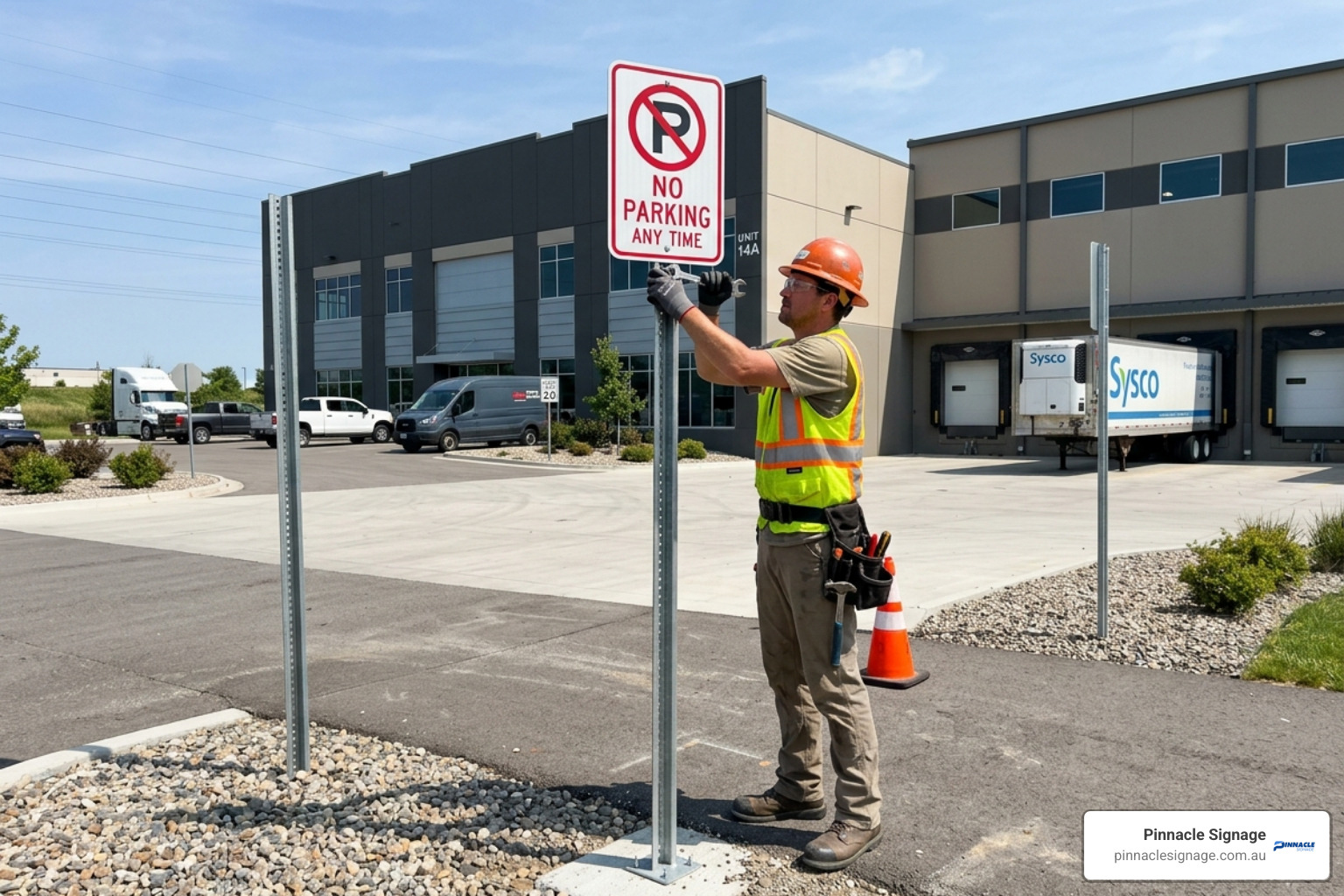
Proper Mounting for an At Any Time Parking Sign
Installation isn't just about sticking a sign on a pole. It’s about safety, height, and security.
Most of our signs come with pre-punched 3/8" (approx. 9.5mm) mounting holes at the top and bottom. This makes them compatible with standard U-channel posts or square galvanised posts.
For a permanent Bollard No Parking Sign or post-mounted sign, keep these tips in mind:
- Height: In pedestrian areas, the bottom of the sign should typically be at least 2 metres from the ground to prevent people from bumping their heads. In areas without foot traffic, 1.5 metres is often acceptable.
- Hardware: Use tamper-resistant nuts and bolts. There is nothing more frustrating than having your expensive aluminium signs "walk away" because someone had a basic spanner.
- Stability: If you are using a portable base - like a rubber base or a weighted stand - ensure it can handle the local wind conditions. A sign that blows over is a hazard, not a help.
- Bollards: Mounting signs directly onto bollards is a great way to save space in tight car parks. We provide specific brackets designed to wrap around circular or square bollards without damaging the structural integrity of the post.

Comparing No Parking, No Standing, and Tow Away Zones
One of the biggest headaches for drivers (and site managers) is the alphabet soup of parking terminology. Let's clear up the confusion between an at any time parking sign and its cousins.
No Parking vs. No Standing In the old days, "No Standing" meant you couldn't even stop to let someone out. In modern Australian road rules, "No Standing" has largely been phased out in favour of "No Stopping." If you see a No Standing Any Time sign, treat it as a "No Stopping" zone. You cannot stop there for any reason, even for a second.
No Parking Any Time As mentioned, this allows for a 2-minute "stop" for goods or passengers. It is less restrictive than "No Stopping" but more restrictive than a 3 hour parking sign.
Tow Away Zones This is the "radioactive option" of parking enforcement. A Tow Away Zone sign is often paired with an at any time restriction. It warns the driver that the consequence isn't just a piece of paper on the windshield; it's a trip to the impound lot. These are vital for clearways or emergency access routes where a parked car isn't just an annoyance - it's a danger.
Clearways A clearway is a "No Stopping" zone that usually applies during peak traffic hours. However, some areas are designated as "Clearways At All Times." If you park in one of these, expect your car to be gone by the time you get back with your coffee.
Frequently Asked Questions about At Any Time Parking Signs
Can I stop briefly in a No Parking Any Time zone?
Yes, but only under very specific conditions. In Australia, you can stop in a "No Parking" zone for up to two minutes to drop off or pick up passengers or goods. Crucially, you must stay within three metres of your vehicle. If you walk into a shop to "just grab a milk," you are technically parked and can be fined. If the sign says "No Stopping," you cannot stop at all.
What are the fines for ignoring these signs in NSW?
Fines vary significantly depending on whether you are in a high-traffic area, a school zone, or a standard street. Council rangers and NSW Police enforce these rules. Fines can range from around $120 to over $600 if the violation occurs in a particularly sensitive area (like a disability space or a fire hydrant zone). Always check with your local council for the most current penalty rates.
Do these signs apply to private driveways?
You cannot park across a driveway, even your own, if it blocks the footpath or the road access. An at any time parking sign placed by a council on the street near a driveway must be obeyed. On purely private property (like a farm or a private business park), the owner can set the rules, but they usually need clear signage to enforce them through private security or towing contracts.
Park It Here: The Final Word on At Any Time Signs
Managing a site effectively requires clear communication, and nothing communicates "Keep Clear" better than a high-quality at any time parking sign. Whether you are protecting a fire lane in East Wagga Wagga or managing a busy construction project in Sydney, the right signage prevents accidents, reduces congestion, and ensures your operations run smoothly.
At Pinnacle Signage, we take pride in being the premier safety signage manufacturer in the New South Wales region. We understand the local conditions and the regulatory requirements that Australian site managers face every day. Our signs are built to last, using premium aluminium and the highest grades of reflective sheeting to ensure 24/7 visibility.
When you work with us, you aren't just getting a piece of metal; you are getting regional expertise and a commitment to quality. We offer:
- Fast Turnaround: Most orders are dispatched within 48 hours.
- Local Pickup: If you are in the Wagga area, you can pick up your order directly from our warehouse (Mon-Fri, 8 am - 5 pm).
- Nationwide Reach: We offer free shipping on orders over $100 Australia-wide (exceptions apply).
- Bunnings Partnership: You can find our trusted products through the Pinnacle Signage at Bunnings brand page, both in-store and online.
Don't leave your site access to chance. Ensure your "No Parking" zones are clearly marked with signs that won't fade or fail. If you have a large project or need custom requirements, visit us at our East Wagga Wagga facility. We are here to help you get the job done right.