

Don't Get Caught Out: Your Guide to Understanding Incomplete Scaffold Signage
Why Incomplete Scaffold Signage is Essential for Construction Safety

Incomplete scaffold signage is a critical safety measure used to clearly warn workers and visitors that scaffolding is not yet ready for use. On a typical Australian site, scaffolds are adjusted, extended, or partially dismantled as the job progresses, so there is often a short window where they are not safe to step onto.
Here is what you need to know:
- Purpose: To prevent unauthorised access to scaffolding that is under construction, partially dismantled, or otherwise unsafe
- Key Message Types: 'Danger - Scaffolding Incomplete', 'Do Not Use - Scaffolding Incomplete', 'Warning - Incomplete Scaffolding'
- Who Needs Them: Construction sites, renovation projects, maintenance operations, commercial facilities, and any location with temporary scaffolding structures
- Standard Sizes: Commonly 400 x 600 mm or 600 x 450 mm for maximum visibility
- Materials: Durable, weather-resistant options suitable for outdoor construction and industrial environments
- Placement: At all access points to the incomplete scaffold, ideally at eye level
Incomplete scaffolding represents one of the most significant fall hazards on Australian worksites. Without clear, visible signage, workers, subcontractors, or visitors might assume a scaffold structure is safe to use when it is not. The consequences can be severe, ranging from serious injuries to fatalities, as well as investigations and disruption to the project.
Danger signs are specifically designed to warn of hazards that can be life-threatening. An incomplete scaffold clearly falls into this category. Whether it is missing guardrails, unsecured platforms, or structural components that have not been properly installed, incomplete scaffolding can fail catastrophically if someone attempts to use it.
Incomplete scaffold signs are one part of a wider safety communication system that also includes danger signage, caution signs, notice signs, traffic control signs, and general information signage across a site. When these are planned together, it becomes much easier for everyone on site to recognise where they can and cannot go, and what controls are in place.
Pinnacle Signage manufactures a comprehensive range of scaffold and construction safety signs designed for Australian conditions and work practices. Many of these signs, including popular danger and site safety designs, are now stocked at Bunnings stores and online across Australia, making it straightforward for businesses and contractors to pick up what they need while organising other materials.

For example, a "Danger - Construction Site - Do Not Enter" sign is commonly used alongside scaffold signage to control access around work zones. You can view a typical design on the Bunnings website here: Pinnacle 600 x 400 mm Metal Danger Construction Site Do Not Enter Sign. For a broader overview of how different safety and general signs work together on a site, you can explore our Ultimate Guide to Construction Safety Signage.
The Critical Role of Incomplete Scaffold Signage
The primary purpose of incomplete scaffold signage is to act as a clear, unmistakable warning system. Imagine a construction site, a busy hub of activity where various tasks are happening simultaneously. Scaffolding is often a temporary structure, constantly evolving as construction progresses. One day it might be fully erected and safe, the next it might be undergoing modifications, making it unstable or incomplete. This dynamic environment creates a high-risk scenario if hazards are not clearly communicated.
Our signs ensure that everyone on or near a site understands the immediate danger posed by an unfinished scaffold. They are a fundamental component of effective hazard communication and play a vital role in accident prevention. By clearly marking an incomplete scaffold, we help to safeguard worker safety and public safety, ultimately contributing to better site management. It's not just about avoiding immediate danger, it's about fostering a culture of safety on every project. For a broader understanding of comprehensive safety measures, you can explore our Ultimate Guide to Construction Safety Signage.
Why Clear Communication is Essential
Unauthorised access to an incomplete scaffold is a recipe for disaster. Without clear, unambiguous signage, someone might mistakenly step onto a platform that lacks guardrails or attempt to climb a section that isn't structurally sound. This can lead to devastating falls from height, resulting in serious injuries or even fatalities.
Clear communication through appropriate signage mitigates these risks by providing an immediate, visual deterrent. It's a simple, yet incredibly effective way to prevent people from entering a hazardous zone. Our signs act as a constant reminder of the "duty of care" that site managers and employers have towards everyone on their premises. This isn't just a suggestion, it's a critical safety protocol.

The effectiveness of this communication relies on the sign being easily understood by anyone, regardless of their language background or familiarity with the site. This is why standard designs, clear text, and universal symbols are so important. As the statistics highlight, "Danger signs provide warning when a hazard or a hazardous condition is likely to be life threatening." An incomplete scaffold certainly fits this description, making clear and concise communication non-negotiable.
Who Benefits from Proper Signage?
The benefits of proper incomplete scaffold signage extend across the entire construction ecosystem:
- Construction Workers: These are the individuals most frequently interacting with scaffolding. Clear signs protect them from inadvertently using a scaffold that is not safe, especially when moving between different work areas.
- Site Managers: Proper signage helps site managers fulfil their legal and ethical obligations to maintain a safe workplace, reducing the risk of incidents, investigations, and potential legal action.
- Subcontractors: Often moving between different sites, subcontractors may not be fully aware of the status of every scaffold. Signage provides them with crucial, immediate information.
- Visitors: Delivery drivers, inspectors, or clients visiting a site need clear warnings to avoid hazardous areas.
- General Public: If a scaffold is near a public pathway or accessible area, signage is vital to prevent curious passers-by, especially children, from approaching or attempting to climb an unsafe structure.
Essentially, anyone who might come into contact with a scaffold benefits from clear, visible warnings. For more on essential site communication, check out our guide on Building Site Signs Essential Requirements for Construction Safety.
Decoding the Messages: Types of Incomplete Scaffold Signs
When it comes to incomplete scaffold signage, not all signs are created equal. Different types of signs convey different levels of risk and types of instruction, utilising specific visual cues to ensure their message is understood instantly. Understanding these distinctions is crucial for effective hazard communication.
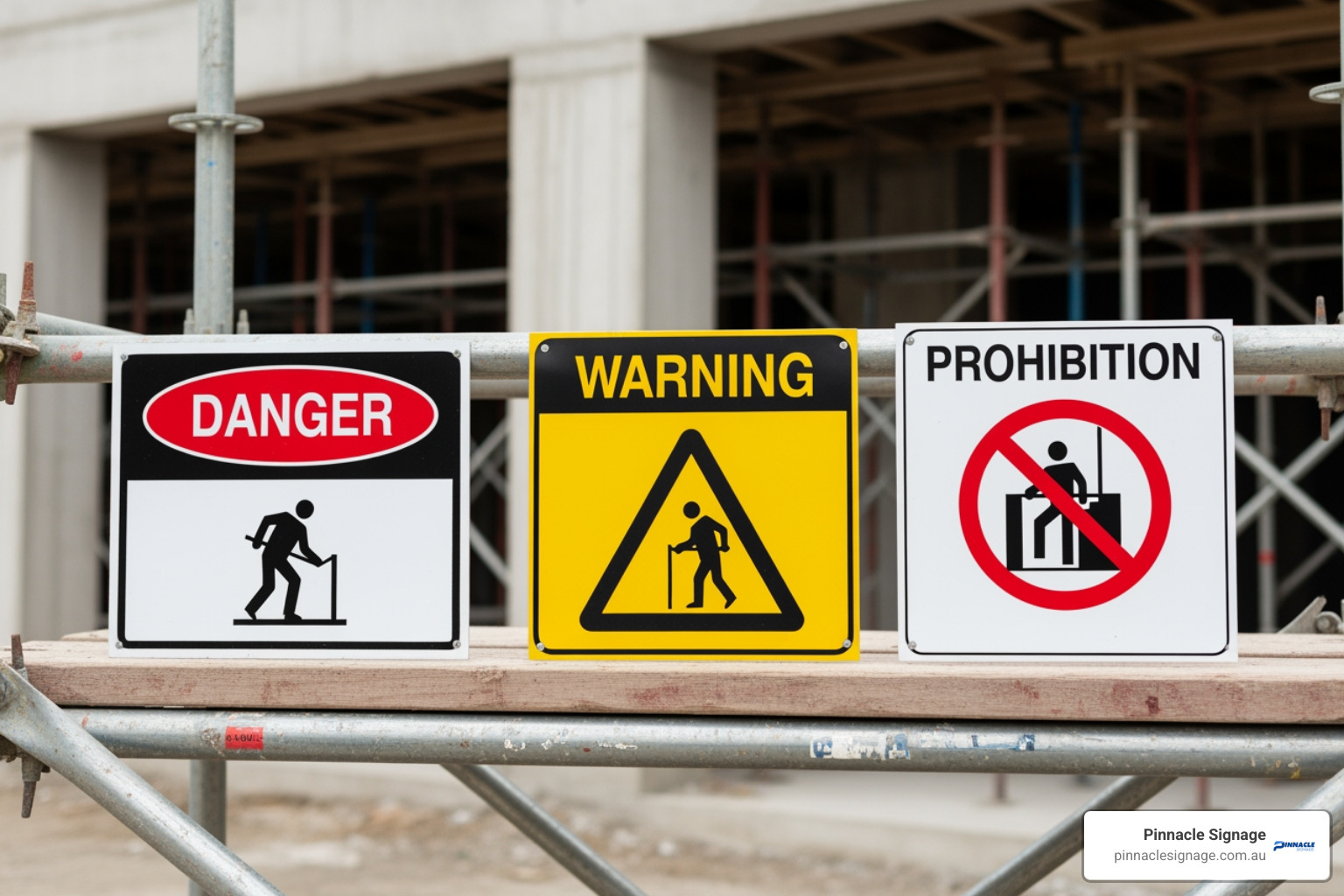
The signage categories, such as 'Danger', 'Warning', and 'Prohibition', are designed to communicate risk levels and direct appropriate behaviour. Each type uses specific colours, symbols, and text formats that are recognised across Australia, ensuring that the message is universally understood.
'Danger' Signs
'Danger' signs are reserved for the most serious hazards, those that are likely to be life-threatening. When you see a 'Danger' sign on an incomplete scaffold, it means there's an immediate and severe risk of serious injury or death if the instructions are not followed.
These signs are instantly recognisable by their distinctive design: the word "DANGER" is prominently featured in white text within a red oval, which is then set against a black rectangular background. This bold colour coding and clear text ensure maximum visibility and impact. For example, a sign might read "DANGER - SCAFFOLD INCOMPLETE - DO NOT USE". This leaves no room for misinterpretation. We offer a comprehensive range of high-visibility, compliant Danger Safety Signs in Australia, and you can learn more about their importance in our guide to Decoding Danger. Danger signs warn of hazards or hazardous situations which can be life threatening.
'Warning' and 'Caution' Signs
While an incomplete scaffold often warrants a 'Danger' sign, it's useful to understand the broader spectrum of hazard communication. 'Warning' and 'Caution' signs indicate a potential hazard or unsafe practice that might cause minor or moderate injuries, rather than immediate life-threatening danger.
'Warning' signs typically feature a black triangle containing a pictogram on a yellow background, with black text below. 'Caution' signs usually have a yellow background with black text and a black triangle symbol. While less severe than 'Danger' signs, they still demand attention and adherence to safety protocols. For a deeper dive into the differences, explore our article on Caution vs Danger vs Warning: What's the Difference?.
Prohibition Signs: 'Do Not Use'
Prohibition signs deliver a direct instruction: something is forbidden. For an incomplete scaffold, a common prohibition message is "DO NOT USE". These signs are designed to prevent specific unsafe actions that could lead to harm.
They are characterised by a red circular band with a diagonal slash through a black pictogram, often on a white background. This universal symbol clearly indicates that an action is prohibited. When combined with text like "Scaffolding Incomplete - Do Not Use", the message is unequivocal. These signs are crucial for preventing individuals from attempting to access or utilise an unsafe structure. You can find more information on the application of these vital warnings in our guide to Prohibition Signs in the Workplace and Public Spaces.
Sign Specifications: Materials, Sizes, and Placement
Effective incomplete scaffold signage requires consideration of more than just the message. The sign's durability, resistance to Australian weather, and visibility are all important for busy construction and commercial environments. A sign that fades, tears, or is too small to see will not do its job, and can leave people exposed to unnecessary risk.
Practical Material Choices for Australian Sites
For outdoor construction, industrial, and commercial environments in Australia, signs need to stand up to strong sun, rain, wind, and general site wear and tear. Pinnacle Signage uses durable, weather-resistant materials designed for long service life in local conditions.
If you need specific material details for safety, hygiene, or industry requirements, our team can provide recommendations for your site and application. This applies whether you are setting up a short-term renovation scaffold or managing a large commercial build with multiple access points.
Standard Sizes and Best Practices for Placement
Visibility is key for incomplete scaffold signage. If a sign cannot be seen, it cannot warn.
Common sizes include:
- 600 mm x 450 mm
- 400 mm x 600 mm
- 300 mm x 225 mm
- 200 mm x 150 mm
Larger sizes are generally preferred at main access points, while smaller signs can act as repeaters deeper into the structure, or on smaller scaffold sections.
When it comes to placement, it helps to think about how people actually move around your site:
- At all access points: Every point where someone could potentially enter the incomplete scaffold should have a clear sign. This includes ladders, stairways, platforms, and any ground-level entry.
- Eye-level: Position signs at eye-level for easy viewing as people approach.
- Maximum visibility: Keep signs clear of obstructions such as stacked materials, temporary fencing, or vehicles.
- Facing approaching traffic: Angle or position signs so they face the direction from which workers, subcontractors, or visitors are most likely to approach.
- Securely attached: Fix signs firmly so they do not move or blow away in windy conditions.
These principles also apply to other types of site signage, such as general safety notices, first aid locations, and directional or housekeeping signs. A consistent approach to size and placement makes your whole site easier to navigate.
Meeting Australian Safety Expectations
In Australia, safety signage, including incomplete scaffold signage, is typically designed in line with Australian Standards such as AS 1319 for safety signs in occupational environments. This helps ensure that colours, symbols, and layouts are familiar to workers across different sites and industries.
The practical benefit for site managers and business owners is simple: consistent, recognisable signage makes it easier for people to understand hazards quickly and respond appropriately. It also supports your broader duty of care under work health and safety laws. For official guidance on managing work health and safety risks, including falls from height, you can refer to Safe Work Australia.
Pinnacle Signage designs and manufactures scaffold, safety, and general workplace signs to align with relevant Australian expectations and standards. Many core designs are available directly through Bunnings, both in-store and online, so you can pick up standard signs at the same time as other building supplies. For more specific or branded messaging, you can contact us directly to discuss custom signage, including custom text, logos, colours, and dimensions.
For guidance on secure sign installation and fixing options, see our article on Mounting Mastery: Your Guide to Installing Signs.
The Risks of Negligence: Consequences of Inadequate Signage
Ignoring the need for appropriate incomplete scaffold signage is a costly mistake, both in terms of human life and financial repercussions. The consequences of inadequate signage can be severe and far-reaching.
Firstly, and most importantly, it dramatically increases the risk of worker injuries and falls from height. An un-signed, incomplete scaffold is an accident waiting to happen. Workers or visitors might assume it's safe to use, only to encounter missing planks, loose components, or a lack of guardrails. Such incidents can lead to catastrophic injuries, permanent disability, or even fatalities.
Beyond the tragic human cost, businesses face significant legal liability. WorkSafe and other regulatory bodies in New South Wales and across Australia take scaffold safety very seriously. Inadequate signage can lead to:
- WorkSafe investigations: These are disruptive, time-consuming, and can halt project progress.
- Fines: Substantial penalties can be imposed for breaches of workplace health and safety regulations.
- Prosecution: Individuals and companies can face criminal charges for negligence, especially in cases resulting in serious injury or death.
- Reputational damage: News of serious accidents can severely damage a company's reputation, affecting future contracts and public trust.
Furthermore, accidents lead to project delays, increased insurance premiums, and the operational costs associated with investigations and remediation. It's far more cost-effective and ethical to invest in proper signage upfront than to deal with the aftermath of an avoidable accident. Don't let your site become a statistic; explore our guide on Must Have Hazard Signs for Construction Sites.
Frequently Asked Questions about Incomplete Scaffold Signage
We often get asked common questions about incomplete scaffold signage from builders, facility managers, and businesses that manage multiple sites across Australia. Here are some of the frequent ones.
Who is responsible for putting up incomplete scaffold signs?
The responsibility for ensuring incomplete scaffold signage is in place usually rests with the person conducting a business or undertaking (PCBU) in control of the site, and the scaffolding contractor. They share a duty to maintain a safe working environment and to manage the risk of falls from height.
A "competent person" (someone with the necessary knowledge, training, and experience) should oversee the erection, modification, and dismantling of scaffolding, and ensure appropriate signage is displayed at every stage where the scaffold is not fully complete and safe for use. This is part of a wider system of controls that may include exclusion zones, barriers, harness use, and supervision.
For more information on general work health and safety duties and falls prevention, you can refer to resources from Safe Work Australia and your relevant state or territory regulator.
When should an incomplete scaffold sign be removed?
An incomplete scaffold sign should not be removed until the scaffold is fully erected, inspected, and deemed safe for use by a competent person. In many cases, this will be supported by a formal inspection record or handover document.
If the scaffold is modified or partially dismantled again, the incomplete signage should be reinstated until a further inspection takes place. Keeping signage aligned with the current condition of the scaffold helps avoid confusion, especially on larger sites with multiple trades working at once.
How is compliant incomplete scaffold signage typically sourced?
Incomplete scaffold and other construction safety signs are available from specialist Australian signage providers. For convenience, many standard signs, including common designs from Pinnacle Signage, are stocked at national hardware retailers like Bunnings. This allows for easy procurement alongside other site materials. For projects requiring specific branding, wording, or dimensions, or for organisations placing bulk orders, working directly with a manufacturer offers custom solutions. This ensures consistent messaging across multiple sites for builders, councils, and facility managers. For a broader overview of scaffold-related signage as part of your site safety planning, you can refer to our Scaffold Safety Sign Requirements 101 article.
Sourcing Australian-Made Safety Signage
Effective incomplete scaffold signage is one part of a broader safety and communication system on any Australian worksite. Clear messages at scaffold access points, combined with danger, warning, notice, housekeeping, and directional signs across the rest of the site, help everyone understand where they can go and what they must avoid.
As an Australian-made signage provider, Pinnacle Signage supports local industries by designing and manufacturing a comprehensive range of safety products. This includes incomplete scaffold signs, general workplace and housekeeping signage, security and site entry signs, and traffic management solutions.
For convenience, many standard Pinnacle Signage products are available through national retailers like Bunnings, both in-store and online. For projects requiring specific branding or bulk orders, custom signage solutions are also available directly from the manufacturer.
If you have any questions or need further information about incomplete scaffold signage or broader site signage needs, you can contact us on 1300 40 45 50 or via our website.